The Producers | Mel Brooks’ Record-Breaking Broadway Musical
Memorabilia Available Here
The Producers
Mel Brooks’ Record-Breaking Broadway Phenomenon
The Ultimate Musical Comedy
The Producers is a musical comedy with music and lyrics by Mel Brooks and a book by Brooks and Thomas Meehan. It is adapted from Brooks’s 1967 film of the same name. The story concerns two theatrical producers who scheme to get rich by fraudulently overselling interests in a Broadway musical designed to fail. Complications arise when the show is a surprise hit.
The humor of The Producers draws on exaggerated accents, caricatures of Jews, gay people and Nazis, and many show business in-jokes.
After 33 previews, the original Broadway production opened at the St. James Theatre on April 19, 2001, starring Nathan Lane and Matthew Broderick, and ran for 2,502 performances, closing on April 22, 2007. The production won a record-breaking 12 Tony Awards, breaking the record held for 37 years by Hello, Dolly! which had won 10.
It spawned a successful West End production running for just over two years, national tours in the US and UK, many productions worldwide and a 2005 film version.
From Screen to Stage
The Genesis
David Geffen persuaded Mel Brooks to turn his film into a stage musical. When Brooks met with Jerry Herman to discuss their working together, Herman declined, telling Brooks that he should do the job himself, as he was a good songwriter. Brooks then asked Thomas Meehan to join him in writing the book for the stage.
Brooks persuaded Mike Ockrent and his wife Susan Stroman to join the creative team as director and choreographer. After Ockrent’s death in 1999, Stroman agreed to continue as both director and choreographer.
Plot Synopsis
Act One
In New York in 1959, theatre producer Max Bialystock opens Funny Boy, a musical version of Hamlet. Reviews are overwhelmingly negative, and the show closes after one performance (“Opening Night”). Max, who was once called the King of Broadway, tells a crowd of down-and-outs of his past achievements and vows to return to form (“King of Broadway”).
The next day, Leo Bloom, a mousy accountant, comes to Max’s office to audit his books. When one of Max’s elderly female “investors” arrives, Max tells Leo to wait in the bathroom until she leaves. She plays a sex game with Max, who persuades her to give him a check to be invested in his next play, to be called “Cash”.
Leo reveals his lifelong dream to be a Broadway producer. After recovering from a panic attack caused by Max touching his blue blanket, Leo tells Max that he has found an accounting error in his books: Max raised $100,000 for Funny Boy, but the play only cost $98,000. Max begs Leo to cook the books to hide the discrepancy; Leo reluctantly agrees.
The Scheme
After some calculations, Leo realizes that, by bilking investors, a producer could profit more from a flop than from a hit. Inspired, Max proposes a scheme to find the worst musical ever written, hire the worst director and actors in New York, raise $2 million of investment from elderly women, produce the work on Broadway, close it after one night, and escape to Rio de Janeiro with the money.
However, Leo refuses to help Max with his scheme (“We Can Do It”). Leo’s antagonistic boss, Mr. Marks, reprimands him for arriving at work six minutes late and calls him a nobody. While he and his miserable co-workers toil over accounts, Leo daydreams of becoming a Broadway producer (“I Wanna Be a Producer”). He realizes that his job is terrible, quits, and returns to Max (“We Can Do It” (reprise)).
The next day, they search for the most offensive play they can find and discover Springtime for Hitler: A Gay Romp with Adolf and Eva at Berchtesgaden, an admiring tribute to Adolf Hitler written by ex-Nazi soldier Franz Liebkind. They go to the playwright’s home in Greenwich Village to get the rights to the play, where Franz is on the roof of his tenement with his pigeons reminiscing about life back in Germany (“In Old Bavaria”).
The producers get him to sign their contract by joining him in singing Hitler’s favorite tune (“Der Guten Tag Hop Clop”) and reciting the Siegfried Oath, under penalty of death, promising never to dishonor Hitler’s spirit or memory. In doing so, Franz gives Hitler’s middle name as “Elizabeth”, explaining that his ancestors include “a long line of English queens”.
At the townhouse of the flamboyant transvestite and failing director Roger De Bris, Roger and his domestic partner Carmen Ghia initially decline the offer to direct because of the serious subject matter. After much persuading and invoking the possibility of a Tony Award, Roger relents and tells the producers that the second act must be rewritten so the Germans win World War II while also insisting that the play be more “gay” (“Keep It Gay”).
Max and Leo return to the office to meet Ulla, a beautiful Swedish woman who wants to audition for their next play (“When You’ve Got It, Flaunt It”). The producers are impressed, mostly by her sex-appeal, and hire her as a clerical worker. Max leaves to raise $2 million to produce Springtime for Hitler by calling on elderly women from all over New York (“Along Came Bialy”), and succeeds at raising the money (“Act I Finale”).
Leo and Ulla are left alone in Max’s office, which she has “redecorated”, and they start to fall in love (“That Face”). Max walks in and sees the tempting form of Ulla’s covered behind (“That Face” (reprise)).
Act Two
At the auditions for the role of Hitler, Roger rejects one actor after another in summary fashion. Finally, a frustrated Franz performs his own jazzy rendition of “Haben Sie Gehört Das Deutsche Band?”, at the end of which Max approves Franz’s audition.
Opening night arrives (“Opening Night” (reprise)), and after Leo curses the production by wishing everyone “good luck” rather than the traditional “break a leg” (“You Never Say ‘Good Luck’ on Opening Night”), Franz literally breaks his leg falling down the stairs. Roger is the only one other than Franz who knows the part of Hitler, and he rushes to the dressing room to get ready.
The curtain rises, and Max and Leo watch the opening number (“Springtime for Hitler”), which shocks the audience, before sneaking away. Unfortunately, Roger plays Hitler so flamboyantly that the audience mistakes the show for satire, and it becomes a surprise smash.
Back at the office, Max and Leo are horrified that the IRS will learn of their actions as they read positive critical reviews for Springtime (“Where Did We Go Right?”). Roger and Carmen come to congratulate them, only to find them fighting over the accounting books. Franz bursts in, waving a pistol, outraged by Roger’s portrayal of Hitler.
Fearful for his life, Max suggests that Franz shoot the actors instead of the producers as a way to close the show. The police are summoned by the commotion and arrest Franz, who breaks his other leg while trying to escape. They also arrest Max and take the books. As Leo hides, Ulla finds him and persuades him to take the $2 million and run off to Rio with her.
In jail awaiting trial, Max receives a postcard from Leo, now living in Rio and having eloped with Ulla. Feeling betrayed, he recounts the events of the story (“Betrayed”). At his trial, Max is found “incredibly guilty”, but Leo and Ulla arrive in the nick of time. Leo turns in the stolen money and tells the judge that Max is a good man who has never hurt anyone despite his swindling, and the only man he has ever called a friend (“‘Til Him”).
Touched by their friendship, the judge decides not to separate the partners, sending them and Franz to Sing Sing prison together for five years. In prison, they write a new musical entitled “Prisoners of Love”, and they are pardoned by the governor of New York for bringing joy into the lives of their inmates by having them act in the play.
Soon after taking Prisoners of Love to Broadway, with Roger and Ulla in the main roles, Leo and Max become successful producers and walk off into the sunset (“Leo & Max”). Everyone comes back for one last song, telling the audience to leave (“Goodbye!”).
Principal Characters
Original Broadway Production
Pre-Broadway Tryout
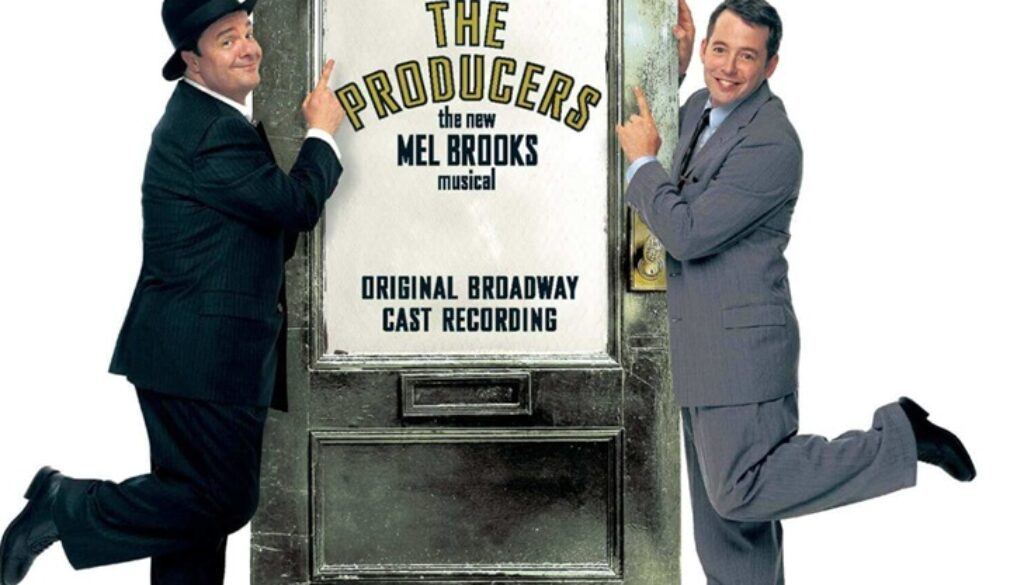
The Producers had a pre-Broadway tryout at Chicago’s Cadillac Palace from February 1 to 25, 2001, starring Matthew Broderick as Leo Bloom and Nathan Lane as Max Bialystock.
Broadway Opening
The production opened on Broadway with the same cast at the St. James Theatre on April 19, 2001. It ran for 2,502 performances, closing on April 22, 2007. The director and choreographer was Susan Stroman. Glen Kelly was the musical arranger and supervisor.
| Role | Original Broadway Cast |
|---|---|
| Max Bialystock | Nathan Lane |
| Leo Bloom | Matthew Broderick |
| Franz Liebkind | Brad Oscar |
| Ulla | Cady Huffman |
| Roger De Bris | Gary Beach |
| Carmen Ghia | Roger Bart |
Box Office Records
After the opening, The Producers broke the record for the largest single day box-office ticket sales in theatre history, taking in more than $3 million. The loss of the original stars later in the run had a detrimental effect on the success of the production, prompting the return of Broderick and Lane for a limited run from December 2003 to April 2004. The show’s sales then broke its own record with over $3.5 million in single day ticket sales.
Notable Replacements
Over the show’s six-year Broadway run, the roles of Max and Leo were played by numerous actors including:
- Max: Henry Goodman, Brad Oscar, Lewis J. Stadlen, Fred Applegate, John Treacy Egan, Richard Kind, Tony Danza
- Leo: Steven Weber, Roger Bart, Don Stephenson, Hunter Foster, Alan Ruck
National Tours & Major Productions
U.S. National Tours
From September 2002 to July 2005, there were two touring companies that played 74 cities across the United States, grossing over $214 million.
The first tour began on September 10, 2002, and starred Don Stephenson as Leo and Lewis J. Stadlen as Max. They were replaced during the Los Angeles engagement in 2003 by Martin Short and Jason Alexander for the duration of the show’s run in that city, as well as in San Francisco.
A second national tour opened on June 17, 2003, at the Colonial Theatre in Boston, Massachusetts, starring Andy Taylor as Leo and Brad Oscar as Max. The cast also featured Lee Roy Reams as Roger and Bill Nolte as Franz. This company toured the US for two years before playing in Tokyo, Japan.
Toronto Production
A Toronto production opened in December 2003 and closed in July 2004 at The Canon Theatre. The cast included Michael Therriault and Seán Cullen as Leo and Max, Juan Chioran as Roger, Paul O’Sullivan as Franz, Sarah Cornell as Ulla and Brandon McGibbon as Carmen Ghia. Stroman also directed and choreographed this production with the same designers as the Broadway production.
West End Production (2004-2007)
The Producers opened in London’s West End at the Theatre Royal, Drury Lane, on November 9, 2004 and closed on January 6, 2007, after 920 performances. The production starred Nathan Lane, reprising the role of Max after Richard Dreyfuss was “let go” by the producers after finding that he was unable “to fulfil the rigours of the role”, with four days to go before first previews.
Lee Evans played Leo (Lane and Evans had worked together in the 1997 movie MouseHunt), with Leigh Zimmerman as Ulla, Nicolas Colicos as Franz Liebkind, Conleth Hill as Roger De Bris, and James Dreyfus as Carmen Ghia.
Leo Bloom was later played by John Gordon Sinclair and Reece Shearsmith. Max Bialystock was then played by Brad Oscar, Fred Applegate, and Cory English.
UK Tours
A United Kingdom tour opened in Manchester on February 19, 2007, where it played for three months before moving on. English and Sinclair reprised their roles of Max and Leo, respectively, and Peter Kay was cast in the role of Roger. For the majority of the tour, which ran until early 2008, Joe Pasquale and Reece Shearsmith took over the role of Leo and Russ Abbot played Roger.
A new production began a UK and Ireland tour at the Churchill Theatre in Bromley on March 6, 2015, starring Cory English as Max, Jason Manford as Leo, Phill Jupitus (until May 16) and Ross Noble (from May 18 onwards) as Franz Liebkind, David Bedella as Roger De Bris and Louie Spence as Carmen Ghia (until May 2). The tour continued until July 2015 in Dublin.
2024 Menier Chocolate Factory Revival
An Off West End revival at the Menier Chocolate Factory, London, directed by Patrick Marber, began previews on November 26, 2024, with an opening night on December 9, and ran until March 1, 2025. Andy Nyman starred as Max, with Marc Antolin as Leo, Trevor Ashley as Roger, Raj Ghatak as Carmen, and Joanna Woodward as Ulla. Choreography was by Lorin Latarro.
The production transferred to the Garrick Theatre for a West End run with the same principal cast. The production began previews on August 30, 2025, with an opening on September 15.
Notable U.S. Regional Productions
A Los Angeles production ran from May 2003 to January 2004 at the Pantages Theatre, co-starring Jason Alexander as Max Bialystock and Martin Short as Leo Bloom.
The Las Vegas production ran for a year in 2007 to 2008 at the Paris Hotel & Casino. It starred Brad Oscar as Bialystock, Larry Raben as Bloom and Leigh Zimmerman as Ulla, with David Hasselhoff receiving top billing as Roger De Bris. Once Hasselhoff left the production, top-billing went to Tony Danza, who stepped in as Bialystock. The production was a 90-minute version.
A production at the Hollywood Bowl, with Richard Kind, Roger Bart, and Gary Beach reprising their roles as Max Bialystock, Carmen Ghia and Roger DeBris from the original Broadway production, ran July 27–29, 2012. The cast also starred Jesse Tyler Ferguson as Leo Bloom and featured Dane Cook as Franz Liebkind and Rebecca Romijn as Ulla.
International Productions
The Producers has been presented professionally in cities around the world, demonstrating its international appeal despite its specifically American Jewish/Broadway humor.
| Region | Cities |
|---|---|
| Europe | London, Berlin, Breda, Copenhagen, Milan, Budapest, Madrid, Manchester, Prague, Stockholm, Bratislava, Vienna, Helsinki, Athens, Lisbon, Gothenburg, Oslo, Oradea, Paris, Varde, Moscow, Ghent, Belgrade |
| Asia-Pacific | Tokyo, Osaka, Nagoya, Seoul, Tel Aviv, Melbourne, Brisbane, Cairns, Sydney, Christchurch, Manila |
| Americas | Toronto, Halifax, Mexico City, Buenos Aires, Rio de Janeiro, São Paulo, Caracas, Panama |
The Berlin Production
Perhaps most remarkably, The Producers was performed in Berlin, Germany—the city where much of Hitler’s reign originated. The New York Times reported on this production in May 2009: “The Führer Returns to Berlin, This Time Saluted Only by Laughs.” The production demonstrated the musical’s ability to use comedy to confront historical trauma.
2005 Film Adaptation
In 2005, the musical was adapted into a musical film. It was directed by Susan Stroman and starred most of the original Broadway cast, except for Brad Oscar—who was unable to reprise the role of Franz because he had signed on to play Max on Broadway and, instead, had a brief cameo as the cab driver—and Cady Huffman. Their roles were played by Will Ferrell and Uma Thurman, respectively.
The songs “King of Broadway”, “In Old Bavaria”, and “Where Did We Go Right?” were not in the theatrical release of the film but were included in the extended cut; “King of Broadway” and “In Old Bavaria” appear on the DVD as deleted scenes.
The movie opened on December 16, 2005, and received mixed reviews.
| Role | 2005 Film Cast |
|---|---|
| Max Bialystock | Nathan Lane |
| Leo Bloom | Matthew Broderick |
| Franz Liebkind | Will Ferrell |
| Ulla | Uma Thurman |
| Roger De Bris | Gary Beach |
| Carmen Ghia | Roger Bart |
Curb Your Enthusiasm Parody
The fourth season of the TV series Curb Your Enthusiasm parodies The Producers in the form of a metareference. Mel Brooks offers Larry David the part of Max, with Ben Stiller as Leo. When Larry and Stiller have a falling out, Stiller is replaced by David Schwimmer.
On opening night, Larry forgets his lines, but instead of causing the play to bomb, his ad-libs keep the audience laughing. Brooks reveals he purposely cast Larry, believing he would fail, to end the show and “free” Brooks of its success. Brooks and his real-life wife, Anne Bancroft, laugh at Larry’s performance, but to their dismay, Larry makes the play a hit once again. Cady Huffman and Nathan Lane appear as themselves.
Musical Numbers
Act One
- “Opening Night” – Max and Company
- “The King of Broadway” – Max and Company
- “We Can Do It” – Max and Leo
- “I Wanna Be a Producer” – Leo and Accountants
- “We Can Do It” (Reprise) – Max and Leo
- “In Old Bavaria” – Franz
- “Der Guten Tag Hop Clop” – Max, Leo, and Franz
- “Keep It Gay” – Roger and Company
- “When You’ve Got It, Flaunt It” – Ulla
- “Along Came Bialy” – Max and Little Old Ladies
- “Act I Finale” – Company
Act Two
- “That Face” – Leo
- “That Face” (Reprise) – Max
- “Haben Sie Gehört Das Deutsche Band?” – Franz and Company
- “You Never Say ‘Good Luck’ on Opening Night” – Company
- “Springtime for Hitler” – Company
- “Where Did We Go Right?” – Max and Leo
- “Betrayed” – Max
- “‘Til Him” – Leo
- “Prisoners of Love” – Max, Leo, Franz, and Prisoners
- “Leo & Max” – Leo and Max
- “Goodbye!” – Company
The Iconic “Springtime for Hitler”
The show-within-a-show number “Springtime for Hitler” is one of the most memorable and outrageous musical theater sequences ever created. Intended to be offensive enough to guarantee failure, it features dancers dressed as stormtroopers forming swastika formations while singing:
“Springtime for Hitler and Germany / Deutschland is happy and gay / We’re marching to a faster pace / Look out, here comes the master race!”
The number’s audacity and comic genius have made it an iconic moment in musical theater history.
Awards & Recognition
The Record-Breaking Tony Awards
At the 2001 Tony Awards, The Producers won 12 out of its 15 nominations, breaking the record of 10 wins set by Hello, Dolly! in 1964. It was one of the few musicals to win in every category for which it was nominated, receiving two nominations for leading actor and three for featured actor.
Its record for most nominations was tied in 2009 by Billy Elliot the Musical and broken in 2016 when Hamilton received 16 nominations, but its record number of wins still stands as of 2025; Hamilton is second, with 11 wins.
| Year | Award | Category | Nominee | Result |
|---|---|---|---|---|
| 2001 | Drama Desk Award | Outstanding Musical | The Producers | Won |
| 2001 | NY Drama Critics’ Circle | Best Musical | The Producers | Won |
| 2002 | Grammy Award | Best Musical Show Album | Cast Recording | Won |
| 2005 | Laurence Olivier Award | Best New Musical | West End Production | Nominated |
| 2005 | Laurence Olivier Award | Best Actor in a Musical | Nathan Lane | Nominated |
| 2005 | Laurence Olivier Award | Best Actor in a Musical | Lee Evans | Nominated |
Complete Timeline
Mel Brooks’ film The Producers premieres, starring Zero Mostel and Gene Wilder. It wins Brooks an Academy Award for Best Original Screenplay.
Producer David Geffen convinces Mel Brooks to adapt his film into a stage musical. Brooks meets with Jerry Herman who encourages him to write it himself.
Brooks collaborates with Thomas Meehan on the book. Director Mike Ockrent and choreographer Susan Stroman join the team. After Ockrent’s death in 1999, Stroman takes on both roles.
Pre-Broadway tryout at Chicago’s Cadillac Palace starring Nathan Lane and Matthew Broderick. The production receives enthusiastic response.
After 33 previews, The Producers opens at the St. James Theatre to critical acclaim and immediate box office success.
Breaks the record for largest single day box-office ticket sales in theater history, taking in more than $3 million.
Wins a record-breaking 12 Tony Awards out of 15 nominations, surpassing Hello, Dolly!‘s record of 10 wins that stood for 37 years.
First U.S. national tour launches, eventually playing 74 cities and grossing over $214 million.
Second U.S. tour opens in Boston, eventually touring for two years before playing in Tokyo, Japan.
Canadian production opens. On Broadway, Lane and Broderick return for a limited engagement from December 2003 to April 2004.
With Lane and Broderick back in their roles, the show breaks its own record with over $3.5 million in single day ticket sales.
London production opens at Theatre Royal, Drury Lane with Nathan Lane and Lee Evans. Runs until January 6, 2007 (920 performances).
Movie version directed by Susan Stroman opens, featuring most of the original Broadway cast plus Uma Thurman and Will Ferrell.
After 2,502 performances over six years, the original Broadway production closes at the St. James Theatre.
90-minute version runs at Paris Hotel & Casino, featuring David Hasselhoff and later Tony Danza as Max.
The show about Hitler opens in Berlin, Germany. The New York Times reports: “The Führer Returns to Berlin, This Time Saluted Only by Laughs.”
Special concert version features Richard Kind, Jesse Tyler Ferguson, Roger Bart, Gary Beach, Dane Cook, and Rebecca Romijn.
New UK and Ireland tour begins, starring Jason Manford and Cory English, running until July 2015.
Off West End revival directed by Patrick Marber opens with Andy Nyman as Max, running until March 1, 2025.
Production transfers to Garrick Theatre with the same cast, marking the show’s return to the West End after 18 years.
Cultural Impact & Legacy
A New Era for Broadway
The Producers arrived at a crucial moment in Broadway history. Opening in April 2001, just months before the September 11 attacks, the show provided much-needed laughter and escapism during a traumatic period for New York City. Its success helped revitalize Broadway tourism and demonstrated that audiences were hungry for big, brash, irreverent comedy.
Breaking Barriers with Humor
The musical’s willingness to make Hitler and Nazis objects of ridicule—”Springtime for Hitler” being the prime example—demonstrated comedy’s power to defang historical evil. By making audiences laugh at the Third Reich, Brooks and his collaborators robbed it of its remaining cultural power.
Star Power & Box Office Innovation
The show pioneered premium ticket pricing on Broadway, with top seats selling for unprecedented amounts. While controversial, this pricing model became standard for major Broadway productions and demonstrated the economic power of star-driven musicals.
The return of Lane and Broderick in 2003-2004, prompted by declining sales after their departure, created a template for limited star engagements that would be replicated by future productions.
Influence on Musical Theater
The Producers demonstrated that movie-to-musical adaptations could be legitimate artistic triumphs, not just commercial cash-grabs. Its success paved the way for other film adaptations like Hairspray, Legally Blonde, and countless others.
The show’s integration of traditional book musical structure with contemporary comedy sensibilities influenced a generation of musical theater writers. Its balance of heart and humor, sentiment and satire, became a model for successful musical comedies.
Record That Still Stands
As of 2025, The Producers‘ record of 12 Tony Award wins remains unbroken. While Hamilton received more nominations (16 vs. 15), it won “only” 11 Tonys. The show’s clean sweep—winning in every category for which it was nominated—is unlikely to ever be matched.
Mel Brooks at the Tonys
At 74 years old when the show opened, Mel Brooks became one of the oldest first-time Broadway composers to win a Tony Award. His acceptance speech, characteristically irreverent and hilarious, is considered one of the great Tony Awards moments. Brooks is one of only 18 people to achieve EGOT status (Emmy, Grammy, Oscar, Tony).