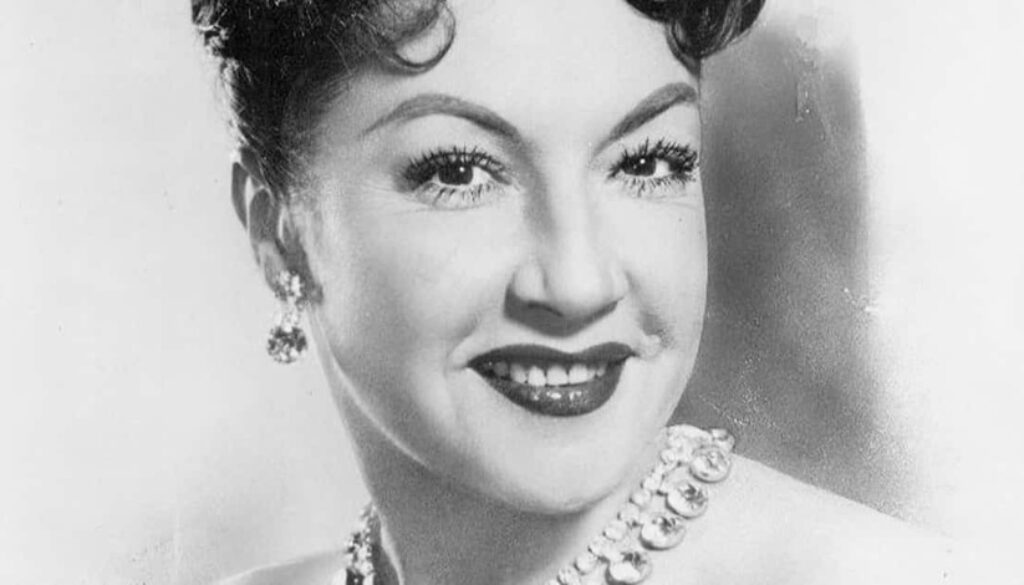
Ethel Merman – The First Lady of the Musical Comedy Stage
Ethel Merman - Podcast
Broadway’s Undisputed Queen
ETHEL
MERMAN
January 16, 1908 — February 15, 1984
The First Lady of the Musical Comedy Stage — a voice that needed no microphone and a presence that commanded every theatre she graced.
The First Lady of Broadway
Ethel Merman — born Ethel Agnes Zimmermann on January 16, 1908, in Astoria, Queens — was an American singer and actress whose extraordinary career spanned five decades and redefined what it meant to be a Broadway star. She has been called “the undisputed First Lady of the musical comedy stage,” a title earned through an unmatched string of legendary performances and a voice that was, as one critic put it, “trumpet-clean, penny whistle-piercing, and Wurlitzer-wonderful.”
Her Broadway career began in 1930 and continued through 1970, encompassing landmark productions including Girl Crazy, Anything Goes, Annie Get Your Gun, Call Me Madam, Gypsy, and Hello, Dolly! She introduced dozens of songs that became American standards, worked with the greatest composers and lyricists of the 20th century, and drew standing ovations from opening night to closing night of virtually every show she appeared in.
Merman received the Tony Award for Best Actress in a Musical for Call Me Madam, a Grammy Award for the cast recording of Gypsy, a Drama Desk Award for Hello, Dolly!, and a Golden Globe Award for the film version of Call Me Madam. She was married four times, raised two children, and remained a beloved public figure until her death in 1984.
Early Life & The Making of a Star
Ethel was an only child, born in her maternal grandmother’s house in Astoria, Queens, though she later insisted — with characteristic showbiz flair — that her birth year was 1912 rather than 1908. Her father, Edward Zimmermann, was an accountant, and her mother, Agnes Zimmermann, was a schoolteacher. The family was deeply religious, attending the Episcopal congregation at the Church of the Redeemer, where Ethel was baptized.
She attended P.S. 4 and then William Cullen Bryant High School in Queens, where she took a secretarial course as practical insurance against a failed entertainment career — at her parents’ insistence. She threw herself into extracurricular activities, including the school magazine, the speakers’ club, and student council, and regularly visited the local music store to browse the latest sheet music. The school later named its auditorium in her honour.
Friday Nights at the Palace
Every Friday night, the Zimmermann family would take the subway into Manhattan to catch the vaudeville shows at the legendary Palace Theatre. The young Ethel watched Blossom Seeley, Fanny Brice, Sophie Tucker, and Nora Bayes perform, and at home would try to emulate their styles — only to discover her own voice was impossible to disguise. It was entirely, unmistakably, her own.
From Stenographer to Sensation
After graduating in 1924, Merman worked as a stenographer, eventually rising to personal secretary to company president Caleb Bragg, whose frequent absences from the office allowed her to sleep in after late-night singing engagements at private parties.
She began performing in nightclubs, first booked by Jimmy Durante‘s partner Lou Clayton. During this period she decided the name Zimmermann was too long for a theatre marquee, and — with her father’s approval — shortened it to Merman.
A chance engagement at a midtown club called Little Russia brought her to the attention of agent Lou Irwin, who secured her a contract with Warner Bros. at $125 a week. Though little film work materialised, he negotiated an arrangement allowing her to continue performing in clubs. She was hired as a torch singer at Les Ambassadeurs, where she shared the stage with Jimmy Durante — beginning a lifelong friendship. A tonsillectomy she feared would destroy her voice instead left it more powerful than before.
The Broadway Years
Girl Crazy (1930) — The Overnight Star
While performing a seven-week engagement at the Brooklyn Paramount, Merman was spotted by theatre producer Vinton Freedley, who invited her to audition for the new George and Ira Gershwin musical Girl Crazy. Upon hearing her sing, the Gershwins cast her immediately. The show opened on October 14, 1930, at the Alvin Theatre and ran for 272 performances.
The New York Times praised her singing as having “dash, authority, good voice and just the right knowing style,” while The New Yorker declared her “imitative of no one.” George Gershwin, bemused by her indifference to her extraordinary reviews, asked her mother: “Have you ever seen a person so unconcerned as Ethel?”
The Five Cole Porter Musicals
Merman would become Cole Porter’s most celebrated interpreter, starring in five of his Broadway shows:
- Anything Goes (1934) — featuring “I Get a Kick Out of You,” “You’re the Top,” and “Blow Gabriel Blow.” Ran 420 performances.
- Red, Hot and Blue (1936) — with Jimmy Durante and Bob Hope
- Du Barry Was a Lady (1939) — with Bert Lahr and Betty Grable, ran a full year
- Panama Hattie (1940) — lasting more than 14 months
- Something for the Boys (1943) — produced by Michael Todd
The New York Post hailed her in Anything Goes as “vivacious and ingratiating in her comedy moments, and the embodiment of poise and technical adroitness.”
George White’s Scandals (1931)
When the troubled latest edition of George White’s Scandals needed saving, Merman was summoned mid-vacation. Producer White paid $10,000 to Freedley for her services on top of her $1,500 weekly salary. The show ran for 202 Broadway performances.
Annie Get Your Gun (1946) — The Triumph of a Decade
While Merman was in hospital recovering from the birth of her second child in August 1945, composer Dorothy Fields visited and proposed she play Annie Oakley in a new musical. Merman accepted. When composer Jerome Kern died before the show could begin, Irving Berlin stepped in to replace him — and the result was one of the most beloved musicals in Broadway history.
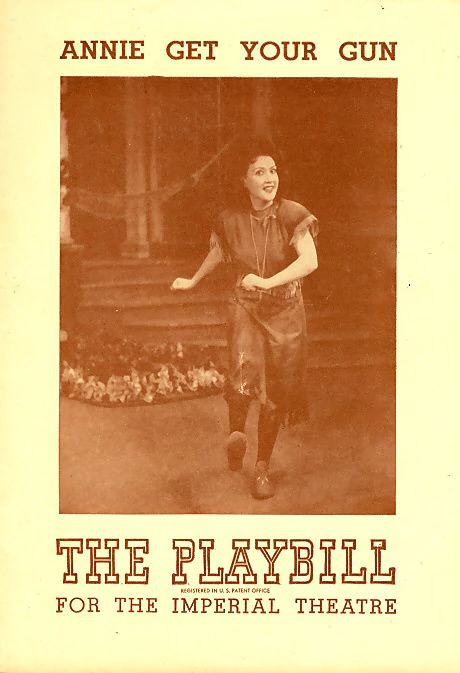
Annie Get Your Gun opened on May 16, 1946, at the Imperial Theatre and ran for 1,147 performances — nearly three years. During that run, Merman took only two vacations and missed only two performances due to illness. Irving Berlin’s song “There’s No Business Like Show Business,” written for the show, became her signature song for the rest of her life.
Call Me Madam (1950) — The Tony Award
Merman reunited with Irving Berlin for Call Me Madam in 1950, for which she won the Tony Award for Best Actress in a Musical. She reprised the role in the 1953 film adaptation, winning the Golden Globe Award for Best Actress in a Musical or Comedy.
Gypsy (1959) — Her Greatest Performance
Gypsy, based on the memoirs of Gypsy Rose Lee, cast Merman as Rose Hovick, the ferociously ambitious stage mother. The show opened on May 21, 1959, at the Broadway Theatre. Richard Watts of the New York Post called Merman “a brilliant actress,” and Brooks Atkinson of the New York Times wrote that she gave “an indomitable performance, both as actress and singer.”
Despite the unanimous critical triumph, Merman lost the Tony Award to her close friend Mary Martin in The Sound of Music. She reportedly quipped with characteristic good humour: “How are you going to buck a nun?”
The Gypsy Film — Broadway’s Greatest Injustice
Throughout Gypsy‘s 702-performance run, director Mervyn LeRoy repeatedly assured Merman she would star in his film adaptation. Before the show even closed, it was announced that Rosalind Russell had been cast instead. Russell’s husband, producer Frederick Brisson, had negotiated a deal giving his wife both Gypsy and another Warner Bros. film as a package.
Merman was devastated. She later called losing the film role “the greatest professional disappointment of my life.” The Grammy Award she received for the cast recording remained scant consolation for being denied the chance to preserve her legendary performance on film.
Hello, Dolly! (1970) — The Grand Finale
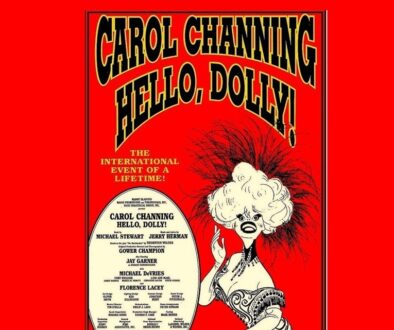
Producer David Merrick had encouraged composer Jerry Herman to write Hello, Dolly! specifically for Merman’s vocal range — but when offered the role, she declined. Six years later, on March 28, 1970, she finally joined the cast as the seventh actress to portray Dolly Gallagher Levi in the original Broadway production.
On her opening night, standing ovations repeatedly halted the show. Walter Kerr in the New York Times described her voice as exactly as “trumpet-clean, exactly as penny whistle-piercing, exactly as Wurlitzer-wonderful as it always was.” She remained with the production for 210 performances until it closed on December 27, 1970, receiving the Drama Desk Award for Outstanding Performance — her final Broadway bow.
Broadway Show Chronology
| Year | Show | Key Songs Introduced | Composer / Lyricist |
|---|---|---|---|
| 1930 | Girl Crazy | I Got Rhythm | Gershwin / Gershwin |
| 1931 | George White’s Scandals | Life is Just a Bowl of Cherries | Ray Henderson |
| 1932 | Take a Chance | Eadie Was a Lady | Youmans / DeSylva |
| 1934 | Anything Goes | I Get a Kick Out of You; You’re the Top; Anything Goes | Cole Porter |
| 1936 | Red, Hot and Blue | It’s De-Lovely; Down in the Depths | Cole Porter |
| 1939 | Stars in Your Eyes | This Is It | Arthur Schwartz |
| 1939 | Du Barry Was a Lady | Friendship; Do I Love You? | Cole Porter |
| 1940 | Panama Hattie | Make It Another Old-Fashioned, Please | Cole Porter |
| 1943 | Something for the Boys | Hey, Good Lookin’ | Cole Porter |
| 1946 | Annie Get Your Gun | There’s No Business Like Show Business; Doin’ What Comes Natur’lly | Irving Berlin |
| 1950 | Call Me Madam | You’re Just in Love; The Hostess With the Mostes’ | Irving Berlin |
| 1956 | Happy Hunting | Mutual Admiration Society | Harold Karr / Matt Dubey |
| 1959 | Gypsy | Everything’s Coming Up Roses; Rose’s Turn; Some People | Jule Styne / Sondheim |
| 1966 | Annie Get Your Gun (Revival) | Lincoln Center Revival | Irving Berlin |
| 1970 | Hello, Dolly! | Hello, Dolly! (Final Broadway Performance) | Jerry Herman |
On the Silver Screen
Merman’s relationship with Hollywood was, to put it diplomatically, complicated. She was a performer built for the live theatre — the sheer power and immediacy of her voice lost something in translation to film, and producers frequently marginalised her in favour of bigger screen names.
Later Career & Personal Life
Merman was married four times: to William Smith (1940–1941), Robert Levitt Sr. (1941–1952), Robert Six (1953–1960), and briefly to Ernest Borgnine in 1964 — a marriage that lasted a mere 32 days and became the stuff of Broadway legend. Her marriage to Levitt produced two children.
The Disco Queen (1979)
Never one to ignore a cultural moment, Merman recorded The Ethel Merman Disco Album in 1979, re-recording many of her signature songs with a full disco beat. The album became an unlikely cult classic and is still celebrated as one of the most gloriously audacious recordings in show business history.
Television & Final Years
After leaving Broadway, Merman made frequent television appearances on variety shows hosted by Perry Como, Red Skelton, Judy Garland, Dean Martin, Ed Sullivan, and Carol Burnett, and appeared in episodes of That Girl, The Lucy Show, Batman, and The Love Boat (playing Gopher’s mother).
She was a guest host on The Muppet Show, appeared on Match Game for seven weeks between 1975 and 1978, did a summer concert tour with Carroll O’Connor, and performed with Mary Martin in a concert benefiting the Museum of the City of New York.
Ethel Merman died on February 15, 1984, in Manhattan following a brain tumour. She was 76 years old. Broadway dimmed its lights in her honour, and tributes poured in from across the entertainment world. She left behind a legacy that remains, to this day, unmatched in the history of the American musical theatre.
Awards & Honours
Frequently Asked Questions
An Immortal Legacy
Ethel Merman towers over the history of the American musical theatre like no other figure. In a career spanning four decades on Broadway, she starred in more landmark productions, introduced more enduring standards, and embodied more of the artform’s defining moments than any performer before or since.
She worked with the greatest songwriters of the 20th century — George and Ira Gershwin, Cole Porter, Irving Berlin, Jule Styne, Stephen Sondheim, and Jerry Herman — and in each collaboration, she elevated the material to a standard that set the template for every Broadway soprano who followed.
The Merman Standard
Every major female Broadway star since 1930 has been measured, consciously or not, against the Merman standard. Her combination of vocal power, comedic timing, emotional directness, and sheer theatrical authority defined what it means to be a Broadway leading lady. From Patti LuPone to Bernadette Peters, from Bette Midler to Idina Menzel — all are in her debt.
She never needed a microphone. In an era before body mics, she could project to the back of any theatre with perfect clarity and effortless power. That voice — broad, bright, and absolutely unwavering — remains the gold standard of musical theatre performance.
Ethel Merman was not merely a Broadway star. She was Broadway itself — the embodiment of everything the Great White Way aspired to be: bold, brilliant, generous, and utterly, magnificently alive. The lights of Times Square have never shone quite as brightly since she took her final bow.
Links
Christopher Isherwood – Novelist
Terrence McNally – Memorabilia
Kiss of the Spider Woman – Memorabilia
Mothers and Sons – Memorabilia