Cole Porter: The Complete Biography — America’s Greatest Songwriter
Cole Porter - Podcast
Composer • Lyricist • Broadway • Hollywood
June 9, 1891 — October 15, 1964
The IncomparableCole Porter
America’s wittiest songwriter — urbane, risqué, brilliant, and enduring
First Broadway hit: 1928 • Greatest show: Kiss Me, Kate (1948)
Standards written: 300+ • Died: Santa Monica, CA, 1964
The Man Who
Wrote Everything
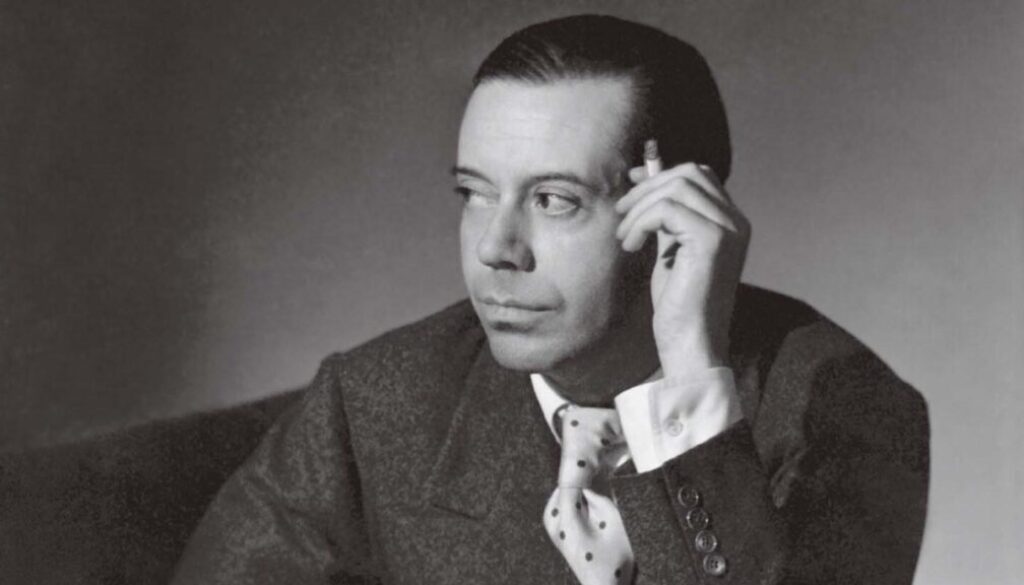
Cole Albert Porter (9 June 1891 – 15 October 1964) was an American composer and songwriter whose songs became standards noted for their witty, urbane lyrics and musically inventive melodies. He wrote both music and lyrics simultaneously — unlike nearly all his contemporaries who worked in pairs — and his recognisable style of chromatic sophistication, list songs, and risqué double entendre remained remarkably consistent across four decades on Broadway and in Hollywood.
Born to wealth in Peru, Indiana, Porter defied his grandfather’s wish that he study law and pursued music from Yale through Harvard to Paris. After years of extravagant living in Europe with little professional success, he broke through to Broadway stardom in 1928 at the age of 36. By the 1930s he was one of the dominant voices on Broadway — Anything Goes, Jubilee, Red Hot and Blue, DuBarry Was a Lady. A catastrophic riding accident in 1937 left him disabled and in constant pain for the rest of his life, yet he kept writing. In 1948 he produced his masterpiece — Kiss Me, Kate — which won the first-ever Tony Award for Best Musical.
Among his best-known songs: “Night and Day,” “Begin the Beguine,” “I Get a Kick Out of You,” “You’re the Top,” “I’ve Got You Under My Skin,” “Love for Sale,” “Let’s Do It,” “Anything Goes,” “True Love.” He died in 1964 and is buried in Peru, Indiana — between his wife and his father.
Early Life —
Peru, Indiana
to Yale & Paris
Childhood — Peru, Indiana (1891–1909)
Cole Porter was born on 9 June 1891 in Peru, Indiana, the only surviving child of a wealthy family. His father Samuel Fenwick Porter was a pharmacist; his mother Kate was the indulged daughter of J.O. Cole — “the richest man in Indiana.” Porter’s mother began his musical education early: violin at six, piano at eight, and his first operetta at ten. She falsified his birth year from 1891 to 1893 to make him appear more precocious.
Yale and Harvard (1909–1915)
Porter entered Yale College in 1909, majored in English, minored in music. He was a member of the Whiffenpoofs a cappella group and in his senior year was elected president of the Yale Glee Club. He wrote 300 songs while at Yale, including fight songs “Bulldog” and “Bingo Eli Yale” still sung today. He enrolled in Harvard Law School in 1913, rooming with future Secretary of State Dean Acheson, then switched to the music department to study harmony and counterpoint with Pietro Yon — kept secret from his grandfather.
Paris — Luxury, Lavender Marriage & Near-Abandonment (1917–1928)
Porter moved to Paris in 1917. In 1918 he met Linda Lee Thomas — a wealthy Louisville-born divoceée eight years his senior. They married on 19 December 1919. She was fully aware of his homosexuality; the marriage was mutually advantageous and genuinely devoted. After inheriting his grandfather’s estate in 1923, Porter rented Venetian palaces, once hiring the entire Ballets Russes to entertain guests. His Broadway output was thin — he nearly gave up songwriting entirely before his breakthrough in 1928.
The Broadway Career —
1928 to 1955
The Breakthrough — Paris (1928)
At 36, Porter returned to Broadway with Paris (1928). The show introduced “Let’s Do It, Let’s Fall in Love” — one of Porter’s best-known list songs. His parallel West End show Wake Up and Dream (1929) introduced “What Is This Thing Called Love?” Stephen Citron: Porter was finally “accepted into the upper echelon of Broadway songwriters.”
The Golden Decade — 1929–1939
Fifty Million Frenchmen (1929) — saved from early closure by Irving Berlin‘s public championing — introduced “You Do Something to Me.” The New Yorkers (1930) introduced “Love for Sale” — Porter’s self-described favourite of his own songs, banned from radio for explicit lyrics. Gay Divorce (1932), Fred Astaire’s last stage show, introduced “Night and Day.” Then Anything Goes (1934) with Ethel Merman — 420 performances; The New Yorker: “Mr Porter is in a class by himself.” Jubilee (1935), written with Moss Hart on a world cruise, produced “Begin the Beguine” and “Just One of Those Things.” Red, Hot and Blue (1936) with Merman, Jimmy Durante and Bob Hope introduced “It’s De-Lovely.”
Riding Accident — October 1937
On 24 October 1937, at the Piping Rock Club in Locust Valley, New York, Porter’s horse rolled on him and crushed both his legs. Doctors recommended amputation; Porter refused. Linda rushed from Paris. He spent seven months in hospital. He resumed work as soon as possible, finding it the only distraction from perpetual pain. He would endure 34 operations over the next 21 years before his right leg was finally amputated in 1958 — after which he wrote no more songs.
The Comeback — Kiss Me, Kate (1948)
After adequate-but-uninspired shows in the 1940s — Panama Hattie, Let’s Face It!, Something for the Boys, Mexican Hayride — many believed Porter’s best work was behind him. Then came Kiss Me, Kate (1948): his most successful show by a considerable margin, running 1,077 performances in New York and 400 in London. It won the first-ever Tony Award for Best Musical. Porter called it, alongside Anything Goes, one of his two perfect shows. The score — “Another Op’nin’ Another Show,” “Wunderbar,” “So In Love,” “Too Darn Hot,” “Brush Up Your Shakespeare” — is the most consistently excellent he ever wrote.
Final Shows (1952–1958)
Can-Can (1952, 892 performances) produced “C’est Magnifique” and “It’s All Right with Me.” Silk Stockings (1955, 477 performances) featured “All of You.” The film High Society (1956) — Crosby, Sinatra, Grace Kelly — included Porter’s final major hit: “True Love.” His last score was the CBS television special Aladdin (1958). After amputation the same year, he never wrote another song.
Personal Life —
Linda, Paris
& the Waldorf
Linda Lee Thomas
Porter met Linda Lee Thomas in Paris in 1918 — a wealthy Louisville-born divoceée eight years his senior who had received over a million dollars in a divorce settlement. They married 19 December 1919 and remained so until her death of emphysema in 1954 — 35 years. She was fully aware of his homosexuality. For Linda: social stability and a partner who was the antithesis of her abusive first husband. For Porter: a respectable public face in an era when homosexuality could not be acknowledged. They were also genuinely devoted, sharing a love of travel, luxury, and mutual encouragement.
Extravagance — Paris, Venice & the Waldorf
The Porter home on the rue Monsieur near Les Invalides had platinum wallpaper and chairs upholstered in zebra skin. In Venice he rented palaces and once hired the entire Ballets Russes for a party at Ca’ Rezzonico — with 50 gondoliers as footmen and tightrope walkers performing in blazing lights. In his final years Porter lived quietly at the Waldorf Towers, his 1908 Steinway grand piano on display in the hotel lobby. He died on 15 October 1964 in Santa Monica, California. He is buried in Mount Hope Cemetery, Peru, Indiana — between his wife and his father.
Musical Style —
Wit, Chromaticism
& the List Song
Lyrics — Sophistication and Risqué Daring
Porter wrote both music and lyrics of all his songs — unusual among Broadway composers of his era. His lyrics are typically about upper-class people in elegant or exotic settings: penthouses, cruise ships, foreign countries. He was educated, sophisticated, witty, an outstanding rhymer, and more often risqué than any mainstream songwriter of his time. He was a modern master of the list song — “Let’s Do It,” “You’re the Top,” “I Get a Kick Out of You” — songs that pile up examples of a single idea with escalating wit. Stephen Sondheim cited his list songs as a particular inspiration. He also wrote sentimental ballads — “Night and Day,” “So In Love,” “Ev’ry Time We Say Goodbye” — of striking emotional directness.
Music — Chromaticism and World Influences
Porter used chromaticism extensively in both melody and harmony — early in his career telling Richard Rodgers he intended to write “Jewish tunes,” with Rodgers later noting Porter’s “unmistakably Mediterranean” use of minor keys. He drew on foreign musical traditions: Latin American rhythms throughout his work; “Night and Day” inspired by a Moroccan chant; “Begin the Beguine” by a native dance in the Dutch East Indies. Despite formal training in orchestration at the Schola Cantorum in Paris, Porter hired other composers to orchestrate his scores, though he closely reviewed and edited their work.
Notable Shows & Films
Breakthrough at 36. Introduced “Let’s Do It, Let’s Fall in Love.”
Saved by Irving Berlin’s public championing. Introduced “You Do Something to Me.” 254 performances.
Introduced “Love for Sale” — Porter’s self-described favourite. Banned from radio. Also “I Happen to Like New York.”
Introduced “Night and Day.” 248 performances. Film rights sold to RKO as The Gay Divorcee.
Porter’s first “perfect show.” “I Get a Kick Out of You,” “You’re the Top,” “All Through the Night,” “Anything Goes.”
Written on a world cruise. Introduced “Begin the Beguine” and “Just One of Those Things.”
Introduced “I’ve Got You Under My Skin” and “You’d Be So Easy to Love.”
Risqué Merman vehicle. Introduced “Well, Did You Evah!” and “Friendship.”
Porter’s masterpiece. “Another Op’nin’,” “So In Love,” “Too Darn Hot,” “Brush Up Your Shakespeare.”
“C’est Magnifique” and “It’s All Right with Me.” Film soundtrack won a Grammy Award.
Porter’s last original Broadway musical, introducing “All of You.”
Porter’s final major film score. His last big hit: “True Love.”
The Songs —
An Immortal Songbook
| Song | Year | Show / Film |
|---|---|---|
| “Let’s Do It (Let’s Fall in Love)”Standard | 1928 | Paris |
| “What Is This Thing Called Love?”Standard | 1929 | Wake Up and Dream |
| “You Do Something to Me”Standard | 1929 | Fifty Million Frenchmen |
| “Love for Sale”Standard | 1930 | The New Yorkers — Porter’s favourite |
| “Night and Day”Standard | 1932 | Gay Divorce |
| “I Get a Kick Out of You”Standard | 1934 | Anything Goes |
| “All Through the Night”Standard | 1934 | Anything Goes |
| “You’re the Top”Standard | 1934 | Anything Goes |
| “Begin the Beguine”Standard | 1935 | Jubilee |
| “Just One of Those Things”Standard | 1935 | Jubilee |
| “I’ve Got You Under My Skin”Standard | 1936 | Born to Dance (film) |
| “It’s De-Lovely”Standard | 1936 | Red, Hot and Blue |
| “In the Still of the Night”Standard | 1937 | Rosalie (film) |
| “My Heart Belongs to Daddy”Standard | 1938 | Leave It to Me! — Mary Martin’s Broadway debut |
| “Well, Did You Evah!”Standard | 1939 | DuBarry Was a Lady |
| “Don’t Fence Me In”Standard | 1934/1944 | Written 1934; Roy Rogers film 1944 |
| “Ev’ry Time We Say Goodbye”Standard | 1944 | Seven Lively Arts |
| “Another Op’nin’, Another Show”Standard | 1948 | Kiss Me, Kate |
| “So In Love”Standard | 1948 | Kiss Me, Kate |
| “Too Darn Hot”Standard | 1948 | Kiss Me, Kate |
| “It’s All Right with Me”Standard | 1952 | Can-Can |
| “True Love”Standard | 1956 | High Society — Porter’s final major hit |
Life Chronology
Only surviving child of a wealthy family. Grandfather J.O. Cole is “the richest man in Indiana.”
Violin at 6, piano at 8, first operetta at 10. Mother falsifies birth year to make him appear more precocious.
Majors in English, minors in music. Writes 300 songs. Elected president of the Yale Glee Club.
Enrolls in Harvard Law School; rooms with future Secretary of State Dean Acheson. Switches to music department.
“Esmeralda” in Hands Up (1915). See America First (1916) closes after two weeks.
Moves to Paris. May have served in the French Foreign Legion (listed in Legion records). Legendary parties with European nobility and international artists.
Weds wealthy Louisville-born divoceée in Paris. A genuine partnership of devotion and mutual protection lasting 35 years until her death in 1954.
Inherits grandfather’s estate. Hires entire Ballets Russes for parties. Nearly gives up songwriting altogether.
Returns to Broadway with Paris. “Let’s Do It” establishes him as a major voice at last.
Fifty Million Frenchmen, Gay Divorce (“Night and Day”), Anything Goes, Jubilee (“Begin the Beguine”), Born to Dance (“I’ve Got You Under My Skin”).
At Piping Rock Club, Locust Valley. Horse rolls on him, crushing both legs. Refuses amputation. Seven months in hospital. 34 operations ahead.
1,077 performances. First-ever Tony Award for Best Musical. Porter’s greatest show by every measure.
Mother Kate dies 1952. Linda dies 1954. Final hit: “True Love” (High Society, 1956).
Right leg amputated after 34 operations. Never writes another song. Seclusion at Waldorf Towers.
Dies of kidney failure at 73. Buried in Mount Hope Cemetery, Peru, Indiana — between his wife and his father.
Tributes &
Enduring Legacy
Ella Fitzgerald‘s 1956 Cole Porter Songbook — the first complete artist-composer album of its kind — set the template for how his work would be honoured. Bing Crosby had released an all-Porter album in 1950. Others who recorded complete Porter albums: Frank Sinatra, Oscar Peterson, Rosemary Clooney, Anita O’Day, Dionne Warwick. In 2021, Tony Bennett and Lady Gaga released Love for Sale — named after Porter’s own favourite song — which won Grammy Awards. In 1990, Red Hot + Blue — a Porter tribute to benefit AIDS research — featured U2 and Annie Lennox among 20 artists.
His life was fictionalised in the 1946 film Night and Day (Cary Grant as Porter, widely mocked for inaccuracy but commercially successful). The 2004 film De-Lovely (Kevin Kline as Porter, Ashley Judd as Linda) was more accurate, with soundtrack performances by Alanis Morissette, Sheryl Crow, Elvis Costello, Diana Krall and Natalie Cole. Porter appears as a character in Woody Allen’s 2011 film Midnight in Paris.
Permanent Honours
Grammy Trustees Award (1989). Hollywood Walk of Fame star (2007). US commemorative postage stamp (1991 centenary). Legacy Walk plaque, Chicago (2014, LGBT achievers). Member of the Songwriters Hall of Fame, the American Theater Hall of Fame, and the Great American Songbook Hall of Fame. The Cole Porter Festival is held every June in Peru, Indiana. His birthplace is now an inn with suites named for his works. His 1908 Steinway grand piano has been on display in the Waldorf-Astoria Hotel lobby since his death.
Awards & Honours
| Year | Award | Category / Note | Result |
|---|---|---|---|
| 1949 | Tony Award ◆ | Best Musical — Kiss Me, Kate (first-ever in this category) | Won ◆ |
| 1949 | Tony Award ◆ | Best Composer and Lyricist — Kiss Me, Kate | Won ◆ |
| 1960 | Grammy Award ◆ | Best Sound Track Album — Can-Can film | Won ◆ |
| 1973 | Songwriters Hall of Fame ◆ | Inductee | Inducted ◆ |
| 1989 | Grammy Trustees Award ◆ | Lifetime Achievement | Won ◆ |
| 1991 | US Postal Stamp ◆ | Commemorative stamp — centenary of birth | Issued ◆ |
| 2007 | Hollywood Walk of Fame ◆ | Star dedicated May 2007 | Star ◆ |
| 2014 | Legacy Walk, Chicago ◆ | LGBT achievers commemorative plaque | Honoured ◆ |
| Ongoing | American Theater Hall of Fame ◆ | Inductee | Inducted ◆ |
| Ongoing | Great American Songbook Hall of Fame ◆ | “Musically complex songs with witty, urbane lyrics” | Inducted ◆ |