Cabaret – Musical
Cabaret: The Iconic Musical That Defined a Generation
Cabaret is an American musical with music by John Kander, lyrics by Fred Ebb, and a book by Joe Masteroff. It is based on the play I Am a Camera by John Van Druten, which premiered in 1951, which in turn was based on the 1939 novel Goodbye to Berlin by Christopher Isherwood.
Memorabilia Available Here
Setting and Synopsis
Set in 1929-1930 Berlin during the twilight of the Jazz Age as the Nazis rise to power, the musical focuses on the hedonistic nightlife at the seedy Kit Kat Klub and revolves around American writer Clifford Bradshaw’s relations with English cabaret performer Sally Bowles. A subplot involves the doomed romance between German boarding house owner Fräulein Schneider and her elderly suitor Herr Schultz, a Jewish fruit vendor. Overseeing the action is the Master of Ceremonies at the Kit Kat Klub, and the club itself serves as a metaphor for ominous political developments in late Weimar Germany.
Original Broadway Production
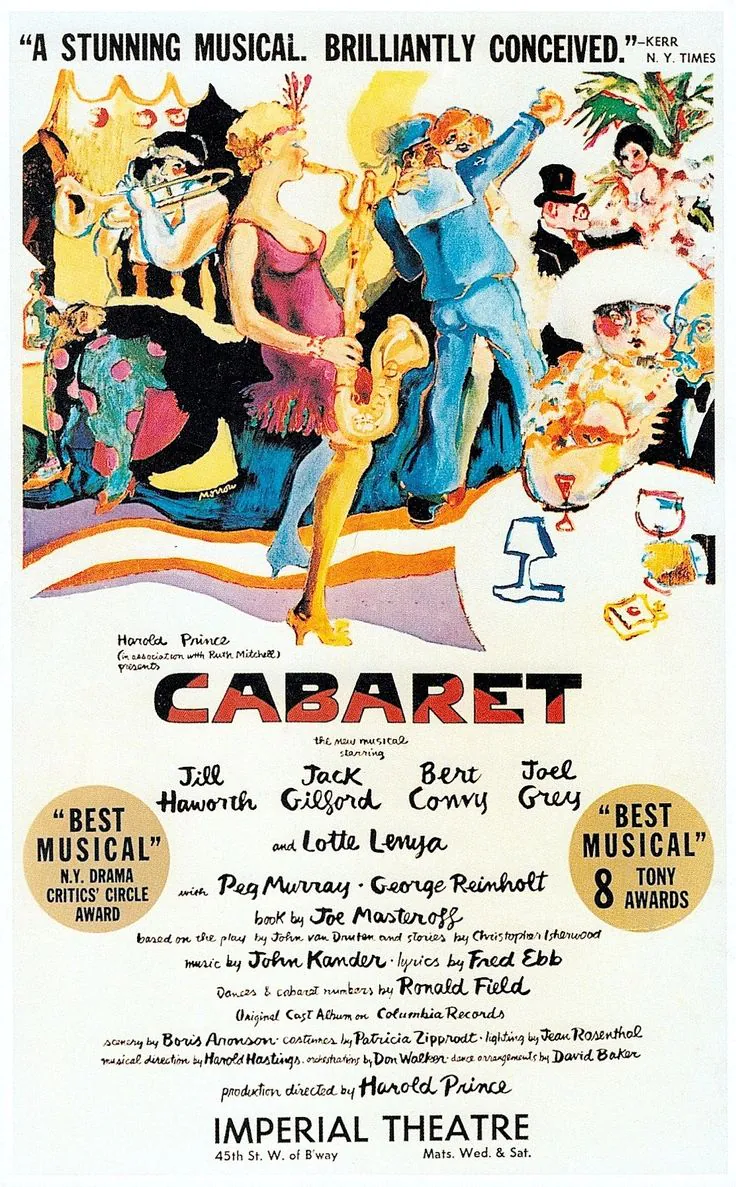
The original Broadway production opened on November 20, 1966, at the Broadhurst Theatre in New York City and became a box office hit that ran for 1,166 performances. The production won eight Tony Awards and inspired numerous subsequent productions around the world as well as the 1972 film of the same name.
Historical Background
The events depicted in the 1966 musical are derived from Anglo-American writer Christopher Isherwood’s autobiographical tales of his colorful escapades in the Weimar Republic. In 1929, Isherwood visited Weimar-era Berlin during the final months of the Golden Twenties. He relocated to Berlin to avail himself of boy prostitutes and to enjoy the city’s orgiastic Jazz Age cabarets. He socialized with a coterie of gay writers that included Stephen Spender, Paul Bowles, and W.H. Auden.
Jean Ross: The Real Sally Bowles
In Berlin, Isherwood shared modest lodgings with 19-year-old British flapper Jean Ross, an aspiring film actress who earned her living as a chanteuse in lesbian bars and second-rate cabarets. While room-mates at Nollendorfstrasse 17 in Schöneberg, a 27-year-old Isherwood settled into a sexual relationship with a 16-year-old German boy, and Ross became pregnant after engaging in a series of sexual liaisons. She believed the father of the child to be jazz pianist and later film actor Peter van Eyck.
As a favor to Ross, Isherwood pretended to be her heterosexual impregnator in order to facilitate an abortion of which Ross nearly died due to the doctor’s incompetence. Visiting the ailing Ross in a Berlin hospital, Isherwood felt resentment by the hospital staff for, as they assumed, forcing Ross to undergo the abortion. This event inspired Isherwood to write his 1937 novella Sally Bowles and is dramatized as its narrative climax.
Escape from Nazi Germany
While Ross recovered from the botched abortion, the political situation rapidly deteriorated in Weimar Germany as the incipient Nazi Party grew stronger day by day. Stephen Spender recalled, “There was a sensation of doom to be felt in the Berlin streets.” As Berlin’s daily scenes increasingly featured poverty, unemployment, political demonstrations and street fighting between the forces of the extreme left and the extreme right, Isherwood, Ross, Spender, and other British nationals realized that they must leave the politically volatile country as soon as possible.
Two weeks after the Enabling Act cemented Adolf Hitler’s dictatorship, Isherwood fled Germany and returned to England on April 5, 1933. Afterwards, the Nazis shuttered most of Berlin’s seedy cabarets, and many of Isherwood’s cabaret acquaintances fled abroad or perished in concentration camps.
Development of the Musical
In early 1963, producer David Black commissioned English composer and lyricist Sandy Wilson to undertake a musical adaptation of Van Druten’s 1951 play I Am a Camera. Black hoped that singer Julie Andrews would agree to star in the adaptation, but Andrews’ manager refused to allow her to accept the role of Sally Bowles due to the character’s immorality. By the time Wilson completed his work, however, Black’s option on both the 1951 Van Druten play and its source material by Isherwood had lapsed and been acquired by rival Broadway producer Harold Prince.
Harold Prince’s Vision
Prince wished to create a gritty adaptation of Isherwood’s stories that drew parallels between the spiritual bankruptcy of Germany in the 1920s and contemporary social problems in the United States at a time when the struggle for civil rights for black Americans was heating up as a result of nonviolent but bold demonstrations being held in the Deep South.
Prince hired playwright Joe Masteroff to work on the adaptation. Both men believed that Wilson’s score failed to capture the carefree hedonism of the Jazz Age in late 1920s Berlin. They wanted a score that evoked the Berlin of Kurt Weill and Lotte Lenya. Consequently, Prince invited the songwriting team of John Kander and Fred Ebb to join the project.
Character Adaptations
For the musical adaptation, playwright Joe Masteroff significantly altered Isherwood’s original characters. He transformed the English protagonist into an American writer named Clifford Bradshaw; the antisemitic landlady became a tolerant woman with a Jewish beau who owned a fruit store; they cut various supporting characters and added new characters such as the Nazi smuggler Ernst Ludwig for dramatic purposes. The musical ultimately expressed two stories in one: the first, a revue centered on the decadence of the Kit Kat Klub, for which Hal Prince created the Master of Ceremonies (Emcee) character played by Joel Grey; the second, a story set in the society outside the club.
Plot Summary
Act One
At the twilight of the Jazz Age in Berlin, the incipient Nazi Party is growing stronger. The Kit Kat Klub is a seedy cabaret – a place of decadent celebration. The club’s Master of Ceremonies together with the cabaret girls and waiters, warm up the audience (“Willkommen”). Meanwhile, a young American writer named Clifford Bradshaw arrives via a railway train in Berlin. He has journeyed to the city to work on a new novel. Cliff encounters Ernst Ludwig, a German smuggler who offers him black market work and recommends a boarding house.
At the boarding house, the proprietress Fräulein Schneider offers Cliff a room for one hundred reichsmarks, but he can only pay fifty. After a brief debate, she relents and allows Cliff to live there for fifty marks. Fräulein Schneider observes that she has learned to take whatever life offers (“So What?”).
When Cliff visits the Kit Kat Klub, the Emcee introduces an English chanteuse, Sally Bowles, who performs a flirtatious number (“Don’t Tell Mama”). Afterward, she asks Cliff to recite poetry for her, and he recites Ernest Thayer’s mock-heroic poem “Casey at the Bat”. Cliff offers to escort Sally home, but she says that her boyfriend Max, the club’s owner, is too jealous. Sally performs her final number at the Kit Kat Klub aided by a female ensemble of jazz babies (“Mein Herr”).
The next day at the boarding house, Cliff has just finished giving an English lesson to Ernst when Sally arrives. Max has fired her and thrown her out, and now she has no place to live. Sally asks Cliff if she can live in his room. At first he resists, but she convinces him to take her in (“Perfectly Marvelous”). The Emcee and two female companions sing a song (“Two Ladies”) that comments on Cliff and Sally’s new living arrangement.
Herr Schultz, an elderly Jewish fruit-shop owner who lives in the boarding house, gives a pineapple to Fräulein Schneider as a romantic gesture (“It Couldn’t Please Me More”). In the Kit Kat Klub, a young waiter starts to sing a song – a patriotic anthem to the Fatherland that slowly descends into a darker, Nazi-inspired marching song (“Tomorrow Belongs to Me”).
Act Two
Months later, Cliff and Sally are still living together and have grown intimate. Cliff knows that he is in a “dream”, but he enjoys living with Sally too much to come to his senses (“Why Should I Wake Up?”). Sally reveals that she is pregnant, but she does not know who the father is and decides to have an abortion. Cliff reminds her that it could be his child and tries to convince her to have the baby (“Maybe This Time”).
Meanwhile, Fräulein Schneider has caught one of her boarders, the prostitute Fräulein Kost, bringing sailors into her room. Herr Schultz saves Fräulein Schneider’s reputation by telling Fräulein Kost that he and Fräulein Schneider are to be married in three weeks (“Married”).
At Fräulein Schneider and Herr Schultz’s engagement party, Cliff arrives and delivers the suitcase of contraband to Ernst. Sally and Cliff gift the couple a crystal fruit bowl. A tipsy Schultz sings “Meeskite” (meeskite, he explains, is Yiddish for ugly or funny-looking), a song with a moral. Afterward, seeking revenge on Fräulein Schneider, Kost tells Ernst, who now sports a Nazi armband, that Schultz is a Jew. Ernst warns Schneider that marrying a Jew is unwise.
Fräulein Schneider expresses her concerns about her impending nuptials to Herr Schultz, who assures her that everything will be all right. They are interrupted by the crash of a brick being thrown through the glass window of Herr Schultz’s fruit shop. Schultz tries to reassure her that it is merely rowdy children making trouble, but Fräulein Schneider is now afraid.
Back at the Kit Kat Klub, the Emcee performs a song-and-dance routine with a woman in a gorilla suit, singing that their love has been met with universal disapproval (“If You Could See Her”). Encouraging the audience to be more open-minded, he defends his ape-woman, concluding with, “if you could see her through my eyes… she wouldn’t look Jewish at all.”
Fräulein Schneider goes to Cliff and Sally’s room and returns their engagement present, explaining that her marriage has been called off. When Cliff protests and states that she can’t just give up this way, she asks him what other choice she has (“What Would You Do?”).
Cliff begs Sally to leave Germany with him so that they can raise their child together in America. Sally protests and claims that their life in Berlin is wonderful. Cliff urges her to “wake up” and to notice the growing social upheaval around them. Sally retorts that politics have nothing to do with them and returns to the Kit Kat Klub (“I Don’t Care Much”).
At the club, after another heated argument with Sally, Cliff is accosted by Ernst, who has another delivery job for him. Cliff tries to brush him off. When Ernst inquires if Cliff’s attitude towards him is because of “that Jew at the party”, Cliff attacks him – only to be beaten by Ernst’s bodyguards and ejected from the club. On stage, the Emcee introduces Sally, who enters to perform again, singing that “life is a cabaret, old chum,” cementing her decision to live in carefree ignorance (“Cabaret”).
The next morning, a bruised Cliff is packing his clothes in his room when Herr Schultz visits. He informs Cliff that he is moving to another boarding house, but he is confident that these difficult times will soon pass. When Sally returns, she announces that she has had an abortion, and Cliff slaps her. She chides him for his previous insistence on keeping the baby, pointing out it would be a “terrible burden” for a child knowing it was the only reason the parents were together. Cliff still hopes that she will join him in France, but Sally retorts that she has “always hated Paris.” She hopes that, when Cliff finally writes his novel, he will dedicate the work to her. Cliff leaves, heartbroken.
On the railway train to Paris, Cliff begins to compose his novel, reflecting on his experiences: “There was a cabaret, and there was a master of ceremonies … and there was a city called Berlin, in a country called Germany – and it was the end of the world and I was dancing with Sally Bowles – and we were both fast asleep” (“Willkommen” (reprise)). In the Kit Kat Klub, the Emcee welcomes the audience once again as the ensemble reprises “Willkommen” but the song is now harsh and discordant. The Emcee sings, “Auf Wiedersehen… à bientôt…” followed by a drum roll crescendo and a cymbal crash.
Musical Numbers
Every production of Cabaret has modified the original score, with songs being changed, cut, or added from the film version. The principal musical numbers include:
- “Willkommen” – Emcee and Company
- “So What?” – Fräulein Schneider
- “Don’t Tell Mama” – Sally Bowles
- “Mein Herr” – Sally Bowles (added from film)
- “Perfectly Marvelous” – Sally and Cliff
- “Two Ladies” – Emcee and Company
- “It Couldn’t Please Me More” – Fräulein Schneider
- “Tomorrow Belongs to Me” – Waiters/Company
- “Why Should I Wake Up?” – Cliff
- “Maybe This Time” – Sally (added from film)
- “Money” / “Sitting Pretty” – Emcee and Company
- “Married” – Fräulein Schneider and Herr Schultz
- “Meeskite” – Herr Schultz
- “If You Could See Her” – Emcee
- “What Would You Do?” – Fräulein Schneider
- “I Don’t Care Much” – Sally (added in later revivals)
- “Cabaret” – Sally Bowles
Cut Songs
Many songs planned for the 1966 production were cut. Three excised songs – “Good Time Charlie”, “It’ll All Blow Over”, and “Roommates” – were recorded by Kander and Ebb, and the sheet music published in a collector’s book. The 1972 film added several songs, notably “Mein Herr” and “Maybe This Time” which were included in later productions. The later 1987 and 1998 Broadway revivals also added new songs such as “I Don’t Care Much”.
Major Productions
Original Broadway Production (1966-1969)
Directed by Harold Prince and choreographed by Ron Field, the original cast featured Jill Haworth as Sally, Bert Convy as Cliff, Lotte Lenya as Fräulein Schneider, Jack Gilford as Herr Schultz, Joel Grey as the Emcee, Edward Winter as Ernst, and Peg Murray as Fräulein Kost. Replacements later in the run included Anita Gillette and Melissa Hart as Sally, Ken Kercheval and Larry Kert as Cliff, and Martin Ross as the Emcee.
The original Broadway production was not an instant success according to playwright Joe Masteroff due to its perceived immoral content. “When the show opened in Boston,” Masteroff recalled, “there were a lot of walkouts. Once the reviews came out, the public came back.” At the time, actor Joel Grey was merely fifth-billed in the show. Nevertheless, audiences were hypnotized by Grey’s sinister performance as the Emcee.
West End Premiere (1968)
The musical premiered in the West End on February 28, 1968, at the Palace Theatre with Judi Dench as Sally, Kevin Colson as Cliff, Barry Dennen as the Emcee, Lila Kedrova as Fräulein Schneider and Peter Sallis as Herr Schultz. It ran for 336 performances. Critics such as Ken Mandelbaum have asserted that “Judi Dench was the finest of all the Sallys that appeared in Hal Prince’s original staging, and if she’s obviously not much of a singer, her Sally is a perfect example of how one can give a thrilling musical theatre performance without a great singing voice.”
1987 Broadway Revival
The first Broadway revival opened on October 22, 1987, with direction and choreography by Prince and Field. Joel Grey received star billing as the Emcee, with Alyson Reed as Sally, Gregg Edelman as Cliff, Regina Resnik as Fräulein Schneider, Werner Klemperer as Herr Schultz, and David Staller as Ernst Ludwig. The song “Don’t Go” was added for Cliff’s character.
1993 Donmar Warehouse Production
In 1993, Sam Mendes directed a new production for the Donmar Warehouse in London. The revival starred Jane Horrocks as Sally, Adam Godley as Cliff, Alan Cumming as the Emcee and Sara Kestelman as Fräulein Schneider. Kestelman won the Olivier Award for Best Supporting Performance in a Musical, and Cumming was nominated for an Olivier.
Mendes’ concept was different from either the original production or the conventional first revival, particularly with respect to the character of the Emcee. The role, as played by Joel Grey in both prior productions, was a sexually aloof, edgy character with rouged cheeks dressed in a tuxedo. Alan Cumming’s portrayal was highly sexualized, as he wore suspenders around his crotch and red paint on his nipples.
1998 Broadway Revival
The second Broadway revival, by the Roundabout Theatre Company, was based on the 1993 Mendes-Donmar Warehouse production. For the Broadway transfer, Rob Marshall was co-director and choreographer. The production opened after 37 previews on March 19, 1998, at the Kit Kat Klub, housed in what previously had been known as Henry Miller’s Theatre. Later that year it transferred to Studio 54, where it remained for the rest of its 2,377-performance run, becoming the third longest-running revival in Broadway musical history.
Cumming reprised his role as the Emcee, opposite newcomers Natasha Richardson as Sally, John Benjamin Hickey as Cliff, Ron Rifkin as Herr Schultz, Denis O’Hare as Ernst Ludwig, Michele Pawk as Fräulein Kost, and Mary Louise Wilson as Fräulein Schneider. The Broadway production was nominated for ten Tony Awards, winning four for Cumming, Richardson and Rifkin, as well as the Tony for Best Revival of a Musical.
This production featured a number of notable replacements: Susan Egan, Joely Fisher, Gina Gershon, Debbie Gibson, Milena Govich, Jennifer Jason Leigh, Melina Kanakaredes, Jane Leeves, Molly Ringwald, Brooke Shields, and Lea Thompson as Sally; Michael C. Hall, Raúl Esparza, Neil Patrick Harris, Adam Pascal, Jon Secada, and John Stamos as the Emcee.
2014 Broadway Revival
In September 2013, Roundabout Theatre Company announced plans to return the company’s acclaimed 1998 production to Studio 54 in New York. For this, the show’s third Broadway revival, Sam Mendes and Rob Marshall reprised their respective roles as director and co-director/choreographer. Alan Cumming starred again as the Emcee while Academy Award-nominee Michelle Williams made her Broadway debut as Sally Bowles.
The production began a 24-week limited engagement with previews from March 21, 2014, with opening night on April 24, 2014, but the engagement was extended. Emma Stone replaced Michelle Williams as Sally from November 2014 to February 2015. Critics praised Stone’s performance for her interpretation of Sally Bowles “as a flaming flapper, the kind hymned by F. Scott Fitzgerald and embodied by the young Joan Crawford in silent movies.” Sienna Miller took over the role on March 29, 2015, remaining through to the show’s closing. Alan Cumming continued in the role of the Emcee until the show’s final curtain.
2021 West End Revival at the Kit Kat Club
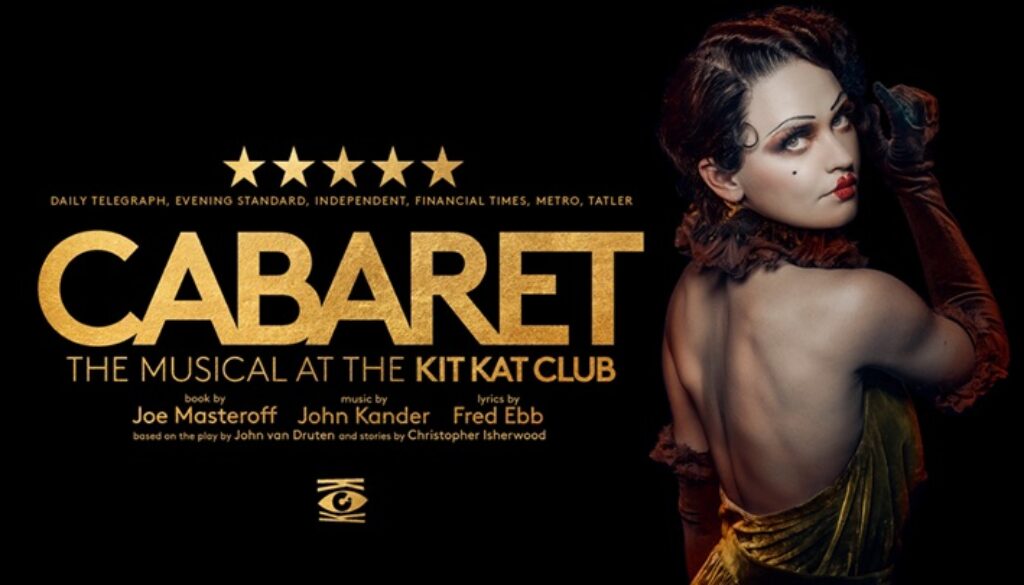
Eddie Redmayne and Jessie Buckley starred as the Emcee and Sally Bowles in a West End production directed by Rebecca Frecknall, designed by Tom Scutt, choreographed by Julia Cheng, with lighting design by Isabella Byrd and sound design by Nick Lidster. Produced by Underbelly and Ambassador Theatre Group, and billed as Cabaret at the Kit Kat Club, the production began previews November 15, 2021 at Playhouse Theatre, which was reduced to a 550-seat capacity with an intimate in-the-round stage and table seating for some audience members, in effect transforming the theater into a Weimar-era nightclub.
The production led the 2022 Olivier Award nominations with 11 nods, including Best Musical Revival, Best Actor in a Musical for Redmayne and Best Actress in a Musical for Buckley. The production won seven awards and set a record as the most award-winning revival in Olivier history and the first production to receive awards in all four eligible acting categories.
Following the departure of Redmayne and Buckley, notable players as the Emcee and Sally Bowles have been Fra Fee and Amy Lennox; Callum Scott Howells and Madeline Brewer; Aimee Lou Wood and John McCrea; Maude Apatow and Mason Alexander Park; Jake Shears and Rebecca Lucy Taylor (aka Self Esteem); Luke Treadaway and Cara Delevingne; Layton Williams and Rhea Norwood; Adam Gillen and Katherine Langford; Billy Porter and Marisha Wallace; Hannah Dodd and Rob Madge; and Eva Noblezada and Reeve Carney.
2024 Broadway Transfer
The 2021 West End production transferred to the August Wilson Theatre on Broadway, with previews from April 1, 2024, and the opening on April 21. As in the West End production, the August Wilson Theatre was refurbished as the “Kit Kat Club” with an intimate in-the-round staging. Redmayne reprised his role as the Emcee with Gayle Rankin and Ato Blankson-Wood co-starring as Sally and Cliff.
The production was nominated for 9 Tony Awards, winning one for scenic design. Replacements in this revival included Adam Lambert, Orville Peck, and Billy Porter as the Emcee and Auliʻi Cravalho, Eva Noblezada, and Marisha Wallace as Sally Bowles. The production closed on September 21, 2025, having played 18 previews and 592 performances.
International Productions
Since 2003, international stagings of the show, many influenced by Mendes’ concept, have included productions in Argentina, Australia, Brazil, Colombia, Costa Rica, France, Portugal, Greece, Israel, Malaysia, Mexico, Peru, Puerto Rico, Serbia, South Africa, Spain and Venezuela.
A 2008 production at the Stratford Shakespeare Festival’s Avon Theatre in Canada featured Bruce Dow as the Emcee, Trish Lindström as Sally, Sean Arbuckle as Cliff, Nora McClellan as Fräulein Schneider and Frank Moore as Herr Schultz. The Shaw Festival at Niagara-on-the-Lake, Ontario, included Cabaret in its 2014 season.
A 2017 revival played in Sydney and Melbourne, Australia, starred Paul Capsis as the Emcee and Chelsea Gibb as Sally. The production mixed elements of the Mendes production with the colorful art design of the original and most of the additional songs from the 1972 film.
Recordings
The first recording of Cabaret was the original Broadway cast album with a number of the songs either truncated or outright cut to conserve disk space. When this album was released on compact disc, Kander and Ebb’s voice-and-piano recordings of songs cut from the musical were added as bonus material.
The 1968 London cast recording features “a more accurate rendering of the score” and includes the Act One finale “Tomorrow Belongs to Me” reprise, the second-act finale as performed in the theatre, and a number of other previously unrecorded bits and pieces. The 1972 movie soundtrack with Liza Minnelli is much re-written and eliminates all but six of the original songs from the stage production.
Both the 1986 London and 1998 Broadway revival casts were recorded. A 1993 two-CD studio recording contains nearly the entire score, featuring Jonathan Pryce as the Emcee, Maria Friedman as Sally, Gregg Edelman as Cliff, Judi Dench as Fräulein Schneider, and Fred Ebb as Herr Schultz.
The 2021 London cast recording featuring Eddie Redmayne and Jessie Buckley was recorded live at the Playhouse Theatre, London, and released in January 2023. Cabaret: The Maida Vale Session is an EP that was released in March 2024 with four songs from the revival at the Playhouse Theatre.
Awards and Recognition
The original 1966 Broadway production won 8 Tony Awards including Best Musical. The 1998 Broadway revival won 4 Tony Awards including Best Revival of a Musical. The 2021 West End revival won 7 Olivier Awards, setting a record as the most award-winning revival in Olivier history and the first production to receive awards in all four eligible acting categories.
Legacy and Impact
Cabaret has become one of the most iconic and frequently revived musicals in theater history. Its powerful themes about political indifference, the rise of fascism, and the dangers of willful blindness continue to resonate with contemporary audiences. The musical’s innovative structure, combining the decadence of the cabaret numbers with the darkening political reality outside the Kit Kat Klub, has influenced countless productions and continues to be studied as a masterpiece of musical theater.
The character of the Emcee, particularly as reimagined by directors like Sam Mendes, has become one of the most challenging and sought-after roles in musical theater. The production’s ability to transform traditional theater spaces into immersive cabaret experiences has set new standards for theatrical design and audience engagement.
Through its many iterations over nearly six decades, Cabaret remains a powerful reminder that “life is a cabaret” – but also a sobering meditation on what happens when people choose entertainment over engagement with the world around them.
Matt Baume on Cabaret
The 1972 Movie
Cabaret – directed and choreographed by Bob Fosse from a screenplay by Jay Presson Allen. It is based on the 1966 stage musical by Joe Masteroff (book) and the duo Kander and Ebb (music), which in turn was based on the 1951 play I Am a Camera by John Van Druten and the 1939 novel Goodbye to Berlin by Christopher Isherwood. It stars Liza Minnelli, Michael York, Helmut Griem, Marisa Berenson, and Joel Grey. Multiple numbers from the stage score were used for the film, which also featured three other songs by Kander and Ebb, including two written for the adaptation.
In the traditional manner of musical theater, most major characters in the stage version sing to express their emotions and advance the plot; in the film, however, the musical numbers are almost entirely diegetic and take place inside the club, with the exception of “Tomorrow Belongs to Me”, which is not performed in the club or by the club characters, but is still diegetic, a nationalistic song sung by a Nazi youth and the German crowd.
Cabaret was released in the United States on February 13, 1972, by Allied Artists. The film received critical acclaim and eventually earned more than $42 million in the box office against a production budget of $4.6 million. At the 45th Academy Awards, the film won in eight categories – including Best Director (Fosse), Best Actress (Minnelli), Best Supporting Actor (Grey), and Best Score – holding the record for most Oscars earned by a film not honored for Best Picture. In 1995, Cabaret was selected by the Library of Congress for preservation in the United States National Film Registry as being deemed “culturally, historically, or aesthetically significant”.