The Book of Mormon Musical | History, Cast, Story & Legacy
The Book
of Mormon
The wickedly funny, impossibly catchy musical comedy by Trey Parker, Matt Stone & Robert Lopez that rewrote the rules of Broadway satire.
Memorabilia Available Here
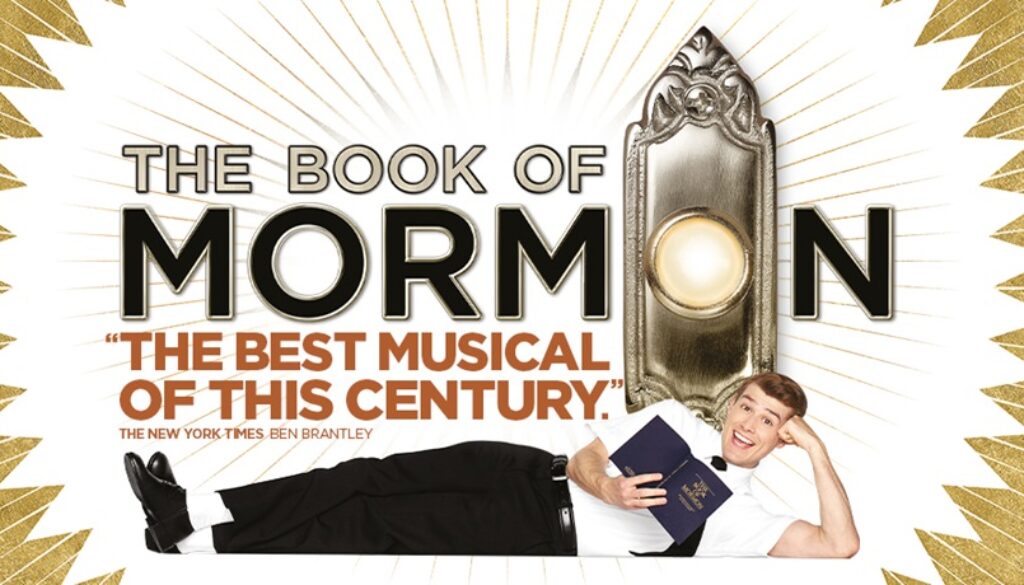
The Book of Mormon is a musical comedy with music, lyrics, and book by Trey Parker, Robert Lopez, and Matt Stone. The story follows two missionaries of the Church of Jesus Christ of Latter-day Saints as they attempt to preach the faith to the inhabitants of a remote Ugandan village — challenged by the locals’ more pressing concerns, including HIV/AIDS, famine, and a terrifying local warlord. Premiering on Broadway in March 2011, it became one of the most commercially and critically celebrated musicals of the 21st century.
A Tale of Faith, Lies & Unlikely Heroes
Act One
At a Missionary Training Center, the devout Elder Kevin Price leads his classmates in a spirited demonstration of door-to-door evangelism. Price is certain that if he prays hard enough, he’ll be sent to Orlando, Florida for his two-year mission. Instead, he and his assigned companion, Elder Arnold Cunningham — an insecure, pop-culture-obsessed compulsive liar — are sent to Uganda.
Upon arriving in northern Uganda, the pair are immediately robbed by soldiers of General Butt Fucking Naked, a local warlord. They are welcomed by Mafala Hatimbi, whose village endures appalling conditions. The villagers cope with a recurring phrase that translates as a defiant curse against God. Price and Cunningham meet fellow missionaries who have been utterly unsuccessful in converting anyone — Elder McKinley, the district leader, teaches them to suppress upsetting thoughts.
Price, confident he can succeed where others have failed, launches into a tribute to Joseph Smith that inevitably becomes a tribute to himself. When the General announces a horrifying demand for the genital mutilation of all female villagers and murders a protester, the reality of their mission hits home. Nabulungi, Mafala’s daughter, dreams of the paradise the missionaries have promised — a new land where all their troubles will end.
Religion itself can do enormous good as long as it is taken metaphorically and not literally.
Shocked by the violence, Price abandons his mission and requests a transfer to Orlando — dumping Cunningham in the process. But when Nabulungi seeks Cunningham out, eager to learn, he finds the courage to step up. Desperate to keep his audience engaged, Cunningham begins inventing stories — blending LDS doctrine with science fiction, fantasy, and pop culture. His conscience, personified by figures including Joseph Smith, Hobbits, Darth Vader, and Yoda, admonishes him — but Cunningham rationalises that if it helps people, it can’t be wrong.
Act Two
Price, meanwhile, dreams he’s arrived in Orlando — only to discover he’s actually in Hell, surrounded by Jesus, Satan, Adolf Hitler, Jeffrey Dahmer, and Johnnie Cochran. He wakes up with renewed resolve and re-commits to his mission. Cunningham’s invented teachings gain traction: the villagers are baptised in a joyful ceremony, and the missionaries celebrate their newfound bond with the people of Uganda.
The mission president arrives to inspect the Ugandan mission. Nabulungi and the villagers perform a pageant celebrating Joseph Smith — faithfully dramatising Cunningham’s wildly distorted stories, including the claim that having sex with a frog can cure AIDS. The mission president is appalled, orders all the missionaries home, and declares the villagers are not members of the Church.
In a moment of revelation, Price realises that Cunningham was right all along: the literal scripture matters less than the message itself. When the General returns to carry out his threats, Price and Cunningham reappear — the villagers, believing Cunningham to have been resurrected from the dead, frighten the General into fleeing. Price rallies the Ugandans and missionaries together to build their own paradise. The show closes with the newly converted Ugandan elders — including the General — going door to door with “The Book of Arnold.”
How a South Park Sketch Became a Broadway Phenomenon
The Book of Mormon was conceived by Trey Parker, Matt Stone, and Robert Lopez — a collaboration born from a chance encounter in 2003. Parker and Stone, best known for South Park, had long carried a fascination with Mormonism rooted in their upbringing in Colorado. They had explored the subject previously in their 1997 film Orgazmo and the 2003 South Park episode “All About Mormons.”
The fateful meeting happened when producer Scott Rudin advised Parker and Stone to see Avenue Q on Broadway. Lopez and co-writer Jeff Marx noticed the duo in the audience and introduced themselves. Over drinks afterwards, both camps discovered they each wanted to write something about Joseph Smith. The four began developing ideas almost immediately, even taking a research road trip to Salt Lake City to interview missionaries and ex-missionaries.
In 2006, Parker and Stone spent three weeks in London with Lopez — who was working on the West End production of Avenue Q — writing “four or five songs” and sketching the basic story. After an argument over creative control, Jeff Marx departed the project. The remaining trio developed what they initially called The Book of Mormon: The Musical of the Church of Jesus Christ of Latter-day Saints, hopping back and forth between Los Angeles and New York for years.
Lopez pushed for a formal workshop process, which was foreign to Parker and Stone. Over the next four years, they ran through half a dozen workshops — from intimate 30-minute performances for friends to large-scale staged readings. Parker and Stone invested hundreds of thousands of their own dollars. At an early workshop, a rudimentary animatic played above the actors, as the creators were still undecided between a stage show and an animated film. The first fully staged reading took place at the Vineyard Theatre in February 2008, after which the decision was made: it would be a live musical.
The Casting Search
Finding the right Elder Price was a long road. The producers cycled through Benjamin Walker, Cheyenne Jackson, and Daniel Reichard before narrowing it to three finalists: T.R. Knight, Nick Lachey, and Andrew Rannells — who ultimately won the part. There was even brief talk of celebrity stunt casting, including Jack Black as Elder Cunningham. Josh Gad, Rory O’Malley, and Nikki James were involved from the earliest stages of development.
Producers Scott Rudin and Anne Garefino originally planned an off-Broadway premiere at the New York Theatre Workshop, but ultimately decided to go straight to Broadway — reasoning that Parker and Stone “work best when the stakes are highest.” Casey Nicholaw came on board as choreographer and co-director. The production came in under budget at $9 million (against an expected $11 million), with 28 actors cast from hundreds of auditions. The producers first watched the finished show just six days before the first paying audience.
Numerous changes occurred between early drafts and the final production. A song called “Family Home Evening” was cut entirely. The warlord was originally named after the real-life Joseph Kony before being renamed. “The Bible Is A Trilogy” was rewritten to become “All-American Prophet,” and “Spooky Mormon Hell Dream” was originally titled “H-E Double Hockey Sticks.”
From Cocktail Napkin to Broadway Legend
Original & Notable Casts
Original Broadway Cast (2011)
| Role | Actor | Notes |
|---|---|---|
| Elder Kevin Price | Andrew Rannells | Won the role after a search that included T.R. Knight and Nick Lachey |
| Elder Arnold Cunningham | Josh Gad | Involved from the earliest workshop stages |
| Nabulungi | Nikki James | Also involved from earliest development |
| Elder McKinley | Rory O’Malley | Present from early workshops |
| Mafala Hatimbi | David Aron Damane | Also played the General in later productions |
| Joseph Smith / Mission President | Lewis Cleale | Still with the show at the 4,000th performance in 2022 |
West End Opening Cast (2013)
| Role | Actor | Notes |
|---|---|---|
| Elder Price | Gavin Creel | Reprised from the First National Tour |
| Elder Cunningham | Jared Gertner | Also reprised from the First National Tour |
Chicago / Second US Tour (2012–13)
| Role | Actor | Notes |
|---|---|---|
| Elder Price | Nic Rouleau | Later played Price on Broadway three times |
| Elder Cunningham | Ben Platt | Later became a major Broadway and film star |
Australian Production (2017)
| Role | Actor | Notes |
|---|---|---|
| Elder Price | Ryan Bondy | Previously toured with the Second US Tour |
| Elder Cunningham | A.J. Holmes | Appeared in multiple productions worldwide |
| Elder McKinley | Rowan Witt | |
| Nabulungi | Zahra Newman | |
| Mafala Hatimbi | Bert Labonté |
Notable Cast Journeys
Nic Rouleau played Elder Price on Broadway, in Chicago, on the Second National Tour, and in the West End — making him one of the most versatile performers in the show’s history, playing the role three separate times on Broadway alone.
Kevin Clay epitomises the climb: joining the Second National Tour ensemble in November 2015, he worked his way up from ensemble to understudy to standby before finally assuming the role of Elder Price in October 2017.
Lewis Cleale, an original Broadway cast member playing Joseph Smith and the Mission President, remained with the show through its 4,000th performance in June 2022 — over eleven years of service.
A Global Comedy Sensation
Over 20 million people have seen The Book of Mormon around the world. The show has been staged in multiple languages and across dozens of cities on every inhabited continent.
The Song List
The score blends parodies of classic Broadway styles with genuinely catchy, original compositions. The cast recording became the fastest-selling Broadway cast album in iTunes history.
- 1Hello!
- 2Two by Two
- 3The Welcome Song† Not on cast album
- 4Hello! (Reprise)† Not on cast album
- 5Hasa Diga Eebowai
- 6Turn It Off
- 7I Am Here for You
- 8All-American ProphetOriginally “The Bible Is A Trilogy”
- 9Sal Tlay Ka Siti
- 10I Am Here for You (Reprise)† Not on cast album
- 11Man Up
- 12Making Things Up Again
- 13Spooky Mormon Hell DreamOriginally “H-E Double Hockey Sticks”
- 14I Believe
- 15Baptize Me
- 16I Am Africa
- 17Turn It Off (Reprise)† Not on cast album
- 18Spooky Mormon Hell Dream (Reprise)† Not on cast album
- 19Orlando
- 20Joseph Smith American Moses
- 21Hasa Diga Eebowai (Reprise)† Not on cast album
- 22You and Me (But Mostly Me) (Reprise)† Not on cast album
- 23Tomorrow Is a Latter DayIncludes Hello! (Reprise) & Encore
The Orchestra
The Book of Mormon uses a compact nine-member orchestra with multi-instrumentalist players covering a wide range of sounds. In the West End and UK Tour productions, the Woodwind part is reduced to Flute, Piccolo, Alto Saxophone, and Clarinet.
The Cast Album
The original Broadway cast recording was released on May 17, 2011, by Ghostlight Records. A free preview of the entire album was streamed on NPR starting May 9, before its official release.
During its first week on the iTunes Store, the recording became the fastest-selling Broadway cast album in iTunes history, reaching No. 2 on the iTunes Top 10 Chart on its day of release. After the show’s triumphant run at the 2011 Tony Awards, the album rapidly ascended the Billboard 200 to number three — making it the highest-charting Broadway cast album in over four decades.
An outstanding album that highlights the wit of the lyrics and the incredible tunefulness of the songs while leaving you desperate to score tickets to see the actual show.
The recording includes all songs performed on stage except for several reprises. “Hello!” (Reprise) and the Encore are appended to the final track, “Tomorrow Is a Latter Day.” In the West End production, additional characters join the offstage chorus on several tracks.
Awards & Recognition
Reviews, Debate & Legacy
The Book of Mormon received sweeping critical praise upon its debut. Vogue declared it possibly the funniest musical ever produced on Broadway. The New York Post reported that audiences were “sore from laughing so hard,” praising the score as tuneful and funny while noting that “the show has heart.” The New York Times compared it favourably to Rodgers and Hammerstein classics, writing that it achieved something close to a miracle by simultaneously satirising and celebrating the Broadway musical form — a feat not seen since Mel Brooks adapted The Producers for the stage.
The Washington Post called it “one of the most joyously acidic bundles Broadway has unwrapped in years,” while the Los Angeles Times praised the songs as “catchy as they are clever.” Not all reviews were glowing — The Wall Street Journal’s Terry Teachout called the score “jingly-jangly,” and a handful of critics dismissed it as derivative. But the commercial and cultural dominance of the show made dissenting voices rare.
Representation & Race
The show’s depiction of Africans drew significant criticism. NPR’s Janice Simpson argued the villagers functioned primarily as “noble savages.” Harvard’s Max Perry Mueller noted the creators had worked to get the Mormon elements right while “completely ignoring the Ugandan culture.” Several critics pointed to a broader anti-Africa bias in how the show’s jokes landed.
In July 2020, following the murder of George Floyd, Black actors from the original and current casts signed a letter to the creative team warning that the show would be “viewed through a new lens” upon its return. The team responded by conducting a two-week workshop in the summer of 2021, revising the script to centre the villagers and give them more agency — a significant evolution in the show’s storytelling.
The Church’s Response
The response of the Church of Jesus Christ of Latter-day Saints was notably measured and, many observers noted, remarkably savvy. The Church’s official statement read: “The production may attempt to entertain audiences for an evening, but the Book of Mormon as a volume of scripture will change people’s lives forever by bringing them closer to Christ.”
Michael Otterson, head of the Church’s Public Affairs, wrote that the real danger was not laughter but people taking the parody literally. The Church went further: throughout the show’s run, it has placed advertisements in Playbill programmes at venues worldwide, with messaging like “you’ve seen the play, now read the book” and “the book is always better.” In Melbourne during the 2017 run, the Church ran TV ads featuring prominent Australian Mormons, including rugby league player Will Hopoate and ballet dancer Jake Mangakahia.
Parker and Stone themselves called the Church’s response their “Q.E.D.” — proof that the musical’s central message, that faith can be a force for good even when its literal beliefs are absurd, had landed exactly as intended. Josh Gad confirmed that during his 1.5 years performing the show, he never received a single complaint from a practising Mormon — and that a handful of audience members told him the musical had actually inspired them to join the faith.
Themes & Meaning
The Book of Mormon contains many religious themes, most notably faith and doubt. Although it satirises organised religion and the literal credibility of the Church of Jesus Christ of Latter-day Saints, the Mormons are portrayed as well-meaning and optimistic — naïve, perhaps, but never cruel. The show’s central argument is that religion does enormous good when taken metaphorically rather than literally. Matt Stone described it as “an atheist’s love letter to religion.” The opening scenes of both acts parody the Hill Cumorah Pageant, a real annual production staged by the Church near its sacred sites in New York.
Box Office & Financial Records
The Book of Mormon set records almost immediately. During its first year, it was consistently among the top five best-selling shows on Broadway and set 22 new weekly sales records for the Eugene O’Neill Theatre. The production employed an innovative dynamic pricing strategy — similar to airline and hotel pricing models — charging as much as $477 for premium seats during high-demand performances.
For the week of Thanksgiving 2011, the average paid admission exceeded $170, even though the highest regular listed price was $155. The show’s financial backers recouped their entire $11.4 million investment in just nine months — an extraordinarily fast return for a Broadway production. To date, the show has grossed over $800 million worldwide, cementing its place as one of the most financially successful musicals in history.
Cast Details
Broadway
Chronological timeline of principal Broadway performers for The Book of Mormon (Broadway, Eugene O’Neill Theatre) across its run from 2011 through recent cast changes.
Elder Kevin Price (lead missionary)
| Period | Actor |
|---|---|
| Mar 24, 2011 – Jun 10, 2012 | Andrew Rannells (originated the role) |
| Nov 2012 – Jan 2014 | Matt Doyle |
| Jan 6, 2015 – Jan 3, 2016 | Gavin Creel |
| Feb 23, 2016 – Feb 18, 2018 | Nic Rouleau (replacement) |
| Nov 24, 2018 – Mar 31, 2019 | Kevin Clay |
| Apr 2019 – Mar 11, 2020 | Dave Thomas Brown |
| Oct 16, 2018 – Nov 2018 | Ryan Bondy (short engagement) |
| Nov 5, 2021 – Present | Kevin Clay (continuing) |
Elder Arnold Cunningham (lead missionary)
| Period | Actor |
|---|---|
| Mar 24, 2011 – ~Jun 2012 | Josh Gad (original) |
| May 28, 2013 – Jan 05, 2014 | Cody Jamison Strand |
| Feb 23, 2016 – Feb 19, 2017 | Christopher John O’Neill |
| Feb 21, 2017 – Feb 18, 2018 | Brian Sears |
| Feb 20, 2018 – Dec 03, 2023 | Cody Jamison Strand (returned) |
| Dec 05, 2023 – Dec 30, 2023 | Noah Marlowe |
| Jan 02, 2024 – Nov 10, 2024 | Cody Jamison Strand |
| Jan 07, 2025 – Oct 26, 2025 | Cody Jamison Strand |
| Oct 28, 2025 – Present | Diego Enrico (Broadway debut as Cunningham) |
Nabulungi (female lead)
| Period | Actor |
|---|---|
| Mar 24, 2011 – ? | Nikki M. James (originated) |
| Jun 12, 2012 – Jul 21, 2012 | Samantha Marie Ware (replacement) |
| Jan 07, 2014 – Jun 22, 2014 | Syesha Mercado |
| Nov 08, 2016 – Sep 10, 2017 | Kim Exum |
| Aug 21, 2018 – Oct 06, 2024 | (Unnamed performer covering) |
| Oct 08, 2024 – Oct 26, 2025 | Keziah John-Paul |
| Oct 28, 2025 – Present | Sydney Quildon |
Elder McKinley (supporting missionary)
| Period | Actor |
|---|---|
| Mar 24, 2011 – ? | Rory O’Malley (original) |
| Circa Aug 2014 – Aug 21, 2016 | Grey Henson |
| Aug 23, 2016 – Aug 11, 2019 | Stephen Ashfield |
| Oct 08, 2019 – ? | Stephen Ashfield (continuing) |
| Oct 28, 2025 – Present | Charlie Franklin |
Mafala Hatimbi (Ugandan village leader)
| Period | Actor |
|---|---|
| Mar 24, 2011 – ? | Michael Potts (original) |
| Mar 26, 2013 – ? | Stanley Wayne Mathis |
| Feb 21, 2017 – ? | Billy Eugene Jones |
| Mar 15, 2022 – Present | Jacques C. Smith |
Other Recurring / Rotating Principal Roles
These principal supporting roles have also been filled by notable performers over the Broadway run:
General – Brian Tyree Henry (original), then David Aron Damane, others
Joseph Smith / Mission President / Price’s Dad / MTC Voice – Lewis Cleale (original and long-serving), later Jay Wilkison (from Oct 28, 2025)
Summary: Major Broadway Performers by Role
| Role | 2011–2015 | 2015–2020 | 2020–2025 | 2025–Present |
|---|---|---|---|---|
| Elder Price | Andrew Rannells, Matt Doyle | Gavin Creel, Nic Rouleau | Kevin Clay, Dave Thomas Brown | Kevin Clay |
| Elder Cunningham | Josh Gad, Cody Jamison Strand | Christopher J. O’Neill, Brian Sears | Cody Jamison Strand, Noah Marlowe | Diego Enrico |
| Nabulungi | Nikki M. James, Samantha Ware | Syesha Mercado, Kim Exum | (Various) | Sydney Quildon |
| Elder McKinley | Rory O’Malley | Grey Henson, Stephen Ashfield | Stephen Ashfield | Charlie Franklin |
| Mafala Hatimbi | Michael Potts | Stanley Wayne Mathis | Billy Eugene Jones | Jacques C. Smith |
| Joseph Smith / Mission President |
West End
Chronological overview of the principal (main) characters and notable actors from the London / West End run of The Book of Mormon, which opened at the Prince of Wales Theatre in February 2013 and has run continuously since.
West End – Principal Cast Timeline
Elder Kevin Price
Gavin Creel – Original West End cast (2013–2014)
Dominic Andersen – mid-2010s
Blair Gibson – long-running West End tenure
Conner Peirson – later West End / recent years
Elder Arnold Cunningham
Jared Gertner – Original West End cast
Cody Jamison Strand – transferred from Broadway, major West End run
Ross Harmon – later West End company
Nabulungi
Alexia Khadime – Original West End cast
Jade Ewen – mid-run replacement
Shan Ako – later West End
Faith Omole – recent West End years
Elder McKinley
Stephen Ashfield – Original West End cast
Tom Xander – later long-running West End performer
Mafala Hatimbi
Chris Jarman – Original West End cast
Wilton Max Roney – later West End
Joel Montague – recent West End company
Joseph Smith / Mission President / Price’s Dad
Stephen Ashfield – original West End track
Lewis Cleale – later joined West End, long-running in the role
| haracter | Notable West End Actors |
|---|
| Elder Price | Gavin Creel, Dominic Andersen, Blair Gibson, Conner Peirson |
| Elder Cunningham | Jared Gertner, Cody Jamison Strand, Ross Harmon |
| Nabulungi | Alexia Khadime, Jade Ewen, Shan Ako, Faith Omole |
| Elder McKinley | Stephen Ashfield, Tom Xander |
| Mafala Hatimbi | Chris Jarman, Wilton Max Roney, Joel Montague |
| Joseph Smith / Mission President | Stephen Ashfield, Lewis Cleale |