Chess Musical: Complete Guide to ABBA & Tim Rice’s Masterpiece
Memorabilia Available Here
A Cold War Musical Epic
CHESS
MUSIC BY BENNY ANDERSSON & BJÖRN ULVAEUS OF ABBA • LYRICS BY TIM RICE
The Game Begins
Chess is a musical with music by Benny Andersson and Björn Ulvaeus of the pop group ABBA, lyrics by Ulvaeus and Tim Rice, and book by Rice. The story involves a politically charged, Cold War-era chess tournament between two grandmasters, one American and the other Soviet, and their fight over a woman who manages one and falls in love with the other.
Although the protagonists were not intended to represent any real individuals, the character of the American grandmaster was loosely based on Bobby Fischer, while elements of the story may have been inspired by the chess careers of Russian grandmasters Viktor Korchnoi and Anatoly Karpov.
Chess allegorically reflected the Cold War tensions present in the 1980s. Released and staged at the height of the strong anti-communist agenda that came to be known as the “Reagan Doctrine,” Chess addressed and satirized the hostility of the international political atmosphere of the 1980s.
As with other productions such as Jesus Christ Superstar and Evita, a highly successful concept album was released prior to the first theatrical production in order to raise money. In the case of Chess, the concept album was released in late 1984 while the show opened in 1986 in London’s West End, where it played for three years.
A much-altered US version premiered on Broadway in 1988 but survived only for two months. Chess is frequently revised for new productions, many of which try to merge elements from both the British and American versions, but was not revived in the West End until 2018.
Chess placed seventh in a BBC Radio 2 listener poll of the UK’s “Number One Essential Musicals.”
Genesis: Creating the Musical
Tim Rice’s Cold War Vision
Tim Rice, a lyricist and librettist best known for musicals such as Jesus Christ Superstar and Evita, had long wanted to write a musical about the Cold War. During the mid-1970s, he had discussed the idea of a musical about the Cuban Missile Crisis with his usual collaborator, composer Andrew Lloyd Webber, but the idea never came to fruition.
The Match of the Century
By the late 1970s, Rice had become inspired to tell his Cold War story through the prism of the long-standing United States-Soviet Union chess rivalry; he had earlier been fascinated by the political machinations of the 1972 “Match of the Century” between Bobby Fischer and Boris Spassky.
However, by the time Rice wanted to begin work on the musical in early 1979, Lloyd Webber was unavailable, as he was already at work on his next musical, Cats.
Enter ABBA
Subsequently, American producer Richard Vos suggested to Rice to work with Andersson and Ulvaeus instead, knowing that they were looking to develop and produce projects outside of ABBA. An ardent fan of the group, Rice agreed. He later wrote that he felt no reservations because “there is a sense of theatre in the ABBA style”.
With Vos also in attendance, Rice met with the two in Stockholm for the first time on 15 December 1981 in order to discuss the concept, and they quickly signed on to the project.
The Collaborative Process
All through 1982 and 1983, the three men worked on the music and lyrics. Rice would describe the mood of particular songs he wanted, then Andersson and Ulvaeus would write and record the music and send the tapes to Rice, who would then write lyrics to fit the music, and send the resulting tapes back to Andersson and Ulvaeus and so on.
ABBA DNA in Chess
Some of the songs on the resulting album contained elements of music Andersson and Ulvaeus had previously written for ABBA. For example:
- The chorus of “I Know Him So Well” was based on the chorus of “I Am An A”, a song from their 1977 tour
- The chorus of “Anthem” used the chord structures from the guitar solo from their 1980 ABBA song “Our Last Summer”
- “Heaven Help My Heart” was recorded with an entire set of lyrics, sung by ABBA’s Agnetha Fältskog with the title “Every Good Man”
The “One Night in Bangkok” Story
Ulvaeus would also provide dummy lyrics to emphasise the rhythmic patterns of the music, and since Rice found a number of these “embarrassingly good” as they were, incorporated a few in the final version. The most well known example is “One night in Bangkok makes a hard man humble”.
The Concept Album (1984)
Partly to raise money in order to produce the show in the West End and partly to see how the material would fare with the public, it was decided to release the music as an album before any stage productions were undertaken, a strategy that had proven successful with Rice’s two previous musicals, Jesus Christ Superstar and Evita.
Recording Process
Recording on the album musical of Chess began in Stockholm in early November 1983, with Andersson recording the many layered keyboard parts himself along with other basic work at their usual Polar Studios, and choral and orchestral work then recorded in London by The Ambrosian Singers along with the London Symphony Orchestra. The album was then sound-engineered and mixed back at Polar by longtime ABBA sound engineer Michael B. Tretow.
The Double LP Release
The double LP, often referred to as a concept album or album musical, was released worldwide in the autumn of 1984 by RCA Records. Liner notes included with the album featured a basic synopsis of the story in multiple languages along with song lyrics and numerous photos.
The music on the album was described by The New York Times as “a sumptuously recorded… grandiose pastiche that touches half a dozen bases, from Gilbert and Sullivan to late Rodgers and Hammerstein, from Italian opera to trendy synthesizer-based pop, all of it lavishly arranged for the London Symphony Orchestra with splashy electronic embellishments”.
Original Cast
| Role | Actor/Singer |
|---|---|
| The American | Murray Head |
| The Russian | Tommy Körberg |
| Florence | Elaine Paige |
| Molokov | Denis Quilley |
| The Arbiter | Björn Skifs |
| Svetlana | Barbara Dickson |
Chart Success
“One Night in Bangkok” & “I Know Him So Well”
A single from the album, “One Night in Bangkok”, with verses performed by Murray Head and choruses performed by Anders Glenmark, became a worldwide smash, reaching #3 on the US Billboard Hot 100.
The duet “I Know Him So Well” by Elaine Paige and Barbara Dickson held the #1 spot on the UK singles charts for four weeks, winning the Ivor Novello Award in the process as the Best Selling Single (‘A’ Side).
The album became a Top 10 hit in the UK, West Germany and South Africa, reached #47 on the US Billboard 200, and for seven weeks remained at #1 on the Swedish album chart due in no small part to the composers’ Swedish heritage.
Critical Acclaim
The original concept album received critical accolades, with Rolling Stone raving that the “dazzling score covers nearly all the pop bases”, Kurt Ganzl’s Blackwell Guide to the Musical Theatre on Record telling readers about the “thrilling exposition of an exciting piece of modern musical theater occurring before the event” and Time declaring that the “rock-symphonic synthesis [was] ripe with sophistication and hummable tunes”.
West End Premiere (1986-1989)
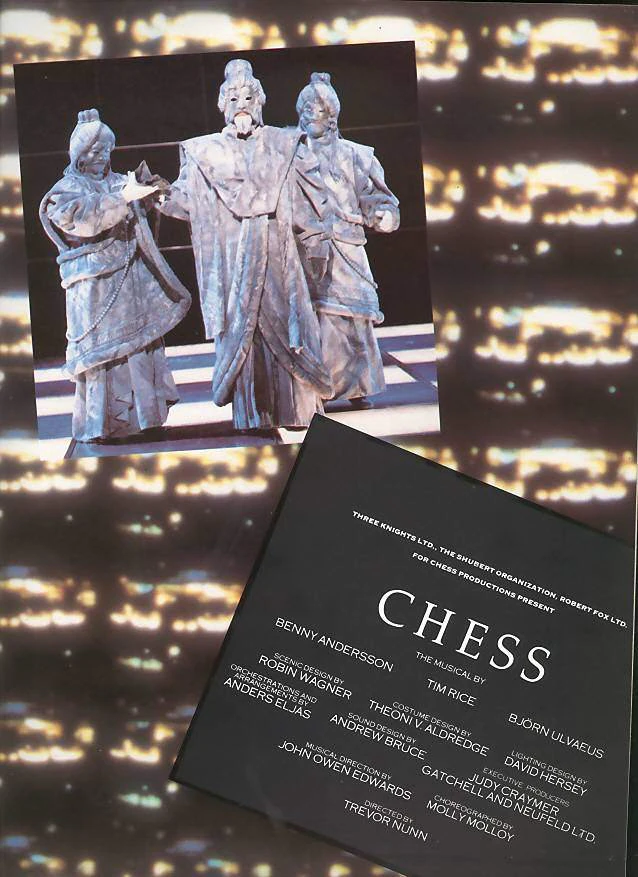
Chess premiered in London’s West End on 14 May 1986 at the Prince Edward Theatre. The original production was originally set to be directed by Michael Bennett, but after casting the show and commissioning the expansive set and costume designs, he withdrew from the project for health reasons and died on 2 July 1987 from AIDS-related lymphoma.
Trevor Nunn Takes Over
Trevor Nunn, who had directed the musicals Cats and Les Misérables, took over as director. Set designer Robin Wagner later told Lynn Pecktal that Bennett had planned a “multimedia” show, with an elaborate tilting floor, banks of television monitors, and other technological touches.
Nunn applied his realistic style to the show instead, although the basics of the mammoth set design were still present in the final production. These included three video walls, the main of which featured commentary from chess master William Hartston, and appearances from various BBC newsreaders. Costs were estimated at up to $12 million.
The London Version
The London version expanded the storyline of the concept album, adding considerable new recitative. The three principal singers from the concept album, Elaine Paige, Tommy Körberg and Murray Head reprised their roles on stage.
Barbara Dickson was unable to appear, and Siobhán McCarthy played the part of Svetlana, and the cast also featured Anthony Head, Grainne Renihan, Ria Jones, David Burt and Peter Karrie, during its three-year run.
Awards & Success
The show won the Critics’ Circle Theatre Award for Best Musical and received three 1986 Laurence Olivier Award nominations for Best Musical, Outstanding Performance by an Actor (Tommy Körberg) and Outstanding Performance by an Actress (Elaine Paige).
The production closed on 8 April 1989 after three years and over 1,000 performances.
Critical Reception
The premiere of the musical provoked an overall mixed to favourable verdict from the critics. Most of the naysaying notices had comments ranging from “far too long” and “shallow, improbable story masquerading as a serious musical” to The Guardian’s conclusion that, “A musical is only as good as its book, and here one is confronted by an inchoate mess.”
Other newspapers posted rave reviews however. The Daily Telegraph wrote that the show was “gift-wrapped and gorgeous…compels admiration”, The Times noted that “it turns out to be a fine piece of work that shows the dinosaur mega-musical evolving into an intelligent form of life”.
The British Version Plot
Act One: Merano, Italy
The president of the International Chess Federation—the Arbiter—speculates on the origins of the game of chess before announcing the location of the upcoming world chess championship: Merano, Italy. As the townsfolk prepare for the occasion, the current world champion, Freddie Trumper of the United States, arrives with his second and presumed lover: Hungarian-born, English-raised Florence Vassy.
Freddie’s Outburst
Florence confronts Freddie about his brash behavior and rocky relationship with the press, which immediately gets out of hand when he assaults a journalist who questions his relationship with Florence. Meanwhile, Freddie’s Soviet Russian challenger, Anatoly Sergievsky, argues with his own second, the scheming Molokov.
During the increasingly intense match, Freddie suddenly throws the chessboard to the floor and storms out of the arena, leaving Florence to negotiate with Anatoly, Molokov, and the Arbiter. It turns out that Freddie engineered the outburst in the hopes of extracting more money from his sponsor, Global Television.
Florence later scolds Freddie, and they fight about the politics of the tournament until he viciously turns the argument toward her missing father, believed captured or killed by Soviet forces during the 1956 Hungarian Revolution. She laments the situation alone (“Nobody’s Side”) before heading off to the Merano Mountain Inn for a reconciliatory meeting between Freddie and Anatoly.
Freddie does not immediately turn up, leaving Anatoly and Florence awkwardly alone together; however, they eventually embrace as romantic feelings arise before being finally interrupted by Freddie (“Mountain Duet”).
Freddie’s Collapse
The chess match proceeds. Distracted by the loss of Florence’s love, however, Freddie flounders, leaving himself just one more loss away from losing his title. Due to Freddie’s atrocious attitude, Florence finally deserts him, whereby Freddie ponders how his unhappy childhood left him the man he is today (“Pity the Child”).
He sends the Arbiter a letter of resignation, resulting in Anatoly becoming the new world champion. Anatoly immediately defects from the Soviet Union and seeks asylum at the British embassy. When the mob of reporters ambush Anatoly and ask why he is deserting his country, he tells them that he will never truly leave his homeland (“Anthem”).
Act Two: Bangkok, Thailand
A year later, Anatoly is set to defend his championship in Bangkok, Thailand. Freddie is already there, chatting up locals and experiencing the Bangkok nightlife (“One Night in Bangkok”); he is Global TV’s official commentator for the match.
Florence and Anatoly are now openly lovers, and worry about Freddie’s sudden reappearance as well as the impending arrival of Anatoly’s estranged wife, Svetlana, from Russia, which Anatoly suspects is part of Molokov’s plan to shame him into returning to the Soviet Union. Molokov, meanwhile, has trained a new protégé, Leonid Viigand, to challenge, defeat, and humiliate Anatoly.
Manipulation and Blackmail
Walter, now Freddie’s boss, manipulates Freddie into embarrassing Anatoly on live TV. Molokov blackmails Svetlana into urging Anatoly to throw the match. Walter, who has been promised the release of certain captured American agents if he can ruin Anatoly’s performance, informs Florence that her father is still alive though imprisoned, and that he too will be released if she can convince Anatoly to lose.
Despite Molokov and Walter’s efforts, none of their ploys work to get Anatoly to throw the game.
Surprisingly, Svetlana and Florence end up bonding over their respective relationships with Anatoly. Florence ultimately admits that it would be best for Anatoly to return to his children and Svetlana, while Svetlana accepts that Anatoly has long fallen out of love with her (“I Know Him So Well”).
Anatoly, meanwhile, follows an anonymous letter guiding him to Wat Pho, where Freddie appears to tell him that he is willing to put their conflict behind him. Having decided that he only wants Anatoly to “be true to the game”, Freddie informs Anatoly of a significant flaw in Viigand’s strategy that will help Anatoly win.
The Ending
In the deciding game of the match, with the score tied at five games all, Anatoly achieves a superb victory against Viigand. Later, Florence confesses her feelings that he should return to his family in the Soviet Union. The pair reflects on the conclusion of their romance (“You and I: Reprise”).
Walter later approaches Florence with the news that Anatoly has defected back to the USSR, meaning that her father will certainly be released. He startlingly admits, however, that no one actually knows if her father is still alive. Florence breaks down, realising that she too has been used, and she sadly mirrors Anatoly’s earlier sentiment that her only borders lie around her heart (“Anthem: Reprise”).
Principal Characters
Broadway Production (1988)
After the West End production, the creative team decided to reimagine the show from the top down, leading to a second major stage version of the musical intended for American audiences, with considerable differences from the British version in both plot and music.
A Complete Reimagining
Trevor Nunn brought in playwright Richard Nelson to recreate the musical as a straightforward “book show” for Broadway audiences. Nunn brought in new, younger principals after he disqualified Paige from the role of Florence by insisting Nelson recreate the character as an American.
The story changed drastically, with different settings, characters, and many different plot elements, although the basic plot remained the same. Benny Andersson told Variety: “The main difference between London and here is that in London there is only about two or three minutes of spoken dialog. Here, in order to clarify some points, it is almost one-third dialog”.
American Version Differences
The musical’s American incarnation has noticeably different settings, lyrics, song orders, and a completely different Act 2 from the British version. In particular, in the American Chess the entire show is about one chess match, not two. Act 1 involves the first part of the match, which is held in Bangkok, Thailand, while Act 2 handles the conclusion, and is set in Budapest, Hungary.
Also, the incumbent champion is switched in the American version (that is, to Anatoly Sergievsky rather than Freddie Trumper) as is the winner of the Sergievsky–Trumper tournament.
Opening Night Drama
The first preview on 11 April 1988 ran 4 hours with a 90-minute intermission (the stage crew reportedly had problems with the sets); by opening night on 28 April, it was down to 3 hours 15 minutes.
But despite a healthy box-office advance, the Broadway production did not manage to sustain a consistently large audience and closed on 25 June, after 17 previews and 68 regular performances.
Critical Response
Many critics panned the show, most notably Frank Rich of The New York Times, who wrote that “the evening has the theatrical consistency of quicksand” and described it as “a suite of temper tantrums, [where] the characters … yell at one another to rock music”.
A few reviewers, however, praised it highly. William A. Henry III wrote an exceptionally sympathetic review in Time: “Clear narrative drive, Nunn’s cinematic staging, three superb leading performances by actors willing to be complex and unlikeable and one of the best rock scores ever produced in the theater. This is an angry, difficult, demanding and rewarding show, one that pushes the boundaries of the form”.
The Three Leading Performances
All critics agreed on the three leading performances by Judy Kuhn, David Carroll and Philip Casnoff. They were showered with praise – “splendid and gallant” (Newsweek), “powerful singers” (The New York Times), “remarkably fine” (New York Post) – especially Kuhn, whose performance Variety called a “show’s chief pleasure”.
Awards & Nominations
The Broadway production was nominated for several major awards. It got five nods from the Drama Desk Awards and Tony Award nominations for Leading Actor and Leading Actress in a Musical. Philip Casnoff received a 1988 Theatre World Award for Best Debut Performance.
The Original Broadway Cast recording of the musical was nominated for the 1988 Grammy Award in the category Best Musical Cast Show Album (won by Into the Woods).
Notable Productions Through the Years
Directed by Jim Sharman at the Theatre Royal. A critical and popular success using a new version of the book rewritten primarily by Rice. Starred Jodie Gillies, David McLeod, and Robbie Krupski.
Swedish-language version with lyrics and book by Björn Ulvaeus. Streamlined story to original form. Starred Tommy Körberg, Helen Sjöholm, and Josefin Nilsson. Won six national Swedish Theatre Awards.
New Amsterdam Theater. Combined both American and British versions. Cast included Adam Pascal, Julia Murney, 22-year-old Josh Groban, Norm Lewis, and Sutton Foster.
Two-performance concert version with City of London Philharmonic Orchestra. Tim Rice stated this was the “official version”. Cast: Adam Pascal, Idina Menzel, Josh Groban, Kerry Ellis. Released as 2-CD album and DVD.
First West End revival in 30 years. Directed by Laurence Connor. Cast: Michael Ball (Anatoly), Alexandra Burke (Svetlana), Tim Howar (Freddie), Cassidy Janson (Florence).
First Russian production. Lyrics translated by Aleksei Ivaschenko. Ran for over 600 performances, making it the second-longest running professional production after only the original London production.
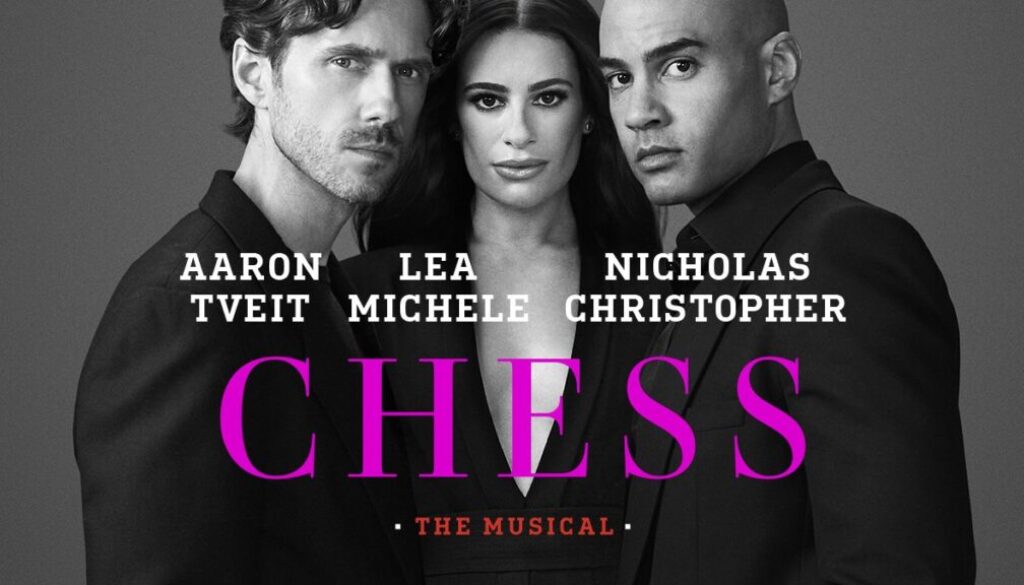
New book by Danny Strong, directed by Michael Mayer. Starring Aaron Tveit (Freddie), Lea Michele (Florence), and Nicholas Christopher (Anatoly). Began previews October 15, 2025.
The Iconic Score
The Hit Singles
“One Night in Bangkok”
The show’s most famous song, performed by Murray Head on the concept album and in most stage productions. A funky, electronic number about the nightlife of Bangkok with the memorable lyric “One night in Bangkok makes a hard man humble.” Reached #3 on the US Billboard Hot 100 in 1985.
The song has been covered countless times and remains a pop culture touchstone, regularly featured in films, TV shows, and sporting events.
“I Know Him So Well”
A duet between Florence and Svetlana about their complicated feelings for Anatoly. Originally performed by Elaine Paige and Barbara Dickson, it became a #1 hit in the UK for four weeks and won the Ivor Novello Award.
The song is one of the most beloved duets in musical theatre, exploring the bittersweet understanding between two women who love the same man.
Other Notable Songs
- “Anthem” — Anatoly’s powerful declaration of his love for his homeland despite defecting. One of the most stirring songs in the score.
- “Nobody’s Side” — Florence’s solo about refusing to be a pawn in anyone’s game, declaring her independence.
- “Pity the Child” — Freddie’s emotional breakdown about his troubled childhood and how it shaped him.
- “Heaven Help My Heart” — Florence’s ballad about falling in love with Anatoly despite knowing the complications.
- “Someone Else’s Story” — Added in the American version, a powerful ballad about feeling like a supporting character in your own life.
- “You and I” — The romantic duet between Anatoly and Florence.
- “Mountain Duet” / “Terrace Duet” — The moment Florence and Anatoly first connect romantically.
Legacy & Impact
A Troubled Masterpiece
In 2001, in an interview with the San Francisco Chronicle, Tim Rice admitted that after the “comparative failure of Chess, his all-time favourite, he became disillusioned with theatre.” The musical has developed a cult following based primarily on the score, while Nelson’s book received more mixed notices.
The Endless Revisions
Chess is frequently revised for new productions, many of which try to merge elements from both the British and American versions. No two productions are quite the same, as directors, producers, and the creative team continue to search for the “perfect” version of the show.
Later, the musical developed a cult following based primarily on the score, with Frank Rich noting in his book Hot Seat that “the score retains its devoted fans.”
Cold War Metaphor
Chess allegorically reflected the Cold War tensions present in the 1980s. Released and staged at the height of the Reagan Doctrine, Chess addressed and satirized the hostility of the international political atmosphere. Once the Soviet Union fell, the modernization attempts died out, though the themes of manipulation, loyalty, and personal sacrifice remain timeless.
Global Impact
Despite its troubled theatrical history, Chess has been produced worldwide in numerous languages and versions:
- Swedish — Chess på Svenska (2002, 2012)
- Danish — Danish tour (2001, 2025)
- German — Staatsoperette Dresden (2008-2010)
- Italian — First official production (2009-2011)
- Hungarian — Budapest revival (2010)
- Estonian — Vanemuine Theatre (2006)
- Korean — Production with k-pop stars (2015)
- Russian — Moscow MDM Theatre (2020-2022)
- Norwegian — Oslo Folkteateret (2022)
- Japanese — Tokyo/Osaka (2020)
BBC Radio 2 Poll
Chess placed seventh in a BBC Radio 2 listener poll of the UK’s “Number One Essential Musicals” — a testament to its enduring popularity despite its complicated production history.
Film Adaptation Dreams
Tim Rice has always expressed his desire of adapting Chess for the big screen. In 2003, Kylie Minogue was in talks to play one of the two female parts, with Jude Law and Brendan Gleeson discussed as male leads.
On 10 January 2022, Rice stated that in addition to a possible Broadway revival happening soon, he hopes for a film adaptation to follow suit, in part bolstered by the recent success of the chess-focused Netflix miniseries The Queen’s Gambit.
The Score Lives On
Whatever the theatrical challenges Chess has faced, the score by Andersson and Ulvaeus remains one of the most sophisticated and complex in musical theatre. The music blends rock, pop, electronic synthesizers, classical orchestration, and operatic vocals into something wholly unique.
From the electronic funk of “One Night in Bangkok” to the soaring balladry of “Anthem” to the heartbreaking intimacy of “I Know Him So Well,” the Chess score showcases ABBA’s theatrical ambitions beyond their pop roots.
The concept album remains a landmark recording, and productions around the world continue to introduce new audiences to this Cold War epic about love, loyalty, and the ultimate game of strategy.
Checkmate
THE GAME CONTINUES
From the 1984 concept album to the 2025 Broadway revival, Chess has proven to be one of musical theatre’s most enduring and fascinating works. Its troubled production history — West End triumph, Broadway failure, countless revisions — mirrors the complexity of its plot: there are no easy answers, no simple victories, only the endless game.
The Cold War may be over, but the themes of Chess remain relevant: manipulation by powerful forces, the personal cost of political games, the struggle between love and duty, and the question of where true loyalty lies.
One night in Bangkok. A mountain duet in Merano. A final game in Budapest.
The players change. The board resets. But the game — the beautiful, maddening, impossible game — goes on.
Your move.