Chicago Musical: Complete History & Broadway Guide
Memorabilia Available Here
Chicago
A Musical Vaudeville
Broadway Phenomenon
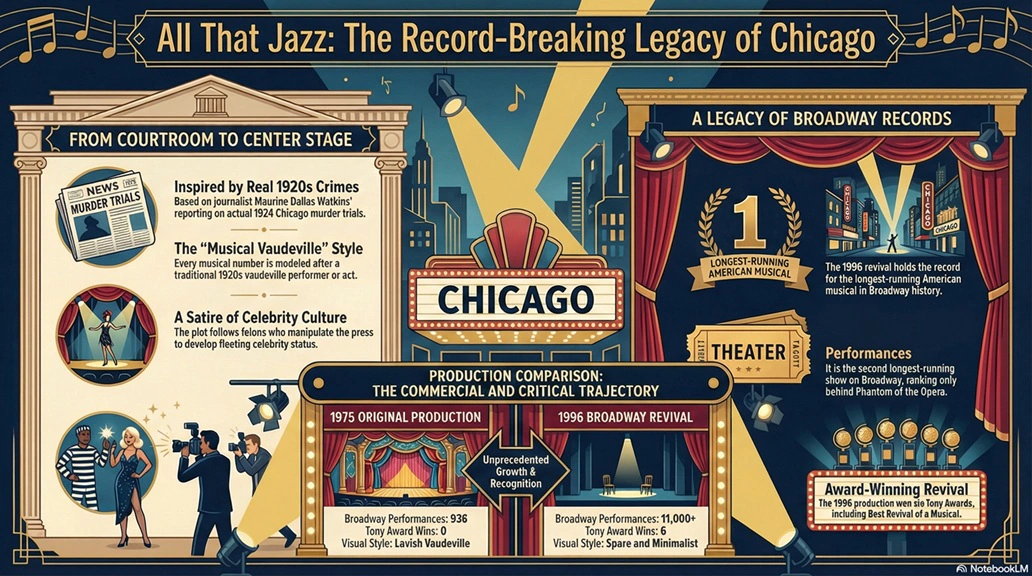
The 1996 Broadway revival holds the record as the longest-running musical revival and the longest-running American musical in Broadway history. It is the second longest-running show ever to run on Broadway, behind only The Phantom of the Opera. Chicago surpassed Cats on November 23, 2014, when it played its 7,486th performance. The ongoing 1996 revival is the longest-running show currently on Broadway.
Historical Background
The True Crimes Behind the Story
The musical Chicago is based on a play of the same name by reporter and playwright Maurine Dallas Watkins, who was assigned to cover the 1924 trials of accused murderers Beulah Annan and Belva Gaertner for the Chicago Tribune. In the early 1920s, Chicago’s press and public became riveted by the subject of homicides committed by women. Several high-profile cases arose, which generally involved women killing their lovers or husbands.
The Real Roxie Hart
Annan, the model for the character of Roxie Hart, was 23 when she was accused of the April 3, 1924 murder of Harry Kalstedt, who served as the basis for the Fred Casely character. The Tribune reported that Annan played the foxtrot record “Hula Lou” over and over for two hours before calling her husband to say she killed a man who “tried to make love to her”. Her husband Albert Annan inspired the character Amos Hart. Albert was an auto mechanic who bankrupted himself to defend his wife, only for her to publicly dump him the day after she was acquitted.
The Real Velma Kelly
Velma Kelly is based on Gaertner, who was a cabaret singer and society divorcée. The body of Walter Law was discovered slumped over the steering wheel of Gaertner’s abandoned car on March 12, 1924. Two police officers testified that they had seen a woman getting into the car and shortly thereafter heard gunshots. A bottle of gin and an automatic pistol were found on the floor of the car. Just days apart, separate juries at the Criminal Courts building acquitted both women.
Celebrity Criminal Culture
These cases were tried against a backdrop of changing views of women in the Jazz Age, and a long string of acquittals by Cook County juries of female murderers (juries at the time were all male, and convicted murderers generally faced death by hanging). A lore arose that, in Chicago, feminine or attractive women could not be convicted. Regardless of stance, the press covered several of these women as celebrities.
From Play to Musical
Watkins’ sensational columns documenting these trials proved so popular that she wrote a play based on them. The show received both good box-office sales and newspaper notices and was mounted on Broadway in 1926, running 172 performances. Cecil B. DeMille produced a silent film version, Chicago (1927), starring Phyllis Haver as Roxie Hart. It was later remade as Roxie Hart (1942) starring Ginger Rogers.
In the 1960s, Gwen Verdon read the play and asked her husband, Bob Fosse, about the possibility of creating a musical adaptation. Fosse approached playwright Watkins numerous times to buy the rights, but she repeatedly declined. Nonetheless, upon her death in 1969, her estate sold the rights to producer Richard Fryer, Verdon, and Fosse. John Kander and Fred Ebb began work on the musical score, modeling each number on a traditional vaudeville number or a vaudeville performer.
Plot Synopsis
Act I
All That Jazz
Velma Kelly is a vaudevillian who welcomes the audience to tonight’s show. Interplayed with the opening number, the scene cuts to February 14, 1928, in the bedroom of chorus girl Roxie Hart, where she murders Fred Casely as he attempts to break off an affair with her.
Roxie convinces her husband Amos that the victim was a burglar, and Amos agrees to take the blame. Roxie expresses her appreciation of her husband’s willingness to do anything for her (“Funny Honey”). However, when the police mention the deceased’s name, Amos belatedly realizes that Roxie has lied to him. With both Roxie and Amos furious at each other, Roxie confesses and is arrested.
She is sent to the women’s block in the Cook County Jail, where several women accused of killing their lovers are held (“Cell Block Tango”); among the inmates is Velma Kelly, revealing herself to have been involved in the death of her husband and sister after she caught them having sex. The block is presided over by Matron “Mama” Morton, whose system of taking bribes (“When You’re Good to Mama”) perfectly suits her clientele.
Enter Billy Flynn
Velma is not happy to see Roxie, who is stealing not only her limelight but also her lawyer, Billy Flynn. Roxie convinces Amos to pay for Billy Flynn to be her lawyer (“A Tap Dance”), though Amos lacks the funds. Eagerly awaited by his all-woman clientele, Billy sings his anthem, complete with a chorus of fan dancers (“All I Care About”). Billy takes Roxie’s case and turns it into a media circus, hoping to raise funds by auctioning off Roxie’s belongings at inflated prices.
Roxie’s press conference turns into a ventriloquist act, with Billy dictating a new version of the truth (“We Both Reached for the Gun”) to the reporters while Roxie mouths the words. Roxie becomes the most popular celebrity in Chicago, as she boastfully proclaims while planning for her future career in vaudeville (“Roxie”).
As Roxie’s fame grows, Velma’s notoriety subsides, and in an act of desperation she tries to talk Roxie into recreating the sister act (“I Can’t Do It Alone”). Roxie turns her down, only to find her own headlines replaced by the latest sordid crime of passion. Separately, Roxie and Velma realize there is no one they can count on but themselves (“My Own Best Friend”), and Roxie decides that being pregnant in prison would put her back on the front page.
Act II
Velma returns to introduce the opening act, resentful of Roxie’s manipulation of the system (“I Know a Girl”) and ability to seduce a doctor into saying Roxie is pregnant; as Roxie emerges, she sings gleefully of the future of her unborn (nonexistent) child (“Me and My Baby”). Amos proudly claims paternity, but still, nobody notices him (“Mister Cellophane”).
The Trial
Roxie, upset with being treated like a “common criminal” and considering herself a celebrity, has a heated argument with Billy and fires him. At that moment, Roxie witnesses one of her fellow inmates, a Hungarian woman who insisted on her innocence but could not speak English, become the first woman to be executed in Chicago in decades. The trial date arrives, and the now freshly terrified Roxie runs back to Billy, who calms her by suggesting she will be fine so long as she makes a show of the trial (“Razzle Dazzle”).
Billy uses Amos as a pawn, turning around and insisting that Amos is actually the father of Roxie’s child. As Roxie recounts Billy’s carefully crafted false narrative of the night of Fred’s murder, she steals all of Velma’s schtick, down to the rhinestone garter (“Class”). As promised, Billy gets Roxie acquitted, but just as the verdict is announced, some even more sensational crime pulls the press away, and Roxie’s fleeting celebrity life is over.
Finale: Nowadays
The final scene cuts to a Chicago vaudeville theater, where Roxie and Velma (acquitted off-stage) are performing a new act in which they sing bittersweetly about modern life (“Nowadays”). The former Mary Sunshine, revealed during the trial actually to be a man in drag, takes his natural male form as a pushy vaudeville promoter, shaping Roxie and Velma’s dance (“Hot Honey Rag”) to make it as sexy as possible. The show ends with a brief finale as Roxie and Velma thank their audience.
Musical Numbers
Act I
- Overture – Orchestra
- All That Jazz – Velma and Company
- Funny Honey – Roxie
- Cell Block Tango – Velma and the Girls
- When You’re Good to Mama – Matron Mama Morton
- A Tap Dance – Roxie and Amos
- All I Care About – Billy Flynn and Girls
- A Little Bit of Good – Mary Sunshine
- We Both Reached for the Gun – Billy, Roxie, Mary Sunshine, and Company
- Roxie – Roxie and Boys
- I Can’t Do It Alone – Velma
- My Own Best Friend – Roxie and Velma
Act II
- Entr’acte – Orchestra
- I Know a Girl – Velma
- Me and My Baby – Roxie and Boys
- Mister Cellophane – Amos
- When Velma Takes the Stand – Velma and Boys
- Razzle Dazzle – Billy and Company
- Class – Velma and Mama Morton
- Nowadays – Roxie and Velma
- Hot Honey Rag – Roxie and Velma
- Finale – Company
Original Broadway Production (1975-1977)
The Bob Fosse Era
Chicago: A Musical Vaudeville opened on June 3, 1975 at the 46th Street Theatre, and ran for a total of 936 performances, closing on August 27, 1977. Fosse directed and choreographed the original production, and his style is strongly identified with the show. The opening night cast starred Chita Rivera as Velma Kelly, Gwen Verdon as Roxie Hart, Jerry Orbach as Billy Flynn, and Barney Martin as Amos Hart.
Mixed Reception
The musical received mixed reviews. The Brechtian style of the show, which frequently dropped the fourth wall, made audiences uncomfortable. The show opened the same year as Michael Bennett’s highly successful A Chorus Line, which beat out Chicago in both ticket sales and at the Tony Awards.
The show was on the verge of closing when it ran into another setback: Verdon had to have surgery on nodes in her throat after inhaling a feather during the show’s finale. The producers contemplated closing the show, but Liza Minnelli stepped in and offered to play the role of Roxie Hart in place of Verdon. Her run lasted slightly over a month (August 8, 1975, through September 13, 1975), boosting the show’s popularity, until Verdon recuperated and returned to the show.
Ann Reinking’s Connection
Ann Reinking, who would go on to star in the highly successful 1996 revival and choreograph that production in the style of Fosse, was also a cast replacement for Roxie Hart during the show’s original run.
1996 Broadway Revival
City Center Encores! (1996)
City Center Encores! series presented Chicago in concert in May 1996. The production was directed by Walter Bobbie with choreography “in the style of Bob Fosse” by Ann Reinking, who also reprised her previous role as Roxie Hart. Also in the cast were Bebe Neuwirth as Velma Kelly, Joel Grey as Amos Hart and James Naughton as Billy Flynn.
Critical Acclaim
The show was well-received, with Howard Kissel reviewing for the New York Daily News writing that “This Chicago impressed me far more than the original.” Ben Brantley, in his review for The New York Times, wrote: “‘Make love to the audience’ was another Fosse dictum. That’s exactly what Ms. Reinking and her ensemble do.”
Transfer to Broadway
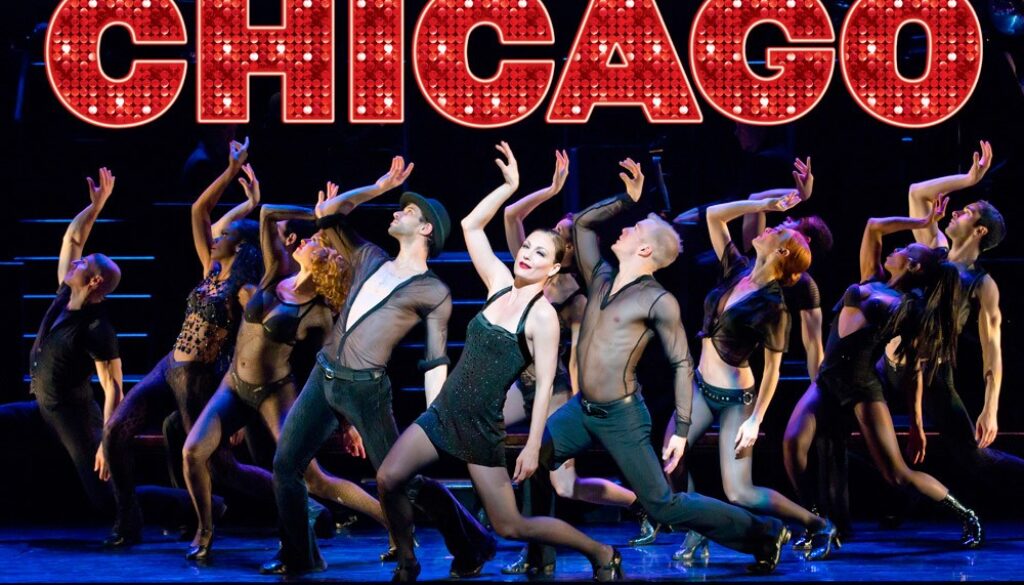
Barry and Fran Weissler brought the Encores! production to Broadway, after some revision and expansion, but retaining the spare and minimalist style in costumes and set. The set design includes the presence of the band center stage in an evocation of a jury box, around and upon which the actors play some scenes. The show opened on November 14, 1996, at the Richard Rodgers Theatre (the same theater where the original production had played), eventually setting a record for recovering its initial costs faster than any other musical in history.
Perfect Timing
Unlike the original production, the revival was met with praise from critics. Society had changed in light of events such as the O.J. Simpson murder case, and audiences were more receptive to the criminal-as-celebrity theme of the show. The CurtainUp reviewer noted, “The show garnered ecstatic reviews, enviable box office sales and enough awards to warrant a special Chicago trophy room.”
Record-Breaking Success
The revival of Chicago won six Tony Awards, more than any other revival in Broadway history until South Pacific won seven Tonys in 2008. Chicago won for Best Revival of a Musical, Best Leading Actress in a Musical for Bebe Neuwirth, Best Leading Actor in a Musical for James Naughton, Best Lighting Design, Best Director of a Musical for Walter Bobbie and Best Choreography for Ann Reinking.
Moves and Milestones
On February 12, 1997, the Broadway production moved into the larger Shubert Theatre. On January 29, 2003, more than six years into its run, the Broadway production moved a second time, to the Ambassador Theatre, where it has played ever since. On November 23, 2014, Chicago became the second longest-running Broadway show, surpassing Cats.
Celebrity Casting
Broadway Revival Notable Cast
Roxie Hart
Pamela Anderson, Mel B, Christie Brinkley, Charlotte d’Amboise, Paige Davis, Sandy Duncan, Robin Givens, Melanie Griffith, Melora Hardin, Marilu Henner, Ruthie Henshall, Olivia Holt, Erika Jayne, Bonnie Langford, Ariana Madix, Bianca Marroquín, Alyssa Milano, Gretchen Mol, Jennifer Nettles, Bebe Neuwirth, Brandy Norwood, Lisa Rinna, Chita Rivera, Angelica Ross, Brooke Shields, Ashlee Simpson, Denise van Outen, Michelle Williams, Rumer Willis, Rita Wilson, Ryoko Yonekura
Billy Flynn
Wayne Brady, Jaime Camil, Billy Ray Cyrus, Taye Diggs, Brandon Victor Dixon, Colman Domingo, Cuba Gooding Jr., Michael C. Hall, Todrick Hall, George Hamilton, Harry Hamlin, James Monroe Iglehart, Joey Lawrence, Huey Lewis, Norm Lewis, Brian McKnight, Adam Pascal, Jerry Springer, Patrick Swayze, Paulo Szot, Alan Thicke, Robert Urich, Usher, Ben Vereen, Tom Wopat, Sebastián Yatra, Billy Zane
Mama Morton
Kandi Burruss, Lea DeLaria, Jennifer Holliday, Cady Huffman, Patti LaBelle, NeNe Leakes, Jinkx Monsoon, Bebe Neuwirth, Orfeh, Roz Ryan, Angie Stone, Sofía Vergara, Lillias White, Wendy Williams, Chandra Wilson
West End Production
Original West End (1979)
The first West End, London production opened at the Cambridge Theatre in April 1979 and ran for around 600 performances. It commenced in the West End with most of the Sheffield cast, and was directed by Peter James and choreographed by Gillian Gregory. Jenny Logan starred as Velma Kelly, with Ben Cross as Billy, Antonia Ellis as Roxie Hart and Don Fellows as Amos Hart.
West End Revival (1997-2012)
Like the New York revival, it was directed by Walter Bobbie and designed by John Lee Beatty, with choreography by Ann Reinking in the style of Bob Fosse. The show ran at the Adelphi Theatre for nine years until transferring to the Cambridge Theatre in April 2006. The original cast included German jazz singer Ute Lemper as Velma, British actress Ruthie Henshall as Roxie Hart, Nigel Planer as Amos Hart, and Henry Goodman as Billy Flynn.
Awards and Success
The production won the 1998 Olivier Award for Outstanding Musical, and Lemper was awarded Best Actress in a Musical. Both Lemper and Henshall have played the role of Velma on Broadway. Like its Broadway counterpart, the London production featured many celebrities throughout its run.
The production moved out of the Cambridge Theatre on August 27, 2011 and transferred to the Garrick Theatre on November 7, 2011. Robin Cousins joined the cast as Billy Flynn on July 17, 2012. The show closed on September 1, 2012 after a total run of nearly 15 years in London.
21st Anniversary Return (2018)
To celebrate the 21st Anniversary of the West End revival production, Chicago returned, this time at the Phoenix Theatre opening April 11, 2018, starring Cuba Gooding Jr. as Billy Flynn, Sarah Soetaert as Roxie Hart, Josefina Gabrielle as Velma Kelly, and Ruthie Henshall as Mama Morton.
International Productions
Australian Production (1981)
The original Australian production opened at the Sydney Opera House’s Drama Theatre in June 1981. Featuring Nancye Hayes (Roxie), Geraldine Turner (Velma), Terence Donovan (Billy), Judi Connelli (Mama) and George Spartels (Amos), it was a new production directed by Richard Wherrett for the Sydney Theatre Company. It transferred to the Theatre Royal in Sydney, before touring to Melbourne, Adelaide and Hong Kong.
National Tours
North American Tours
There have been ten North American national tours of Chicago. The first tour started in April 1997 in Cincinnati, Ohio, six months after the revival opened on Broadway. The most recent tour continues to perform across North America, featuring various celebrity and professional performers throughout its run.
Recent Australian Tour (2019, 2023-2024)
A revival tour commenced early 2019 at the Capitol Theatre in Sydney, starring Natalie Bassingthwaighte as Roxie and Casey Donovan as Mama Morton. The Melbourne leg starred Jason Donovan as Billy Flynn. A new 2023/2024 production premiered at Perth’s Crown Theatre in November 2023, featuring Anthony Warlow as Billy Flynn opposite Lucy Maunder as Roxie Hart.
International Versions
- Japan (2008): Starring Ryoko Yonekura as Roxie Hart
- Peru (2012): Starring Tati Alcántara and Marco Zunino
- France (2018-2019): Théâtre Mogador in Paris with Sofia Essaïdi
- South Korea: Multiple productions since 2000, with over 1,000 performances
- Denmark: Multiple productions since 1976
- Germany: Cast album recorded in Stuttgart
- Netherlands: Dutch cast recording released
2002 Film Adaptation
Academy Award for Best Picture
The 2002 film adaptation of the musical won the Academy Award for Best Picture, bringing Chicago to an even wider audience and cementing its place in popular culture. The film starred Renée Zellweger as Roxie Hart, Catherine Zeta-Jones as Velma Kelly, Richard Gere as Billy Flynn, and Queen Latifah as Mama Morton. The film won six Academy Awards and helped fuel renewed interest in the Broadway production.
Vaudeville Style and Influences
Composer John Kander elaborates that the reason the show was called a vaudeville “is because many of the songs we wrote are related to specific performers like those you mentioned, and Eddie Cantor and Bert Williams as well.”
Staging Innovations
It was through the initial production, and not the writing, that many of the “traditional” Chicago staging conventions were developed. The double snap in “Razzle Dazzle” was added as an afterthought at the suggestion of Ebb to Kander. During rehearsals, “Razzle Dazzle” was originally staged as an orgy on the steps of the courthouse, but Fosse was talked out of this staging when Jerry Orbach convinced him that he was missing the Brechtian subtlety intrinsic in the number.
Awards and Recognition
1997 Tony Awards
| Category | Winner/Nominee | Result |
|---|---|---|
| Best Revival of a Musical | Chicago | WON |
| Best Leading Actress in a Musical | Bebe Neuwirth | WON |
| Best Leading Actor in a Musical | James Naughton | WON |
| Best Director of a Musical | Walter Bobbie | WON |
| Best Choreography | Ann Reinking | WON |
| Best Lighting Design of a Musical | Ken Billington | WON |
Other Major Awards
- 1997 Grammy Award: Best Musical Show Album
- 1998 Olivier Award: Outstanding Musical (West End)
- 1998 Olivier Award: Best Actress in a Musical (Ute Lemper)
- 2003 Academy Awards: Best Picture for film adaptation
Cultural Impact and Legacy
A Cynical Masterpiece
According to James Leve, “Chicago is cynical and subversive, exploiting American cultural mythologies in order to attack American celebrity culture.” The show’s satire on corruption in criminal justice and the media’s obsession with celebrity criminals proved prescient, becoming even more relevant in the age of reality television and social media.
The Longest-Running Revival
Chicago: The Musical has run for more than 11,000 performances and holds the record for longest-running musical revival on Broadway. The show continues to attract audiences with its timeless commentary on fame, corruption, and the American justice system. Its spare, minimalist staging and vaudeville-inspired presentation have influenced countless productions and remain a testament to Bob Fosse’s visionary choreography and direction.
All That Jazz
From its origins as a true crime story in 1920s Chicago to its status as one of Broadway’s longest-running shows, Chicago has proven that razzle dazzle never goes out of style. The musical’s exploration of media manipulation, celebrity worship, and corruption in the justice system continues to resonate with audiences nearly 50 years after its debut, making it one of the most enduring and relevant musicals in theater history.