City of Angels Musical: Broadway’s Film Noir Masterpiece — Cast, Songs & History
City of Angels - Musical Podcast
Memorabilia Available Here
A Musical Comedy
CITY OF ANGELS
Double Vision. Double Deals. A Satirical Film Noir Masterpiece.
Hollywood Through a Cracked Mirror
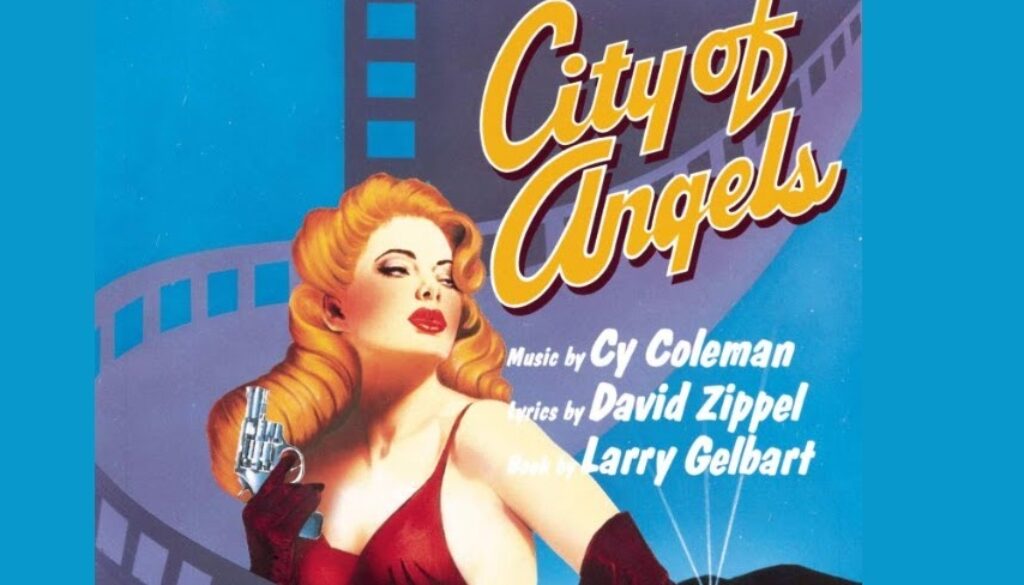
City of Angels is a satirical musical comedy with music by Cy Coleman, lyrics by David Zippel, and a book by Larry Gelbart. The show takes a critical look at Hollywood through the eyes of Stine, a successful writer who is adapting his latest novel into a film. The musical explores two parallel storylines: one following Stine’s struggles to adapt his novel, and the other taking place within the world of the film he’s creating.
The musical also serves as an ode to the classic film noir genre of the 1940s — a loving satire of hardboiled detective stories, corrupt studio executives, and the dream factory’s machinery of compromise.
What makes City of Angels brilliant is its structure: the “real-life” Hollywood scenes feature full-color sets and costumes, while the movie scenes are performed in black-and-white. The stage becomes a double exposure — reality and fiction bleeding into each other, until the boundaries dissolve and Stine’s fictional detective Stone confronts his creator.
The Double Feature
The Film Noir World (Black-and-White)
Stone is a tough Los Angeles private eye. He lies on a hospital gurney with a bullet in his shoulder, flashing back to a week earlier when his loyal Girl Friday secretary, Oolie, ushered in a rich, beautiful woman named Alaura. Alaura claims she wants Stone to find her missing stepdaughter, Mallory Kingsley, a beautiful bad girl. Against his better judgment, he takes the case.
As Stone investigates, he encounters a cast of noir archetypes: a polio-stricken husband in an iron lung, a quack doctor, a lustful stepson, two brutal thugs. He’s framed for murder by Lieutenant Munoz, his former partner who bears a bitter grudge. He finds the missing Mallory waiting naked in his bed. He discovers that Alaura is a fortune-hunting femme fatale who has already murdered one husband and is plotting to eliminate this one — along with his children.
The case leads Stone to a brothel where he’s stunned to find Bobbi, his former love — a lounge singer who wanted stardom more than marriage. We learn it was she who shot the producer; Stone has been covering for her all this time. In the final confrontation at Alaura’s mansion, Stone and Alaura grapple for her gun; shots ring out. Alaura falls dead, Stone is gravely wounded.
The Hollywood World (Full Color)
Stine is the author of the novel City of Angels, which he is adapting into a screenplay. A man at a typewriter, he can rewind and replay scenes, changing dialogue at will. His wife Gabby has misgivings and wishes he would stick to novels, but for now, Stine is enjoying the ride.
Buddy Fidler is the Hollywood producer-director who is butchering Stine’s script, demanding changes for commercial reasons, meddling with everything. Buddy’s secretary Donna is the model for Oolie. Buddy’s wife Carla Haywood will be playing Alaura in the film — and she’s having an affair with crooner Jimmy Powers. The young starlet Avril will be playing Mallory — and she’s having an affair with Buddy.
After Gabby returns to New York, Stine takes comfort in Donna’s bed. He’s having a lousy time: Buddy is butchering his script, his conscience is nagging him about his infidelity, and Stone — his own creation — is disgusted with him. When Stine phones home, Gabby has discovered his affair. He flies to New York with an elaborately prepared excuse, but she’s not buying it.
The Collision of Worlds
The genius of City of Angels is the way the two worlds comment on each other. Gabby and Oolie both lament how their men won’t listen to them. Stone’s faithless love Bobbi is based directly on Gabby. The corrupt producer Stone catches Bobbi with is based on Buddy. Stine’s moral compromises in Hollywood mirror Stone’s compromises in the case.
Finally, the boundaries break down completely. When Stine arrives on the movie set to find Buddy’s name above his on the screenplay, and that the shallow crooner Jimmy Powers will play Stone, Stine boils over. With the “real” Stone — his conscience — finally leading him to make the right choice, Stine rages at Buddy and gets himself fired.
Stone somehow appears at Stine’s typewriter and writes him the fighting skills of a superhero, then tacks on a “Hollywood ending” in which Gabby returns, forgiving all.
The Players (Hollywood & Movie)
The Doubling Conceit
With the exception of the actors playing Stine and Stone, most of the cast doubles as characters in the “real” world and their fictional counterparts. This creates a hall of mirrors effect — the actress playing Gabby also plays Bobbi, the actress playing Donna also plays Oolie, and so on. The audience must constantly shift between reality and fiction, never quite sure which is which.
Broadway Premiere (1989-1992)
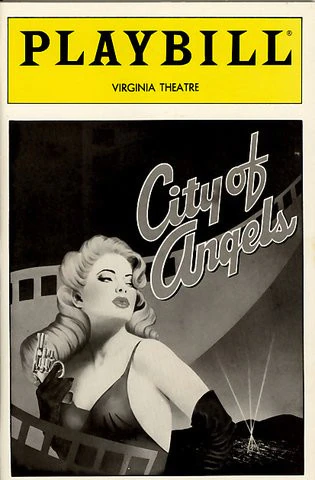
City of Angels premiered on Broadway at the Virginia Theatre (now August Wilson Theatre) on December 11, 1989 and closed on January 19, 1992 after 879 performances and 24 previews. It was directed by Michael Blakemore with sets designed by Robin Wagner, costumes by Florence Klotz, and lighting by Paul Gallo.
| Role | Original Broadway Cast |
|---|---|
| Stone | James Naughton |
| Stine | Gregg Edelman |
| Alaura / Carla | Dee Hoty |
| Oolie / Donna | Randy Graff |
| Bobbi / Gabby | Kay McClelland |
| Buddy Fidler | René Auberjonois |
| Director | Michael Blakemore |
Frank Rich’s Power
An article in the Deseret News noted the extraordinary impact of Rich’s rave review: “City of Angels, a new musical without big stars, was taking in about $18,000 a day in advance ticket sales before it opened. The day after it opened to mixed reviews — but lavish praise from Rich — the box office take was $324,700.”
Awards & Triumph
City of Angels won six Tony Awards out of nine nominations in 1990, dominating the season. The wins for Best Musical, Best Score, and Best Book represented a clean sweep of the major creative categories — a rare achievement that recognized the show’s complete artistic vision.
Production History
US National Tour (1991-1992)
While the show continued on Broadway, the Los Angeles company opened in June 1991 at the Shubert Theater in Century City, with Stephen Bogardus as Stine, Randy Graff and James Naughton reprising their original roles. The production then toured nationally, with Barry Williams (yes, Greg Brady from The Brady Bunch) in the role of Stone.
West End (1993)
The musical opened in the West End at the Prince of Wales Theatre in March 1993. Michael Blakemore again directed, with Roger Allam as Stone, Martin Smith as Stine, and Henry Goodman as Buddy Fidler.
The West End Paradox
Despite excellent notices, the Los Angeles Times reported: “It was announced that the production of City of Angels was closing prematurely after four months.”
Frank Rich reported that the box-office collapse was blamed on the gravity of the recession and “the declining sophistication of West End audiences” — a pointed commentary on the changing theatrical landscape.
Despite its short run, the production was nominated for five 1994 Laurence Olivier Awards and won for Best New Musical.
Donmar Warehouse Revival (2014-2015)
The first West End revival was staged at the Donmar Warehouse, opening officially on December 16, 2014 and running till February 2015. Directed by the Donmar’s artistic director Josie Rourke, the cast included:
- Hadley Fraser as Stine
- Tam Mutu as Stone
- Rosalie Craig as Gabbi/Bobbi
- Katherine Kelly as Alaura/Carla
- Rebecca Trehearn as Donna/Oolie
- Samantha Barks as Mallory/Avril
This production was nominated for five 2015 Olivier Awards, winning for Best Musical Revival and Best Lighting Design.
Garrick Theatre Transfer (2020) — COVID Closure
The production transferred to the Garrick Theatre in the West End beginning previews on March 5, 2020, however closed on March 16 due to the COVID-19 pandemic. The cast included Craig, Fraser and Trehearn reprising their roles from the Donmar production, with Theo James as Stone, Nicola Roberts as Mallory/Avril, and Vanessa Williams as Alaura/Carla.
Other Notable Productions
- Reprise! Broadway’s Best (2006) — Freud Playhouse, UCLA, featuring Burke Moses and Stephen Bogardus
- Porchlight Music Theatre (2015) — Chicago, Illinois
- Arts Centre Melbourne (2015) — Australia, starring Kane Alexander
The Creative Genius
Cy Coleman — Music
Cy Coleman’s jazz-infused score is a delirious celebration of 1940s pop and jazz styles. The music swings with big-band energy, croons with torch-song melancholy, and pulses with noir tension. Songs range from the detective’s lament to the showstopping comic duets between Stine and Stone.
David Zippel — Lyrics
David Zippel’s lyrics are razor-sharp, witty, and emotionally sophisticated. He captures both the hardboiled cynicism of noir dialogue and the genuine pathos of characters trapped by their choices.
Larry Gelbart — Book
Larry Gelbart (co-creator of the M*A*S*H television series) crafted a book that is simultaneously a loving tribute to film noir and a savage satire of Hollywood’s creative compromises. His dialogue crackles with wit, his structure is ingenious, and his characters — even the cartoonish ones — have emotional depth.
Legacy & Influence
A Landmark of Musical Theatre
City of Angels stands as one of the most ingenious musicals of the late 20th century. Its dual-reality structure influenced countless subsequent shows that experimented with metatheatrical storytelling. The visual conceit of black-and-white noir scenes versus full-color Hollywood scenes created an unforgettable theatrical experience.
The Last Great Jazz Musical
Coleman’s score represents perhaps the final flowering of jazz as the dominant musical language of Broadway. The show arrived at a moment when rock and pop were taking over the musical theater landscape, yet it proved that jazz still had something vital to say.
Satire with Heart
What makes City of Angels more than just clever is its emotional core. Beneath the satire and the structural gimmicks is a genuine meditation on artistic integrity, on the compromises we make for success, on the gap between who we are and who we want to be. Stine’s journey from cynical sell-out to embattled artist is genuinely moving.
The Power of Laughter
As Frank Rich noted in his review, the show brought audiences to a halt with “riotous jokes” — a rare achievement in musical theater. The laughter wasn’t just at the clever wordplay or the Hollywood in-jokes, but at the show’s willingness to puncture every pretension, to mock every sacred cow, to find the absurdity in both high art and low commerce.
Film Adaptation
In June 2009, a film adaptation of City of Angels was announced with Barry Levinson as director. The project has remained in development, facing the challenge of translating the show’s theatrical double-vision to cinema.
Enduring Appeal
The Donmar Warehouse’s 2014 revival proved that City of Angels has lost none of its wit, sophistication, or satirical bite. In an era when Hollywood compromises are more visible than ever — when franchise films dominate, when studio notes dictate creative choices, when writers battle executives for control of their vision — the show’s themes remain powerfully relevant.
The shining city on the hill turns out to be a soundstage, the angels are all hustlers and dreamers, and the only way out is to write your own ending. In City of Angels, art and commerce collide with spectacular results — a musical that is both a valentine to classic Hollywood and a scathing indictment of everything it stands for.
As Stone would say: “It’s a living.”