Equus Play by Peter Shaffer | Complete Guide, Cast History & Analysis (1973-2024)
Equus - Play Podcast
Memorabilia Available Here
Peter Shaffer’s Psychological Masterpiece
EQUUS
A Journey Into the Dark Territory of the Human Mind
The Genesis of Equus
Equus is a groundbreaking 1973 play by British playwright Peter Shaffer that explores the psychology of a child psychiatrist attempting to treat a young man with a pathological religious fascination with horses.
The play’s inspiration came from a shocking real-life crime: Shaffer heard about a 17-year-old boy who blinded 26 horses in a small town in northern England. Without knowing any details of the actual crime, Shaffer constructed a fictional account to explore what might have caused such an act, deliberately preserving the “air of mystery” and “numinous” qualities that characterized his earlier work, The Royal Hunt of the Sun (1964).
At its core, the play follows Dr. Martin Dysart’s attempts to understand the cause of young Alan Strang’s violent actions while simultaneously wrestling with his own sense of purpose, professional identity, and the fundamental nature of psychiatric treatment.
Thematic Exploration
Alan sees the horses as representative of God and confuses his religious adoration with sexual attraction. Shaffer examines the conflict between personal values and societal expectations, and between Apollonian (rational, ordered) and Dionysian (passionate, instinctual) values. The play questions whether conformity to social norms is worth the loss of individual passion and authentic worship.
Complete Plot Summary
Act One: The Psychiatrist’s Dilemma
Martin Dysart is a child psychiatrist working in a psychiatric hospital. The play opens with a monologue in which he outlines the case of 17-year-old Alan Strang, who has committed the shocking act of blinding six horses with a metal spike. Dysart reveals his deep dissatisfaction with his profession and his life.
Dysart finds himself caught in an endless cycle of “adjusting” troubled young people back into “normal” living, but he increasingly doubts the value of this work. These youths simply return to dull, conformist lives that lack any real commitment or capacity for worship. He reflects that while Strang’s crime was extreme, such extremity might be necessary to break free from the chains of mundane existence.
Hesther Saloman’s Request
Court magistrate Hesther Saloman visits Dysart, believing he possesses the skills to help Alan come to terms with his actions. At the hospital, Dysart initially struggles to engage with his new patient, who responds to questioning only by singing television advertising jingles—a defense mechanism that keeps the psychiatrist at bay.
Dysart’s Disturbing Dream
Dysart shares a recurring dream set in ancient Greece, where he serves as a public official presiding over a mass ritual sacrifice. One after another, he slices open the abdomens of hundreds of children and pulls out their entrails.
He becomes disgusted with what he is doing but fears being murdered in the same manner if discovered as a “non-believer” by the other priests. He continues the gruesome ritual until the other priests sense his misgivings and grab the knife from his hand, at which point he awakens. This dream symbolizes Dysart’s growing horror at his own profession: destroying the essential passion in troubled youths to make them socially acceptable.
The Parents’ Influence
Through interviews with Alan’s parents, Dysart learns that the boy has received conflicting messages about religion from an early age. Alan’s mother, Dora Strang, is a devout Christian who read to him daily from the Bible, focusing particularly on vivid, violent passages. This practice antagonized Alan’s father, Frank Strang, a staunch non-believer.
Slowly, Dysart makes contact with Alan by playing a question game where each participant must answer honestly. This gradual building of trust allows deeper revelations to emerge.
The Crucifixion Image
Dysart discovers a pivotal childhood incident: Frank, concerned that Alan was taking far too much interest in the violent aspects of the Bible, destroyed a graphic picture of the crucifixion of Jesus that Alan had hung at the foot of his bed. Alan then replaced the religious image with one of a horse, with large, staring eyes—marking the beginning of his transference of religious devotion onto horses.
The Development of Obsession
Alan reveals that his attraction to horses developed through multiple influences: his mother’s Biblical tales of suffering and sacrifice, a horse story she had read to him, Western films featuring heroic riders, and his grandfather’s passionate interest in horses and riding.
Alan’s sexual education began with his mother’s teachings that true love and contentment could be found through religious devotion and marriage. During this formative period, Alan also developed a sexual attraction to horses—desiring to touch their coats, feel their muscular bodies, and smell their sweat. The religious and sexual became inextricably intertwined.
The Beach Encounter
Alan reveals his first encounter with a horse at age six, on a beach. A rider approached him and lifted him onto the horse. Alan was visibly excited and enthralled, but his parents discovered him and Frank violently pulled him off the horse. The horse rider scoffed at Frank’s behavior and rode off. This traumatic interruption of Alan’s moment of ecstasy with the horse would resonate throughout his psyche for years.
Hypnosis and Revelation
Dysart hypnotizes Alan, during which session he reveals elements of his dream about human sacrifice—mirroring Dysart’s own dreams and suggesting a deep connection between doctor and patient. Dysart begins to jog Alan’s memory by filling in blanks and asking careful questions. Alan reveals that he wants to help captive horses by removing the bit from their mouths—the metal piece that enslaves them to human will.
Meeting Jill Mason
After turning 17, Alan took a job at an electrical goods shop, where he met Jill Mason, an outgoing and free-spirited young woman who worked for a local stable owner. She visited the shop to purchase blades for horse-clippers, which immediately piqued Alan’s interest. Jill suggested that Alan work for Harry Dalton, the owner of the stables. Alan eagerly agreed.
The Midnight Rides
Dysart interviews Dalton, who tells him that he initially considered Alan a model worker. Alan kept the stables immaculately clean and groomed the horses with extraordinary care, particularly one named Nugget. Through careful questioning, Dysart uncovers the truth: Alan is erotically fixated on Nugget (whom he calls “Equus”) and secretly takes him for midnight rides, bareback and naked. In these ecstatic nocturnal rituals, Alan envisions himself as a king astride the godhead Equus, both of them destroying their enemies together.
The Critical Night
Dysart gives Alan a placebo “truth pill” to help him feel safe enough to reveal the traumatic events. Alan begins to re-enact the night everything changed:
Jill, who has developed a romantic interest in Alan, asks him to accompany her to an adult movie theater. While there, they unexpectedly encounter Frank, Alan’s father. Alan is traumatized, particularly when he realizes his father is lying to justify his presence at the pornographic theater. However, this encounter also reveals to Alan that sexual desire is natural for all men, even his supposedly proper father. Alan walks Jill home, and she convinces him to come with her to the stables.
The Failed Seduction
Once at the stables, Jill seduces Alan and the two undress to have sex. However, Alan hesitates when he hears the horses making noises in the stables beneath, and he is unable to achieve an erection. The horses—his gods—are watching. Jill tries to understand what’s wrong, but Alan shouts at her to leave.
After Jill dresses and walks out, the still-nude Alan begs the horses for forgiveness, prostrating himself before his jealous god.
The Blinding
“Mine!…You’re mine!…I am yours and you are mine!” cries Equus through Dysart’s voice during the re-enactment, but then the tone becomes threatening: “The Lord thy God is a jealous God,” Equus/Dysart seethes, echoing Biblical language, “He sees you, he sees you forever and ever, Alan. He sees you!…He sees you!”
Alan screams, “God seest! God seest!” and then says “No more. No more, Equus!” Unable to bear the shame of being seen by his god in a moment of sexual failure and betrayal, Alan uses a steel spike to blind all six horses in the stable, whose eyes have “seen” his very soul and witnessed his inadequacy.
Characters in Equus
Original Production History
National Theatre London (1973-1975)
The original stage production premiered at the National Theatre in London on 26 July 1973 and ran until 1975, directed by John Dexter. The production was an immediate critical and commercial success.
| Role | Original London Cast |
|---|---|
| Martin Dysart | Alec McCowen |
| Alan Strang | Peter Firth (later Dai Bradley) |
| Later Dysart | Michael Jayston |
| Director | John Dexter |
When Peter Firth left the London production to open the Broadway production, Dai Bradley took over the role of Alan Strang, playing opposite Michael Jayston as Dr. Dysart.
Broadway Original Production (1974-1977)
The play opened on Broadway at the Plymouth Theatre on 24 October 1974, ending on 11 September 1976. It then transferred to the Helen Hayes Theatre, where it ran from 5 October 1976 to 2 October 1977, for a total of 1,209 performances—an extraordinary run for a serious psychological drama.
The Legendary Broadway Cast
Dr. Martin Dysart
- Anthony Hopkins (Original cast member)
- Richard Burton
- Leonard Nimoy
- Anthony Perkins
Alan Strang
- Peter Firth (Original, reprising his London role)
- Tom Hulce
Remarkable Achievement
Marian Seldes appeared in every single performance of the entire Broadway run—1,809 consecutive performances—first in the role of Hesther Saloman and then as Dora Strang. This remains one of Broadway’s most remarkable attendance records.
The Horses on Stage
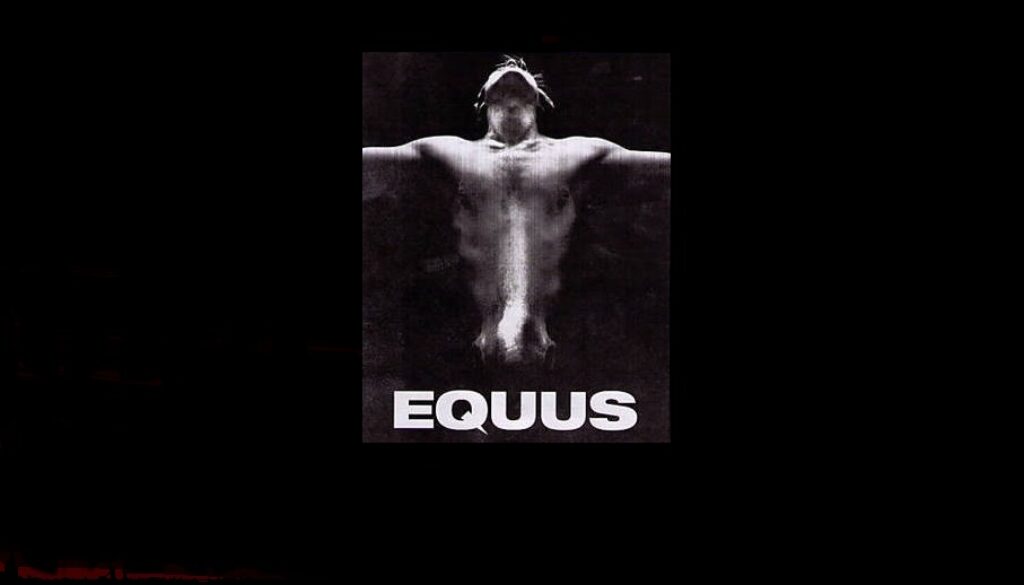
Unlike later film adaptations that used real horses, stage productions portray the horses through human actors—typically muscular men wearing stylized tribal masks and wire-frame horse heads. This theatrical convention became one of the play’s most distinctive and powerful elements, emphasizing the ritualistic, mythological, and symbolic nature of Alan’s worship rather than literal realism.
The 1977 Film Adaptation
Peter Shaffer adapted his own play for a 1977 film directed by acclaimed filmmaker Sidney Lumet. The film received multiple Academy Award nominations.
| Role | Actor |
|---|---|
| Martin Dysart | Richard Burton |
| Alan Strang | Peter Firth (reprising stage role) |
| Dora Strang | Joan Plowright |
| Frank Strang | Colin Blakely |
| Hesther Saloman | Eileen Atkins |
| Jill Mason | Jenny Agutter |
| Director | Sidney Lumet |
The Controversial Decision: Real Horses
Unlike stage productions where horses are portrayed by human actors in stylized masks, director Sidney Lumet made the controversial decision to use real horses in the film. Lumet did not believe that human actors in masks could work effectively on film, arguing that cinematic realism required actual horses to create the psychological reality of Alan being watched by living creatures.
Critical Reception of the Film
The film received mixed reviews from critics who loved the stage production. English professor James M. Welsh argued that while using real horses was understandable for film, the outdoor scenes and realistic settings “infringed on the abstract theatrical design” that gave the play its extraordinary creativity and power.
Welsh also felt the explicit depiction of the blinding was “potentially repulsive” and that “much of the spirit of the play is lost as a consequence” of translating the theatrical ritual into cinematic realism. Despite these criticisms, the film received three Academy Award nominations, including Best Actor for Richard Burton and Best Supporting Actor for Peter Firth.
Notable Revivals & Modern Productions
The Daniel Radcliffe Phenomenon (2007-2009)
The casting of seventeen-year-old Daniel Radcliffe—then internationally famous as Harry Potter—triggered significant media controversy since the role of Alan Strang required him to appear nude onstage in the seduction scene. Radcliffe publicly insisted that the nude scene was not “gratuitous” but essential to the character and the story, and that he felt obligated to portray the character and the scene exactly as called for by Shaffer’s script.
Broadway Transfer (2008-2009)
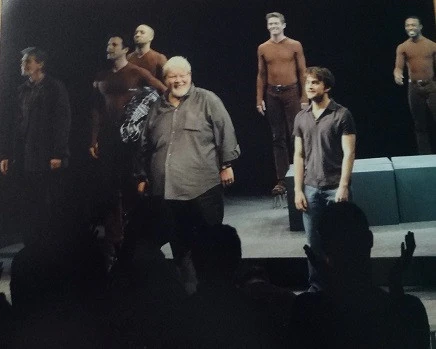
This West End revival was subsequently transferred to Broadway, where it ran at the Broadhurst Theatre from 5 September 2008 through 8 February 2009. Radcliffe and Griffiths reprised their acclaimed roles, and Thea Sharrock returned as director.
Complete Broadway Revival Cast (2008-2009)
- Martin Dysart: Richard Griffiths
- Alan Strang: Daniel Radcliffe
- Dora Strang: Kate Mulgrew
- Hesther Saloman: Anna Camp
- Frank Strang: T. Ryder Smith
- Jill Mason: Anna Camp
- Horsemen: Lorenzo Pisoni, T. Ryder Smith, Graeme Malcolm, Sandra Shipley, Collin Baja, Tyrone Jackson, Spencer Liff, Adesola Osakalumi, Marc Spaulding
Daniel Radcliffe was nominated for the Drama Desk Award for Outstanding Actor in a Play for his performance, proving himself a serious stage actor beyond his film franchise fame.
21st Century Regional Productions
City Lights Theater Company, San Jose (2011)
This production, featuring actors Sean Gilvary as Alan Strang and Steve Lambert as Martin Dysart, received rave reviews from regional critics. The San Jose Mercury News labelled both actors “haunting,” stating that Gilvary was “exposing emotions and epidermis, rides bareback in every sense.”
StarkInsider rated the production 4.5 out of 5 stars, calling Lambert “superb” with a “pitch-perfect performance,” while calling Gilvary “dazzling” with “a preternatural ability to inhabit the very soul of his character.” This production received a Standout Classic Production Award from the Silicon Valley Small Theatre Awards.
Frenetic Theater, Houston (2014)
Equus was revived in Houston for a limited run in July 2014 at Frenetic Theater. The production was largely funded by donations on Kickstarter and received enthusiastic critical response. Broadway World called the production “dark, daunting and sensual” while commending its “stellar cast”. Houston Press declared it “astonishingly good… a must see” while Culturemap listed the show as one of the “hottest” productions of the year.
The Illustrated Edition
The first illustrated edition of the play text was produced as a large-format artist’s book by the Old Stile Press, with images and an afterword by the British artist Clive Hicks-Jenkins, in 2009. This limited edition brought new visual interpretation to Shaffer’s text.
Awards & Recognition
| Year | Award | Category | Recipient |
|---|---|---|---|
| 1975 | Tony Award | Best Play | Peter Shaffer – WON |
| 1975 | Tony Award | Best Actor in a Play | Anthony Hopkins – WON |
| 1975 | Tony Award | Best Featured Actor in a Play | Peter Firth – WON |
| 1975 | Tony Award | Best Director | John Dexter – WON |
| 1978 | Academy Award | Best Actor (Nominated) | Richard Burton |
| 1978 | Academy Award | Best Supporting Actor (Nominated) | Peter Firth |
| 2009 | Drama Desk Award | Outstanding Actor in a Play (Nominated) | Daniel Radcliffe |
Themes & Legacy
The Central Questions of Equus
Worship vs. Normalcy
Equus poses one of theatre’s most profound questions: Is it better to live with passionate worship and extreme feeling, even if destructive, or to live a “normal” life devoid of deep commitment and meaning?
Dysart envies Alan’s capacity for worship and transcendent experience, even as he must “cure” him of it to make him socially acceptable. The psychiatrist’s dream of ritual sacrifice mirrors his daily work—destroying the essential passion and individuality in troubled youths to make them acceptable to society. The play suggests there may be no satisfactory answer to this dilemma.
Religion and Sexuality in Equus
The play explores the dangerous intersection of religious fervor and sexual awakening in adolescence. Alan’s personal theology transforms horses into gods, and his worship becomes inseparable from sexual desire and arousal. His parents’ conflicting views on religion—his mother’s intense Christianity versus his father’s aggressive atheism—create an ideological vacuum that Alan fills with his own mythological system centered on “Equus.”
Apollonian vs. Dionysian Values
Shaffer examines the fundamental conflict between Apollonian values (reason, order, civilization, conformity) represented by Dysart’s profession and society’s expectations, and Dionysian values (passion, instinct, chaos, authentic experience) embodied in Alan’s ecstatic worship of Equus. The play questions whether civilization requires the systematic suppression of Dionysian experience.
The Cost of Civilization and Conformity
The play suggests that civilization and social conformity demand the sacrifice of passion, intensity, and genuine worship. To be “normal” is to be stripped of the capacity for transcendent experience and authentic feeling. Dysart recognizes that in curing Alan and making him socially functional, he will create someone who can hold a job and interact appropriately but who has lost the ability to truly feel, truly worship, truly live at full intensity.
This represents Shaffer’s critique of modern psychiatry and social institutions that prioritize conformity over individual authenticity and passion.
Theatre of Cruelty and Ritual Performance
The staging of Equus, with actors in stylized horse masks creating a ritualistic atmosphere, draws on Antonin Artaud’s concept of the “Theatre of Cruelty.” The production doesn’t simply tell a story—it creates a visceral, almost religious experience for the audience, implicating them in the ritual and forcing them to confront their own relationship with passion, worship, and conformity.
Lasting Influence on Theater and Psychology
Equus remains one of the most psychologically complex and theatrically innovative plays of the 20th century. Its exploration of psychiatry, religion, sexuality, and the nature of worship continues to challenge and disturb audiences over fifty years after its premiere at the National Theatre.
The play has been performed countless times around the world, from major Broadway revivals featuring film stars to small regional theaters and university productions. Each production must grapple with Shaffer’s profound questions about what it means to be human, to worship something greater than oneself, to feel deeply, and to be “cured” of passion in the name of social acceptability.
Equus influenced subsequent theatrical works that explore the conflict between individual passion and social conformity, and its themes remain strikingly relevant in contemporary discussions about mental health treatment, religious extremism, and the costs of normalization.
Links
The Official Site of Jerry Herman
Chess the Musical – Memorabilia
Little Shop of Horrors – Memorabilia
Starlight Express – Memorabilia
Dear Evan Hansen – Memorabilia
How to Succeed in Business Without Really Trying – Memorabilia
Terrence McNally – Memorabilia