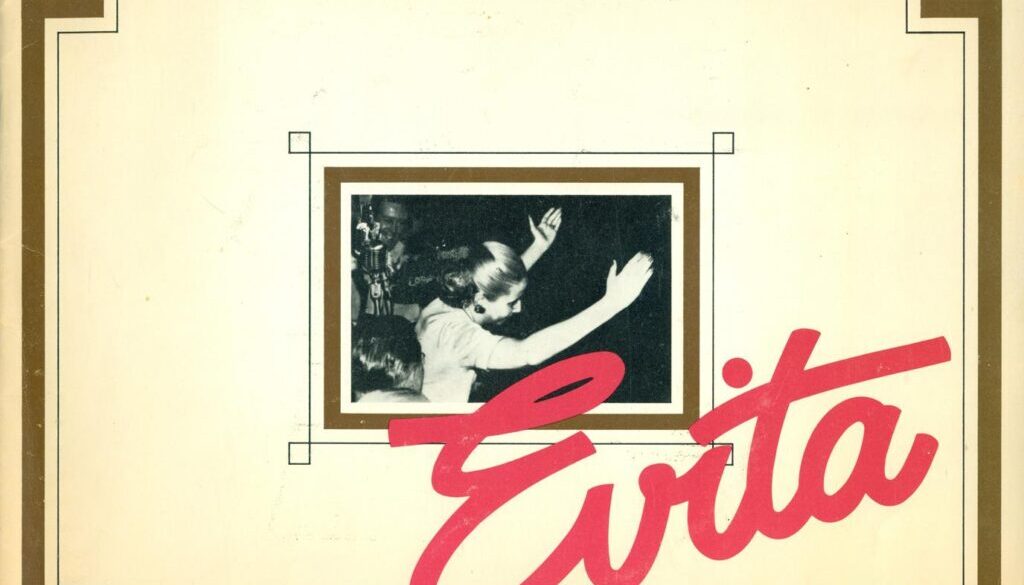
Evita: The Musical – Complete Guide | Andrew Lloyd Webber & Tim Rice
Memorabilia Available Here
Evita
Don’t Cry for Me Argentina: The Legendary Musical About Eva Perón
Music by Andrew Lloyd Webber • Lyrics by Tim Rice
The Sung-Through Musical That Conquered the World
From Concept Album to Tony Award-Winning Broadway Phenomenon
Overview
Evita is a sung-through musical with music by Andrew Lloyd Webber and lyrics by Tim Rice. It concentrates on the life of Argentine political leader Eva Perón, the second wife of Argentine president Juan Perón. The story follows Evita’s early life, rise to power, charity work, controversies, and death.
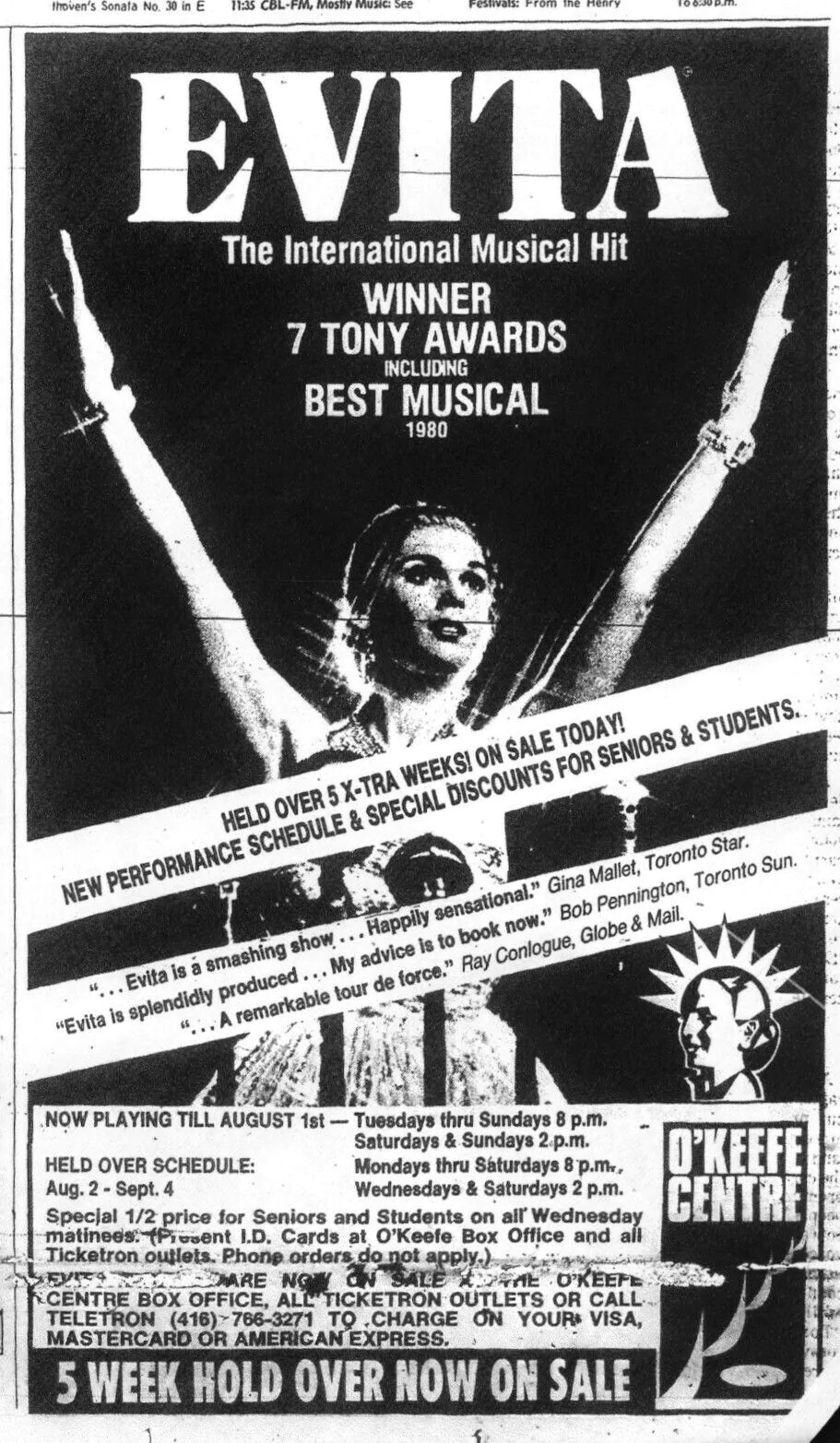
The musical began as a rock opera concept album released in 1976. Its success led to productions in London’s West End in 1978, winning the Laurence Olivier Award for Best Musical, and on Broadway a year later, where it was the first British musical to receive the Tony Award for Best Musical.
This has been followed by a string of professional tours and worldwide productions and numerous cast albums, as well as a 1996 film adaptation starring Madonna. The musical was revived in London’s West End in 2006, 2014, 2017, and 2025, and on Broadway in 2012.
Plot Synopsis
Act I: The Rise of Eva Perón
On July 26, 1952, a crowd in a Buenos Aires, Argentina theatre is watching a movie that is interrupted when news breaks of the death of First Lady Eva Perón. Both the crowd and the nation go into a period of public mourning as Che, a member of the public, marvels at the spectacle and promises to show how Eva did “nothing for years.”
In 1934, 15-year-old Eva Duarte lives in the city of Junín and longs to seek a better life in Buenos Aires. Eva takes up with tango singer-songwriter Agustín Magaldi after she meets him at one of his shows. Eva persuades an initially resistant Magaldi to take her with him to Buenos Aires. Upon her arrival in the city, Eva sings about her hopes and ambitions of glory in “Buenos Aires.”
After her arrival, Eva is quick to leave Magaldi and pursue other romantic connections to climb up the social ladder. Che tells of both a left-wing coup in 1943 and Eva’s success, implying that Argentine politics and Eva’s career may soon coincide. Che also introduces the figure of Colonel Juan Domingo Perón, an ambitious army colonel making his way up the Argentine political ladder.
The Charity Concert
After a massive earthquake hits the town of San Juan, Perón organizes a charity concert at Luna Park to provide aid to the earthquake’s victims, which Eva attends. Perón’s rousing speech is well-received by the crowd. Eva introduces herself to Perón and they share a secret rendezvous following the charity concert, where Eva hints that she could help Perón rise to power in “I’d Be Surprisingly Good For You.”
Eva dismisses Perón’s unnamed mistress, who ponders the rejection and her fate in the haunting ballad “Another Suitcase in Another Hall.”
Upon moving in with Perón, Eva is introduced to high society only to be met with disdain from the upper classes and the Argentine Army. In 1946, after launching his presidential bid, Perón discusses his chances of winning the election with Eva. After reassuring him of their chances of winning, Eva organizes rallies for the descamisados (shirtless ones) and gives them hope for a better future while Perón and his allies plot to dispose of anyone who stands in their way in “A New Argentina.”
Act II: Power, Glory, and Death
Perón is elected President in a sweeping victory in 1946. He stands on the balcony of the Casa Rosada addressing his descamisados. Eva speaks from the balcony of the Presidential Palace to her adoring supporters, where she proclaims that despite her elevated status, her heart remains with the people of her country in the iconic “Don’t Cry for Me Argentina.” Che analyses the price of fame as Eva dances at the Inaugural Ball with Perón, now the president-elect.
The Rainbow Tour
Eva insists on a glamorous image to impress the people of Argentina and promote Peronism. She prepares to tour Europe as she is dressed for success by her fashion consultants in “Rainbow High.” Her famous 1947 tour meets with mixed results in “Rainbow Tour”:
- Spaniards adore her
- Italians liken her husband to Benito Mussolini
- France is impressed
- The British snub her by inviting her to a country estate rather than Buckingham Palace
Eva affirms her disdain for the upper class, while Che asks her to start helping those in need. Eva begins the Eva Perón Foundation to direct her charity work. Che describes Eva’s controversial charitable work and possible money laundering in “And the Money Kept Rolling In (And Out).”
The Final Act
Eva appears at a church to take the sacrament in front of her adoring supporters, but passes out suddenly. While unconscious, she appears to have a dream that reflects upon the conflicting views of her life. In her dream, she and Che heatedly debate her actions in “Waltz for Eva and Che.” Che accuses Eva of using the Argentine people for her own ends, while Eva cynically replies that there is no glory in trying to solve the world’s problems from the sidelines. At the end of the argument, Eva finally admits to herself and Che that she is dying and can’t go on for much longer.
Perón’s generals finally get sick of Eva’s meddling and demand that Perón force her to leave politics. However, Perón objects in “She Is a Diamond,” claiming that if it weren’t for her, they would never have achieved as much as they have. But he also concedes that she won’t be able to keep working for long as she will soon succumb to her cancer.
Realizing she is about to die, Eva renounces her pursuit of the vice presidency and swears her eternal love to the people of Argentina. Eva’s numerous achievements flash before her eyes before she dies, and she asks for forgiveness, contemplating her choice of fame instead of long reign in “Lament.” Evita dies, and embalmers preserve her body forever. Che notes a monument was set to be built for Evita but says “only the pedestal was completed, and Evita’s body disappeared for 17 years.”
Development and Creation
The Inspiration
In 1972, Robert Stigwood proposed that Andrew Lloyd Webber and Tim Rice develop a new musical version of Peter Pan, but abandoned the project. Travelling late to a meal one night in 1973, Rice heard the end of a radio show about Eva Perón which intrigued him. As a child stamp collector, he had been fascinated by her image on the Argentine stamps, but was unaware of her significance in Argentina’s history.
He began research and was introduced to the Argentine film director Carlos Pasini Hansen who had produced the TV film Queen of Hearts. The more Rice investigated Eva Perón, going so far as to travel to Buenos Aires to research her life, the more fascinated he became by the woman; he even named his first daughter after her.
Rice suggested the idea of a musical based on the subject to Lloyd Webber, but although the idea of writing a score including tangos, paso dobles, and similar Latin flavours intrigued him, Lloyd Webber ultimately rejected the idea. He decided instead to collaborate with Alan Ayckbourn on Jeeves, which proved to be a critical and commercial failure. After Jeeves, Lloyd Webber returned to Rice, and they began developing Rice’s proposed musical.
The Character of Che
Rice created the character “Che” to serve as both narrator and represent the voice of the lower, working class, providing insight and criticism to Eva’s character. When Harold Prince later became involved with the project, he insisted that the actors portraying Che should use Che Guevara as a role model. In the 1996 film adaptation, the character returned to his more anonymous roots. This was also the case for the 2006 London revival.
The Concept Album (1976)
As they had previously done with Jesus Christ Superstar, the songwriting team decided to record Evita as an album musical and selected actress and singer Julie Covington to sing the title role. The recording was released by MCA Records and commenced in April 1976, produced by Lloyd Webber and Rice.
Original Concept Album Cast
- Eva Perón: Julie Covington
- Che: Colm Wilkinson
- Juan Perón: Paul Jones
- Perón’s Mistress: Barbara Dickson
- Agustín Magaldi: Tony Christie
Released in 1976, the two-record set included contributions from several artists. The writers had originally considered Steve Marriott and John Fogerty but neither was interested. Murray Head, who had enormous success with the Superstar album, recorded some demos but Rice later admitted they “didn’t really reproduce the magic” of his Judas portrayal.
Chart Success
In Britain, Australia, South Africa, South America, and various parts of Europe, sales of the concept album exceeded those of Jesus Christ Superstar. Covington’s recording of “Don’t Cry for Me Argentina” (originally titled “It’s Only Your Lover Returning”) was released in October 1976. It reached No. 1 on the UK Singles Chart and enjoyed similar success internationally. Dickson’s “Another Suitcase in Another Hall” also became a hit.
Original West End Production (1978-1986)
Evita opened at the Prince Edward Theatre on June 21, 1978 and closed on February 8, 1986, after 3,176 performances. Elaine Paige played Eva with David Essex as Che, Joss Ackland as Perón, Mark Ryan as Magaldi and Siobhán McCarthy as Mistress. Paige was selected from among many hopefuls, after Julie Covington declined the role.
Original West End Cast
| Role | Original Actor | Notable Replacements |
|---|---|---|
| Eva Perón | Elaine Paige | Marti Webb, Stephanie Lawrence, Siobhán McCarthy, Kathryn Evans |
| Che | David Essex | Gary Bond, Mark Ryan, Martin Smith |
| Juan Perón | Joss Ackland | John Turner, Oz Clarke, Daniel Benzali |
The production was directed by Harold Prince, choreographed by Larry Fuller, and produced by Robert Stigwood. Webb originally played the role during Paige’s holiday and was persuaded by Prince to remain in the cast as an alternate for two shows each week. This set the precedent until the show closed.
Critical Reception
Design Elements
Timothy O’Brien and Tazeena Firth collaborated on the design of the show. The set was minimal, with a scaffolded balcony running along the back and sides of the stage and images projected onto a screen above. Madame Tussauds produced a wax figurine of Eva, based on Elaine Paige, for the coffin during the funeral scene at the beginning of the show.
Inspired by the murals of Diego Rivera, Prince suggested the proscenium be flanked by artwork depicting the struggles of the Argentine peasants. The now iconic balcony scene featured Eva in a broad, diamond encrusted white dress based on one actually owned by Eva Perón which had been designed by Christian Dior addressing a crowd from the rear balcony of the stage.
Original Broadway Production (1979-1983)
After debuting at the Dorothy Chandler Pavilion in Los Angeles, with a subsequent engagement at the Orpheum Theatre in San Francisco, the Broadway production opened at the Broadway Theatre on September 25, 1979 and closed on June 26, 1983, after 1,567 performances and 17 previews.
Original Broadway Cast
- Eva Perón: Patti LuPone
- Che: Mandy Patinkin
- Juan Perón: Bob Gunton
- Agustín Magaldi: Mark Syers
- Perón’s Mistress: Jane Ohringer
Harold Prince directed with choreography by Larry Fuller. During the run, six actresses alternated playing the title role, in addition to LuPone: Terri Klausner (matinees), Nancy Opel (matinees), Pamela Blake (matinees), Derin Altay, Loni Ackerman and Florence Lacey.
Patti LuPone on Evita
LuPone’s performance brought her massive acclaim, but she struggled with the vocal demands. “It’s horrible. When I first heard the score to Evita, I thought Andrew Lloyd Webber hated women because the score’s written in a soprano’s passaggio… The fact that I willed my voice every single night to hit those notes and I didn’t do more damage to my voice is shocking… And every night I went on stage in terror, absolute terror. That’s not good for the soul. It’s not good for the head. It’s not good for anything. But I knew it was my test. I knew that if I survived this, I could survive anything.”
The Actors’ Equity Controversy
Elaine Paige was originally told she would re-create her role in the Broadway production, however the Actors’ Equity Association refused permission for a non-American. Prince attempted to persuade the organisation for a second time when LuPone was suffering vocal problems before the production reached New York. LuPone stated in her memoir that this was nothing more than a rumour started by Prince himself to build publicity.
International Productions
Australia (1980)
The original Australian production opened at the Adelaide Festival Theatre on April 30, 1980. It featured Jennifer Murphy as Eva, John O’May as Che, Peter Carroll as Perón, Tony Alvarez as Magaldi, and Laura Mitchell as Perón’s mistress. Patti LuPone took over the title role in mid-1981 during its Sydney run after Murphy left the production. LuPone’s experience in the Sydney production was a much more positive one than her time on Broadway because by that time she felt comfortable singing the score and enjoyed playing the part.
Spain (1980)
The first Spanish language version premiered at the Teatro Monumental in Madrid on December 23, 1980, directed by Jaime Azpilicueta and with Paloma San Basilio as Eva, Patxi Andión as Che, Julio Catania as Perón, Tony Landa as Magaldi and Montserrat Vega as Perón’s mistress. A double album recorded by the original cast was released and the song “No llores por mí Argentina” became a hit single. This production later played in Barcelona and in other cities in Latin America.
Mexico (1981)
In Mexico City the show premiered at the Teatro Ferrocarrilero on June 26, 1981, with Valeria Lynch and Rocío Banquells alternating as Eva, Jaime Garza and Javier Díaz Dueñas alternating as Che, Jorge Pais as Perón, César Millán as Magaldi and Carmen Delgado as Perón’s mistress.
Brazil (1983)
Directed by Maurício Shermann and starring Cláudia as Evita, Mauro Mendonça as Péron, Carlos Augusto Strazzer as Che, Sílvia Massari as Perón’s mistress, and Hildon Prado as Magaldi, it premiered at Teatro João Caetano in Rio de Janeiro on January 12, 1983. It later moved to Teatro Palace in São Paulo in 1986.
It opened to great success in Brazil, with the Brazilian singer Cláudia being considered by some critics as the best Evita of all time. English producers Robert Stigwood and David Land, after watching the Brazilian production, said that Cláudia was the best Evita of all the singers who had played the role.
Major Revivals
2006 West End Revival
On June 2, 2006, the first major London production of Evita since the original had closed 20 years earlier opened in the West End at the Adelphi Theatre. Directed by Michael Grandage, Argentine actress Elena Roger debuted as Eva, while Philip Quast appeared as Perón with Matt Rawle as Che.
Its libretto included “You Must Love Me”, written for the 1996 film, but which had not yet been included in an English-language stage production. The production opened to very positive reviews, but ticket sales were slow, which resulted in its closure on May 26, 2007 after a run of less than a year. Quast and Roger were nominated for Best Actor in a Musical and Best Actress in a Musical respectively at the 2007 Laurence Olivier Awards.
2012 Broadway Revival
A Broadway revival of the show, based upon the 2006 West End production, ran at the Marquis Theatre, with Elena Roger in the title role, Ricky Martin as Che, Michael Cerveris as Perón, Max von Essen as Magaldi and Rachel Potter as Mistress. Christina DeCicco alternated with Roger as Eva.
2012 Broadway Revival Details
Director: Michael Grandage
Choreography: Rob Ashford
Set and Costume Design: Christopher Oram
Lighting Design: Neil Austin
Producers: Hal Luftig and Scott Sanders
Previews began: March 12, 2012
Official opening: April 5, 2012
Closed: January 26, 2013
Performances: 337 performances and 26 previews
The production was nominated for three Tony Awards, including Best Revival of a Musical at the 66th Tony Awards.
2025 West End Revival
A West End revival based upon the 2019 production at Regent’s Park Open Air Theatre began previews at the London Palladium on June 14, 2025 with its opening on July 1. The limited run closed on September 6, 2025.
2025 Cast
- Eva Perón: Rachel Zegler (West End debut)
- Che: Diego Andres Rodriguez
- Juan Perón: James Olivas
- Agustín Magaldi: Aaron Lee Lambert
- The Mistress/Alternate Eva: Bella Brown
Critical Reception of 2025 Revival
The production was directed by Jamie Lloyd and featured a unique staging: the number “Don’t Cry for Me Argentina” was performed on the exterior balcony of the Palladium and broadcast to the theatre audience using cameras outside and a large screen inside the theatre.
Major Tours
US National Tours
1980–1983: 1st US National Tour
Opened at the Shubert Theatre in Los Angeles and starred Loni Ackerman as Eva, Scott Holmes as Che, Jon Cypher as Juan Perón, Sal Mistretta as Magaldi and Cynthia Hunt as Perón’s Mistress.
1979-1983: 2nd US National Tour
Opened at the Shubert Theatre in Chicago and subsequently toured to major U.S. cities starring Valerie Perri as Eva, John Herrera as Che, Robb Alton as Juan Perón, Peter Marinos as Magaldi and Cynthia Simpson as Perón’s Mistress. The 2nd National went on to finish touring Scandinavia.
2013 US Tour (Broadway Revival)
Based on the 2012 Broadway revival, began in September 2013. The cast included Caroline Bowman as Eva, Josh Young as Che, Sean McLaughlin as Perón, Christopher Johnstone as Magaldi, Krystina Alabado as Mistress and Desi Oakley as the alternate for Eva Perón.
UK Tours
A 1996 tour, mounted in anticipation of the film version, featured several actresses in the title role, including Valerie Perri, Donna Marie Asbury and Marla Schaffel. It was directed and choreographed by Larry Fuller.
A 2013–2014 UK Tour was produced by Bill Kenwright and starred Marti Pellow (lead singer of Wet Wet Wet) as Che, Andrew C Wadsworth as Juan Perón, and Madalena Alberto as Eva Perón. The tour concluded with 55 performances at the Dominion Theatre in the West End in September and October 2014.
2018 Australian Revival
Tina Arena as Evita
A 2018 Australian revival directed by Harold Prince was announced by Opera Australia, with Australian singer-songwriter Tina Arena as the lead actress. The stage tour production began at the Sydney Opera House on September 13, running to November 3, 2018, then moved to Arts Centre Melbourne from December 5-30, 2018.
Arena said she felt the time was right to tackle the role: “I have been approached to do this role on a couple of occasions. I never felt emotionally ready for it. I felt I had a lot of living and learning before I could get up and take on the enormity of the story and the human spirit she possessed.”
2018 Australian Cast
- Eva Perón: Tina Arena / Jemma Rix (alternate)
- Juan Perón: Paulo Szot (Brazilian operatic baritone)
- Che: Kurt Kansley
- Agustín Magaldi: Michael Falzon
- Perón’s Mistress: Alexis van Maanen
The 1996 Film
Plans for a film directed by Ken Russell developed soon after the West End and Broadway openings. Much speculation of potential leads included Barbra Streisand or Liza Minnelli as Eva, and Barry Gibb or Elton John as Che. These plans never came to fruition.
It was not until 1996 that Evita came to the big screen. Alan Parker directed the film, with Madonna in the title role, Antonio Banderas as Che and Jonathan Pryce as Perón.
Academy Awards Success
The film was nominated for five Academy Awards, winning one for Best Original Song (“You Must Love Me,” composed especially for the film) at the 69th Academy Awards. Madonna received mixed reviews but won the Golden Globe Award for Best Actress – Motion Picture Musical or Comedy at the 54th Golden Globe Awards, where the film also won Best Picture–Musical or Comedy.
Awards and Recognition
1978 Laurence Olivier Awards (Original West End)
Winner Best New Musical
Winner Best Performance in a Musical – Elaine Paige
Nominated Best Director – Harold Prince
Nominated Best Performance in a Musical – David Essex
1980 Tony Awards (Original Broadway)
Historic Achievement
Winner Best Musical – First British musical to win Tony Award for Best Musical
Winner Best Leading Actress in a Musical – Patti LuPone
Winner Best Leading Actor in a Musical – Mandy Patinkin
Winner Best Featured Actor in a Musical – Bob Gunton
Winner Best Direction – Harold Prince
Winner Best Book of a Musical – Tim Rice
Winner Best Original Score – Andrew Lloyd Webber and Tim Rice
2012 Tony Award Nominations (Broadway Revival)
Nominated Best Revival of a Musical
Nominated Best Actor in a Musical – Ricky Martin
Nominated Best Actress in a Musical – Elena Roger
Musical Style and Themes
The musical employs an eclectic range of styles. Classical music in Evita includes the opening choral piece “Requiem for Evita” and a choral interlude in “Oh What a Circus.” Rhythmic Latinate styles are heard in pieces such as “Buenos Aires,” “And the Money Kept Rolling in (And Out)” and “On This Night of a Thousand Stars,” while ballads include “High Flying, Adored” and “Another Suitcase in Another Hall.” Rock music includes “Oh What a Circus,” “Perón’s Latest Flame.”
Historical Accuracy
The lyrics and storyline of the musical are influenced by Mary Main’s biography, Evita: The Woman with the Whip, which drew heavily upon the accounts of anti-Perónist Argentines. Shortly after the musical appeared, Nicholas Fraser and Marysa Navarro published a more neutral account of Eva Perón’s life, in which they claim that many of Main’s assertions were false.
Some critics suggested that Rice’s lyrics disparaged Evita’s achievements unnecessarily, particularly her charity work. Following the success of the film version of Evita in 1996, an Argentinean film biography of Eva Perón was released, Eva Perón: The True Story, asserting that it corrected distortions in the musical’s account.
Legacy and Cultural Impact
Evita came in sixth in a BBC Radio 2 listener poll of the UK’s “Number One Essential Musicals.”
Pop Culture References
One episode of The Simpsons, “The President Wore Pearls,” has a plot loosely based on the musical, with Lisa Simpson in Eva’s role. The episode includes parodies of songs such as “A Vote for a Winner” which includes the lyrics, “don’t cry for me, kids of Springfield.”
During the Glee episode “Special Education,” Kurt Hummel and Rachel Berry sing “Don’t Cry for Me Argentina” when Kurt is auditioning for a solo in the Warblers for Sectionals.
From concept album to worldwide phenomenon
Evita transformed musical theater with its sung-through format and made “Don’t Cry for Me Argentina” one of the most recognizable songs in musical history. The story of Eva Perón continues to captivate audiences around the world, cementing Andrew Lloyd Webber and Tim Rice’s place in theatrical history.