Falsettos | William Finn’s Musical About Love, Family & AIDS
Falsettos
Memorabilia Available Here
Four Jews in a Room Bitching
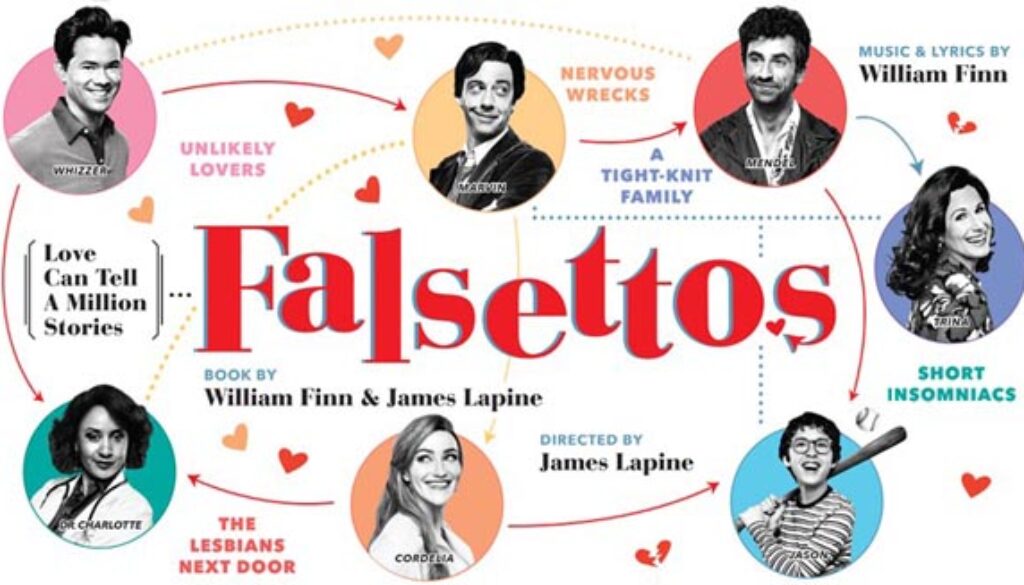
William Finn and James Lapine’s Tony-winning sung-through musical about Marvin, who has left his wife for a male lover, and struggles to keep his unconventional family together as they navigate love, Jewish identity, and the early AIDS crisis in late 1970s-early 1980s New York.
Falsettos is a sung-through musical with a book by William Finn and James Lapine, and music and lyrics by Finn. The musical consists of March of the Falsettos (1981) and Falsettoland (1990), the last two installments in a trio of one-act musicals that premiered off-Broadway (the first was In Trousers). The story centers on Marvin, who has left his wife to be with a male lover, Whizzer, and struggles to keep his family together. Much of the first act explores the impact his relationship with Whizzer has had on his family. The second act explores family dynamics that evolve as he and his ex-wife plan his son’s bar mitzvah, which is complicated as Whizzer comes down with an early case of AIDS.
Falsettos premiered on Broadway in 1992 and was nominated for seven Tony Awards, winning those for Best Book and Best Original Score. The musical was revived on Broadway in 2016 starring Christian Borle, Stephanie J. Block, and Andrew Rannells. The 2016 revival was filmed and adapted for the PBS Live from Lincoln Center television series, and aired on October 27, 2017. The revival was nominated for five Tony Awards, including Best Revival of a Musical.
Central to the musical are the themes of Jewish identity, gender roles, and gay life in the late 1970s and early 1980s. The musical was praised by critics for its melodic compositions, humor, character development, and positive portrayal of non-traditional family structures.
The Marvin Trilogy
Composer William Finn began his theater career with a one-act musical In Trousers (1979), which centers on the character Marvin questioning his sexuality. It was produced twice at Playwrights Horizons off-Broadway, opening in February 1978 and again in December 1979. After In Trousers received sharply unfavorable reviews, Finn considered abandoning musical theater and attending medical school. He felt that “if the critic for the Times at that time had been more responsible, it would have been a considerable debut. But as it was, he just said it was junk.” Finn struggled in his science classes and discarded his medical school plans, turning back to writing about the character of Marvin.
March of the Falsettos (1981)
Finn soon wrote the songs for another one-act musical about Marvin and his family, March of the Falsettos, collaborating with director James Lapine on the book. Actress Alison Fraser, who originated the role of Trina, contributed additional vocal orchestrations. This premiered at Playwrights Horizons in April 1981, ran there through September and moved to the Westside Theatre in October 1981. March of the Falsettos received more positive critical reception than In Trousers: Ellen Pall of The New York Times wrote that Finn’s “brilliant form combined with the absolute topicality of his social themes first bowled critics over.”
Falsettoland (1990)
Almost a decade after March of the Falsettos, in the wake of the 1980s AIDS epidemic, Finn followed with Falsettoland. The musical concluded Finn’s “Marvin Trilogy” of one-act pieces about Marvin and his circle, beginning with In Trousers and March of the Falsettos. Falsettoland opened at Playwrights Horizons on June 28, 1990, then moved to the Lucille Lortel Theatre, on September 16, 1990, where it closed on January 27, 1991. It won the 1991 Lucille Lortel Award for Outstanding Musical and the 1991 Drama Desk Award for Outstanding Lyrics.
Combining Into Falsettos
Finn and Lapine then combined March of the Falsettos and Falsettoland to form a full-length show, titled Falsettos, slightly altering them to form a “more unified, more thematically consistent” musical. In writing both acts of Falsettos, Finn prioritized making the audience laugh, believing that provoking laughter is more challenging than garnering tears. Each musical was developed during rehearsals, particularly as Finn is a disorganized writer and composer.
Development Details
Finn often composed songs without a clear idea of where they would fit in the musical; he struggled to decide where to place the bar mitzvah in the action. The idea to set it in the hospital came to him in a dream. According to Stephen Bogardus, who played Whizzer, James Lapine came up with the idea to incorporate racquetball scenes in Falsettoland. Some songs, including “Four Jews in a Room Bitching”, originated with Finn humming improvised melodies while strolling the streets of New York City.
March of the Falsettos (1979)
In 1979 in New York City, Marvin, his ten-year-old son Jason, his psychiatrist Mendel, and his lover Whizzer are in the midst of an argument (“Four Jews in a Room Bitching”). Marvin explains the situation: he has left his wife Trina for a man, Whizzer, but no one is happy with his attempts to integrate Whizzer into the family (“A Tight-Knit Family”).
At Marvin’s suggestion, Trina visits Mendel and explains she is having trouble accepting the end of her marriage and her failure to be a perfect wife. Mendel, instantly attracted to her, tries to reassure her that she is not to blame (“Love Is Blind”). Marvin and Whizzer note that they have very little in common but are intensely attracted to each other and worry that their feelings for one another are fading (“The Thrill of First Love”).
Therapy & Breakdowns
In a series of therapy sessions with Mendel, Marvin discusses his relationship with Whizzer, his failed relationship with Trina, and his inability to connect with his son (“Marvin at the Psychiatrist – A Three-Part Mini-Opera”). Jason is worried that he will turn out to be gay like his father (“My Father’s a Homo”). His parents suggest he see Mendel to deal with his mood swings.
Marvin and Whizzer fight over Whizzer’s disdain for monogamy and Marvin’s attempt to force him into the role of a housewife (“This Had Better Come to a Stop”). Trina is concerned that Whizzer is taking her place in the family and has a mental breakdown (“I’m Breaking Down”). Mendel clumsily proposes to Trina (“A Marriage Proposal”). She accepts, sparking jealousy in Marvin. Trina is frustrated with the male-dominated world she lives in and the immaturity of the men around her (“Trina’s Song”).
Breaking Up
Marvin tries to teach Whizzer how to play chess, but both of their bitterness boils over, causing them to fight and break up (“The Chess Game”). Meanwhile, Trina and Mendel move in together (“Making a Home”). As he packs his things to leave, Whizzer reflects on his life and relationship with Marvin. He has been used by other men his whole life, and finally decides that he doesn’t want to live like that anymore (“The Games I Play”).
After receiving Mendel and Trina’s marriage announcement, Marvin breaks down in rage and slaps Trina (“Marvin Hits Trina”). Shocked by his actions, everyone confesses that they never intended to feel so deeply about the people in their lives, and they accept the pain that love can bring (“I Never Wanted to Love You”). In the wake of the destruction of his relationships with both Whizzer and Trina, Marvin sits Jason down for a talk. Marvin tells Jason that no matter what kind of man Jason turns out to be, Marvin will always be there for him, ending the act with the two in a warm embrace (“Father to Son”).
Falsettoland (1981)
It is 1981, two years later. Two new characters are introduced: Marvin’s lesbian neighbors Dr. Charlotte, an internist, and Cordelia, a gentile caterer specializing in Jewish cuisine. Marvin has not seen Whizzer for two years and has not gotten over him (“Falsettoland”). Marvin observes that it’s time for him to grow up and get over himself (“About Time”). He has managed to maintain his relationship with Jason and now shares split custody of him with Trina, who has married Mendel.
The Bar Mitzvah
Marvin and Trina begin planning Jason’s bar mitzvah, and each character has a different opinion regarding how it should be celebrated (“Year of the Child”). Later, at Jason’s Little League Baseball game, Jason ponders which girls he will invite to the bar mitzvah (“Miracle of Judaism”). Whizzer arrives at the baseball game after being invited by Jason. Marvin cautiously asks Whizzer on a date just as Jason manages to hit the ball (“The Baseball Game”). An interlude ends with everyone reflecting on how wonderful life is (“A Day in Falsettoland”).
Soon afterwards, Marvin and Trina argue at length about the logistics of the bar mitzvah (“The Fight”). Jason wants to call it off because of all the arguing, and Mendel consoles him, telling him that hating his parents is normal for his age, but everyone eventually matures (“Everyone Hates His Parents”). Later, Marvin sits in bed looking at a sleeping Whizzer, and wonders at how much he loves him (“What More Can I Say?”).
Something Bad Is Happening
Dr. Charlotte, meanwhile, is becoming aware that young gay men in the city are arriving at the hospital sick with a mysterious illness that no one understands (“Something Bad Is Happening”). Whizzer collapses suddenly during a game of racquetball and is hospitalized (“More Racquetball”). Trina is disturbed to realize how upset she is at his condition (“Holding to the Ground”).
In Whizzer’s hospital room, everyone gathers to cheer him up, commenting on how well he looks. They agree that it is days like this that make them believe in God, but Jason is honest and tells Whizzer that he looks awful (“Days Like This”). Jason wants to wait for Whizzer to get well before holding his bar mitzvah, but Mendel and Trina sit him down to inform him that Whizzer may not recover (“Canceling the Bar Mitzvah”). Marvin sits in Whizzer’s hospital room and is joined by Cordelia and Dr. Charlotte, and the four reaffirm their commitment to each other despite Whizzer’s worsening situation (“Unlikely Lovers”).
The Final Act
As Whizzer’s condition deteriorates, Jason turns to God, offering to get bar mitzvah-ed in exchange for Whizzer getting better (“Another Miracle of Judaism”). Dr. Charlotte explains more about the illness to Marvin and implies that Marvin may become sick as well (“Something Bad Is Happening – Reprise”). Whizzer’s illness becomes terminal, and he resolves to face death with dignity and courage (“You Gotta Die Sometime”).
Everyone bursts into the room; Jason has decided he wants to hold the ceremony in Whizzer’s hospital room (“Jason’s Bar Mitzvah”). As Jason completes his recitation, Whizzer collapses and is taken from the room, followed by everyone but Marvin. Marvin, left alone, asks the departed Whizzer what his life would be if they had not loved each other. Whizzer’s spirit appears, asking if Marvin regrets their relationship, and Marvin states he would do it all again (“What Would I Do?”). Marvin’s friends and family surround him, and he breaks down in their arms. Mendel steps forward, declaring: “This is where we take a stand” (“Falsettoland – Reprise”).
Exhilarating and heartbreaking… one of the most moving bar mitzvah scenes you’ve ever seen.
Characters
Musical Numbers
Act 1: March of the Falsettos (1979)
- Four Jews in a Room Bitching
- A Tight-Knit Family
- Love Is Blind
- The Thrill of First Love
- Marvin at the Psychiatrist (A Three-Part Mini-Opera)
- My Father’s a Homo
- Everyone Tells Jason to See a Psychiatrist
- This Had Better Come to a Stop
- I’m Breaking Down
- Please Come to Our House
- Jason’s Therapy
- A Marriage Proposal
- A Tight-Knit Family (Reprise)
- Trina’s Song
- March of the Falsettos
- Trina’s Song (Reprise)
- The Chess Game
- Making a Home
- The Games I Play
- Marvin Hits Trina
- I Never Wanted to Love You
- Father to Son
Act 2: Falsettoland (1981)
- Falsettoland
- About Time
- Year of the Child
- Miracle of Judaism
- The Baseball Game
- A Day in Falsettoland
- The Fight
- Everyone Hates His Parents
- What More Can I Say?
- Something Bad Is Happening
- More Racquetball
- Holding to the Ground
- Days Like This
- Canceling the Bar Mitzvah
- Unlikely Lovers
- Another Miracle of Judaism
- Something Bad Is Happening (Reprise)
- You Gotta Die Sometime
- Jason’s Bar Mitzvah
- What Would I Do?
- Falsettoland (Reprise)
Encore Performance
Some productions include “In Trousers” as an encore, performed by Marvin and the ensemble, connecting back to the very first musical in the Marvin Trilogy.
Broadway & Beyond
Original Broadway Production (1992)
Falsettos opened on Broadway at the John Golden Theatre on April 29, 1992, and closed on June 27, 1993, after 487 performances. Directed by James Lapine, the cast included Michael Rupert as Marvin, Stephen Bogardus as Whizzer, Barbara Walsh as Trina, Chip Zien as Mendel (he played Marvin in In Trousers), Jonathan Kaplan as Jason, Heather MacRae as Charlotte, and Carolee Carmello as Cordelia.
The cast and producers were unsure if the show would find a strong following on Broadway, but were encouraged when Frank Rich of The New York Times gave the musical a positive review. Falsettos, the last show of Broadway’s 1991–92 season, had a budget of $957,000, a low budget by Broadway standards.
Marketing Strategy
Hoping to create an easily-identifiable logo inspired by the minimalist design of Cats, the producers used the work of artist Keith Haring in which two adults and a child hold up a bright red heart. Although audiences were enthusiastic at previews, the producers worried that the marketing strategy would not draw a large audience. Barry Weissler explained that “Since Keith died of AIDS, many people felt the drawing was meant to attract a gay audience.” The producers then launched a promotional campaign centered on photographing audience members “trying to get across the idea that Falsettos is for everyone.”
In January 1993, Broadway and screen star Mandy Patinkin took over the role of Marvin from Rupert.
2016 Broadway Revival
Producer Jordan Roth announced in 2015 that he would revive the show under the direction of James Lapine in the spring of 2016. The set design incorporated a cube made of large blocks that the actors rearranged throughout the show. The production began previews on Broadway at the Walter Kerr Theatre on September 29, 2016, and opened officially on October 27.
Christian Borle, Andrew Rannells, Stephanie J. Block, and Brandon Uranowitz played Marvin, Whizzer, Trina, and Mendel, respectively. Tracie Thoms played Dr. Charlotte, Betsy Wolfe played Cordelia, and Anthony Rosenthal played Jason. The production closed on January 8, 2017.
Two performances were filmed on January 3 and 4, 2017, which were repackaged into a presentation for the PBS television series Live from Lincoln Center and aired on October 27, 2017.
| Year | Production | Notable Cast/Details |
|---|---|---|
| 1992 | Original Broadway | John Golden Theatre, 487 performances; Michael Rupert, Stephen Bogardus, Barbara Walsh |
| 1993 | First National Tour | Launched from Broadway production |
| 1994 | Sydney Theatre Company (Australia) | Directed by Wayne Harrison; John O’May, Gina Riley, Tony Sheldon, Simon Burke; Green Room Awards |
| 2014 | Darlinghurst Theatre (Sydney) | Part of Sydney Mardi Gras festival; Tamlyn Henderson, Katrina Retallick |
| 2016 | Broadway Revival | Walter Kerr Theatre; Christian Borle, Andrew Rannells, Stephanie J. Block, Brandon Uranowitz |
| 2017 | PBS Broadcast | Live from Lincoln Center; filmed January 2017, aired October 2017 |
| 2019 | Third National Tour (USA) | Max von Essen, Eden Espinosa, Nick Adams, Nick Blaemire |
| 2019 | UK Premiere (London) | The Other Palace; Daniel Boys, Laura Pitt-Pulford, Oliver Savile; WhatsOnStage Award |
| 2022 | NIDA (Australia) | National Institute of Dramatic Art production |
Themes & Cultural Significance
Jewish Identity
Jewish culture and identity plays a significant role in Falsettos, humorously depicting “Jewish neuroses and self-deprecation.” The stage version begins with the four male characters dressed in clothing from Biblical times before they remove these robes to reveal modern clothing. In the song “Four Jews in a Room Bitching,” Marvin, Mendel, and Jason state that they are Jewish, while Whizzer specifies that he is half-Jewish. The first act was originally intended to be titled Four Jews in a Room Bitching until Lapine insisted that Finn change the title.
Jason’s bar mitzvah is a major plot point. Jesse Oxfeld of The Forward wrote that the musical is “in its message of accommodation and dedication and, well, l’dor v’dor, very Jewish.” He also noted that due to the musical’s matter-of-fact depiction of homosexuality, “the lesbians are most interesting for being goyim.” The song “The Baseball Game” pokes fun at a stereotypical lack of athletic prowess among American Jews, but Mendel then points out the success of Jewish baseball players Sandy Koufax and Hank Greenberg.
AIDS & The Epidemic
While Falsettos never explicitly names HIV or AIDS, the disease plays a major role in the second half of the musical, with Whizzer suffering from the disease and ultimately losing his life to it. Examples of implicit references to the virus include “Something that kills/Something infectious/Something that spreads from one man to another” and “Something so bad that words have lost their meaning.”
The first half of the musical takes place in 1979, before the start of the epidemic, and the second half takes place in 1981, the year the epidemic began, leading to a tone shift from primarily comedy to tragedy. Lapine has described the AIDS epidemic as “a time frame in our past that has somewhat been forgotten.”
Finn said about Falsettoland: “I can’t have AIDS be peripheral in the show, and I don’t know that I could write about AIDS head-on because the horror is too real and I don’t want to trivialize it.” Finn later described Falsettos as a “catharsis for people who’ve been going through the AIDS epidemic as well as for people not going through it,” hoping that the show would allow the latter to empathize with people who had lived through it first-hand.
Lesbian Solidarity
The inclusion of lesbian characters Charlotte and Cordelia is a tribute to the lesbians who assisted gay men during the epidemic. The show also explores Trina’s perspective on Whizzer’s illness in “Holding to the Ground”, where she shows solidarity with him despite previously struggling to accept his relationship with Marvin.
The revival of the show in 2016 was partly intended to educate LGBTQ youth about gay life in the 1980s and to instill a sense of gratitude at how both societal attitudes toward homosexuality and HIV/AIDS treatment have vastly improved since that period. AIDS activist and playwright Larry Kramer attended a performance of the 2016 Falsettos revival.
Masculinity & Gender Roles
Critic Charles Isherwood asserts that definitions of masculinity form “a sharp undercurrent in the show.” In the first act, Marvin attempts to force Whizzer into the role of “pretty boy homemaker,” which causes Whizzer to pull away from the relationship. Though Marvin is in a same-sex relationship, he still tries to assume the more traditionally masculine role of the provider.
The song “March of the Falsettos” is an ode to the immaturity of the male characters, and features the three adult male characters singing in falsetto to match Jason’s preadolescent voice. In “Trina’s Song”, Trina complains about the men who rule the world and “her fondness for the man-babies in her life battling with exasperation and needy resentment at every turn.”
About the major plot point of Jason’s bar mitzvah, Finn explains: “There’s so much about what it means to be a man in the show. It’s not only the kid becoming a man – it’s kind of all the men becoming men. It’s a metaphor that resonates.” Critics interpreted the set design of the 2016 revival to reflect immaturity by representing the New York City skyline in the form of children’s building blocks.
Awards & Recognition
Original Broadway Nominations (1992)
- Tony Award for Best Musical (Nominated)
- Tony Award for Best Original Score (WON – William Finn)
- Tony Award for Best Book of a Musical (WON – William Finn & James Lapine)
- Tony Award for Best Actor in a Musical (Michael Rupert – Nominated)
- Tony Award for Best Featured Actor in a Musical (Stephen Bogardus – Nominated)
- Tony Award for Best Featured Actress in a Musical (Barbara Walsh – Nominated)
- Tony Award for Best Direction of a Musical (James Lapine – Nominated)
2016 Revival Nominations
- Tony Award for Best Revival of a Musical (Nominated)
- Tony Award for Best Actor in a Musical (Christian Borle – Nominated)
- Tony Award for Best Featured Actor in a Musical (Andrew Rannells – Nominated)
- Tony Award for Best Featured Actress in a Musical (Stephanie J. Block – Nominated)
- Tony Award for Best Scenic Design of a Musical (David Rockwell – Nominated)
- Drama Desk Award nominations (Multiple categories)
- Outer Critics Circle Award nominations (Multiple categories)
- Drama League Award nominations (Multiple categories)
Critical Reception
1992 Original Production
Frank Rich of The New York Times praised the 1992 opening night performance as “exhilarating and heartbreaking”, speaking favorably of the musical’s cast, humor, and emotional depth. He called Jason’s bar mitzvah scene “one of the most moving you’ve ever seen” and explained that in addressing the AIDS epidemic, “It is the heaven-sent gift of Mr. Finn and company that they make you believe that the love, no less fortissimo, somehow lingers on.”
Joe Brown of The Washington Post praised the chemistry between Marvin and Whizzer, calling their relationship “sexily combative”. Brown also highlighted the emotional ending, stating that the audience, “which began the play roaring with laughter, is left in tear-soaked shreds.”
Jeremy Gerard of Variety commented that “to call Falsettos a musical about gay life in modern times is also to shortchange its tremendous appeal as a masterly feat of comic storytelling and as a visionary musical theater work.” Gerard thought “Four Jews in a Room Bitching” “hilarious” and praised the musical’s pacing.
Kim Hubbard of People characterized Falsettos as both “a laugh-a-minute musical” and “a tragedy filled with hope”. Sylvie Drake of the Los Angeles Times called a 1993 San Diego performance a “stunning ode to modern living” noting that the musical’s “virtuosity is in its mastery of the bittersweet – and eventually the tragic.”
Dissenting Views
John Simon of New York magazine lamented the musical’s “big lie” of portraying the illness of AIDS to look “gentle, elegant–something like a nineteenth-century heroine’s wistful expiring of consumption–where we all know that it is grueling and gruesome”. Clive Barnes of the New York Post wrote that the musical “clatters like a set of false teeth in a politically correct ventriloquist’s dummy”. Douglas Watt of the New York Daily News described the musical as “too sweet and sugary by far” and its plot as “sticky with sentiment”, comparing the tone to that of a soap opera.
2016 Revival
Reviewing the 2016 revival, Alexis Soloski of The Guardian called the show “radically intimate” and praised the musical’s emotional depth and character development. Jesse Green of Vulture described the ending as “almost unbearably moving.” Chris Jones of the Chicago Tribune wrote that Falsettos “throbs with passion and compassion, a masterwork strong enough to bare formative comparison to the work of Stephen Sondheim, but a whole lot more cuddly of a show.”
Linda Winer of Newsweek praised Finn’s “enormously quotable, conversational lyrics that catch in the throat as often as they stick in the mind.” Marilyn Stasio of Variety praised the cast and characterized the music as “a fusion of tuneful melodies with insightful lyrics.” Melissa Rose Bernardo of Entertainment Weekly gave the show a B+ and described “The Baseball Game” as “a work of lyrical comic genius.”
Groundbreaking for its time… achingly poignant… the audience which began the play roaring with laughter is left in tear-soaked shreds.