Gypsy: A Musical Fable – The Greatest American Musical | Complete Guide
Gypsy A Musical Fable
Broadway’s Greatest Musical
GYPSY
A Musical Fable
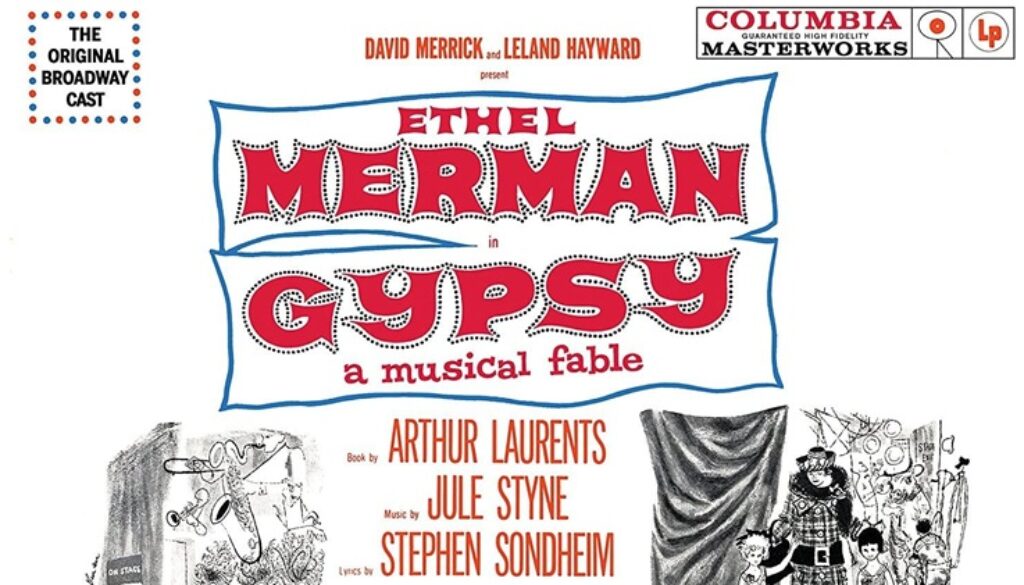
Music by Jule Styne · Lyrics by Stephen Sondheim · Book by Arthur Laurents
The show that has been called Broadway’s own answer to King Lear.
Broadway’s Answer to King Lear
Gypsy: A Musical Fable is a musical with music by Jule Styne, lyrics by Stephen Sondheim, and a book by Arthur Laurents. It is loosely based on the 1957 memoirs of striptease artist Gypsy Rose Lee, and focuses on her mother, Rose, whose name has become synonymous with the ultimate stage mother. It follows Rose’s relentless drive to raise her two daughters as performers — and her devastating reckoning with the truth of her own ambitions.
It is frequently considered one of the crowning achievements of mid-twentieth century musical theatre — often referred to simply as the greatest American musical ever written. The character of Louise is based on Gypsy Rose Lee herself, while the character of June is based on Lee’s sister, the actress June Havoc. The domineering, tragic, magnificent Mama Rose is based on their real mother, Rose Thompson Hovick.
What the Critics Said
Ben Brantley of The New York Times called it “what may be the greatest of all American musicals.”
Frank Rich described Rose as “a monster” — but one of mythic, theatrical power. Clive Barnes called Gypsy “one of the best of musicals” and described Rose as “one of the few truly complex characters in the American musical.”
Sondheim himself explained the character’s depth: “She’s a very American character, a gallant figure and a life force.” He also noted the show’s refusal to offer easy comfort: “It’s not Rodgers and Hammerstein, but you feel maybe the mother and daughter will come to an understanding and maybe triumph over Rose’s craziness and Louise’s bitterness.”
How Gypsy Was Created
Producer David Merrick first encountered Gypsy Rose Lee’s story after reading a chapter of her memoirs in Harper’s Magazine. He approached Lee to obtain the rights and brought director Jerome Robbins and co-producer Leland Hayward on board. Arthur Laurents — initially uninterested — came on board to write the book when he recognised the story as fundamentally about parents living through their children.
The Sondheim Question
Both Irving Berlin and Cole Porter were approached to write the score — and both declined. Robbins then turned to Stephen Sondheim, who agreed. However, Ethel Merman — already attached as Rose — did not want an unknown composer and pushed for the more established Jule Styne to write the music.
Sondheim initially refused to write lyrics only, but was persuaded by his mentor Oscar Hammerstein II to accept the role. It proved to be one of the most significant creative decisions in Broadway history — Styne’s driving, theatrical melodies paired with Sondheim’s psychologically precise lyrics produced a score of extraordinary power and sophistication.
Several songs were cut during the pre-Broadway tryout, including a number for Herbie called “Nice She Ain’t” (cut because actor Jack Klugman could not memorise the staging in time), and a number for the young girls called “Mama’s Talkin’ Soft”, which was cut partly because the staging required young actresses to stand on an elevated platform, which terrified the child playing Baby Louise. The latter was later recorded by Petula Clark as a UK single in 1959.
The Story: Life on the Road
Act One — Baby June and Her Newsboys
The story opens in the early 1920s with Baby June and her older sister Louise performing on the vaudeville circuit, steered relentlessly by their mother Rose. June is the extroverted star; Louise is shy and perpetually in the background. Rose dreams of stardom for her daughters, but her own father refuses to finance those dreams. She meets former agent Herbie and persuades him to become their manager — and he falls under her spell.
As the girls grow up, June is offered a place at a Performing Arts school — which Rose refuses, unwilling to break up the act. Through Herbie’s work, their act grows, but the vaudeville industry is dying around them. One of the act’s boys, Tulsa, secretly prepares his own act — and June, exhausted and suffocated by her mother, elopes with him. Rose is devastated — but immediately pivots: she will make Louise a star instead.
Everything’s Coming Up Roses
Rose’s furious, electrifying declaration at the close of Act One — that she will redirect all her ambitions toward Louise — is one of the most celebrated curtain moments in all of musical theatre. It is not a moment of triumph but one of almost terrifying self-delusion: a woman refusing to acknowledge reality, powered entirely by will and hunger.
Act Two — Burlesque and the Birth of Gypsy Rose Lee
Louise is now a young woman, and Rose has constructed a pale imitation of the old act around her. With vaudeville venues vanishing, they wind up accidentally booked at a burlesque house in Wichita, Kansas. Rose is horrified, but Louise persuades her the wages are better than nothing.
Three of the strippers on the bill — Tessie Tura, Mazeppa, and Electra — advise Louise on the art of burlesque: the key is a gimmick, something that makes your performance unique. When the evening’s headlining stripper is arrested on the day of closing, Rose volunteers Louise as a last-minute replacement. Herbie, disgusted at how far Rose has stooped, walks out for good.
Louise goes on — hesitant and nervous — but discovers something: her gimmick is not stripping at all, but speaking directly to the audience, teasing rather than delivering. With each successive performance, she grows bolder, more assured, more magnetic. Louise disappears — and Gypsy Rose Lee is born, a genuine burlesque star.
Rose’s Turn — The Show’s Devastating Climax
At Louise’s dressing room, mother and daughter have their great confrontation. Rose finally admits what she has never been able to say: that everything she did — every dream, every push, every sacrifice — was never truly about June or Louise. It was always about herself. The stardom she hungered for was her own.
In the extraordinary final aria Rose’s Turn, the name “ROSE” blazes in neon as she performs for an empty stage — a vision of the spotlight she was always denied. It is one of the most devastating and psychologically complex moments in all of musical theatre: triumph and tragedy, madness and lucidity, all at once.
The ending varies across productions. The original suggests a tentative reconciliation. Later revivals have offered darker readings — in 1974 and 2008, Louise simply walks away, leaving Rose alone with her fading dreams.
The Score
The Styne-Sondheim score for Gypsy is widely regarded as one of the greatest in Broadway history — every number a precise expression of character, every song advancing the story while revealing the interior lives of the people singing it. The original cast recording won the Grammy Award for Best Original Cast Album.
| Act | Song Title | Sung By | Significance |
|---|---|---|---|
| I | May We Entertain You | Baby June & Baby Louise | Opening act; becomes the recurring theme of Louise’s transformation |
| I | Some People | Rose | Rose’s manifesto — her refusal to live a small life |
| I | Small World | Rose & Herbie | Rose seduces Herbie into becoming their manager; Grammy-nominated |
| I | Baby June and Her Newsboys | Company | The act at its peak vaudeville success |
| I | Mr. Goldstone, I Love You | Rose & Company | Comic celebration of a booking agent who could change their fortunes |
| I | Little Lamb | Louise | Louise’s quiet birthday lament — her invisibility in her own life |
| I | You’ll Never Get Away From Me | Rose & Herbie | Rose’s seductive hold over Herbie |
| I | If Momma Was Married | June & Louise | The girls’ wry fantasy of a normal life |
| I | All I Need Is the Girl | Tulsa | Tulsa’s dream of his own act — and Louise’s secret longing |
| I | Everything’s Coming Up Roses | Rose | Act One’s magnificent, terrifying curtain number — a standard |
| II | Together, Wherever We Go | Rose, Herbie & Louise | The three clinging together as vaudeville dies around them |
| II | You Gotta Get a Gimmick | Tessie, Mazeppa & Electra | The strippers’ comic masterclass in burlesque performance |
| II | Let Me Entertain You | Louise / Gypsy | Louise’s transformation from shy girl to burlesque star, performance by performance |
| II | Rose’s Turn | Rose | The show’s devastating climax — Rose’s confession and breakdown |
The Original Broadway Production (1959)
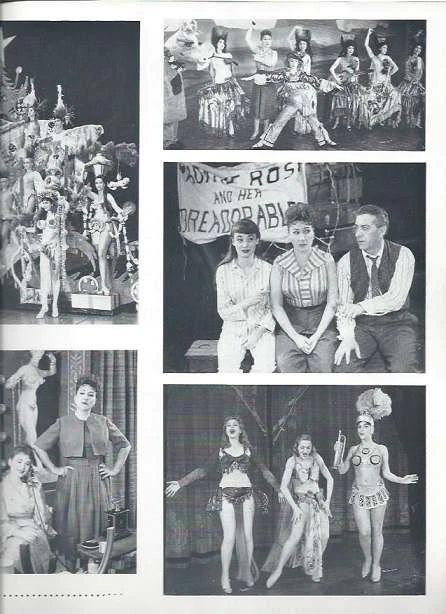
The original Broadway production opened on May 21, 1959, at The Broadway Theatre, later transferring to the Imperial Theatre, where it closed on March 25, 1961, after 702 performances and two previews. The show was produced by David Merrick and directed and choreographed by Jerome Robbins.
The Original Cast
- Rose Hovick — Ethel Merman
- Herbie — Jack Klugman
- Louise / Gypsy Rose Lee — Sandra Church
- Baby June / Dainty June — Jacqueline Mayro / Lane Bradbury
- Tessie Tura — Maria Karnilova
- Mazeppa — Faith Dane
- Electra — Chotzi Foley
- Tulsa — Paul Wallace
- Direction & Choreography — Jerome Robbins
- Scenic & Lighting Design — Jo Mielziner
- Orchestrations — Sid Ramin & Robert Ginzler
The production received eight Tony Award nominations, including Best Musical — but won none, losing in a year of fierce competition. The original Broadway cast recording, however, won the Grammy Award for Best Original Cast Album, and Small World received a Grammy nomination for Song of the Year.
Critic Frank Rich has referred to Jerome Robbins’ staging as one of the most influential direction-and-choreography achievements in American theatrical history. Merman’s performance as Rose — a role she ran for the entire Broadway run and subsequent national tour — is widely considered the defining interpretation of the character, against which all others have been measured.
Merman and the Tony That Got Away
Despite near-universal critical consensus that Ethel Merman’s Rose was one of the greatest performances in Broadway history, she lost the Tony Award to her close friend Mary Martin in The Sound of Music. Merman reportedly quipped with dry humour: “How are you going to buck a nun?” It remains one of the most famous losses in Tony history.
When the show closed, two national touring companies took the production on the road. Merman led the first, opening in Rochester in March 1961 and closing in St. Louis in December 1961. A young Bernadette Peters appeared in the ensemble of the second national company — four decades before she would play Rose herself on Broadway.
The Broadway Revivals
No musical in Broadway history has attracted a more distinguished succession of leading ladies than Gypsy. Each revival has brought a new, definitive interpretation of Mama Rose — and each has reaffirmed the show’s status as the gold standard of the American musical.
West End & International Productions
Notable Regional Productions
Among significant US regional productions: Betty Buckley and Deborah Gibson starred at the Paper Mill Playhouse in Millburn, New Jersey. Leslie Uggams played Rose at Connecticut Repertory Theatre in July 2014, becoming the first African-American woman to portray Rose in an Equity production. Tovah Feldshuh played Rose at the Bristol Riverside Theatre (Pennsylvania) in 2011–12. In 2012, Australian musical theatre actress Caroline O’Connor headlined a Leicester production.
Mama Rose: One of Theatre’s Greatest Characters
Mama Rose stands alone in the American musical theatre — a character so rich, so layered, and so theatrically demanding that she has drawn the greatest performers of each generation to the role. She is simultaneously monstrous and sympathetic, deluded and perceptive, destructive and fiercely loving.
How the Roses Have Described Her
Patti LuPone: “She has tunnel vision, she’s driven, and she loves her kids…. And she is a survivor. I do not see her as a monster at all — she may do monstrous things, but that does not make a monster.”
Bernadette Peters: “Rose was a woman who was traumatized by her own mother leaving her at an early age. I think that longing for acceptance is what fuels all her ambition. In the end, when she confronts herself in Rose’s Turn, she realizes she has failed her daughter just as her own mother failed her… and that destroys Rose.”
Stephen Sondheim on Rose: “The fact that she’s monstrous to her daughters and the world is secondary. She’s a very American character, a gallant figure and a life force.”
Walter Kerr observed that though Rose is a monster, she must be liked and understood — otherwise the show has no heart.
Critic Ben Brantley described Rose as “traditionally presented as an armored tank on autopilot, which finally crashes only minutes before the final curtain.” Bernadette Peters’ 2003 interpretation challenged that tradition entirely — finding vulnerability, even tragedy, at Rose’s core — and was hailed by Brantley as having “broken the Merman mold completely.”
Frequently Asked Questions
A Legacy Without Equal
Gypsy: A Musical Fable has now been on stages around the world for more than six decades. It has never stopped being performed. It has never stopped attracting the greatest performers of each era to its central role. And it has never stopped being discussed as the single most complex, most psychologically truthful, most demanding achievement in the Broadway canon.
Its songs — Everything’s Coming Up Roses, Rose’s Turn, Small World, You Gotta Get a Gimmick — have become part of the permanent vocabulary of American popular culture. Its central character, Mama Rose, has become the definitive archetype of the stage mother in theatrical history — and one of the most complex human portraits the musical theatre has ever produced.
The Show That Defines Broadway
More than any other musical, Gypsy encapsulates what Broadway does best: it takes the melodrama and spectacle of popular entertainment and uses them to excavate genuine psychological and emotional truth. It is at once a raucous showbiz comedy, a mother-daughter tragedy, a portrait of self-deception, and a meditation on the cost of ambition.
Every decade brings a new star to the role of Rose, and every decade the show reveals something new — about ambition, about love, about the stories we tell ourselves to survive. That is why Gypsy endures. Not because it is comfortable or reassuring, but because it is, as Sondheim said, profoundly, unflinchingly true.