How to Succeed in Business Without Really Trying Musical – History & Reviews
How to Succeed in Cynical Corporate Cheat Code
Memorabilia Available Here
How to Succeed in Business Without Really Trying
The Pulitzer Prize-Winning Musical Comedy That Defined an Era
Award-Winning Excellence
The original production won seven Tony Awards, the New York Drama Critics’ Circle award, and the prestigious 1962 Pulitzer Prize for Drama. It was only the fourth musical ever to win the Pulitzer Prize, following Of Thee I Sing (1932), South Pacific (1950), and Fiorello! (1960).
Origins and Development
In 1952, Shepherd Mead’s satirical book, How to Succeed in Business Without Really Trying, became a bestseller. Playwrights Willie Gilbert and Jack Weinstock created a dramatic interpretation in 1955 that remained unproduced for five years. Agent Abe Newborn brought the work to the attention of producers Cy Feuer and Ernest H. Martin, who had great success with the 1950 adaptation of Guys and Dolls.
Feuer and Martin brought in the creative team from Guys and Dolls to work on How to Succeed. Burrows and Loesser set to work on the new adaptation, with rehearsals beginning in August 1961. Burrows collaborated on the book with Jack Weinstock and Willie Gilbert while also serving as director. Their new adaptation became even more satirical and added romance to the story. Loesser wrote both music and lyrics for the show, which was orchestrated by Robert Ginzler.
The Choreography Mystery
An interesting behind-the-scenes story involves the choreography credit. The original Broadway production credited choreography to Hugh Lambert, while the legendary Bob Fosse received only a “musical staging by…” credit. According to Abe Burrows’ autobiography, producer Cy Feuer hired Lambert after seeing an elaborate dance number he created for a trade show. However, it soon became clear in rehearsals that Lambert’s creative abilities were completely used up in that one dance number. Bob Fosse was brought in to replace him, but Fosse was unwilling to hurt Lambert’s career by having him fired. Lambert’s trade-show dance number was recycled as the “Treasure Hunt” dance, while Fosse agreed to take a “musical staging” credit for choreographing all the other dance numbers.
Plot Synopsis
Act I
J. Pierrepont Finch, a young window cleaner in New York City, reads the book How to Succeed in Business Without Really Trying as he works. The “Book Voice” tells him that he will succeed if he follows the book’s advice. He enters the World Wide Wicket Company searching for a job.
Finch bumps into J. B. Biggley, the president of the company, who dismisses him to the personnel manager, Mr. Bratt. Rosemary Pilkington, an ambitious young secretary, helps Finch meet Mr. Bratt. Finch tells Bratt that Biggley sent him, and Bratt gives him a job in the mailroom, where he works with Mr. Biggley’s lazy, arrogant, and nepotism-minded nephew Bud Frump.
Rosemary dreams of a life with Finch in the suburbs (“Happy To Keep His Dinner Warm”). The fatigued workers rush to get their coffee break (“Coffee Break”). In the mailroom, Finch earns favor with the long-time head of the mailroom, Mr. Twimble, who tells him the secret to longevity at the company (“The Company Way”).
When Twimble is promoted to head of the shipping department and has to choose his replacement, the book warns Finch not to stay in the mailroom too long, so Finch recommends Frump instead of himself. Twimble is reluctant to promote the lazy Frump, but Frump promises to be a good employee. Twimble and Bratt are impressed by Finch’s apparent selflessness, and Bratt offers him a job as a junior executive in the Plans and Systems department.
An extremely attractive but air-headed woman named Hedy LaRue, who is Mr. Biggley’s secret mistress, is hired as a secretary. On her first day of work, the male employees are instantly attracted to her, but Mr. Bratt warns them against taking advantage (“A Secretary Is Not a Toy”).
Finch learns from Mr. Biggley’s secretary, Miss Jones, that Biggley is a proud alumnus of Old Ivy College. Arriving early Saturday morning, Finch sets up the office so it looks like he has been working all night. Biggley believes Finch’s ruse, and Finch convinces Biggley that he, too, is a proud alumnus of Old Ivy (a “Groundhog”), and they sing the Old Ivy fight song (“Grand Old Ivy”). With the book’s help, Finch realizes that Biggley must be Hedy’s advocate and sends her on an errand to Gatch, knowing that Gatch will make a pass at her. Gatch falls for the trap and is dispatched to Venezuela, and Finch is promoted to his position as head of Plans and Systems.
At a reception for the new Advertising Department head, Benjamin Burton Daniel Ovington, Rosemary hopes to impress Finch with her new “Paris original” dress, but all the other women arrive wearing the same dress (“Paris Original”). After some farcical complications, Ovington is forced to resign when Biggley learns that he is a graduate from Northern State, Old Ivy’s bitterest rival (a “Chipmunk”). Biggley names Finch vice-president in charge of advertising, and Finch and Rosemary declare their love for each other, while Bud Frump vows revenge (“Act I Finale”).
Act II
Two days later, Rosemary has been neglected by Finch. She decides to quit, but her fellow secretaries convince her to stay because she’s living their dream of marrying an executive (“Cinderella, Darling”).
The book warns Finch that because vice-president of advertising is a bad position, he needs a brilliant idea. Bud Frump slyly tells Finch his idea for a treasure hunt, which Finch loves, unaware that Biggley has already heard the idea and rejected it. Finch shares the idea with Rosemary, who tells him that she’ll stay with him no matter what happens. Hedy tells Biggley that she is unhappy as a secretary and is leaving for California. He begs her to stay and tells her he loves her, and she agrees to stay (“Love From a Heart of Gold”). In the executive washroom, Finch gives himself a pep talk while, behind his back, the other executives and Frump plot against him (“I Believe In You”).
Finch presents “his” idea to Biggley: he will hide five thousand shares of company stock in each of the ten offices around the country and give a television audience weekly clues as to their whereabouts. Biggley accepts this idea when Finch explains that each clue will be given by the scantily-dressed World Wide Wicket Treasure Girl: Miss Hedy LaRue.
During the first television show, Hedy is asked to swear on a Bible that she doesn’t know the location of the prizes. Hedy panics and reveals the locations to the entire television audience, which prompts all the Wicket employees to tear apart the offices looking for them.
The executives, including Chairman of the Board Wally Womper, are waiting in Biggley’s office for Finch’s resignation. About to sign his letter of resignation, Finch mentions that he’ll probably go back to washing windows. Womper is drawn to Finch as he, too, was a window washer and they both “had a book”: Wally’s book was a book of betting records. Finch blames the treasure hunt on Frump, also mentioning that Frump is Biggley’s nephew. Womper is about to “clean house from top to bottom,” when Finch steps in on everyone’s behalf. Finch tells the executives that even though the business world is a place filled with betrayal and competitiveness, the World Wide Wicket staff is like a family to him (“Brotherhood of Man”).
Everyone is spared except Frump, who is fired because he is Biggley’s nephew. Biggley remains president, Womper retires to travel the world with his new wife, Hedy, and Finch becomes chairman of the board. Rosemary stands by his side and inadvertently inspires him to aspire for the Presidency of the United States. Frump gets a job washing windows, swearing revenge against Finch (“Company Way (Finale)”).
Characters
Major Characters
- J. Pierrepont Finch – A window washer who applies for a job at the World Wide Wicket Company and climbs the corporate ladder with the help of a how-to book
- Rosemary Pilkington – A secretary at the World Wide Wicket Company who instantly falls in love with Finch
- J. B. Biggley – The boss of the World Wide Wicket Company and proud alumnus of Old Ivy College
- Bud Frump – Biggley’s arrogant and lazy nephew who becomes Finch’s rival
- Hedy LaRue – Biggley’s attractive and dim-witted mistress
Supporting Characters
- Miss Jones – Biggley’s immovable secretary who is charmed by Finch
- Book Voice – The “voice” of the book How to Succeed in Business Without Really Trying, which narrates the musical
- Mr. Bert Bratt – Personnel manager
- Mr. Twimble – Head of the mail room for 25 years; finally gets promoted to the shipping department (traditionally played by the same actor as Wally Womper)
- Smitty – Rosemary’s best friend and fellow secretary
- Mr. Milton Gatch – Head of the Plans and Systems department
- Miss Krumholtz – A secretary of Mr. Gatch, then of J. Pierrepont Finch
- Mr. Benjamin Burton Daniel Ovington (BBDO) – Head of the advertising department until Finch reveals he graduated from Biggley’s college’s arch-rival
- Mr. Wally Womper – The chairman of the World Wide Wicket Company
Major Productions
Original Broadway Production (1961-1965)
The original Broadway production starred Robert Morse as Finch, Bonnie Scott as Rosemary, Charles Nelson Reilly as Bud Frump, and Rudy Vallée as J. B. Biggley. Virginia Martin played Hedy LaRue.
The production was directed by Abe Burrows with choreography credited to Hugh Lambert and “musical staging” by Bob Fosse. It ran for an impressive 1,417 performances and became one of the most successful musicals of the 1960s.
West End Production (1963)
The West End production was also directed by Burrows and Bob Fosse, featuring a new London cast. Warren Berlinger and Billy De Wolfe starred as Finch and Biggley respectively, with Patricia Michael as Rosemary, Josephine Blake as Smitty, David Knight as Bud Frump, Olive Lucius as Miss Jones, Bernard Spear as Mr. Twimble, and Eileen Gourlay as Hedy LaRue.
Australian Production (1963)
The Australian production presented by J. C. Williamson’s starred Len Gochman as Finch, with Betty McGuire as Hedy, and Annabelle Adams as Rosemary. The show toured across Australia, playing seasons in Sydney, Perth, and Adelaide. Nancye Hayes, who started in the ensemble, would later replace Betty McGuire as Hedy.
First Broadway Revival (1995-1996)
The first Broadway revival opened at the same theatre as the original production (by then renamed the Richard Rodgers Theatre). It was directed by Des McAnuff and choreographed by Wayne Cilento, with musical direction by Ted Sperling.
Matthew Broderick starred as Finch and Rosemary was played by Megan Mullally. The cast also included Ronn Carroll as J. B. Biggley, Victoria Clark as Smitty, and Jeff Blumenkrantz as Bud Frump. In a pre-recorded performance, Walter Cronkite served as the Book Voice.
The replacements for Mullally and Broderick were Broderick’s future wife Sarah Jessica Parker as Rosemary and John Stamos as Finch. Ralph Macchio was offered the role of Finch when Broderick left the show, but opted to take the role in the touring cast instead. Broderick made a brief return to the show so he could star opposite Parker.
The wardrobe was designed by Susan Hilferty and is on display at the Costume World Broadway Collection in Pompano Beach, Florida.
National Tour (1996-1997)
A national tour ran from Baltimore in May 1996 and ended in Milwaukee in June 1997, with stops including Sacramento, Portland, and Seattle. The national tour cast featured Ralph Macchio as J. Pierrepont Finch, Shauna Hicks as Rosemary Pilkington, Richard Thomsen as J. B. Biggley, Pamela Blair as Hedy LaRue, and Roger Bart as Bud Frump. Both Macchio and the production played to favorable reviews.
Second Broadway Revival (2011-2012)
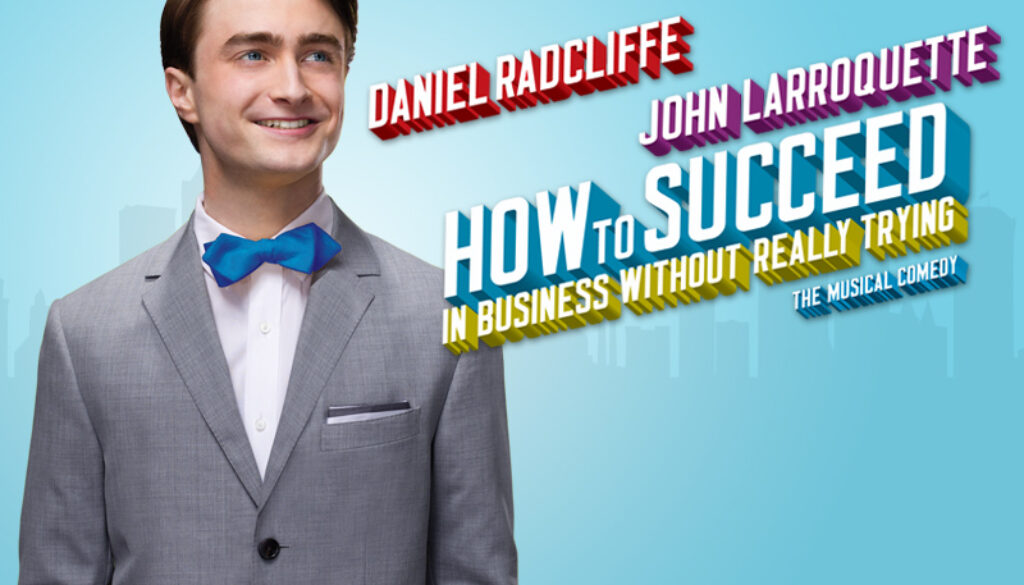
The 50th-anniversary Broadway revival was directed and choreographed by Rob Ashford. Daniel Radcliffe starred as Finch for ten months, with the production beginning previews on February 26, 2011. Other cast members included John Larroquette as J. B. Biggley, Rose Hemingway as Rosemary Pilkington, Mary Faber as Smitty, Tammy Blanchard as Hedy La Rue, and Christopher Hanke as Bud Frump. Anderson Cooper recorded the Voice of the Book for the production.
The production was nominated for nine 2011 Tony Awards, including for director-choreographer Rob Ashford and as Best Revival of a Musical. John Larroquette won the Tony Award for Best Featured Actor in a Musical.
Darren Criss succeeded Radcliffe in the role of J. Pierrepont Finch for a limited three-week engagement from January 3-22, 2012. Criss was awarded the Broadway.com Audience Choice Award for Favorite Replacement for his performance in this role. Beau Bridges replaced John Larroquette as J. B. Biggley starting January 3, 2012.
Nick Jonas took over the role of Finch on January 24, 2012, and was nominated for a 2012 Broadway Beacon Award for his performance. Michael Urie replaced Christopher Hanke in the role of Bud Frump starting on January 24, 2012. A cast recording was released by Decca Broadway on June 7, 2011.
Off-West End Gender-Fluid Revival (2023)
An off-West End gender-fluid revival of the show ran from May to June 2023. It included Olivier winner Tracie Bennett in the role of J. B. Biggley and featured Michelle Visage as the voice of “the book.”
Film and Television Adaptations
1967 Film
In 1967, United Artists released a film adapted and directed by David Swift. Robert Morse, Rudy Vallée, Michele Lee (who replaced Bonnie Scott as Rosemary during the show’s Broadway run), Sammy Smith and Ruth Kobart recreated their roles for the film, and Fosse again choreographed.
Several songs were omitted from the score, such as “Love From a Heart of Gold,” “Happy to Keep His Dinner Warm,” “Cinderella Darling,” “Paris Original,” and “Coffee Break,” although there are musical and verbal references respectively to the last two. In the film’s finale, Frump was among the entire company singing a finale version of “The Company Way.”
1975 Television Production
The musical was adapted by Burrows for a television production starring Alan Bursky, Susan Blanchard and Larry Haines, directed by Burt Brinckerhoff. The production aired as an ABC Comedy Special on June 27, 1975.
Critical Reception
Original Production (1961)
The original 1961 Broadway production opened to unanimously positive reviews, one of only eight musicals that opened on Broadway between 1943 and 1964 that did so.
— Howard Taubman, New York Times
Taubman praised the show’s “adult viewpoint and consistency of style,” stating that Burrows had “directed brilliantly” and that Loesser had “written lyrics with an edge and tunes with a grin…the songs sharpen the ridicule.” He stated Robert Morse played Finch “with unfailing bravura and wit,” pronouncing Finch, as portrayed by Morse, “a rumpled, dimpled angel with a streak of Lucifer.”
— John Chapman, Daily News
Chapman declared that “Loesser is the perfect man for his end of the show – the songs; for he is a cynic without being tough. He has not put in a note of music or a syllable of lyric that doesn’t carry the story along.”
— Richard Watts Jr., New York Post
In the New York Herald Tribune, critic Walter Kerr stated: “Not a sincere line is spoken in the new Abe Burrows-Frank Loesser musical, and what a relief that is…How to Succeed is crafty, conniving, sneaky, cynical, irreverent, impertinent, sly, malicious, and lovely, just lovely.” He opined that Burrows was most responsible for the musical’s success, pronouncing, “What most distinguishes a sassy, gay, and exhilarating evening is–you’ll never believe this–the book.”
— John McClain, New York Journal American
McClain particularly noted Bob Fosse’s choreography, saying that his dances were “a whole new chapter in ingenuity.”
2011 Revival Reception
In contrast, reviews of the 2011 Broadway revival were more mixed. New York Times chief theater critic Ben Brantley warned that the show’s book writers “failed to give Ponty any defining traits beyond all-consuming ambition” and that “you don’t particularly want [Daniel Radcliffe’s] character in the show to succeed, and that really is a problem.”
Charles McNulty of the Los Angeles Times opined that the musical “is hampered by a dated book” and that its “episodic structure now seems as belabored as a sitcom plucked from a rusty time capsule,” while “all the romantic brouhaha with moony secretaries is beyond retro.”
Awards and Recognition
Historic Achievement
The show was the second musical in three years to win the top three theatre awards – Tony, the New York Drama Critics Circle award, and the Pulitzer Prize – following the success of Fiorello!. It was only the fourth musical to win the Pulitzer after Of Thee I Sing (1932), South Pacific (1950) and Fiorello! (1960).
1961-1962 Original Production Awards
| Award | Category | Nominee | Result |
|---|---|---|---|
| Tony Awards | Best Musical | How to Succeed… | Won |
| Tony Awards | Best Author of a Musical | Abe Burrows, Jack Weinstock, Willie Gilbert | Won |
| Tony Awards | Best Producer of a Musical | Cy Feuer, Ernest H. Martin | Won |
| Tony Awards | Best Director | Abe Burrows | Won |
| Tony Awards | Best Actor in a Musical | Robert Morse | Won |
| Tony Awards | Best Featured Actor in a Musical | Charles Nelson Reilly | Won |
| Tony Awards | Best Musical Director and Conductor | Elliot Lawrence | Won |
| Grammy Awards | Best Original Cast Album | How to Succeed… | Won |
| New York Drama Critics’ Circle | Best Musical | How to Succeed… | Won |
| Pulitzer Prize | Drama | How to Succeed… | Won |
1995 Broadway Revival Awards
| Award | Category | Nominee | Result |
|---|---|---|---|
| Tony Awards | Best Revival of a Musical | How to Succeed… | Nominated |
| Tony Awards | Best Actor in a Musical | Matthew Broderick | Nominated |
2011 Broadway Revival Awards
| Award | Category | Nominee | Result |
|---|---|---|---|
| Tony Awards | Best Revival of a Musical | How to Succeed… | Nominated |
| Tony Awards | Best Featured Actor in a Musical | John Larroquette | Won |
| Tony Awards | Best Direction of a Musical | Rob Ashford | Nominated |
| Tony Awards | Best Choreography | Rob Ashford | Nominated |
| Grammy Awards | Best Musical Theater Album | How to Succeed… | Nominated |
Legacy
How to Succeed in Business Without Really Trying remains one of the most celebrated musicals of the 1960s and a landmark in American musical theatre history. Its sharp satire of corporate culture, memorable score by Frank Loesser, and clever book by Abe Burrows and collaborators have ensured its place in the Broadway canon. The musical’s success spawned multiple revivals, international productions, film and television adaptations, and continues to be performed by professional and amateur theatre companies around the world.
The show’s examination of ambition, corporate politics, and the American dream resonates across generations, even as some aspects of its portrayal of workplace dynamics and gender roles reflect the era in which it was written. Its satirical edge and comedic brilliance have allowed it to endure as a quintessential example of musical comedy at its finest.