South Pacific Musical: The Complete Guide — Rodgers & Hammerstein’s Pulitzer Prize Masterpiece
South Pacific - Podcast
Mary Martin • Ezio Pinza
South Pacific
Book by Oscar Hammerstein II and Joshua Logan
Based on Tales of the South Pacific by James A. Michener
Directed by Joshua Logan • Sets by Jo Mielziner
Some Enchanted
Evening — A Masterpiece
Is Born
South Pacific is a musical composed by Richard Rodgers, with lyrics by Oscar Hammerstein II and book by Hammerstein and Joshua Logan. Based on James A. Michener’s Pulitzer Prize-winning 1947 short story collection Tales of the South Pacific, it premiered on Broadway on 7 April 1949 at the Majestic Theatre and ran for 1,925 performances — the second-longest-running Broadway musical to that point (behind Rodgers and Hammerstein’s own Oklahoma!).
The plot centres on an American Navy nurse, Nellie Forbush, who falls in love with a sophisticated middle-aged French plantation owner, Emile de Becque, but struggles to accept his mixed-race children. A secondary romance — between US Marine Lieutenant Joe Cable and a young Tonkinese woman, Liat — explores the consequences of interracial love. Racial prejudice is candidly explored throughout, most controversially in Cable’s song “You’ve Got to Be Carefully Taught.”The show won the Pulitzer Prize for Drama in 1950 and ten Tony Awards including Best Musical, Best Score, and Best Libretto — the only musical ever to win Tonys in all four acting categories. Its original cast album was the bestselling record of the 1940s. Starring Mary Martin and Ezio Pinza, its songs — “Some Enchanted Evening,” “Bali Ha’i,” “I’m Gonna Wash That Man Right Outa My Hair,” “There Is Nothing Like a Dame,” “Happy Talk,” “Younger Than Springtime,” “I’m in Love with a Wonderful Guy” — became immortal American standards.
The Racial Message — Bold and Unapologetic
Rodgers and Hammerstein believed they could write a financially successful musical that sent a strong progressive message on racism. South Pacific argued that racial prejudice is a learned behaviour — “You’ve Got to Be Carefully Taught” — and dramatised its human cost across two intertwined love stories. In the Southern US the show provoked controversy; Georgia state legislators introduced a bill to ban it, arguing the themes were “communist.” Rodgers and Hammerstein were utterly unapologetic. They had not intended to write a message musical — but the message was the point.
The Source —
Michener’s Tales
James Michener and Tales of the South Pacific
Although a birthright Quaker, James Michener enlisted in the US Navy in 1942, assigned to write a history of the Navy in the Pacific. He survived a plane crash in New Caledonia; the experience motivated him to write fiction. On Espiritu Santo, he met the real “Bloody Mary” — small, almost toothless, face stained with betel juice. On the Treasury Islands, he found a village called Bali-ha’i, populated by “scrawny residents and only one pig.” His collection Tales of the South Pacific won the 1948 Pulitzer Prize for Fiction. He accepted 1% of gross receipts rather than the $500 outright offered — a decision he never regretted.
The Two Source Stories — “Fo’ Dolla'” and “Our Heroine”
The musical draws primarily from two tales. “Fo’ Dolla'” tells of Marine Lieutenant Joe Cable and Tonkinese Liat — Cable’s inability to overcome his racial prejudice prevents him from marrying her. “Our Heroine” tells of nurse Nellie Forbush’s romance with French planter Emile de Becque, and her struggle to accept his Polynesian children. Rodgers and Hammerstein combined both stories, expanded the comic character Luther Billis, and shortened the title — reportedly because the producers tired of risqué puns on the word “tales.”
Creation — Rodgers, Hammerstein, Logan and the Speed of Genius
Following Allegro‘s comparative disappointment, Rodgers and Hammerstein were determined to produce another hit. Director Joshua Logan brought Michener’s book to their attention. Logan, a military veteran, became essential to writing the book because Hammerstein had no military knowledge — he ultimately received co-writing credit though no author’s royalties, a dispute that simmered for decades. Rodgers composed with legendary speed: “Happy Talk” in about twenty minutes; “Bali Ha’i”‘s defining three-note motif sketched in ten minutes over coffee. The lyric for “Bali Ha’i” was inspired by a mist-painted backdrop by designer Jo Mielziner.
Casting — Martin, Pinza and the Perfect Pairing
Ezio Pinza — a former Metropolitan Opera bass who had become bored with opera — was cast as Emile. His contract limited singing to 15 minutes per performance. For Nellie, Mary Martin was reluctant to sing opposite Pinza’s powerful voice; Rodgers promised they would rarely sing simultaneously. Three songs into a private audition, Martin was captivated by “Some Enchanted Evening” — not her song — and agreed to the part. Martin’s own idea gave rise to “I’m Gonna Wash That Man Right Outa My Hair” — she had come up with it while showering during rehearsals. For Bloody Mary, African-American singer Juanita Hall simply squatted on stage at her audition and stared at the panel. Logan recalled: “I am Bloody Mary and don’t you dare cast anyone else!”
The Story —
A South Pacific Island, World War II
Act One — Love and Revelation
On a South Pacific island during WWII, two half-Polynesian children sing (“Dites-Moi”). Nellie Forbush — a sunny Navy nurse from Little Rock, Arkansas — has fallen for the sophisticated French planter Emile de Becque (“A Cockeyed Optimist,” “Twin Soliloquies”). Emile declares his love (“Some Enchanted Evening”). The American Seabees lament the absence of women (“There Is Nothing Like a Dame”). Bloody Mary introduces US Marine Lieutenant Joe Cable to the forbidden island of Bali Ha’i (“Bali Ha’i”). Nellie resolves to end things with Emile but reverses when he arrives — she washes him out of her hair but then can’t (“I’m Gonna Wash That Man Right Outa My Hair,” “I’m in Love with a Wonderful Guy”). On Bali Ha’i, Bloody Mary introduces Cable to her daughter Liat (“Younger Than Springtime”). After Emile’s party, he reveals Ngana and Jerome are his children by a now-dead Polynesian wife. Nellie, unable to overcome her prejudice, tearfully leaves him.
Act Two — Mission, Loss and Redemption
On Thanksgiving, the GIs perform a holiday revue. Bloody Mary urges Cable and Liat to marry; Cable cannot bring himself to commit to a Tonkinese girl and Bloody Mary furiously drags Liat away (“Happy Talk”). Nellie performs dressed as a sailor (“Honey Bun”). Cable, filled with self-loathing, sings that racial hatred is learned, not innate (“You’ve Got to Be Carefully Taught”). Emile, with nothing left to lose, agrees to join Cable’s espionage mission. The mission succeeds — but Cable is killed. Nellie, realising she was wrong, begins caring for Ngana and Jerome and comes to love them. As they teach her to sing “Dites-Moi” — Emile’s voice joins them. He has survived. Seeing that Nellie has overcome her prejudice, they are reunited.
The Songs —
Standards of the American Stage
The Characters
A naïve, sunny Navy nurse from Little Rock whose warmth is tested by deep-seated racial prejudice. Her journey from prejudice to acceptance is the show’s emotional heart.
A middle-aged French plantation owner who fled France after accidentally killing a man. Ezio Pinza — former Metropolitan Opera bass — became an unlikely Broadway sex symbol at 58.
A sassy Tonkinese vendor — simultaneously great comic figure and morally complex character — scheming to give daughter Liat a better life through marriage to an American officer.
A Princeton-educated Marine from a wealthy Philadelphia family who falls in love with Liat but cannot bring himself to marry her. Sings the show’s most explicit anti-racist statement: “You’ve Got to Be Carefully Taught.” Dies on the spy mission.
A crafty, lovable Seabee whose comic scheming ties together the show’s separate storylines. The only original cast member present at the final performance, January 1954.
Bloody Mary’s beautiful young daughter, who communicates with Cable only haltingly in French. The most poignant embodiment of the costs of Cable’s prejudice.
Original Broadway Cast — Majestic Theatre, 1949
| Character | Original Cast | Notes |
|---|---|---|
| Nellie Forbush | Mary Martin | Tony Award winner; left 1951 for London production |
| Emile de Becque | Ezio Pinza | Tony Award winner; left June 1950 for MGM film career |
| Bloody Mary | Juanita Hall | Tony Award winner — African-American singer |
| Lt. Joe Cable | William Tabbert | Logan had him lose 20lbs before rehearsal |
| Luther Billis | Myron McCormick | Tony Award winner; only original cast member at final performance |
| Liat | Betta St. John | Formerly Betty Striegler; had replaced Bambi Linn in Carousel |
Opening Night &
Reception
Tryouts — New Haven and Boston
Rehearsals began at the Belasco Theatre on 2 February 1949. Logan was “fiery, demanding, and brilliantly inventive” — his staging of the Seabees pacing like caged animals during “There Is Nothing Like a Dame” was so effective it was never changed. Tryouts in New Haven began 7 March; the New Haven Register wrote: “South Pacific should make history.” In Boston the demand was so extraordinary that playwright George S. Kaufman joked the queues “don’t actually want anything… they just want to push money under the doors.”
Opening Night — 7 April 1949
The advance sale was $400,000, with an additional $700,000 in immediate sales. The first-night audience repeatedly stopped the show with sustained applause. Rodgers and Hammerstein rented the St. Regis Hotel roof and ordered 200 copies of the New York Times. Times critic Brooks Atkinson gave a rave review. Steven Suskin: one of only eight Broadway musicals 1943–1964 to earn “unanimous raves from major first-night newspaper critics.” One critic simply called it “South Terrific.”
The Run and Final Night
The show ran 1,925 performances, closing 16 January 1954. Pinza left June 1950 (replaced by Ray Middleton). Martin left 1951 for the London production (replaced by Martha Wright, later Cloris Leachman). Despite the departure of both stars, the show remained a massive attraction. At the final performance, Myron McCormick — the only remaining original cast member — led performers and audience in “Auld Lang Syne.” The curtain was never lowered — it remained raised as the audience departed.
Major Productions
& Revivals
Stars Mary Martin and Ezio Pinza. Directed by Joshua Logan, sets by Jo Mielziner. Wins 10 Tony Awards and the Pulitzer Prize for Drama. Closes 16 January 1954.
Cleveland opening: 250,000 ticket requests for 48,000 available seats, forcing the box office to close for three weeks. Stars Janet Blair (Nellie), Richard Eastham (Emile), Ray Walston (Billis). Runs five years.
Stars Mary Martin, Wilbur Evans, Ray Walston, Muriel Smith. Future stars Sean Connery and Mary Martin’s son Larry Hagman played Seabees. On 30 January 1952 King George VI attended with Princess Elizabeth — he died less than a week later.
Stars Mitzi Gaynor (Nellie), Rossano Brazzi voiced by Giorgio Tozzi (Emile), John Kerr (Cable), Juanita Hall reprising Bloody Mary. Directed by Joshua Logan. Controversial for use of coloured filters during romantic scenes.
Timed to celebrate Richard Rodgers’s centenary. Directed by Trevor Nunn, musical staging by Matthew Bourne, designs by John Napier. Stars Lauren Kennedy (Nellie) and Philip Quast (Emile).
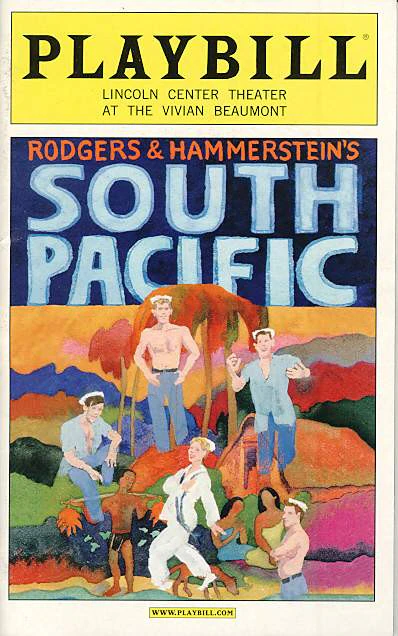
Directed by Bartlett Sher. Stars Kelli O’Hara (Nellie), Paulo Szot (Emile), Matthew Morrison (Cable), Danny Burstein (Billis), Loretta Ables Sayre (Bloody Mary). NYT: “I’m darned if I can find one serious flaw in this production.” Wins 7 Tony Awards. Broadcast live in HD on PBS. Closes 22 August 2010.
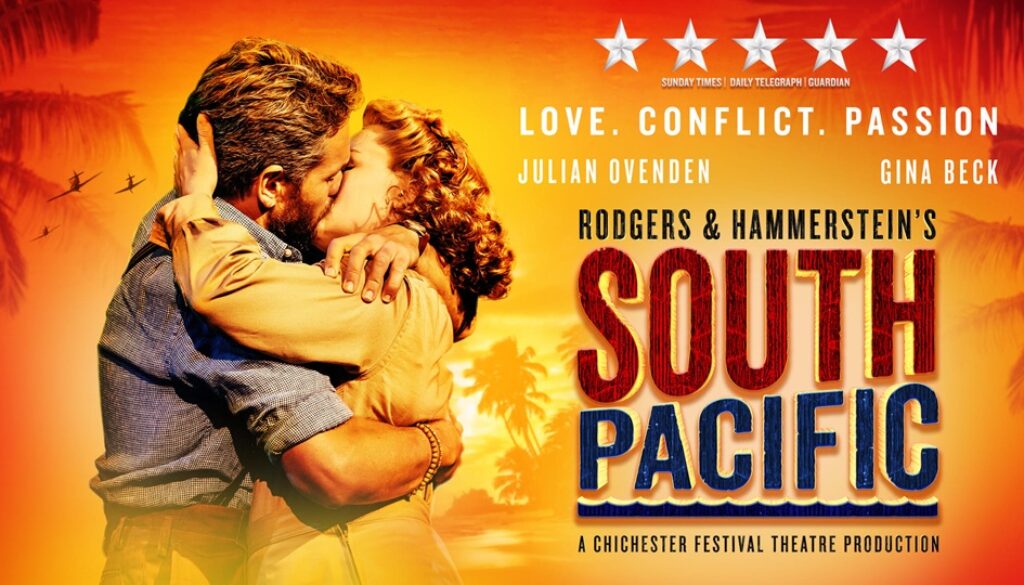
Directed by Daniel Evans; stars Gina Beck / Alex Young (Nellie), Julian Ovenden (Emile), Joanna Ampil (Bloody Mary). UK/Ireland tour runs July–November 2022. Receives positive reviews.
Awards &
Recognition
| Year | Award | Category | Nominee | Result |
|---|---|---|---|---|
| 1950 | Tony Award ✦ | Best Musical | South Pacific | Won ✦ |
| 1950 | Tony Award ✦ | Best Score | Rodgers & Hammerstein | Won ✦ |
| 1950 | Tony Award ✦ | Best Libretto | Hammerstein & Logan | Won ✦ |
| 1950 | Tony Award ✦ | Best Actress in a Musical | Mary Martin | Won ✦ |
| 1950 | Tony Award ✦ | Best Actor in a Musical | Ezio Pinza | Won ✦ |
| 1950 | Tony Award ✦ | Best Featured Actress | Juanita Hall | Won ✦ |
| 1950 | Tony Award ✦ | Best Featured Actor | Myron McCormick | Won ✦ |
| 1950 | Tony Award ✦ | Best Direction — Musical | Joshua Logan | Won ✦ |
| 1950 | Tony Award ✦ | Best Scenic Design | Jo Mielziner | Won ✦ |
| 1950 | Tony Award ✦ | Best Costume Design | Motley | Won ✦ |
| 1950 | Pulitzer Prize ✦ | Drama | South Pacific | Won ✦ |
| 2008 | Tony Award ✦ | Best Revival of a Musical | South Pacific 2008 | Won ✦ |
| 2008 | Tony Award ✦ | Best Actress in a Musical | Kelli O’Hara | Won ✦ |
| 2008 | Tony Award ✦ | Best Actor in a Musical | Paulo Szot | Won ✦ |
| 2008 | Tony Award ✦ | Best Featured Actress | Loretta Ables Sayre | Won ✦ |
| 2008 | Tony Award ✦ | Best Direction of a Musical | Bartlett Sher | Won ✦ |
| 2008 | Tony Award ✦ | Best Lighting Design | South Pacific 2008 | Won ✦ |
| 2008 | Tony Award ✦ | Best Sound Design | South Pacific 2008 | Won ✦ |
| 2008 | Tony Award | Best Featured Actor | Danny Burstein / Matthew Morrison | Nominated |
Links & Related
South Pacific — Memorabilia & Collectables Phantom of the Opera – Musical Rodgers & Hammerstein — Memorabilia Cabaret – Musical Kelli O’Hara — Theatre Memorabilia Ragtime – Memorabilia Anything Goes — Cole Porter Musical Guide Cole Porter Biography Mame – Memorabilia Starlight Express – Memorabilia