Sunset Boulevard | Andrew Lloyd Webber’s Gothic Musical Drama
Memorabilia Available Here
Sunset Boulevard
“I’m Ready for My Close-Up” — The Musical Phenomenon
Music by Andrew Lloyd Webber
Lyrics and Book by Don Black and Christopher Hampton
Based on the 1950 Billy Wilder Film
The Story of Faded Hollywood Star Norma Desmond
Overview
Sunset Boulevard is a musical with music by Andrew Lloyd Webber, and lyrics and libretto by Don Black and Christopher Hampton, based on the 1950 film. The plot follows Norma Desmond, a faded star of the silent-screen era, living in her decaying mansion on Sunset Boulevard in 1949 Los Angeles. When young screenwriter Joe Gillis accidentally crosses her path, she sees an opportunity to make her return to the big screen, with romance and tragedy to follow.
Opening first in London in 1993, the musical has had several long runs internationally and enjoyed extensive tours. However, it has been the subject of several legal battles and ultimately lost money due to its extraordinary running costs. The 1994 Broadway production was nominated for 11 Tony Awards, winning 7, including Best Musical. The 2023 West End revival was nominated for 11 Olivier Awards, winning 7, including Best Musical Revival. The 2024 Broadway revival was nominated for 7 Tony Awards and won 3, including Best Revival of a Musical.
Early Development Attempts
Gloria Swanson’s Boulevard! (1952-1957)
From approximately 1952 to 1956, Gloria Swanson worked with actor Richard Stapley and cabaret singer and pianist Dickson Hughes on a musical adaptation originally entitled Starring Norma Desmond, then Boulevard! It ended on a happier note than the film, with Norma Desmond allowing Joe Gillis to leave and pursue a happy ending with Betty Schaefer.
Rights holder Paramount Pictures originally had given Swanson verbal permission to proceed with the musical, but there had been no formal legal arrangement. On February 20, 1957, Paramount executive Russell Holman wrote to Swanson asking her to cease work on the project because “it would be damaging for the property to be offered to the entertainment public in another form as a stage musical.”
In 1994, Hughes incorporated material from the production into Swanson on Sunset, based on his and Stapley’s experiences in writing Boulevard!. A recording of the entire score was released on CD in 2008.
Stephen Sondheim’s Abandoned Project (Early 1960s)
In the early 1960s, Stephen Sondheim outlined a musical stage adaptation and went so far as to compose the first scene with librettist Burt Shevelove. A chance encounter with Billy Wilder at a cocktail party gave Sondheim the opportunity to introduce himself and ask the original film’s co-screenwriter and director his opinion of the project (which was to star Jeanette MacDonald).
Sondheim immediately aborted his plans. A few years later, when he was invited by Hal Prince to write the score for a film remake starring Angela Lansbury as a fading musical comedian rather than a silent film star, Sondheim declined, citing his conversation with Wilder.
Andrew Lloyd Webber’s Development
The Inspiration
When Andrew Lloyd Webber saw the film in the early 1970s, he was inspired to write what he pictured as the title song for a theatrical adaptation, fragments of which he instead incorporated into Gumshoe. In 1976, after a conversation with Hal Prince, who had the theatrical rights to Sunset, Lloyd Webber wrote “an idea for the moment when Norma Desmond returns to Paramount Studios”; Lloyd Webber did no further work on the play until after 1989’s Aspects of Love.
At that point, Lloyd Webber “felt it was the subject [he] had to compose next,” though by February 1990 he had announced plans to turn Really Useful Group private so he could “make movies rather than musicals.”
The Sydmonton Festival Workshops
In 1991, Lloyd Webber asked Amy Powers, a lawyer from New York with hardly any professional lyric-writing experience, to write the lyrics for Sunset Boulevard. Don Black was later brought in to work with Powers; the two wrote the version that was performed in 1991 at Lloyd Webber’s Sydmonton Festival.
1991 Sydmonton Festival Cast
- Norma Desmond: Ria Jones
- Joe Gillis: Michael Ball
- Betty Schaefer: Frances Ruffelle
- Max von Mayerling: Kevin Colson
It was still in the experimental stage, however, and not ready for potential producers. A revised version, written by Black and Christopher Hampton, had a complete performance at the 1992 Sydmonton Festival, with Patti LuPone playing Norma, Kevin Anderson as Joe, Michael Bauer as Max, and Meredith Braun as Betty. This “met with great success.”
Lloyd Webber borrowed several of the tunes from his 1986 mini-musical Cricket, written with Tim Rice, which had been performed at Windsor Castle and later at the 1986 Sydmonton Festival.
Plot Synopsis
Prologue
The place: A mansion on Sunset Boulevard, Los Angeles, 5 a.m. A homicide has been reported. Joe Gillis sets the scene, noting that “an old-time movie star is involved / Maybe the biggest star of all”, and that, if you want to know the “real facts”, “you’ve come to the right party.”
Act I: The Entrapment
A down-on-his-luck screenwriter, Joe Gillis, is trying to hustle up some work at Paramount Studios (“Let’s Have Lunch”). His appointment with a producer goes poorly when the executive rejects both Joe’s proposed script and a loan to bring his car payments up to date. Joe does, however, meet Betty Schaefer, a pretty, young script editor who suggests they collaborate to rework one of his earlier screenplays (“Every Movie’s a Circus”).
As they chat, car repossession agents spot Joe, who quickly escapes. During the ensuing chase, Joe evades his pursuers by pulling in to the garage of a palatial but dilapidated mansion on Sunset Boulevard.
Enter Norma Desmond
Beckoned inside the house, Joe encounters Norma Desmond, a star actress of the silent-film era. Taken aback, Joe comments, “You used to be in pictures; you used to be big,” to which Norma retorts in the musical’s most famous line:
“I am big – it’s the pictures that got small!”
This moment is accompanied by the powerful song “With One Look.”
The gloomy estate is inhabited only by Norma and Max von Mayerling, her loyal butler and chauffeur. Although decades past her prime and mostly forgotten by the public, Norma is convinced she is as beautiful and popular as ever. Max perpetuates this illusion by shielding her from the realities of life out of the limelight and by writing her letters purportedly from still-devoted fans.
Norma informs Joe that she plans to make her comeback with Salome, a script she has written for Cecil B. DeMille to direct with her in the starring role as the teenage biblical temptress. Dubious but sensing opportunity, Joe accepts her offer to work on editing the script. Norma insists that Joe stay in her home while they collaborate on Salome (“The Greatest Star of All”).
The Kept Man
Joe immediately realizes the script is incoherent, but because Norma won’t allow a major rewrite, the revision drags on for months. During this time Joe is virtually imprisoned within the house, but he does break away to fulfill his commitment to Betty. Their working relationship blossoms into a romance that has her reconsidering her engagement to Joe’s best friend, Artie Green (“Girl Meets Boy”).
Blind to Joe’s opportunism, Norma lavishes him with gifts that include a wardrobe makeover and he becomes her kept man (“The Lady’s Paying”).
She declares her love for him and turns quite possessive (“The Perfect Year”); when he leaves her to attend Artie’s New Year’s Eve party (“This Time Next Year”), she is distraught and attempts suicide. As a conciliatory gesture, Joe reluctantly returns to work on Salome.
Act II: The Illusion Shatters
Joe is now living in luxury at Norma Desmond’s mansion, for reasons he bluntly states are mercenary (“Sunset Boulevard”). A cryptic message from Paramount has Norma certain that DeMille is eager to discuss her script (“There’s Been A Call”).
The Paramount Visit
She drops in on the set of his current film and is greeted warmly by former colleagues and the famed director himself, but he is non-committal about Salome. She performs the emotional “As If We Never Said Goodbye,” believing she is about to return to stardom.
Meanwhile, Max discovers the studio had called to ask about Norma’s Isotta Fraschini car, not her screenplay. However, a delusional Norma leaves the lot convinced she’ll soon be back in front of the cameras and begins to prepare for the role (“Eternal Youth Is Worth a Little Suffering”).
The Tragic Ending
Increasingly paranoid, Norma deduces that Joe and Betty are more than just friends (“Too Much in Love to Care”). Max tells Joe of the depth of his commitment to protecting Norma from discovering the truth, revealing that he was Norma’s first husband and has stayed with her all these years.
She calls Betty to reveal Joe’s secret life at the mansion, but he overhears and grabs the phone to tell Betty to come see for herself. Realizing their affair is doomed, Joe brusquely tells Betty he enjoys being Norma’s pet and that she should go back to Artie. Betty departs, confused and heartbroken.
Joe tells Norma he is leaving her and returning to his hometown of Dayton, Ohio. He also bluntly informs her that Salome is an unfilmable script and her fans have long abandoned her. Furious and grief-stricken, Norma fatally shoots Joe three times as he storms out of the house.
“The Final Scene”
Now completely insane, Norma mistakes the swarms of police and reporters who arrive for studio personnel. Imagining herself on the set of Salome, she slowly descends her grand staircase and utters the immortal words:
“And now, Mr. DeMille, I am ready for my close-up.”
Principal Characters
A faded, eccentric, former silent screen star living in delusion, convinced of her eternal stardom and beauty.
A struggling young screenwriter who becomes Norma’s kept man, trapped by circumstance and opportunity.
Norma’s first husband and devoted butler who perpetuates her delusions by writing fake fan letters.
A budding writer and Joe’s love interest, representing hope and a potential escape from Norma’s world.
Betty’s fiancé and Joe’s best friend.
The famous director, representing the Hollywood establishment that has moved on from Norma.
Original West End Production (1993-1997)
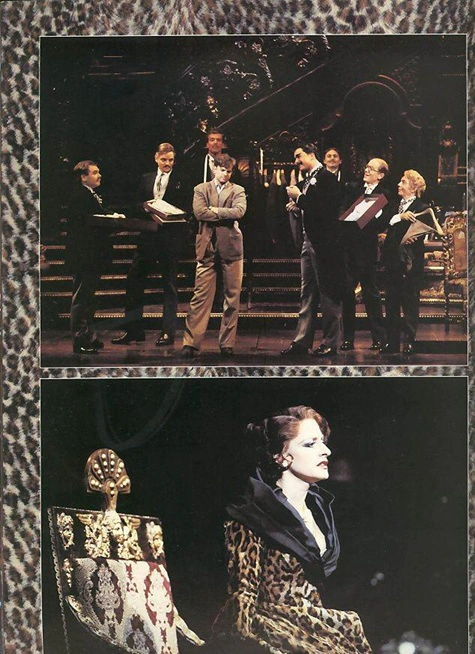
The original West End production, directed by Trevor Nunn and choreographed by Bob Avian, with costumes by Anthony Powell, opened on July 12, 1993 at the Adelphi Theatre. The cast featured Patti LuPone as Norma Desmond, Kevin Anderson as Joe Gillis, Meredith Braun as Betty Schaefer, and Daniel Benzali as Max.
Opening Night
Billy Wilder and his wife Audrey Young were joined by Nancy Olson, who had played Betty in the original film, at the opening night performance. Wilder said, “The best thing they did was leave the script alone”, and praised LuPone.
Critical Reception
Reviews were mixed. Some reviewers felt Lloyd Webber took the sting out of a cynical tale. “Wilder’s bitter brew has been diluted… When LuPone is off stage, the show sags.”
The Revamp and Re-Opening
The show closed for three weeks, re-opening on April 19, 1994, revamped to follow the Los Angeles production, with a second official “opening”. It had a new song, “Every Movie’s a Circus”, a new set, and new stars, Betty Buckley and John Barrowman.
West End Cast Succession (1993-1997)
| Role | Performers |
|---|---|
| Norma Desmond | Patti LuPone, Betty Buckley, Elaine Paige, Petula Clark, Rita Moreno |
| Joe Gillis | Kevin Anderson, John Barrowman, Alexander Hanson, Graham Bickley, Glyn Kerslake |
| Betty Schaefer | Meredith Braun, Anita Louise Combe |
Buckley and the production garnered improved reviews. Elaine Paige, who had filled in when Buckley was ill in 1994, took over the part in May 1995. Petula Clark replaced Paige in September/October 1995 and again from January 1996. The last new actress to play Norma in London was Rita Moreno. The show closed on April 5, 1997 after 1,530 performances.
Los Angeles Production (1993-1994)
The first American production opened at the Shubert Theatre in Century City, Los Angeles, California, on December 9, 1993, with Glenn Close as Norma and Alan Campbell as Joe. Featured were George Hearn as Max and Judy Kuhn as Betty.
Improved Reception
Lloyd Webber had reworked both the book and score, tightening the production, better organising the orchestrations, and adding the song “Every Movie’s a Circus”. This new production was better received by the critics than the premiere, and was an instant success, running for 369 performances. The production also recorded a new cast album that is well regarded.
The Faye Dunaway Controversy
Faye Dunaway was hired to replace Close and began rehearsals with Rex Smith as Joe and Jon Cypher as Max. Tickets went on sale for Dunaway’s engagement but shortly after rehearsals started, the producers announced that Dunaway was unable to sing the role to their standards; the production would shut down when Close left.
Lloyd Webber’s spokesman stated: “The cancellation came despite advance ticket sales for the Los Angeles production ‘way in excess of $4 million'”; Dunaway denied this. She filed a lawsuit claiming her reputation had been damaged by the producer’s claims. The producers paid her a settlement.
Original Broadway Production (1994-1997)
The musical opened on Broadway at the Minskoff Theatre on November 17, 1994 with Close, Campbell, and Hearn recreating their roles from the Los Angeles production and Alice Ripley joining the cast as Betty. Also in the cast were Alan Oppenheimer as Cecil B. DeMille and Vincent Tumeo as Artie Green.
The production opened with the highest ticket sale advance in Broadway history to that time. Billy Wilder, in attendance on opening night, was coaxed onstage by Close for the curtain call.
Tony Awards Success (1995)
Winner Best Musical
Winner Best Original Score – Andrew Lloyd Webber
Winner Best Book of a Musical – Don Black and Christopher Hampton
Winner Best Actress in a Musical – Glenn Close
Winner Best Featured Actor – George Hearn
Winner Best Scenic Design
Winner Best Lighting Design
In a season with only one other original musical nominated, The New York Times critic Vincent Canby later commented about the Tony season: “Awards don’t really tell you much when the competition is feeble or simply non-existent, as was the case the year that Sunset Boulevard won its Tony.”
During the run, Buckley replaced Close as Norma, followed by Paige. It closed on March 22, 1997, after playing 977 performances.
The Financial Disaster and Legal Battles
The Patti LuPone Lawsuit
LuPone, who initially had been promised the Broadway run, sued Lloyd Webber and received a settlement reported to be $1 million.
The “Flop-Hit” Phenomenon
Frank Rich, in his book The Hot Seat, noted that these lawsuits contributed to Sunset Boulevard setting the record for the most money lost by a theatrical endeavour in the history of the United States.
According to The New York Times, operating costs soared far beyond the budget, and the “Broadway production has earned back, at best, 80% of the initial $13 million.” The paper reported that during the week of July 2, 1995, “it cost $731,304 to run Sunset Boulevard, including… advertising fees of $138,352 (which had been budgeted at $40,000 a week).”
The road companies also generated large financial losses. Rich puts the final figure near or above US$20 million lost, making the show what he termed a “flop-hit”, as it ran more than two years, and the musical sold over a million tickets on Broadway.
US National Tours
First National Tour (1996-1997)
The first national US tour in 1996 starring Linda Balgord ended in early 1997 after only a handful of venues due to exorbitant costs involved in transporting the set.
Revised Tour (1997-1999)
Lloyd Webber called in director Susan H. Schulman to design a scaled-down production, with Petula Clark once again in the lead opposite Lewis Cleale as Joe. This production featured Anthony Powell’s costumes, a slightly modified libretto by Schulman and Don Black and a new, more tour-friendly set by Derek McLane.
The revised production, opening in Pittsburgh about a year after the closing of the original tour in Chicago, went on the road for almost two years, though it avoided the cities covered by the previous tour.
UK Tours
2001-2002 UK Tour
In August 2001, a UK tour commenced in Plymouth starring Faith Brown as Norma, opposite Earl Carpenter as Joe, and Michael Bauer reprising his West End performance as Max. The production had a completely new set, much simpler than the original London set, although the overall production remained closer to the original staging than the revamped US national tour.
Carpenter left midway through the tour and was replaced by Jeremy Finch, who had previously understudied the role. The tour finished in late 2002 in Manchester and met with both excellent reviews and respectable ticket sales.
2017 UK Tour
Ria Jones, who originated the role of Norma Desmond in the 1991 Sydmonton Workshop and understudied Glenn Close in the 2016 London revival, led a production opening at Leicester’s Curve Theatre on September 16, 2017 for a two-week run before embarking on a UK national tour. Starring opposite Jones as Norma was Danny Mac as Joe Gillis.
The tour, directed by Curve artistic director Nikolai Foster, transferred the musical into a Hollywood sound stage setting, designed by Colin Richmond, with acclaimed use of vintage archive film and projections designed by Douglas O’Connell.
West End Revivals
2008 Watermill Theatre Production
An eight-week engagement of a minimalist production, in which the actors used musical instruments, ran at the Watermill Theatre in Newbury over the summer of 2008. Directed and choreographed by Craig Revel Horwood, the cast featured Kathryn Evans as Norma Desmond and Ben Goddard as Joe Gillis.
A West End transfer of the production began on December 4, 2008 prior to an official opening on December 15 at the Comedy Theatre, with Evans and Goddard reprising their roles, and Dave Willetts joining the cast as Max. The production received rave reviews. The production closed on May 30, 2009.
2023 West End Revival (Savoy Theatre)
A revival opened at the Savoy Theatre in September 2023 for a 16-week limited run. Starring Nicole Scherzinger as Norma, the piece was reimagined in a modern and minimalist staging directed by Jamie Lloyd and produced by Lloyd Webber Harrison Musicals.
2023 West End Revival Cast
- Norma Desmond: Nicole Scherzinger / Rachel Tucker (guest performances)
- Joe Gillis: Tom Francis
- Max von Mayerling: David Thaxton
- Betty Schaefer: Grace Hodgett Young (professional debut)
Rachel Tucker guest starred as Norma on October 12, 2023, and played on Monday evenings beginning October 16. Changes to the score included cutting two songs and substantial lyric rewrites. “Let’s Have Lunch” became “Let’s Do Lunch”, and the “Exit Music” was more substantively incorporated into the show.
2024 Olivier Awards Triumph
The revival received eleven nominations at the 2024 Laurence Olivier Awards and won seven, the most for any production of the season, including:
- Winner Best Musical Revival
- Winner Best Actress in a Musical – Nicole Scherzinger
- Winner Best Actor in a Musical – Tom Francis
- Winner Best Director – Jamie Lloyd
- Winner Best Set Design
- Winner Best Lighting Design
- Winner Best Sound Design
A cast album, recorded live at the Savoy Theatre, Sunset Blvd: The Album, was released on October 25, 2024.
Broadway Revivals
2017 Broadway Revival (Glenn Close Returns)
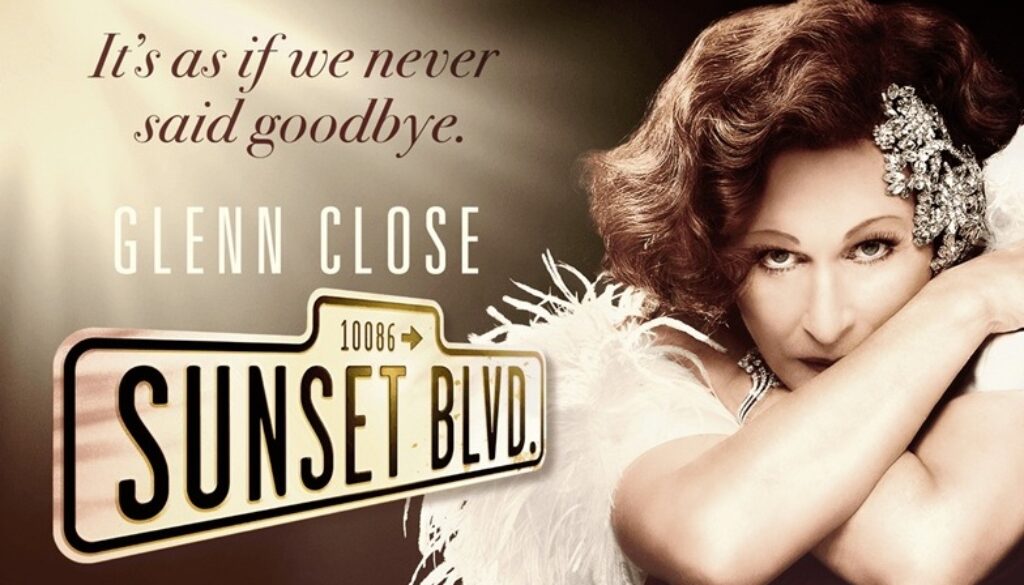
Close reprised her performance as Norma Desmond in the first revival on Broadway. Featuring a 40-piece onstage orchestra and a relatively minimalist set, the production began performances at the Palace Theatre on February 2, 2017 before opening officially on February 9 for a limited run, with tickets on sale through June 25, 2017.
2017 Broadway Revival Cast
- Norma Desmond: Glenn Close
- Joe Gillis: Michael Xavier
- Betty Schaefer: Siobhan Dillon
- Max von Mayerling: Fred Johanson
- Cecil B. DeMille: Paul Schoeffler
The cast featured Xavier, Dillon, and Johanson, all reprising their roles from the 2016 London ENO production. The 2017 Broadway revival was directed by Lonny Price.
2024 Broadway Revival (Nicole Scherzinger)
The 2023 West End revival transferred to Broadway for a limited run at the St. James Theatre, with previews from September 28, 2024 and an opening night on October 20. It closed on July 20, 2025. Scherzinger reprised her role as Norma, with West End co-stars Francis as Joe, Thaxton as Max, and Young as Betty.
The Shubert Alley Sequence
In a six-minute sequence at the start of the second act, Joe walked through the backstage area of the theater, exited onto West 44th Street, and began to sing “Sunset Boulevard”. As he sang, he strode down the street and through Shubert Alley, joined by the company before reentering the theater at the end of the song. A 25-foot LCD screen inside the theater followed the sequence live.
Mandy Gonzalez played Norma Desmond at select performances once a week beginning October 22, 2024. Jordan Donica took over the role of Max on June 10, 2025.
2025 Tony Awards
The revival was nominated for seven Tony Awards, winning three:
- Winner Best Revival of a Musical
- Winner Best Actress in a Musical – Nicole Scherzinger
- Winner Best Lighting Design
International Productions
Canada (1995-1997)
The original Canadian production opened in Toronto on October 15, 1995, with Diahann Carroll in the lead role. Her performance was praised by critics. It also starred Rex Smith as Joe, Walter Charles as Max and Anita Louise Combe, who had played Betty in the London production, repeating in this role. Toronto performances ended in August 1996, with the production later moving to Vancouver where it ran from November 1996 to March 1997.
Germany (1995-1998)
A German production of the musical opened December 7, 1995 at the newly built Rhein-Main Theater in Niedernhausen near Wiesbaden, starring Helen Schneider and Sue Mathys (matinees) as Norma and Uwe Kröger as Joe. A cast recording (with Schneider and Kröger) was released in 1996. The production closed in May 1998.
Australia (1996-1997)
Melbourne Production
In October 1996, the original Australian production of the musical opened at Melbourne’s newly restored Regent Theatre. The cast included:
- Norma Desmond: Debra Byrne / Maria Mercedes (alternate, 2 shows per week)
- Joe Gillis: Hugh Jackman
- Betty Schaefer: Catherine Porter / Amanda Harrison (later)
The production ran until June 14, 1997.
Netherlands (2008-2009)
A year-long Dutch tour commenced in the Netherlands on October 10, 2008, with Simone Kleinsma and Pia Douwes alternating as Norma and Antonie Kamerling as Joe. Kleinsma went on to win the Best Actress Award for the role in the 2009 Dutch Musical Awards and also Best Actress at the Flemish Musical Prizes.
Sweden (2009-2010)
The Swedish premiere took place at the Värmlandsoperan in September 2009, to mostly positive reviews. The role of Norma was played by Maria Lundqvist. A second much more elaborate production opened in October 2010, at the Gothenburg opera house, with Gunilla Backman starring as Norma.
South Africa (2013-2014)
A South African production starring Angela Kilian as Norma and Jonathan Roxmouth as Joe, was shown at the Pieter Toerien Theatre at Montecasino in Johannesburg from late August 2013 to mid-October 2013 and at Theatre on the Bay in Cape Town from late October 2013 until early January 2014.
Czech Republic (2015-2017)
The Czech production with Hana Fialová and Katarína Hasprová in the role of Norma had its premiere in National Moravian-Silesian Theatre in Ostrava. The premiere took place on February 19, 2015. The show closed in March 2017.
Spain (2017)
The Spanish premiere production opened December 27, 2017 at the Auditorio de Tenerife, directed by Jaime Azpilicueta and starring Paloma San Basilio as Norma Desmond, Gerónimo Rauch as Joe Gillis, Inma Mira as Betty Schaefer, and Gonzalo Montes as Max von Mayerling.
Denmark (2022)
Another Danish production by Den Jyske Opera opened August 12, 2022 at Musikhuset Aarhus, directed by Philipp Kochheim and starring Tammi Øst as Norma, Randy Diamond as Joe, Katharina Maria Abt as Betty, and Martin Loft as Max. The production received mixed reviews from critics who praised the performances of Øst and the Aarhus Symphony Orchestra while criticizing the direction and the casting of Diamond as Joe due to his advanced age.
Australia (2024-2025)
Sarah Brightman’s Return to Theatre
Sarah Brightman starred as Norma in a production that opened in Melbourne on May 21, 2024, at the Princess Theatre with an official opening night on May 29. This was Brightman’s first theatrical role in more than three decades.
The cast also included Tim Draxl as Joe, Robert Grubb as Max, Ashleigh Rubenach as Betty, Jarrod Draper as Artie, and Paul Hanlon as Cecil B. DeMille. Silvie Paladino was the alternate Norma.
This was followed by an engagement at the Sydney Opera House beginning August 28. The production transferred to Singapore’s Marina Bay Sands in February 2025 and toured China from March to May 2025.
Regional and Concert Productions
US Regional Productions
In 2004, the first regional production of Sunset Boulevard was staged in the round at the Marriott Theatre in Chicago for a limited period and starred Paula Scrofano as Norma. It was the first and only regional production to be licensed by the Really Useful Group for the next six years. However, in the spring of 2010, the leasing rights were finally released to regional companies and numerous productions have been staged around the United States.
Ogunquit Playhouse (2010)
Production ran from July 28 through August 14, 2010 and starred Stefanie Powers as Norma and Todd Gearhart as Joe. This was the first fully staged production in the U.S. in nearly a decade.
Arvada Center (2010)
Production ran from September 14 to October 10, 2010, in Denver, Colorado. The show starred Ann Crumb as Norma and Kevin Earley as Joe.
Kennedy Center (2023)
Production ran from February 1-8, 2023 in Washington, D.C., with Stephanie J. Block starring as Norma, Derek Klena as Joe, Nathan Gunn as Max, Auli’i Cravalho as Betty, and Michael Maliakel as Artie. The show ran as a limited engagement as part of the Kennedy Center’s Broadway Center Stage series.
Concert Productions
In April 2004, Petula Clark reprised her role as Norma opposite Michael Ball as Joe in a two-night concert production at the Cork Opera House in Ireland, which was later broadcast on BBC Radio 2.
A concert production of Sunset Boulevard was performed Off West End at the Alexandra Palace in June 2021. Ramin Karimloo starred as Joe Gillis, with Mazz Murray as Norma Desmond, Zizi Strallen as Betty Schaeffer, Jeremy Secomb as Max von Mayerling, and Sharif Afifi as Artie Green. The production transferred to the Royal Albert Hall in London on December 3, 2021.
Film Adaptation Plans
Paramount Pictures and the Relevant Picture Company began developing a film adaptation of the musical by 2005. Actresses reportedly considered for the role of Norma Desmond included Close, Paige, Meryl Streep, Liza Minnelli, Barbra Streisand and Madonna.
In 2013 Lloyd Webber said: “Talks with [Paramount] have never led to anything… I think in many ways Sunset is… the most complete musical I have written… I’m producing School of Rock on stage, and that’s a Paramount picture, so maybe if they like what I do with that they’ll let me do Sunset.”
By 2019 Rob Ashford had agreed to direct the film, with Close as Norma Desmond, Tom MacRae penning the script, and production hoped to begin later that year. Further delays followed, including from the COVID-19 pandemic.
In 2021, Lloyd Webber stated: “Paramount has not wanted to go ahead with it…. Glenn Close has been absolutely doggedly trying to get it made.” In 2024, Close stated that the film is still moving forward, but Ashford is no longer directing. In 2025, Nicole Scherzinger said: “There has been some talk” that she might play Norma in the film.
Musical Numbers
Act I
- “A Cinema in Buenos Aires, 26 July 1952” / “Prologue”
- “Let’s Have Lunch” / “Let’s Do Lunch” (2023 revival)
- “Every Movie’s a Circus” (added for Los Angeles production)
- “Surrender”
- “With One Look”
- “Salome”
- “The Greatest Star of All”
- “Girl Meets Boy”
- “The Lady’s Paying”
- “The Perfect Year”
- “This Time Next Year”
Act II
- “Sunset Boulevard”
- “There’s Been A Call”
- “As If We Never Said Goodbye”
- “Eternal Youth Is Worth a Little Suffering”
- “Too Much in Love to Care”
- “New Ways to Dream” (reprise)
- “The Final Scene”
Awards and Recognition
1994 Olivier Awards (Original West End)
Winner Best Musical
Winner Best Actress in a Musical – Patti LuPone
Nominated Best Actor in a Musical – Kevin Anderson
1995 Tony Awards (Original Broadway)
Winner Best Musical
Winner Best Original Score – Andrew Lloyd Webber
Winner Best Book of a Musical – Don Black and Christopher Hampton
Winner Best Actress in a Musical – Glenn Close
Winner Best Featured Actor in a Musical – George Hearn
Winner Best Scenic Design – John Napier
Winner Best Lighting Design – Andrew Bridge
2009 Olivier Awards (Watermill Revival)
Nominated Best Musical Revival
2016 Evening Standard Theatre Awards (ENO Production)
Nominated Best Musical
2017 Olivier Awards (ENO Production)
Winner Best Musical Revival
Nominated Best Actress in a Musical – Glenn Close
2023 Evening Standard Theatre Awards (Savoy Revival)
Winner Best Musical
Winner Best Musical Performance – Nicole Scherzinger
2024 Olivier Awards (Savoy Revival)
Record-Breaking Seven Wins
Winner Best Musical Revival
Winner Best Actress in a Musical – Nicole Scherzinger
Winner Best Actor in a Musical – Tom Francis
Winner Best Director – Jamie Lloyd
Winner Best Set Design – Soutra Gilmour
Winner Best Lighting Design – Jack Knowles
Winner Best Sound Design – Adam Fisher
2025 Tony Awards (Broadway Revival)
Winner Best Revival of a Musical
Winner Best Actress in a Musical – Nicole Scherzinger
Winner Best Lighting Design of a Musical – Jack Knowles
Nominated Best Actor in a Musical – Tom Francis
Nominated Best Featured Actor in a Musical – David Thaxton
Nominated Best Direction of a Musical – Jamie Lloyd
Nominated Best Sound Design of a Musical – Adam Fisher
2025 Drama Desk Awards
Winner Outstanding Revival of a Musical
Winner Outstanding Actress in a Musical – Nicole Scherzinger
Winner Outstanding Lighting Design – Jack Knowles
2025 Drama League Awards
Winner Distinguished Performance Award – Nicole Scherzinger
Legacy and Cultural Impact
From Billy Wilder’s Masterpiece to Andrew Lloyd Webber’s Musical Triumph
Sunset Boulevard transformed one of cinema’s greatest films into a powerful theatrical experience. Despite financial difficulties and legal controversies, the musical has proven its enduring appeal through multiple revivals and international productions spanning three decades. The iconic character of Norma Desmond continues to attract the world’s greatest leading ladies, from Glenn Close’s definitive interpretation to Nicole Scherzinger’s critically acclaimed modern reimagining.
“With One Look” — The Power of a Timeless Story
From Gloria Swanson’s original attempt in the 1950s through Stephen Sondheim’s abandoned project to Andrew Lloyd Webber’s triumphant realization, Sunset Boulevard has captivated audiences with its tale of faded glamour, delusion, and tragedy. The musical stands as a testament to the enduring power of Billy Wilder’s cinematic masterpiece and proves that some stories transcend time, medium, and generation.