The Boys in the Band | Mart Crowley’s Groundbreaking Play
The Boys in the Band - Podcast
Memorabilia Available Here
The Boys in the Band
Mart Crowley’s Groundbreaking Portrait of Pre-Stonewall Gay Life
A Landmark in American Theater
The Boys in the Band is a 1968 American play by Mart Crowley that revolutionized LGBTQ+ representation in American theater. The play premiered Off-Broadway and was revived on Broadway for its 50th anniversary in 2018. Revolving around a group of gay men who gather for a birthday party in New York City, the work was groundbreaking for its portrayal of gay life in pre-Stonewall America.
The play was adapted into two feature films—in 1970 directed by William Friedkin and in 2020 for Netflix directed by Joe Mantello. A sequel, The Men from the Boys, premiered in 2002.
Set in an apartment on the Upper East Side of Manhattan—described as “a smartly appointed duplex apartment in the East Fifties”—the backgrounds of the characters are revealed over the course of a birthday party that devolves from celebration into emotional confrontation.
Plot Synopsis
The action takes place entirely in Michael’s Upper East Side apartment during Harold’s birthday party. What begins as a celebration among friends becomes increasingly fraught as the evening progresses and alcohol flows.
The party takes an unexpected turn with the arrival of Alan McCarthy, Michael’s married college friend and former roommate, who is visiting New York and anxious to tell Michael something but hesitant to do so in front of the others. The tension escalates as the nine men become increasingly inebricated.
The party culminates in a cruel “game” orchestrated by Michael, where each man must call someone whom he has loved and tell them about it. Michael, believing that Alan has finally “outed” himself when he makes his call, grabs the phone from him and discovers Alan has called his wife. The audience never learns what Alan originally intended to discuss with Michael.
The Cruel Game
The emotional climax of the play centers on Michael’s telephone game, forcing each guest to confront their deepest feelings and vulnerabilities. This devastating sequence reveals the internalized homophobia and self-loathing that characterized gay life in 1960s America, where love and desire were sources of shame rather than celebration.
Characters
The Birthday Boy
Harold’s Six Closest Friends
The Unexpected Guest
Mart Crowley & the Play’s Development
Early Career
The Boys in the Band was written by American playwright Mart Crowley (1935-2020). In 1957, Crowley started working for a number of television production companies before meeting Natalie Wood on the set of her film Splendor in the Grass while working as a production assistant.
Wood hired him as her assistant, primarily to give him ample free time to work on his gay-themed play. Wood, Crowley’s close friend, inspired him to move from New York to Hollywood. According to Crowley’s friend Gavin Lambert, Wood sympathized with Hollywood’s gay scene and financially supported Crowley so he would be free to write his play. Crowley worked as an assistant for Wood and her husband Robert Wagner for many years.
Writing the Play
After several Hollywood film productions he was helping on were canceled, his wealthy friend Diana Lynn hired him to housesit. He lived in the Hollywood Georgian mansion where he only had to “throw dinner parties and drink myself into oblivion.” He began writing instead of drinking, and began working on The Boys in the Band.
According to Crowley, his motivation in writing the play was not activism, but anger that “had partially to do with myself and my career, but it also had to do with the social attitude of people around me, and the laws of the day.” He says he “wanted the injustice of it all—to all those characters—known.”
Characters Based on Real People
Crowley made no secret that all characters were based on real people in his life, with Michael reminding him of himself, describing the character as “a complex person who is aware of what is politically correct but has a sort of contempt for it.” He called Donald “a foil for Michael” and inspired by a droll friend he would periodically take wry comments from.
In the 1995 documentary The Celluloid Closet, Crowley explained, “The self-deprecating humor was born out of a low self-esteem, from a sense of what the times told you about yourself.”
In The Boys in the Band: Something Personal, a short documentary accompanying Netflix’s release of the 2020 film adaptation, Crowley clarified that Donald was based on Douglas Murray, to whom the play was dedicated. Harold, the character whose birthday was being celebrated, is a cipher for dancer/choreographer Howard Jeffrey, who died in 1988 of AIDS, to whom the play was also dedicated.
Crowley took one of the key lines of the play, “I try to show a little affection; it keeps me from feeling like such a whore,” from a hustler he danced with on Fire Island, telling, “I couldn’t write anything that good!”
Finding Producers and Actors
While Crowley was pitching the script, early agents stayed away from the project, and it was championed by playwright Edward Albee and Richard Barr, who at the time was head of the Playwrights Units in New York. For the production, it proved “nearly impossible to find” actors willing to play gay characters.
An old college friend of Crowley’s, 33-year-old Laurence Luckinbill, agreed to play Hank despite warnings from his agent that it would end his career, even though the agent was herself a lesbian. It proved hard for Crowley to find producers and theater owners who were interested.
Production History
Original Off-Broadway Production (1968-1970)
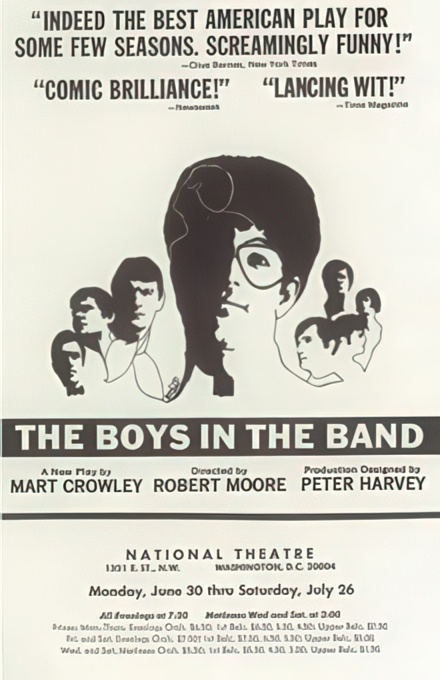
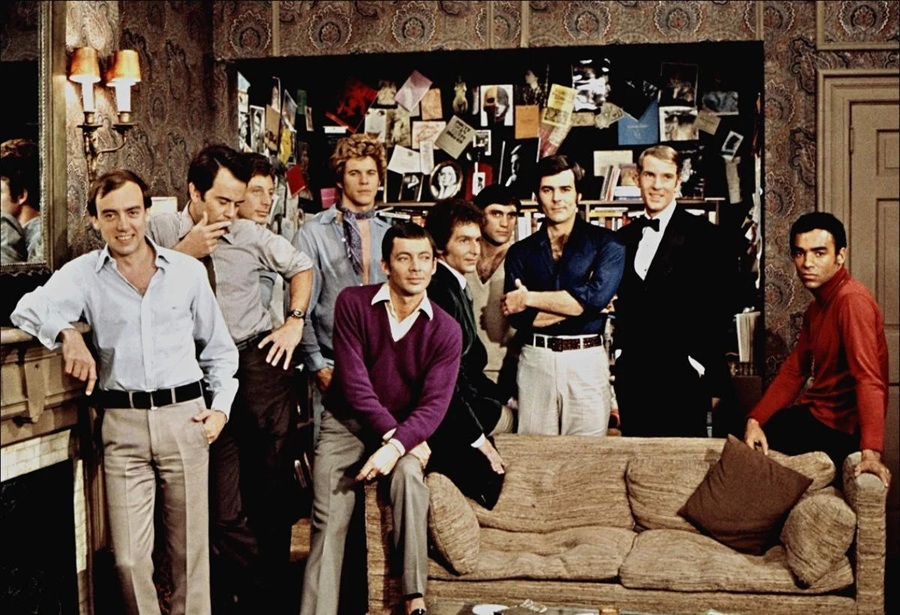
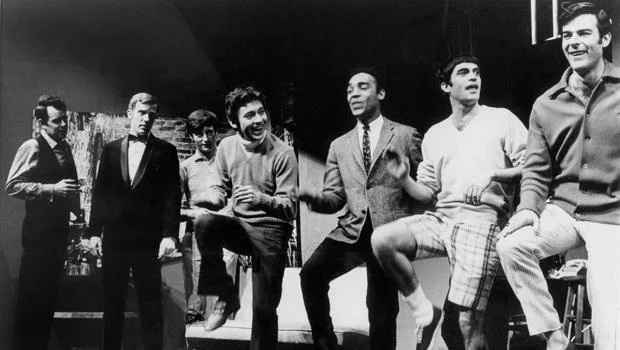
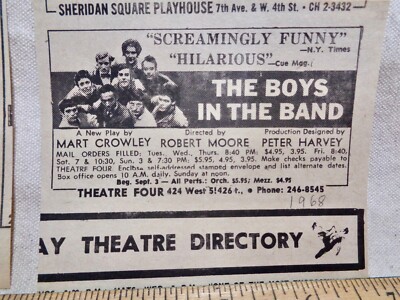
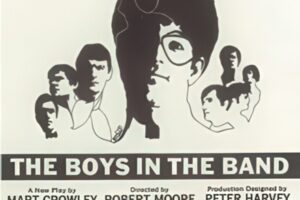
The play premiered Off-Broadway on April 14, 1968, at Theater Four, and closed on September 6, 1970, after 1,001 performances. Directed by Robert Moore, the cast included:
| Actor | Role |
|---|---|
| Kenneth Nelson | Michael |
| Peter White | Alan McCarthy |
| Leonard Frey | Harold |
| Cliff Gorman | Emory |
| Frederick Combs | Donald |
| Laurence Luckinbill | Hank |
| Keith Prentice | Larry |
| Robert La Tourneaux | Cowboy |
| Reuben Greene | Bernard |
The play was one of the early works to present a story centered on homosexuals. In 1968, although only originally scheduled to run for five performances at a small venue off Broadway, it was a fast success and was moved to a larger theater. It went on to have a run in London as well.
Celebrity Audiences
The premiere’s actors such as Laurence Luckinbill drilled a hole in the set so they could spy on whoever was in the house’s best seats. In the initial weeks, they saw Jackie Kennedy, Marlene Dietrich, Groucho Marx, Rudolf Nureyev, and New York mayor John Lindsay attending the groundbreaking production.
Despite the success of the play, all the gay members of the original company stayed in the closet after the premiere. Between 1984 and 1993, five of the gay men in the original production (as well as director Robert Moore and producer Richard Barr) died in the ensuing AIDS epidemic.
Off-Broadway Revivals
The play was revived Off-Broadway at the Lucille Lortel Theatre in 1996, running from August 6 to October 20, after its initial sold-out run at the WPA Theater.
The Boys in the Band was presented by the Transport Group Theater Company, New York City, from February 2010 to March 14, 2010, directed by Jack Cummings III.
London West End Production (2016-2017)
A London staging in October 2016 at Park Theatre was the first revival there in two decades. It subsequently transferred to the Vaudeville Theatre in the West End. Positively reviewed, including in The Observer, the production starred:
- Mark Gatiss as Harold
- Ian Hallard as Michael
- Daniel Boys, Jack Derges, James Holmes, John Hopkins, Greg Lockett, Ben Mansfield, and Nathan Nolan in supporting roles
The production was nominated for four awards in the 2017 WhatsOnStage Awards: Best Play Revival and Best Off-West End Production, with Hallard nominated as Best Actor in a Play and Jack Weir for Best Lighting Design.
Broadway Production (2018)
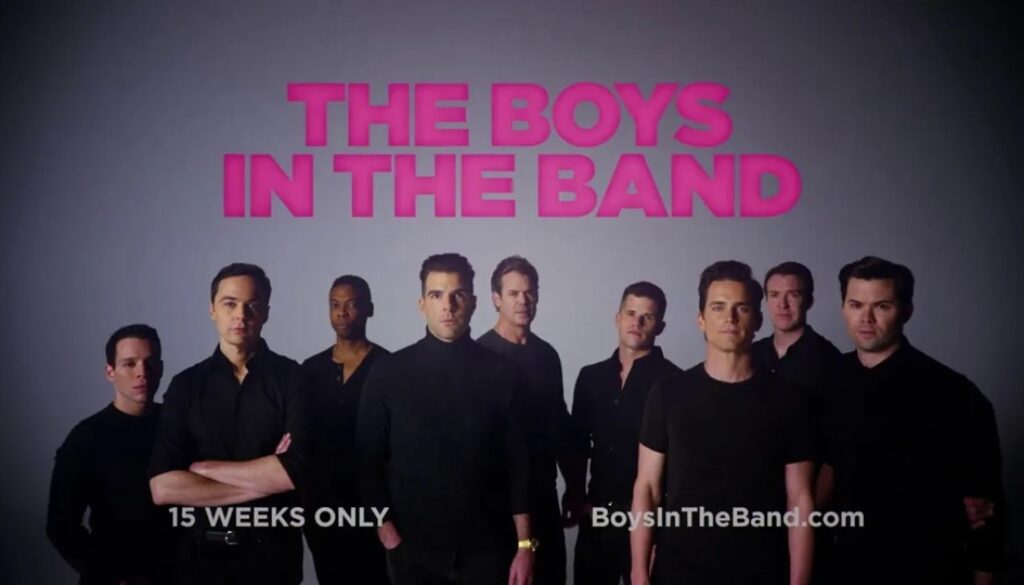
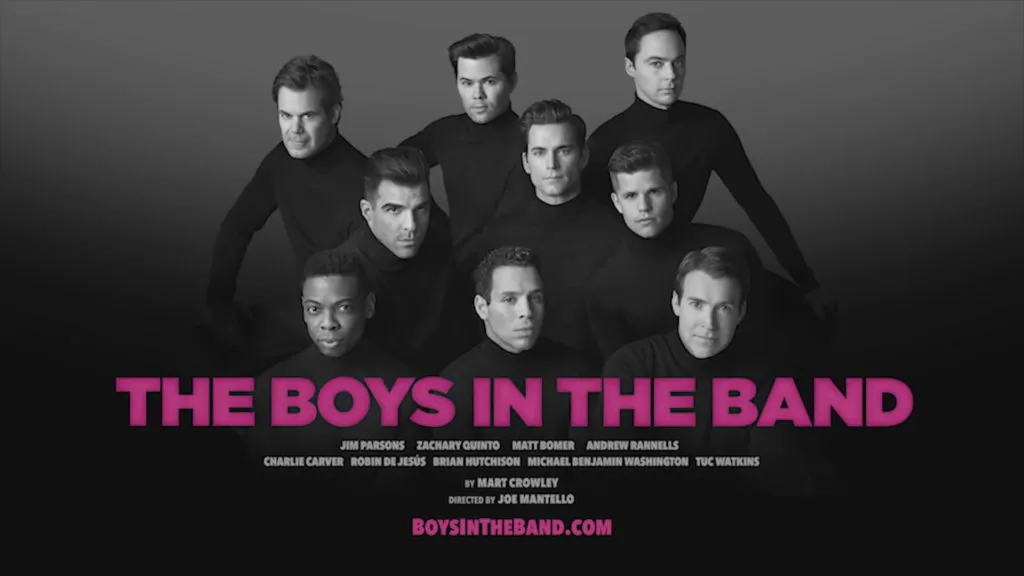
A Broadway production of The Boys in the Band, directed by Joe Mantello, opened in previews at the Booth Theatre on April 30, 2018, officially on May 31, and ran until August 11, 2018. This production, staged for the 50th anniversary of the play’s original premiere, starred:
| Actor | Role |
|---|---|
| Jim Parsons | Michael |
| Zachary Quinto | Harold |
| Matt Bomer | Donald |
| Andrew Rannells | Larry |
| Charlie Carver | Cowboy |
| Brian Hutchison | Alan |
| Michael Benjamin Washington | Bernard |
| Robin de Jesús | Emory |
| Tuc Watkins | Hank |
This production won the 2019 Tony Award for Best Revival of a Play, and Robin de Jesús was nominated for the Tony Award for Best Featured Actor in a Play.
Film Adaptations
1970 Film (William Friedkin)
The play was adapted into a feature film by Cinema Center Films in 1970, directed by William Friedkin (who would later direct The French Connection and The Exorcist). The film retained the entire original Off-Broadway cast, making it a rare instance of a stage production being preserved on film with its original actors.
The 1970 film is among the early major American motion pictures to revolve around gay characters, often cited as a milestone in the history of gay cinema. It was thought to be the first mainstream American film to use the swear word “cunt.”
Critical Reception (1970 Film)
Vito Russo, activist and film historian, examined the film in The Celluloid Closet: “The film presents a perfunctory compendium of easily acceptable stereotypes who gather at a Manhattan birthday party and spend an evening savaging each other and their way of life… Yet in spite of itself, Crowley’s passion play was part catharsis and part catalyst. His characters were losers or borderline survivors at best, but they paved the way for winners… The film was not positive, but it was fair… If nothing else, The Boys in the Band illuminated the fear and ignorance that surrounded homosexuality in America.”
Film historian Richard Barrios explored its complexity: “Here are collected all the imposing paradoxes history can offer. By being unnervingly real at the same time that it is rackingly phony, The Boys in the Band makes of itself both a rapturous high and a dirty shame. It exalts with its affection and intimate truths and stunning insights and crashes and burns with pessimism and blame and falsehood. Where homosexuals and homosexuality on film is concerned, this is The Birth of a Nation.”
While not as acclaimed or commercially successful as director Friedkin’s subsequent films, Friedkin considers this film to be one of his favorites. He remarked in an interview on the 2008 DVD: “It’s one of the few films I’ve made that I can still watch.”
2020 Netflix Film (Joe Mantello)
On April 18, 2019, Ryan Murphy announced that the play would be adapted for Netflix, as part of his $300 million deal with the streaming platform. Murphy had previously revived the play for Broadway in 2018 and confirmed the director of the revival, Joe Mantello, would direct the film.
The entire cast of the 2018 Broadway revival reprised their roles for the film, making the film have a cast of entirely openly gay actors—a significant departure from the 1970 film, where the gay actors remained closeted.
The film was dedicated to the memory of Mart Crowley, who died on March 7, 2020, just months before the film’s release. Principal photography began in July 2019 in Los Angeles.
The film was released on Netflix on September 30, 2020. On the same day, a 30-minute mini-documentary was also released, directed by Joel Kazuo Knoernschild with Mart Crowley reflecting on the legacy of the story.
On review aggregator Rotten Tomatoes, the film holds an approval rating of 84% based on 99 reviews, with an average rating of 7.2/10. On Metacritic, the film has a weighted average score of 70 out of 100 based on 19 critics, indicating “generally favorable” reviews.
Owen Gleiberman of Variety praised the performances: “What holds the movie together, apart from Quinto’s dreamy geek mystique and delectable delivery of every line, is the tormented passion that Jim Parsons brings to it.”
David Rooney of The Hollywood Reporter gave the film a positive review: “The Boys in the Band in many ways is dated and formulaic. But it’s also very much alive, an invaluable record of the destructive force of societal rejection, even in a bastion of liberal acceptance like New York City.”
The 2020 film was awarded The Film Award at the ninth annual Virgin Atlantic Attitude Awards.
Cultural Impact & Legacy
Reception in 1968
When The Boys in the Band premiered in 1968, mainstream audiences were shocked. The play was profiled in the William Goldman book The Season: A Candid Look at Broadway, an account of the 1967–1968 season. In the same year, a two-disc vinyl LP set was released, containing the full dialogue of the play voiced by the original actors.
Influence on the Gay Rights Movement
In 2002, Peter Filichia from Theater Mania contended that the play’s original production helped inspire the 1969 Stonewall riots and gay rights movement:
Critical Debates
The play has been the subject of ongoing critical debate within the LGBTQ+ community. In 2004, David Anthony Fox from Philadelphia City Paper praised the play, its one-liners, and its live performance in Philadelphia. He rebutted criticism that the play portrayed “urban gay men as narcissistic, bitter, shallow.”
In 2010, Elyse Summer in her review for CurtainUp called it a “smart gimmick” full of dated “self-homophobic, low self-esteem characters.” In the same year, Steve Weinstein from the Edge website called it “Shakespearean.”
The AIDS Epidemic’s Toll
The play’s legacy is inextricably linked to the AIDS epidemic. Between 1984 and 1993, five of the gay men in the original production died of AIDS, along with director Robert Moore and producer Richard Barr. Harold’s real-life inspiration, dancer/choreographer Howard Jeffrey, died in 1988 of AIDS.
This devastating loss underscores the play’s historical significance as a document of pre-Stonewall gay life and the generations of gay men who would not survive to see full equality.
The Sequel: The Men from the Boys (2002)
In 2002, Crowley wrote The Men from the Boys, a sequel to the play, which takes place 30 years after the original. It premiered in San Francisco in 2002, directed by Ed Decker, and was produced in Los Angeles in 2003.
Awards & Recognition
| Year | Award | Category | Nominee | Result |
|---|---|---|---|---|
| 1968 | Obie Award | Distinguished Play | The Boys in the Band | Won |
| 1968 | Obie Award | Best Performance | Cliff Gorman | Won |
| 1997 | Obie Award | Revival | The Boys in the Band | Won |
| 2017 | WhatsOnStage Awards | Best Play Revival | London Production | Nominated |
| 2017 | WhatsOnStage Awards | Best Off-West End Production | London Production | Nominated |
| 2017 | WhatsOnStage Awards | Best Actor in a Play | Ian Hallard | Nominated |
| 2017 | WhatsOnStage Awards | Best Lighting Design | Jack Weir | Nominated |
| 2019 | Tony Awards | Best Revival of a Play | Broadway Production | Won |
| 2019 | Tony Awards | Best Featured Actor in a Play | Robin de Jesús | Nominated |
| 2019 | Broadway.com Audience Choice Awards | Favorite New Broadway Play | Broadway Production | Nominated |
Complete Timeline
Edward Martino Crowley born August 21, 1935, in Vicksburg, Mississippi.
Graduates from Catholic University of America in Washington, D.C., and moves to Hollywood to work in television production.
Meets actress Natalie Wood on the set of Splendor in the Grass while working as a production assistant.
Serves as secretary/assistant for Wood, who financially supports him and gives him time to write his play.
Housesits in a Hollywood Georgian mansion for Diana Lynn and writes The Boys in the Band instead of drinking himself “into oblivion.”
The Boys in the Band opens at Theater Four in New York. Originally scheduled for just five performances, it becomes an instant success.
Just over a year after the play’s premiere, the Stonewall riots begin, marking the start of the modern LGBTQ+ rights movement.
After 1,001 performances over two years, the original Off-Broadway production closes.
William Friedkin directs the film version with the entire original Off-Broadway cast.
Five of the gay men from the original production die of AIDS, along with director Robert Moore and producer Richard Barr.
Opens at the Lucille Lortel Theatre after a sold-out run at WPA Theater, running until October 20.
Crowley’s sequel, The Men from the Boys, set 30 years after the original, premieres in San Francisco.
Off-Broadway revival presented by Transport Group Theater Company, directed by Jack Cummings III.
First London revival in two decades opens at Park Theatre, later transferring to the Vaudeville Theatre in the West End, starring Mark Gatiss and Ian Hallard.
The play finally reaches Broadway for the first time at the Booth Theatre, directed by Joe Mantello with an all-openly-gay cast including Jim Parsons, Zachary Quinto, Matt Bomer, and Andrew Rannells.
After a limited 104-performance run, the Broadway production closes.
The Broadway production wins the Tony Award for Best Revival of a Play. Robin de Jesús receives a nomination for Best Featured Actor in a Play.
Playwright Mart Crowley dies in Manhattan at age 84 following heart surgery. He had suffered a heart attack and died during recovery.
Ryan Murphy’s Netflix adaptation directed by Joe Mantello, featuring the entire 2018 Broadway cast, is released. The film is dedicated to Crowley’s memory. A companion documentary, The Boys in the Band: Something Personal, is also released.
Themes & Cultural Significance
Self-Loathing & Internalized Homophobia
The play’s central theme is the self-loathing and internalized homophobia experienced by gay men in pre-Stonewall America. As Crowley explained in The Celluloid Closet, “The self-deprecating humor was born out of a low self-esteem, from a sense of what the times told you about yourself.”
The characters’ cruelty toward each other and themselves reflects the broader society’s contempt for homosexuality. Michael’s orchestration of the telephone game—forcing his friends to confront their deepest feelings—is an act of internalized homophobia turned outward.
Pre-Stonewall Gay Life
The play captures a specific historical moment: gay life in 1968 New York, one year before the Stonewall riots. The characters live in a world where homosexuality is still classified as a mental illness, where gay bars are regularly raided, and where being openly gay can cost you your career, family, and freedom.
The party itself represents a safe space where the characters can be themselves, yet even in this private sphere, they cannot escape the shame and self-hatred imposed by the outside world.
Race, Class, and Identity
The play addresses intersecting identities through characters like Bernard, the African-American librarian who faces both racism and homophobia, and Harold, whose Jewish identity compounds his sense of otherness. These intersectional perspectives were rare in 1968 theater.
Catholicism and Guilt
Michael’s status as a lapsed Catholic who struggles with alcoholism reflects the particular burden of religious shame carried by many gay men of his generation. His guilt drives much of the play’s cruelty.
The Evolution of Perspective
The play’s reception has evolved dramatically over decades. What was groundbreaking representation in 1968 was later criticized by some in the LGBTQ+ community for portraying gay men as “self-loathing” and “pathetic.” However, recent revivals have been praised for their historical honesty—documenting what life was actually like before liberation.
Legacy & Influence on LGBTQ+ Theater
The Boys in the Band stands as one of the most important works in LGBTQ+ theater history. It was the first commercially successful play to honestly portray gay life, paving the way for later works like Torch Song Trilogy, Angels in America, Love! Valour! Compassion!, and countless others.
The play’s influence extends beyond theater. It helped spark conversations about gay rights and representation at a crucial historical moment. Within a year of its premiere, the Stonewall riots would ignite the modern LGBTQ+ rights movement.
The 2018 Broadway revival, with its all-openly-gay cast, represented a full-circle moment: actors who could be out and proud performing a play about men who had to hide. This generational shift—from the original cast members who stayed closeted despite the play’s success, to contemporary actors celebrated for their openness—demonstrates how far society has come.
Yet the play remains relevant as a historical document and a reminder of the struggles faced by earlier generations. The devastating toll of the AIDS epidemic on the original cast and creative team adds another layer of poignancy to the work.
Mart Crowley’s Other Works
- Remote Asylum (1970) – Produced in Los Angeles but closed quickly
- A Breeze from the Gulf (1973) – Autobiographical play about his Mississippi childhood, won second place in New York Drama Critics’ Circle award
- Avec Schmaltz (1984) – Performed at Massachusetts Theater Festival
- For Reasons That Remain Unclear (1993) – About a scriptwriter and priest who meet in Rome
- The Men from the Boys (2002) – Sequel to The Boys in the Band
- Hart to Hart (1979-1980) – Served as executive script editor and producer for the TV series starring Robert Wagner
The play has been preserved in multiple formats: the 1968 two-disc vinyl LP recording with the original cast, the 1970 film, the 2020 Netflix film, and the 2011 documentary Making the Boys exploring the production’s creation and cultural impact.
More than 50 years after its premiere, The Boys in the Band remains essential viewing for anyone seeking to understand LGBTQ+ history, the evolution of gay representation in media, and the long, difficult road to equality and acceptance.
-
- Upscaled with Gigapixel v1.0.4. 220x340 => 440x680 (2x) Model: Low Resolution V2, denoise: 0.21, sharpen: 0.01, decompression: 0.01