The Phantom of the Opera Musical | History, Cast & Legacy
The Phantom of the Opera - Podcast
The Greatest Musical of All Time
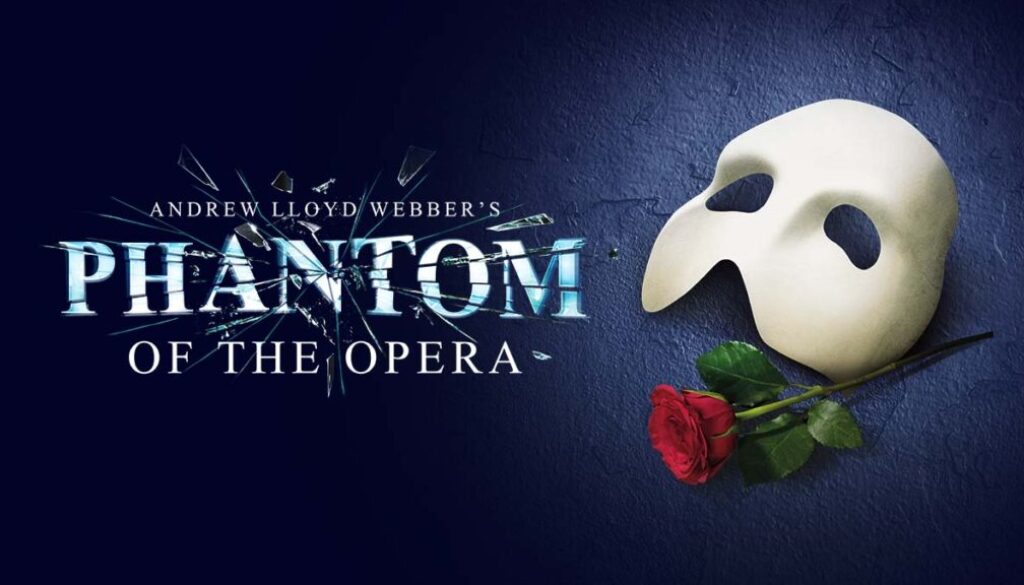
The Phantom
of the Opera
Memorabilia Available Here
A deep dive into the legendary 1986 musical that captivated the world — and never let go.
Few works of art have achieved what The Phantom of the Opera has: a singular, global, decades-long cultural dominance that transcends theatre, music, film, and even the boundaries of language itself.
The Phantom of the Opera is a musical with music by Andrew Lloyd Webber, lyrics by Charles Hart, additional lyrics by Richard Stilgoe, and a libretto by Lloyd Webber and Stilgoe. Based on the 1910 novel by Gaston Leroux, it tells the tragic story of beautiful soprano Christine Daaé, who becomes the obsession of a mysterious and disfigured musical genius living in the subterranean labyrinth beneath the Paris Opera House.
The musical opened in London’s West End in 1986 and on Broadway in New York in 1988, in a production directed by Harold Prince and starring English classical soprano Sarah Brightman as Christine Daaé, screen and stage star Michael Crawford as the Phantom, and international stage performer Steve Barton as Raoul. It won the 1986 Olivier Award and the 1988 Tony Award for Best Musical, with Crawford winning both the Olivier and Tony for Best Actor in a Musical.
The Phantom of the Opera is the longest-running show in Broadway history, and celebrated its 10,000th performance on 11 February 2012 — the first Broadway production in history to reach that milestone. It is also the second longest-running West End musical, after Les Misérables, and the third longest-running West End show overall, after The Mousetrap.
The Story That Haunts Us
The story opens in 1919 at an auction of old theatre memorabilia at the Paris Opéra House. An aged Raoul de Chagny purchases a papier-mâché music box. The next lot — Lot 666 — is a broken chandelier involved in a famous disaster, connected to “the strange affair of the Phantom of the Opera, a mystery never fully explained.” As the overture plays, the chandelier flickers to life and ascends to the ceiling, sweeping us back in time to the opera house’s former grandeur.
The year is 1881. The cast of a new production, Hannibal, is rehearsing when a backdrop inexplicably falls. Carlotta, the Opéra’s resident soprano, storms offstage. Madame Giry, the ballet mistress, suggests that Christine Daaé — a chorus girl and orphaned daughter of a prominent Swedish violinist — can sing Carlotta’s role. The managers reluctantly audition her, and discover that she is indeed a prodigy.
Backstage after her triumphant debut, Christine confesses to Meg Giry that her singing has been inspired by an unseen tutor she knows only as the “Angel of Music.” When Raoul, the Opéra’s new patron and Christine’s childhood friend, visits her dressing room, Christine hears the jealous Phantom’s voice and entreats him to reveal himself. The Phantom appears in her mirror and leads her down into the shadowy sewers beneath the Opéra house, across a subterranean lake to his secret lair.
“It may be possible to have a terrible time at The Phantom of the Opera, but you’ll have to work at it. Only a terminal prig would let the avalanche of pre-opening publicity poison his enjoyment of this show.”
The Phantom explains that he has chosen Christine to sing his compositions, and lays her on a bed as he performs “The Music of the Night.” When Christine awakens and lifts his mask, she beholds his disfigured face — and the Phantom rails at her prying, then ruefully expresses his longing to be loved in “Stranger Than You Dreamt It.”
As tensions escalate, the Phantom sends threatening notes to the opera’s managers, demanding Christine replace Carlotta. During the première of Il Muto, the Phantom enchants Carlotta’s voice, reducing it to a frog-like croak. Joseph Buquet’s corpse drops from the rafters, and mayhem erupts.
Christine escapes with Raoul to the rooftop, where he promises to love and protect her in the soaring duet “All I Ask of You.” The Phantom, who overheard everything, is heartbroken and swears revenge — and the chandelier crashes onto the stage.
Six months later, at a masquerade ball, the Phantom appears as the Red Death and demands the production of his opera, Don Juan Triumphant. Madame Giry reveals the Phantom’s tragic backstory: a brilliant scholar and inventor, born with a deformed face, cruelly exhibited in a cage until he escaped to the opera house beneath. During the final showdown, Christine kisses the Phantom — and having experienced kindness for the first time, he frees Raoul and disappears, leaving only his mask behind.
The Making of a Masterpiece
In 1984, Lloyd Webber contacted Cameron Mackintosh — the co-producer of Cats and Song and Dance — to propose a new musical. He was aiming for a romantic and tragic piece, and suggested Gaston Leroux’s novel as a basis. They screened both the 1925 Lon Chaney and the 1943 Claude Rains film versions, but neither saw an effective way to make the leap from film to stage.
Lloyd Webber first approached Jim Steinman to write the lyrics because of his “dark obsessive side,” but Steinman declined to fulfill commitments on a Bonnie Tyler album. Alan Jay Lerner was then recruited, but became seriously ill and was forced to withdraw. Richard Stilgoe was eventually hired and wrote most of the original lyrics, though Charles Hart — then a young and relatively unknown lyricist — later rewrote many of them, along with original lyrics for “Think of Me.”
A preview of the first act was staged at Sydmonton Court (Lloyd Webber’s home) in 1985, starring Colm Wilkinson as the Phantom and Sarah Brightman as Christine. This preliminary production used Stilgoe’s original unaltered lyrics, and many songs had names that were later changed — “What Has Time Done to Me” became “Think of Me,” and “Papers” became “Notes.” The Phantom’s original mask covered the entire face; designer Maria Björnson created the now-iconic half-mask to replace it.
The Score
Lloyd Webber’s score is sometimes operatic in style but maintains the form and structure of a musical throughout. The full-fledged operatic passages are reserved principally for subsidiary characters such as André and Firmin, Carlotta, and Piangi — providing the content of the fictional operas within the show: Hannibal, Il Muto, and the Phantom’s masterwork, Don Juan Triumphant. Lloyd Webber pasticed various styles from the grand operas of Meyerbeer through to Mozart and even Gilbert and Sullivan.
Notably, the signature five-note descending eighth-note run in the title song shares a similarity with a riff created by Pink Floyd for the track “Echoes” on their 1971 album Meddle — something noted with indignation by Pink Floyd’s Roger Waters in a 1992 interview.
Design & Direction
Maria Björnson designed the sets and over 200 costumes, including the elaborate gowns in the “Masquerade” sequence. Her set designs — the chandelier, the subterranean gondola, and the sweeping staircase — earned her multiple awards. Hal Prince directed the production, while Gillian Lynne provided the choreography.
A Journey Through Time
The Original Casts
| Character | West End (1986) | Broadway (1988) |
|---|---|---|
| The Phantom | Michael Crawford | Michael Crawford |
| Christine Daaé | Sarah Brightman | Sarah Brightman |
| Raoul de Chagny | Steve Barton | Steve Barton |
| Carlotta | Rosemary Ashe | Judy Kaye |
| Monsieur André | David Firth | Cris Groenendaal |
| Monsieur Firmin | John Savident | Nicholas Wyman |
| Madame Giry | Mary Millar | Leila Martin |
| Meg Giry | Janet Devenish | Elisa Heinsohn |
| Piangi | John Aron | David Romano |
Notable Broadway Phantoms over the years include Howard McGillin and Hugh Panaro (the two longest-running), and Norm Lewis — the first African American actor to portray the Phantom on Broadway. The final Broadway Phantom was Laird Mackintosh, who played the role for the closing performance on 16 April 2023.
A World Stage
The Phantom of the Opera has been translated into several languages and produced in over 40 countries on 6 continents. By 2019, it had been seen by over 140 million people in 183 cities across 41 countries. Most international productions are “clones,” using the original staging, direction, sets, and costume concepts.
🇦🇷
🇦🇺
🇦🇹
🇧🇷
🇨🇦
🇨🇳
🇨🇿
🇩🇰
🇪🇪
🇫🇮
🇩🇪
🇭🇺
🇮🇹
🇯🇵
🇲🇽
🇳🇱
🇳🇿
🇳🇴
🇵🇱
🇷🇴
🇷🇺
🇷🇸
🇸🇬
🇰🇷
🇪🇸
🇸🇪
🇨🇭
🇹🇭
🇹🇷
Recordings & Critical Reception
The recording of the 1986 original London cast, released by Polydor Records in 1987, has been certified 4× Platinum in the US and sold 4.97 million copies as of January 2017. The original album recording has sold an alleged 40 million copies worldwide. Cast recordings have been made of the London, Austrian, Dutch, German, Japanese, Swedish, Korean, Hungarian, Mexican, Polish, Russian, and Canadian productions.
A live recording of The Phantom of the Opera at the Royal Albert Hall was released in the UK on 15 November 2011, along with Blu-ray and DVD videos. It began airing in March 2012 on PBS’s “Great Performances” television series.
Critical Reception
Critical reviews were mostly positive on opening. Howard Kissel from the New York Daily News commended the production as “a spectacular entertainment, visually the most impressive of the British musicals,” and praised Lloyd Webber’s score as well as Michael Crawford’s “powerful” performance. Maria Björnson’s set and costume design in particular garnered critical acclaim, with reviewers calling it “a breathtaking, witty, sensual tribute to 19th century theater.”
Legal Battles & What Came Next
Legal Disputes
In 1987, the heirs of Giacomo Puccini filed a lawsuit alleging that a recurring passage in “Music of the Night” closely resembled a phrase from Puccini’s opera La fanciulla del West. The litigation was settled out of court for an undisclosed amount.
In 1990, Baltimore songwriter Ray Repp filed a lawsuit alleging the title song was based on his 1978 composition “Till You.” After eight years of litigation — including an unsuccessful countersuit by Lloyd Webber — the jury found in Lloyd Webber’s favour.
Former Pink Floyd vocalist Roger Waters has claimed that the title song’s signature chord progression was taken from the bass line of “Echoes” on the 1971 album Meddle. He avoided taking legal action, dismissing the idea out of hand.
The Sequel: Love Never Dies
The sequel, written by Lloyd Webber, Ben Elton, Frederick Forsyth, and Glenn Slater, is called Love Never Dies. Loosely adapted from the 1999 novel The Phantom of Manhattan by Forsyth, it is set in 1907 — roughly a decade after the conclusion of the original show. Christine is invited to perform at Phantasma, a new attraction at Coney Island, by an anonymous impresario — who is, of course, the Phantom.
Future Adaptations
In August 2025, it was announced that Qubic Pictures and Lloyd Webber’s LW Entertainment will adapt the musical into an anime, with Justin Leach overseeing the project. In June 2025, Lloyd Webber also revealed that a remake of the 2004 film is in early stages of development.
Videos

Phantom Cast West End
Here’s a comprehensive list of actors who have played the Phantom in Andrew Lloyd Webber’s The Phantom of the Opera in London’s West End, starting from the 1986 opening at Her Majesty’s Theatre (now His Majesty’s).
Focused on principal, alternate, and long-running covers who officially performed the role onstage — not rehearsal-only understudies.
🎭 West End Phantoms (London, from 1986)
Original & Early Years
-
Michael Crawford (1986–1987)
The original Phantom; definitive and iconic. -
Dave Willetts (1987)
-
Peter Karrie (1988–1990)
1990s
-
David Shannon (1990–1992)
-
Ethan Freeman (1992–1996)
-
Anthony Warlow (1998–1999)
2000s
-
John Owen-Jones (2001–2003, returns later)
-
Scott Davies (2004)
-
Earl Carpenter (2005–2007)
-
Rohan Tickell (2007)
2010s
-
Ramin Karimloo (2007–2009)
One of the most popular Phantoms worldwide. -
Killian Donnelly (2011–2012)
-
Gerónimo Rauch (2013–2014)
-
Ben Lewis (2014–2016)
-
Tim Howar (2017–2019)
-
James Gant (alternate / cover, late 2010s)
2020s (Post-COVID reopening)
-
Earl Carpenter (returned 2021)
-
Jon Robyns (2021–2023)
-
Dean Chisnall (2023– )
✅ Notes & accuracy
-
This list reflects official West End performances, not rehearsals or emergency covers.
-
Some actors (notably Earl Carpenter and John Owen-Jones) returned multiple times.
-
Phantom is famously one of the most rotated lead roles in West End history.
Phantom Cast Broadway
🎭 Broadway Phantoms —
(1988 → 2023)
Theatre: Majestic Theatre
Opening Night: January 26, 1988
Closing Night: April 16, 2023
| Actor | Years Performed | Theatre | Notes |
|---|
| Michael Crawford | 1988–1990 | Majestic | Original Broadway Phantom |
| Timothy Nolen | 1990–1992 | Majestic | Dark, intense interpretation |
| Thomas James O’Leary | 1992 | Majestic | Short principal run |
| Peter Karrie | 1992–1993 | Majestic | First actor to play Phantom in both London & Broadway |
| Brad Little | 1993–1999 | Majestic | Long, vocally athletic run |
| Howard McGillin | 1999–2009 | Majestic | Longest-running Broadway Phantom |
| Hugh Panaro | 2002–2004, 2012–2013 | Majestic | Lyrical, emotional favourite |
| John Cudia | 2005–2008 | Majestic | Classical, operatic style |
| James Barbour | 2009–2015 | Majestic | Darker, aggressive Phantom |
| Norm Lewis | 2014–2016 | Majestic | First Black Phantom on Broadway |
| Ben Crawford | 2018–2023 | Majestic | Final Broadway Phantom |
Broadway Phantom — Alternates & Understudies ONLY
These actors officially performed onstage as the Phantom but were not long-term principals.
| Actor | Years Active | Theatre | Notes |
|---|---|---|---|
| Ted Keegan | 1998–2009 | Majestic | Legendary alternate; hundreds of performances |
| Laird Mackintosh | 2007–2011 | Majestic | Regular scheduled alternate |
| Jeremy Hays | 2013–2014 | Majestic | Emergency & vacation cover |
| Paul A. Schaefer | 2015–2016 | Majestic | Short-run cover |
| Gardar Thor Cortes | 2018 | Majestic | Limited cover performances |
Fun Broadway facts
-
Howard McGillin holds the Broadway record (over 2,500 performances).
-
Ted Keegan may have played the Phantom more times than anyone, despite never being billed principal.
-
Michael Crawford is the only actor to open both London and Broadway productions.