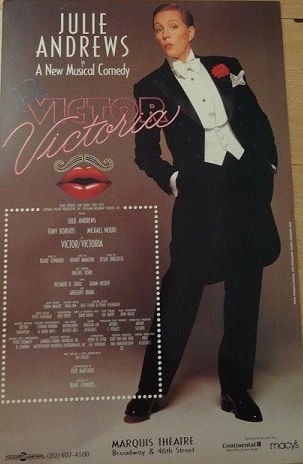
Victor/Victoria Musical: Julie Andrews on Broadway 1995
Memorabilia Available Here
Broadway Musical · 1995 · Marquis Theatre
Victor/
Victoria
A woman. A man. A secret. A sensation.
Book by Blake Edwards · Music by Henry Mancini · Lyrics by Leslie Bricusse · Additional Music & Lyrics by Frank Wildhorn
What Is Victor/Victoria?
Victor/Victoria is a Broadway musical with a book by filmmaker Blake Edwards, music by Henry Mancini, lyrics by Leslie Bricusse, and additional music and lyrics by Frank Wildhorn. The show is based on the beloved 1982 film of the same name, itself a remake of the 1933 German film comedy Viktor und Viktoria, written and directed by Reinhold Schünzel.
The story is set in the glamorous, seductive world of 1930s Paris — a world of jazz clubs, impresarios, tuxedos, and sequins — and follows an English soprano who reinvents herself as a man playing a woman, in order to find the success that has eluded her. Identity, love, deception, and liberation are woven together with wit and spectacle.
Tragically, composer Henry Mancini died before he could complete the score. Frank Wildhorn was brought in to finish the musical material. The result was one of Broadway’s most glamorous and talked-about productions of the 1990s — and one of its most controversial.
The Plot — Act by Act
Act One — Paris, 1930s
Carroll “Toddy” Todd is the resident performer at Henri Labisse’s Left Bank gay club, Chez Lui. After insulting a group of customers — including his ex-boyfriend Richard — Toddy is threatened with the sack. Meanwhile, a penniless English soprano named Victoria Grant auditions for Labisse and is rejected. Toddy and Victoria cross paths, become instant friends, and take shelter together from the cold Parisian night.
When Richard mistakenly assumes the pyjama-clad Victoria is Toddy’s new boyfriend, inspiration strikes: Victoria could find fame by disguising herself as a male female impersonator. Against her better judgment, the persona of Count Victor Grazinsky — a gay Polish aristocrat — is born. When “Victor” shatters a glass with a high G-flat, Cassell, Paris’s leading impresario, is convinced. Victor becomes the toast of Gay Paree.
The only doubter is King Marchan, a dashing American nightclub owner visiting with his girlfriend Norma and bodyguard Squash. King is inexplicably drawn to Victor and determines to prove the star is a woman. At Cassell’s opening night party, a tango is proposed as a test — but Victoria evades detection.
Complications multiply when King and Norma find themselves in the adjoining hotel suite to Toddy and Victor. Victoria confides to Toddy that King is the man of her dreams — yet she must convince him she is a man. King, wrestling with his own feelings, invites them both to dinner and then to Chez Lui, where Labisse also harbours suspicions. A brawl erupts. Outside, King declares he doesn’t care whether Victor is a man — and kisses him. Victoria admits the truth. King kisses her again.
Act Two — Love, Lies & Liberation
Back at the hotel, Squash stumbles upon King and Victor in bed together and — offering a heartfelt apology — reveals to the stunned King that he himself is gay. King and Victoria face an impossible dilemma: publicly, they cannot be seen together without destroying the Victor illusion.
Meanwhile, in Chicago, the scorned Norma informs King’s gangster business partner Sal Andretti that King has left her for “a gay Polish fairy.” Sal is appalled and heads to Paris. Back in Paris, Toddy and Squash have become a happy couple, but King and Victoria remain trapped in shadows. Victoria tells Toddy she no longer wants to live as a man — and neither does he.
Sal arrives and ends his business relationship with King in disgust. Victoria reveals herself as a woman to Norma. The secret is unravelling fast. At Victor’s farewell performance, Labisse attempts to expose the fraud — but Toddy, thrilled to step back into drag, replaces Victoria in an instant, confounding Labisse and clearing the way for a joyful finale: King and Victoria together, Toddy and Squash united.
The Original Cast
Notable Cast Changes During the Run
| Period | Performer | Role |
|---|---|---|
| Early 1997 (four-week vacation) | Liza Minnelli | Victoria Grant / Count Victor Grazinsky |
| 1997 — remainder of run | Raquel Welch | Victoria Grant (succeeded Andrews after her permanent departure) |
Julie Andrews — who boasted a celebrated four-octave vocal range — was ultimately forced to leave the production permanently after developing vocal problems. She underwent surgery to remove non-cancerous nodules from her throat, which left her without a singing voice. Her subsequent lawsuit against surgeon Scott M. Kessler was settled for $20 million.
Songs from Victor/Victoria
The score blends the classic Hollywood sophistication of Henry Mancini with the pop-theatre sensibility of Frank Wildhorn and the wordcraft of Leslie Bricusse. Below are the principal musical numbers from the show.
Julie Andrews & The Tony Rejection
When the Tony Award nominations were announced, Julie Andrews received the production’s sole nomination — for Best Actress in a Musical. In an extraordinary act of solidarity, Andrews publicly rejected the honour, stating that she had searched her conscience and heart and could not accept the nomination. She declared she would stand instead with the “egregiously overlooked” cast and crew of the production.
I have searched my conscience and my heart and find that I cannot accept this nomination.
— Julie Andrews, declining her 1996 Tony Award nominationThe incident was headline news across the entertainment world. Far from hurting the production, Andrews’ refusal actually stimulated ticket sales. Andrews also declined to perform at the Tony Awards ceremony that year, which critics noted suffered from a lack of star power. The moment remains one of Broadway’s most dramatic awards-season episodes.
From Out-of-Town Tryouts to London
A Story 90 Years in the Making
The Victor/Victoria story has a long and fascinating lineage. It began in 1933 with the German film comedy Viktor und Viktoria, written and directed by Reinhold Schünzel. The story of a woman disguising herself as a man impersonating a woman proved timeless — full of comedy, pathos, and surprisingly progressive ideas about gender and identity.
Nearly five decades later, filmmaker Blake Edwards remade the story as the celebrated 1982 Hollywood film, starring Julie Andrews and Robert Preston. The film was a critical and commercial success, and the idea of a stage musical was floated immediately after its release.
Robert Preston — who played Toddy in the film — reportedly declined to be involved in a stage adaptation, remarking that there was no way the musical could be profitable and calling it “just this big ego trip for Blake.” The Broadway production finally arrived thirteen years after the film, in 1995.
Awards & Nominations
The production received nominations from the major Broadway awards bodies in 1996, though its awards story will forever be defined by the extraordinary moment Julie Andrews rejected her Tony nomination in solidarity with her overlooked cast and crew.
| Year | Award | Category | Nominee |
|---|---|---|---|
| 1996 | Tony Award | Best Actress in a Musical (declined) | Julie Andrews |
| 1996 | Drama Desk Award | Outstanding Actress in a Musical | Julie Andrews |
| 1996 | Drama Desk Award | Outstanding Featured Actress in a Musical | Rachel York |
| 1996 | Outer Critics Circle Award | Outstanding Actress in a Musical | Julie Andrews |