West Side Story: The Complete Guide to the Musical
West Side Story Podcast
Memorabilia Available Here
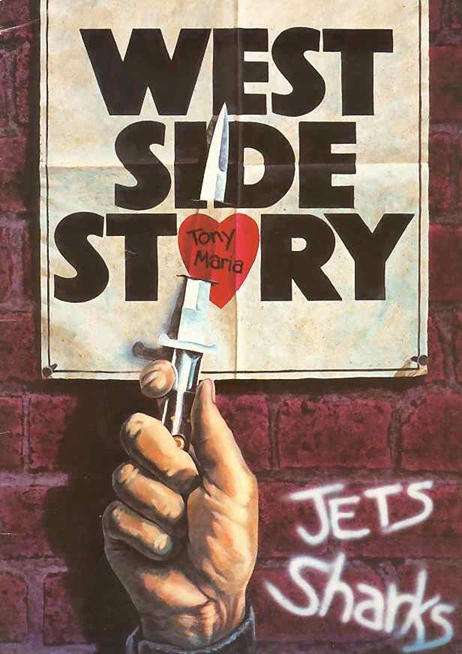
WEST SIDE
STORY
THE COMPLETE GUIDE
Shakespeare’s Romeo and Juliet reimagined on the streets of 1950s Manhattan — where two teenage gangs, a doomed love story, and one of Broadway’s greatest scores collided to change musical theatre forever.
⚡ Show Facts
What Is West Side Story?
West Side Story is a landmark American musical conceived by choreographer-director Jerome Robbins, with music by Leonard Bernstein, lyrics by Stephen Sondheim, and a book by Arthur Laurents. It is one of the most celebrated works in the history of the musical theatre — a Romeo and Juliet for mid-century New York, where the warring Montagues and Capulets have become the Jets and the Sharks.
Set on the Upper West Side of Manhattan in the mid-1950s, then a multiracial, blue-collar neighbourhood undergoing dramatic change, the show explores the violent rivalry between two teenage street gangs of different ethnic backgrounds. The Jets are white Americans; the Sharks are recent migrants from Puerto Rico. Both vie for control of the same few city blocks. Into this world steps Tony, a former Jet, who falls hopelessly in love with Maria — the sister of Bernardo, the Sharks’ leader. The story ends in tragedy.
What set West Side Story apart from everything that had come before it was its unflinching seriousness — its dark themes, sophisticated music, extended dance sequences, tragic conclusion, and direct engagement with social issues of race, immigration, and gang violence. The show marked a turning point in the history of the Broadway musical, demonstrating that the form could carry the weight of genuine tragedy and political meaning.
It was also the Broadway debut of Stephen Sondheim as a lyricist — a beginning that would eventually lead to the most celebrated body of work in the history of the American musical theatre.
A Turning Point in Theatre History: West Side Story’s dark themes, sophisticated score, and tragic ending challenged every assumption about what a Broadway musical could be. Producer after producer rejected it as “too dark and depressing” — every single one of them was wrong.
The Road to Broadway — A Story Eight Years in the Making
1949: The First Spark
The story of West Side Story begins in 1949, when choreographer Jerome Robbins approached composer Leonard Bernstein and playwright Arthur Laurents about collaborating on a contemporary musical adaptation of Romeo and Juliet. His original concept was quite different from the show we know today: Robbins proposed setting the conflict on the Lower East Side of Manhattan, with a Catholic boy and a Jewish girl, their families torn apart by antisemitism during the Easter-Passover season. Laurents wrote a first draft he called East Side Story. The team quickly concluded it covered ground already familiar from plays like Abie’s Irish Rose, and Robbins stepped away. The project was shelved for nearly five years.
1955: A Fresh Start — and a Latin Beat
In 1955, Laurents was hired to write the screenplay for a Hollywood film and found himself in Los Angeles. He met Bernstein — who was in town conducting at the Hollywood Bowl — at The Beverly Hills Hotel. Front-page newspaper stories about a Chicano turf war in Los Angeles turned the conversation to juvenile gang violence. Laurents felt he knew the Puerto Rican communities of New York better than the Mexican American communities of LA. The two contacted Robbins, who was “enthusiastic about a musical with a Latin beat.” The project was back on track — this time as West Side Story.
Enter Stephen Sondheim
Bernstein had decided to concentrate solely on the music and needed a sole lyricist. Betty Comden and Adolph Green had been invited but opted to work on Peter Pan instead. At a New York opening night party, Laurents encountered the young Stephen Sondheim — who had written music and lyrics for his own show, Saturday Night. Initially Sondheim resisted, determined to write his own full score next time rather than be a hired lyricist for someone else’s music. But his mentor Oscar Hammerstein II convinced him that he would benefit enormously from the experience. Sondheim accepted.
During the pre-Broadway tryout in Washington D.C., an important moment occurred: Bernstein removed his co-lyricist billing from the credits, giving Sondheim sole credit. Though the precise reasons remain disputed — Bernstein later said his lyric contributions had simply diminished as the writing progressed — Sondheim was himself uncertain he wanted sole credit for work he felt had been significantly shaped by Bernstein. Regardless, by opening night on Broadway, none of the collaborators were speaking to Robbins, who had used his “Conceived by” credit to justify making major unilateral decisions about the show.
The Struggle to Get It Staged
With the show nearly complete in late 1956, it still had no money behind it. A backers’ audition in spring 1957 — just two months before rehearsals were due to begin — raised nothing. Producer Cheryl Crawford withdrew. Every other producer had already turned it down, calling it too dark and depressing. Bernstein was despondent.
Sondheim then persuaded his friend Hal Prince — then overseeing a tryout in Boston — to read the script. Prince liked it; his mentor George Abbott told him to turn it down. Prince, recognising that Abbott was the reason the Boston show was in trouble, ignored him. He flew to New York with his partner Robert E. Griffith to hear the score. In his memoir, Prince recalled: his experience hearing Bernstein and Sondheim play through the music was galvanising. Prince and Griffith agreed to produce it.
Everyone told us that West Side Story was an impossible project. We were told no one was going to be able to sing augmented fourths, as with “Ma-ri-a.” Also, they said the score was too rangy for pop music. Besides, who wanted to see a show in which the first-act curtain comes down on two dead bodies?
— Leonard Bernstein, on the challenges of getting West Side Story to the stageCasting and Rehearsals
Casting presented its own extraordinary challenge: performers who could sing, dance, and act at a professional level — and pass as teenagers. Laurents had originally wanted James Dean for Tony; Dean died before the show entered production. Sondheim discovered Larry Kert for the role, while Chita Rivera was cast as Anita — a career-defining performance. Robbins kept the Jets and Sharks cast members strictly separated throughout rehearsals, forbidding them from socialising with each other. He posted real news stories about gang violence on the backstage bulletin board. He wanted — and got — something that felt urgently, frighteningly real.
Throughout rehearsals, Columbia Records initially declined to record the cast album, calling the score too depressing and too difficult. They were wrong about that too. The show opened in Washington D.C. and Philadelphia to enthusiastic responses before its Broadway debut on September 26, 1957, at the Winter Garden Theatre.
The Jets & The Sharks
The show’s full roster of characters — teenage gang members, their girls, and the adults caught between them — populate one of the most vibrant and precisely observed ensembles in Broadway history.
- Riff The Leader
- Tony Riff’s Best Friend
- Diesel Lieutenant
- Action
- A-Rab
- Baby John
- Big Deal · Gee-Tar · Mouthpiece
- Snowboy · Tiger · Anybodys
- Velma Riff’s Girl
- Graziella Diesel’s Girl
- Minnie · Clarice · Pauline
- Bernardo The Leader
- Maria Bernardo’s Sister
- Anita Bernardo’s Girl
- Chino Bernardo’s Best Friend
- Pepe Second-in-Command
- Indio · Luis · Anxious
- Nibbles · Juano · Toro · Moose
- Rosalia · Consuelo · Teresita
- Francisca · Estella · Marguerita
- Doc Drugstore Owner
- Schrank · Krupke Police
The Plot — Act by Act
Two rival teenage gangs — the Jets (white Americans) and the Sharks (Puerto Ricans) — struggle for control of the San Juan Hill neighbourhood on Manhattan’s Upper West Side. Police officers Krupke and Lt. Schrank warn them to stop fighting. Jets leader Riff plans a rumble and tries to recruit his best friend Tony, who is trying to leave the gang life behind.
At the neighbourhood dance, Tony and Maria — Bernardo’s sister, newly arrived from Puerto Rico — see each other across the room and fall instantly, helplessly in love. Bernardo pulls Maria away. That night, Tony serenades Maria at her fire escape and they profess their love (“Tonight”). Maria makes Tony promise to stop the coming fight.
At the rumble under the highway, Tony arrives to intervene. Bernardo provokes and taunts him. Riff throws a punch in Tony’s defence, switchblades are drawn, and in the chaos Tony inadvertently leads to Riff being fatally stabbed by Bernardo. Tony then kills Bernardo in rage. Police sirens scatter everyone. Only the bodies of Riff and Bernardo remain.
Maria, still unaware of the rumble, is singing joyfully (“I Feel Pretty”) when Chino arrives with the news that Tony has killed her brother. Tony arrives; Maria rages at him but cannot stop loving him. They plan to run away together (“Somewhere”).
When Chino gets a gun and goes looking for Tony, Anita agrees to carry a warning to Doc’s drugstore. The Jets taunt her with racist slurs and near-assault her. Furious, Anita tells them the wrong message: Maria is dead.
Doc relays this to Tony, who rushes out wanting Chino to shoot him too. Just as Tony sees Maria alive and runs to her, Chino arrives and shoots Tony. He dies in Maria’s arms as she sings a quiet reprise of “Somewhere.” Maria takes the gun and addresses both gangs — their hatred killed Tony, Riff, and Bernardo. She cannot fire it. The gangs, finally, carry Tony away together. The feud is over. The cost was everything.
Songs — Bernstein’s Score
Bernstein composed the score for West Side Story concurrently with his operetta Candide, and several musical ideas migrated between the two works. The score is one of the most technically ambitious in Broadway history — operatic in scale, rhythmically daring (the “Ma-ri-a” melody uses an augmented fourth that singers were warned was unsignable), and yet intensely theatrical. Below is the complete song list.
Borrowed from Candide: Bernstein was writing West Side Story and his operetta Candide simultaneously. The music for “Gee, Officer Krupke” was pulled from a Venice scene in Candide, while Tony and Maria’s “One Hand, One Heart” was originally written for the character Cunegonde. Both were repurposed and transformed into something entirely new in their West Side Story context.
The Cast That Made History
The original Broadway production opened at the Winter Garden Theatre on September 26, 1957, ran for 732 performances, and closed on June 27, 1959. Directed and choreographed by Jerome Robbins. Orchestrated by Sid Ramin and Irwin Kostal. Lighting design by Jean Rosenthal.
James Dean was Laurents’ first choice for Tony. When the project was being cast, playwright Arthur Laurents wanted James Dean for the lead role. Dean died in a car crash in September 1955 before the show entered production. Sondheim subsequently discovered Larry Kert — and Broadway history was made.
From 1957 to Today — Every Major Production
Two Landmark Films — Six Decades Apart
West Side Story has been adapted for the cinema twice — sixty years apart — and both times the film earned Academy Award nominations for Best Picture. Both films left their mark on cinema history.
Co-directed by Robert Wise and Jerome Robbins, with Robbins responsible for all the musical numbers and Wise directing the dramatic scenes. The film starred Natalie Wood as Maria, Richard Beymer as Tony, George Chakiris as Bernardo, and Rita Moreno as Anita. Both Chakiris and Moreno won Academy Awards for their performances. The film was nominated for eleven Oscars and won ten — including Best Picture — one of the highest total wins in Academy history at that time.
Directed by Steven Spielberg, with a screenplay by Tony Kushner, the 2021 adaptation cast Ansel Elgort as Tony, Rachel Zegler (in her film debut) as Maria, and Ariana DeBose as Anita. DeBose’s performance won the Academy Award for Best Supporting Actress for the same role won by Rita Moreno in 1961. Notably, Rita Moreno herself appeared in the film in a new role created for the adaptation. The film received seven Academy Award nominations including Best Picture.
A unique piece of Oscar history: Ariana DeBose winning Best Supporting Actress in 2022 for playing Anita in the 2021 film means that the role of Anita has now won the Academy Award for Best Supporting Actress twice — once for Rita Moreno in 1962 and once for Ariana DeBose sixty years later. No other role in cinema history has achieved this.
Nominations & Awards
Original Broadway — 1958 Tony Awards
| Award | Category | Nominee | Result |
|---|---|---|---|
| Tony Award | Best Choreography | Jerome Robbins | ✦ Won |
| Tony Award | Best Scenic Design | Oliver Smith | ✦ Won |
| Tony Award | Best Musical | West Side Story | Nominated |
| Tony Award | Best Actress in a Musical | Carol Lawrence | Nominated |
| Tony Award | Best Musical Director | Max Goberman | Nominated |
| Tony Award | Best Costume Design | Irene Sharaff | Nominated |
| Theatre World Award | Outstanding Debut | Carol Lawrence | ✦ Won |
1961 Film — Academy Awards
| Award | Category | Result |
|---|---|---|
| Academy Award | Best Picture | ✦ Won |
| Academy Award | Best Director (Robert Wise & Jerome Robbins) | ✦ Won |
| Academy Award | Best Supporting Actor — George Chakiris | ✦ Won |
| Academy Award | Best Supporting Actress — Rita Moreno | ✦ Won |
| Academy Award | Best Cinematography (Color) | ✦ Won |
| Academy Award | Best Art Direction / Set Decoration (Color) | ✦ Won |
| Academy Award | Best Costume Design (Color) | ✦ Won |
| Academy Award | Best Film Editing | ✦ Won |
| Academy Award | Best Sound | ✦ Won |
| Academy Award | Best Scoring — Adaptation or Treatment | ✦ Won |
| Academy Award | Best Writing — Screenplay Based on Material from Another Medium | Nominated |
1980 Broadway Revival — Tony Awards
| Award | Category | Nominee | Result |
|---|---|---|---|
| Tony Award | Best Reproduction (Play or Musical) | West Side Story | Nominated |
| Tony Award | Best Featured Actress — Josie de Guzman | Josie de Guzman | Nominated |
| Tony Award | Best Featured Actress — Debbie Allen | Debbie Allen | Nominated |
| Drama Desk Award | Outstanding Featured Actress | Debbie Allen | ✦ Won |
2009 Broadway Revival — Tony Awards
| Award | Category | Nominee | Result |
|---|---|---|---|
| Tony Award | Best Featured Actress in a Musical | Karen Olivo (Anita) | ✦ Won |
2021 Film — Academy Awards
| Award | Category | Result |
|---|---|---|
| Academy Award | Best Supporting Actress — Ariana DeBose | ✦ Won |
| Academy Award | Best Picture | Nominated |
| Academy Award | Best Director — Steven Spielberg | Nominated |
| Academy Award | Best Cinematography | Nominated |
| Academy Award | Best Costume Design | Nominated |
| Academy Award | Best Production Design | Nominated |
| Academy Award | Best Sound | Nominated |
Why West Side Story Changed Everything
West Side Story arrived on Broadway in 1957 and changed the theatre forever. Before it, musicals were primarily vehicles for entertainment — song, dance, and comedy in well-tested combinations. Tragedy was not the musical’s mode. Social criticism was not its business. Death at the final curtain was unthinkable.
West Side Story broke every one of those rules. It ended on two deaths in Act One and a third in Act Two. It addressed race, immigration, police racism, and gang violence with a directness that no musical had attempted. Its score was operatically demanding in ways that terrified producers and record labels alike. Its choreography was not decoration — it was character, story, and emotion expressed through bodies moving in space. Jerome Robbins made the dancing as narratively essential as any spoken word.
The show was also the Broadway debut of Stephen Sondheim as a lyricist — the beginning of a career that would itself transform the musical theatre over the following six decades. Ironically, Sondheim always had mixed feelings about West Side Story: he’d wanted to write both music and lyrics for his next project and considered the lyrics, influenced by Bernstein’s contributions, imperfect. History has disagreed.
It established Hal Prince as one of the defining producers of the Broadway musical — a career that would go on to include Cabaret, Company, Sweeney Todd, Phantom of the Opera, and many more. It gave Chita Rivera her star-making role. It produced one of the greatest film adaptations in the history of the musical — and then, sixty years later, inspired another.
Sondheim’s Broadway Debut: West Side Story marked Stephen Sondheim’s debut on Broadway as a lyricist — making it the entry point for the man who would go on to write A Funny Thing Happened on the Way to the Forum, Company, Follies, A Little Night Music, Sweeney Todd, Sunday in the Park with George, Into the Woods, and Passion. Few Broadway debuts have had more lasting consequences for the art form.