Wicked Musical | History, Cast, Story & Film Adaptation
The Untold Story of the Witches of Oz
Wicked A Musical Phenomenon
How a misunderstood witch, a glamorous good witch, and one audacious reimagining turned Broadway upside down — and never looked back.
Wicked didn’t just rewrite the story of Oz — it rewrote the rules of what a Broadway musical could become. A cultural phenomenon, a box-office juggernaut, and one of the most beloved shows in theatrical history.
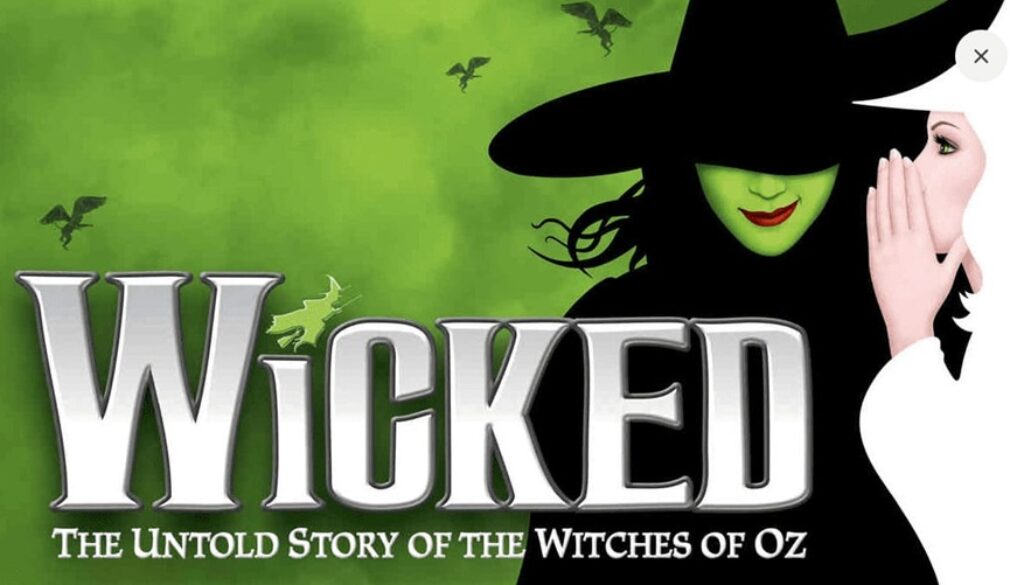
Wicked — known in full as Wicked: The Untold Story of the Witches of Oz — is a musical with music and lyrics by Stephen Schwartz and a book by Winnie Holzman. It is loosely adapted from Gregory Maguire’s 1995 novel Wicked: The Life and Times of the Wicked Witch of the West, which itself was inspired by L. Frank Baum’s 1900 novel The Wonderful Wizard of Oz and its iconic 1939 film adaptation.
Set in the Land of Oz before and after Dorothy Gale’s arrival from Kansas, the musical explores the complex relationship between Elphaba Thropp and Galinda Upland — the future Wicked Witch of the West and Glinda the Good, respectively — as they are tested by their contrasting worldviews, a shared love interest, and their reactions to the Wizard’s corrupt rule.
The original production premiered on Broadway at the Gershwin Theatre in October 2003, starring Idina Menzel as Elphaba, Kristin Chenoweth as Galinda, Norbert Leo Butz as Fiyero, and Joel Grey as the Wizard. Despite mixed reviews at opening, the show won three Tony Awards and seven Drama Desk Awards, and its original cast album received a Grammy Award. Word-of-mouth quickly propelled it to record-breaking success.
Wicked surpassed $1 billion in total Broadway revenue in 2016, joining The Phantom of the Opera and The Lion King as the only shows to achieve this milestone. By 2017, it had surpassed Phantom to become Broadway’s second-highest grossing musical of all time, trailing only The Lion King. In the final week of 2024, it became the first Broadway production ever to earn over $5 million in a single week.
The Story Behind the Story
The citizens of Oz are celebrating the death of the Wicked Witch of the West. Glinda the Good Witch appears and reminisces about their past, beginning with the troubled childhood of the Witch — born Elphaba Thropp — after her mother had an affair and her father, Governor of Munchkinland, disowned her when she was born with bright green skin.
Flashing back many years earlier, Elphaba arrives at Shiz University with her younger paraplegic sister Nessarose, where she is ostracized for her green skin and sarcastic personality. The school’s headmistress, Madame Morrible, assigns Elphaba to room with the popular Galinda Upland. Recognizing Elphaba’s magical potential, Morrible decides to privately tutor her in sorcery — making Galinda intensely jealous, and the two girls come to loathe each other.
A roguish prince, Fiyero, begins attending Shiz and arranges a party for his fellow students. Galinda becomes immediately enamored with him. When Elphaba is mocked at the party for wearing an ugly hat Galinda gave her as a practical joke, Galinda has a change of heart and decides to dance with Elphaba. The girls finally bond, and Galinda gives Elphaba a makeover in the memorable number “Popular.”
“If every musical had a brain, a heart and the courage of Wicked, Broadway really would be a magical place.”
Morrible tells Elphaba that the Wizard of Oz wants to meet her. The two witches travel to the Emerald City, where they are surprised to discover the Wizard’s mortal nature. After being tricked into enchanting the Wizard’s monkey servants to sprout wings painfully, Elphaba deduces that the Wizard is behind the suppression of animals and is a fraud who uses parlor tricks and lies to stay in power. Elphaba refuses to apologize, and in the show’s electrifying Act One finale, she enchants a broom to fly away from the Emerald City, vowing to fight the Wizard — and soars into the air in the iconic “Defying Gravity.”
Sometime later, Elphaba has become known as the Wicked Witch of the West for her opposition to the Wizard’s regime, while Glinda has been positioned as the Wizard’s spokesperson. Tragedy strikes when a tornado — secretly summoned by Madame Morrible — crushes Elphaba’s sister Nessarose to death. Elphaba is distraught and furious. Fiyero arrives to help her escape but is captured, and Elphaba casts a desperate spell to save him — transforming him into the Scarecrow.
In the emotional climax, Elphaba and Glinda share a tearful goodbye in the devastating duet “For Good.” Glinda watches as Dorothy throws water on Elphaba, seemingly melting her — but in a twist, Elphaba has faked her death. She emerges from a trap door at Kiamo Ko Castle, and she and Fiyero depart Oz together in secret, as Glinda — now alone and compromised — tells everyone the Wicked Witch is dead.
The Making of a Musical Phenomenon
Composer and lyricist Stephen Schwartz discovered Gregory Maguire’s 1995 novel while on vacation and immediately saw its potential for a dramatic adaptation. However, Maguire had already released the rights to Universal Pictures, which had planned to develop a live-action feature film. In 1998, Schwartz persuaded Maguire to release the rights to a stage production, while also making what he called an “impassioned plea” to Universal producer Marc Platt to realize his own intended adaptation. Persuaded, Platt signed on as joint producer.
Schwartz collaborated with writer Winnie Holzman to develop the outline of the plot over the course of a year, meeting regularly with producer Marc Platt to refine the structural outline. The result was an original stage piece rather than a strict adaptation of Maguire’s work. While the novel was a dark, sprawling political and social commentary addressing themes including sexual assault, political unrest, and racism, the musical focused primarily on the friendship between the two witches and how their characters led them to completely different destinies.
Casting & Development
Kristin Chenoweth — the actress whom Schwartz had in mind while composing the music for Glinda — joined the project during developmental workshops. Stephanie J. Block played Elphaba in the workshops before Idina Menzel was cast in the role in late 2002. Director Joe Mantello and choreographer Wayne Cilento were engaged, while designer Eugene Lee created the set and visual style inspired by W. W. Denslow’s original illustrations for Baum’s novels and Maguire’s concept of the story being told through a giant clock.
Costume designer Susan Hilferty created a “twisted Edwardian” style, building more than 200 costumes. Lighting designer Kenneth Posner used more than 800 lights to give each of the 54 distinct scenes and locations “its own mood.”
From San Francisco to Broadway
Following the out-of-town tryout in San Francisco in May and June 2003 — which received mixed critical reception — the creative team made extensive changes before its transfer to Broadway. Schwartz had wisely insisted on three months to rewrite between closing in San Francisco and returning to rehearsals in New York. “That was crucial; that was the thing that made the biggest difference in the life of the show,” Holzman later recalled.
The introductory song for Fiyero, “Which Way is the Party?”, was replaced by “Dancing Through Life.” Concern existed that Menzel’s Elphaba was being overshadowed by Chenoweth’s Glinda, so the creative team set about making Elphaba “more prominent” in the revised version.
The Score
The score of Wicked is heavily thematic, bearing more resemblance to an opera than a traditional musical score. Schwartz integrated a handful of leitmotifs throughout the production — some indicating irony, others conveying character. Elphaba’s theme actually originated from The Survival of St. Joan, on which Schwartz worked as musical director. The chord progression he first penned in 1971 became a major theme of the show’s orchestration, with the same melody conveying vastly different moods depending on which instruments carry it.
The second major motif — the “Unlimited” theme — incorporates the first seven notes of “Over the Rainbow” as a tribute to Harold Arlen, who wrote the score for the 1939 film. Schwartz included it as an inside joke: copyright law only kicks in at the eighth note, and he further obscured the motif’s origin by setting it in a minor key in most instances.
A Journey Through the Emerald City
The Original Casts
| Character | San Francisco (2003) | Broadway (2003) | West End (2006) |
|---|---|---|---|
| Elphaba | Idina Menzel | Idina Menzel | Idina Menzel* |
| Glinda | Kristin Chenoweth | Kristin Chenoweth | Helen Dallimore |
| Fiyero | Norbert Leo Butz | Norbert Leo Butz | Adam Garcia |
| The Wizard | Robert Morse | Joel Grey | Nigel Planer |
| Madame Morrible | Carole Shelley | Carole Shelley | Miriam Margolyes |
| Nessarose | Michelle Federer | Michelle Federer | Katie Rowley Jones |
| Boq | Kirk McDonald | Christopher Fitzgerald | James Gillan |
| Dr. Dillamond | John Horton | William Youmans | Martin Ball |
*Idina Menzel returned for a limited engagement in London; Kerry Ellis succeeded her on 1 January 2007 as the first British actress to play Elphaba.
Around the World in Emerald Green
Wicked has been produced in dozens of countries across multiple continents, translated into numerous languages, and performed by millions of audience members worldwide. Productions have broken box-office records on every continent where they have opened.
Recordings & Critical Reception
Cast Recordings
A cast recording of the original Broadway production was released on 16 December 2003 by Universal Music. The music was arranged by Stephen Oremus, who was also the conductor and musical director, and James Lynn Abbott, with orchestrations by William David Brohn. The recording received the Grammy Award for Best Musical Show Album in 2005 and was certified platinum by the RIAA in 2006, then double platinum in 2010.
A fifth-anniversary special edition was released on 28 October 2008, with a bonus CD including tracks from the Japanese and German cast recordings, a version of “I’m Not That Girl” by Kerry Ellis featuring Brian May on guitar, Menzel’s dance mix of “Defying Gravity,” and “For Good” sung by LeAnn Rimes and Delta Goodrem. German and Japanese cast recordings have also been released.
Critical Reception
The Broadway production opened to mixed reviews. Critics tended to compliment the spectacle and the performances — particularly Chenoweth and Menzel — but opinions were divided on the book and score. Elysa Gardner of USA Today described it as “the most complete, and completely satisfying, new musical I’ve come across in a long time.” Conversely, Ben Brantley of the New York Times loved the production values but criticized the show itself as a “sermon” that “overplays its hand.”
Despite the divided critical response, interest in Wicked spread rapidly by word-of-mouth, leading to record-breaking box office success. As Schwartz told The Arizona Republic in 2006: “Reviews are reviews…. I know we divided the critics. We didn’t divide the audience, and that’s what counts.”
Wicked was named the Best Musical of the Decade by Entertainment Weekly magazine and hailed “a cultural phenomenon” by Variety. The character of Elphaba was named 79th on Entertainment Weekly’s list of The 100 Greatest Characters of the Past 20 Years.
Breaking Every Record
Since its opening in 2003, the original Broadway production of Wicked has broken the house record at the Gershwin Theatre twenty times. It regularly grosses in excess of $1.6 million each week, making it one of the most lucrative productions on Broadway. With a $14 million capitalization, the Broadway production took just 15 months to break even, earning back its initial investment by December 2004. In its first year, it grossed more than $56 million.
In January 2011, the Broadway, London, and North American touring productions simultaneously broke their respective records for the highest weekly gross — a feat unprecedented in theatrical history. The collective gross of worldwide productions reached a world record-breaking $11.2 million in a single week.
The Chicago sit-down production played to more than 2 million visitors with a gross of over $200 million, making it the highest-grossing show in Chicago history. The Los Angeles production grossed over $145 million and was seen by more than 1.8 million patrons. The San Francisco production sold over 1 million tickets across 672 performances, with a cumulative gross exceeding $75 million.
The West End production set the record for the highest single-week gross in West End theatre history in December 2010, with over 20,000 people attending nine performances that week. The Melbourne production broke Australian box-office records, selling 24,750 tickets in just three hours during pre-sales.
From Stage to Cinema
A two-part film adaptation was directed by Jon M. Chu and starred Cynthia Erivo as Elphaba, Ariana Grande as Glinda, Jonathan Bailey as Fiyero, and Jeff Goldblum as the Wizard. The first part was released on 22 November 2024, and featured extended cameos by original Broadway stars Idina Menzel and Kristin Chenoweth. The film was nominated for the Academy Award for Best Picture among numerous other accolades.
The second part, Wicked: For Good, is scheduled for release on 21 November 2025, completing the story of how Elphaba and Glinda’s extraordinary friendship shaped the land of Oz forever.