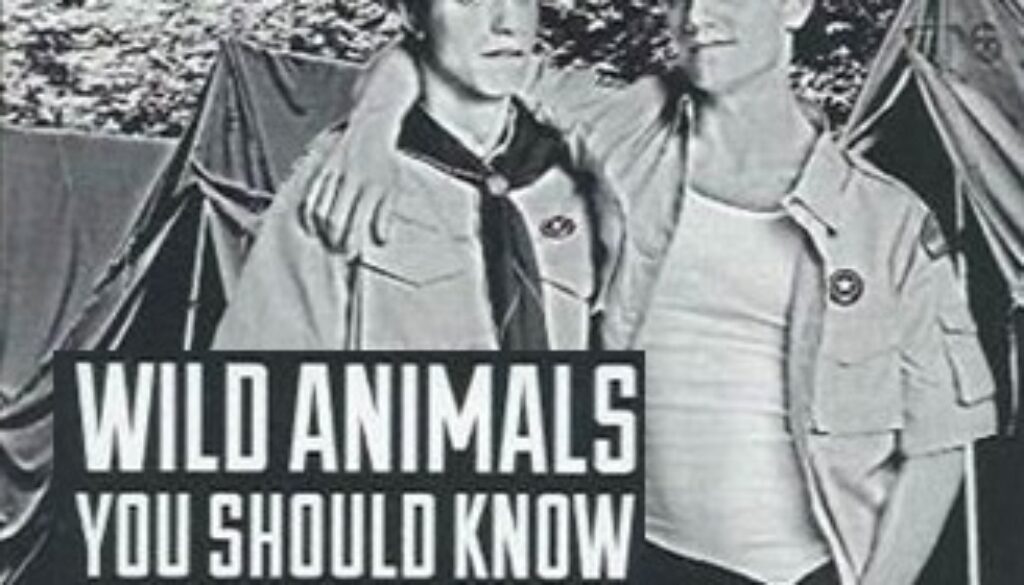
Wild Animals You Should Know (2011)
Playwright Thomas Higgins made his Off-Broadway debut with “Wild Animals You Should Know,” but this naive and glib comedy-drama about a sexually confused golden boy who hits on his closeted scoutmaster in order to destroy him suggests that Higgins would be more at home on the small screen than in a small theatre.
Highlites from Richard Patterson – Dec 2011 Exeunt
America’s great naturalist poet, Walt Whitman, looms over the proceedings of Wild Animals You Should Know, a well-meaning new dramedy that marks playwright Thomas Higgins’s New York debut. “I celebrate myself and sing myself,” Scoutmaster Rodney quotes floridly to his fledgling scouts, encouraging to them to be one with nature, because “what I assume you shall assume, for every atom belonging to me as good belongs to you.”
It’s this central tenet from Whitman’s Song of Myself that seems to inform the bulk of the play, which centres around two young scouts – Matthew, a blonde-haired, popular jock type, and Jacob, a gay geek who happens to be one of Matthew’s closest friends. Whitman’s poem, in a humanist sort of way, is essentially the equivalent of the “golden rule.”
Essentially, to Whitman, we have all come from the grass and will return to it. In Higgins’s play, Matthew – himself a sort of magnetizing, brute, (dare I write it) animal force – has the kind of impulsivity to counteract Scoutmaster Rodney’s hippie-dippie tree-hugging tendencies. You see – handsome leader Rodney happens to be Matthew’s neighbour across the way, and Matthew’s seen him and a man together (yes, together) from the safe perch of his bedroom window.
As Wild Animals You Should Know opens, Matthew is teasing Jacob via webcam. It’s Jacob’s birthday, and Matthew uses the occasion as a means, as ever, to assert his dominance within the confines of their friendship. At first, he removes his shirt, but, after Jacob pleads, he’s soon in his tighty-whiteys. A captive (and rather gay) audience swoons. It’s an intriguing start to a problematic play. From the word go, it’s understood that Wild Animals will be about power plays – about survival of the fittest, or at least survival of the most brutal.
The premise soon shifts to a weekend trip the scouts take as a group. Matthew’s father, Walter (Patrick Breen) is encouraged by his wife Marsha (Alice Ripley) to accompany the scouts as a means of bonding with his son. You see, Walter’s just lost his job (topical!), and Marsha thinks he ought to use some of his excess time to reconnect. Soon, out in the woods along with Rodney and Larry, another scout’s beer-pounding dad, the dynamics set up early in the play shift in new and interesting ways.
In one of the play’s savviest scenes, Matthew, learning to fish alongside Jacob, asks for Rodney’s help casting his line. Rodney does, but Matthew uses what he knows about Rodney against him in increasingly overt physical ways, a boy dipping his toes into dangerous water. When they’re alone later, Matthew challenges Rodney yet again. Ultimately, Matthew finds himself choosing whether to expose Rodney or to let him be. As ever, desire is a key factor.
The conceit of Wild Animals is an extraordinarily intriguing one. Plays are all about power, and a premise regarding vulnerable scouts in the care of a man who could potentially be dangerous, is an excellent one. Even more effective is how Higgins plays with the morality of the situation. Is Rodney a pervert – an abuser of children – or is he a lonely man looking to reconnect with nature?
There are pleasures to be had here. Patrick Breen is winning as bumbling, fumbling Walter opposite an underused but affable Alice Ripley. And Daniel Stewart Sherman as relatable boozehound Larry is fascinatingly flawed. Gideon Glick and Jay Armstrong Johnson are fine as Jacob and Matthew respectively, our central pair, though occasionally their acting-like-children shtick grates.
Director Trip Cullman does a fine job with the material here despite the hindrance of Andromache Chalfant’s misguided set, which mostly consists of tree backdrops covered by white curtains (artsy, but without purpose). In a number of good plays and musicals, a trip into the woods incites a change, and the presence of that kind of wildness is what makes Higgins’s play so dangerous-feeling.

Run
First Performance Nov 04, 2011 Opening Date Nov 20, 2011
Closing Date Dec 11, 2011 – Lucille Lortel Theatre

Cast
John Behlmann, Patrick Breen, Gideon Glick, Jay Armstrong Johnson, Alice Ripley, Daniel Stewart Sherman
Tech
Playwright – Thomas Higgins
Production Stage Management – Rachel Motz/ Kelly Glasow
Scenic Design – Andromache Chalfant
Lighting Design – David Weiner
Sound Design – Fitz Patton
Costume Design – Jenny Mannis
Assistant Direction – David Mendizábal
Assistant Lighting Design – David Sexton
Projections Design – Joe Cantalupo
Assistant Costume Design – Valerie Bert
Master Properties Management – Karin White
Head Sound Engineering – Bill Grady