Les Misérables | The World’s Longest-Running Musical
Les Misérables
Memorabilia Available Here
The World’s Longest-Running Musical
Claude-Michel Schönberg and Alain Boublil’s epic sung-through musical, based on Victor Hugo’s 1862 novel, tells the story of Jean Valjean’s quest for redemption in 19th-century France. From its 1980 Paris premiere to becoming the longest-running West End musical and a global phenomenon, Les Misérables has captivated audiences worldwide for over four decades.
Les Misérables, colloquially known as Les Mis or Les Miz, is a sung-through musical with music by Claude-Michel Schönberg, lyrics by Alain Boublil and Jean-Marc Natel, and a book by Boublil and Schönberg, based on the 1862 novel of the same name by Victor Hugo. Set in early 19th-century France, the story follows Jean Valjean, a French convict imprisoned for 19 years for stealing bread, and his journey toward redemption while pursued by the relentless police inspector Javert.
The English-language adaptation has been running in London since October 1985, making it the longest-running musical in the West End and the second longest-running musical in the world after the original off-Broadway run of The Fantasticks. The first Broadway production ran from 1987 to 2003, with 6,680 performances. At the time of its closing, it was the second-longest-running musical in Broadway history.
The show has been produced in at least 42 countries and translated into at least 23 languages. A film adaptation directed by Tom Hooper was released in 2012 to generally positive reviews, winning three Academy Awards and being nominated for five more, including Best Picture.
From Concept to Musical
Alain Boublil’s initial idea to adapt Victor Hugo’s novel into a musical came while at a performance of the musical Oliver! in London: “As soon as the Artful Dodger came onstage, Gavroche came to mind. It was like a blow to the solar plexus. I started seeing all the characters of Victor Hugo’s Les Misérables—Valjean, Javert, Gavroche, Cosette, Marius, and Éponine—in my mind’s eye, laughing, crying, and singing onstage.”
He shared the idea with French composer Claude-Michel Schönberg, and the two developed a rough synopsis and analysis of each character’s mental and emotional state. Schönberg then began work on the music, while Boublil started writing the text in collaboration with poet Jean-Marc Natel. Two years later, a two-hour demo tape of Schönberg accompanying himself on the piano and singing every role was completed.
1980 French Concept Album & Stage Production
The Les Misérables concept album was released in French in 1980, selling 260,000 copies. It starred Maurice Barrier as Jean Valjean, Jacques Mercier as Javert, Rose Laurens as Fantine, and Michel Sardou as Enjolras.
The first stage adaptation was presented at the Palais des Sports in September 1980, directed by veteran French film director Robert Hossein. The show was a success, with 100 performances seen by over 500,000 people. Most of the cast from the concept album performed in the production, including Barrier, Laurens, and Jean Vallée as Javert.
English Adaptation
In 1983, producer Cameron Mackintosh received a copy of the French concept album from director Peter Farago, who asked Mackintosh to produce an English-language version. Initially reluctant, Mackintosh eventually agreed. In conjunction with the Royal Shakespeare Company (RSC), Mackintosh assembled a production team to adapt the French musical for a British audience.
After two years in development, the English-language version, translated by Herbert Kretzmer (lyrics) and Siobhan Bracke (book), and expanded with additional material by James Fenton, opened in London in October 1985. The English lyrics were not a direct translation—a third were rough translations, another third were adapted from the French, and the final third consisted of new material.
Critical Reception at Opening
Critical reviews for Les Misérables were initially negative. The Sunday Telegraph’s Francis King described the musical as “a lurid Victorian melodrama produced with Victorian lavishness”, and Michael Ratcliffe of The Observer considered the show “a witless and synthetic entertainment”. However, public opinion differed—the box office received record orders, the three-month engagement sold out, and reviews improved.
Plot Synopsis
Act 1: 1815-1823
In 1815 France, Jean Valjean, “Prisoner 24601”, is released on parole by guard Javert after 19 years hard labor for stealing bread. Marked by his yellow ticket of leave, Valjean is shunned until the Bishop of Digne offers him shelter. When Valjean steals the Bishop’s silver, the Bishop pretends to have given it to him and also gives him silver candlesticks. Valjean vows to start an honest life and tears up his ticket, breaking parole.
By 1823, Valjean is living disguised as Monsieur Madeleine, a factory owner and mayor of Montreuil-sur-Mer. Fantine, a single mother working at Valjean’s factory, is fired and sinks into poverty, selling her locket and hair, and becoming a prostitute. When she fights an abusive customer, Javert, now a police inspector, arrests her. Valjean intervenes and takes her to a hospital.
When Valjean rescues a man pinned by a runaway cart, Javert suspects his true identity. Learning an innocent man is about to be jailed in his place, Valjean confesses. At the hospital, Fantine dies after Valjean promises to rescue her daughter Cosette from the thieving Thénardiers, innkeepers who are paid to raise her. Valjean escapes Javert and pays the Thénardiers to release Cosette, taking her to Paris.
Act 2: 1832 Paris Uprising
In 1832 Paris, unrest grows with the impending death of the merciful General Lamarque. Student revolutionaries Marius Pontmercy and Enjolras prepare for an uprising. The Thénardiers lead a gang of street criminals. Éponine secretly loves Marius, but he falls instantly for Cosette when he meets her with Valjean. Javert vows to recapture Valjean.
News of Lamarque’s death sparks plans for revolution. Cosette confronts Valjean about his secrets, and Marius and Cosette confess their love. Believing Javert has found him, Valjean plans to flee with Cosette. On the eve of the 1832 Paris Uprising, Enjolras exhorts all of Paris to join the revolution.
The Barricade
The students build a barricade. To keep Éponine safe, Marius sends her to deliver a farewell letter to Cosette. Valjean intercepts the letter and learns about their romance. The French army arrives, demanding surrender. Javert, disguised as a rebel, is exposed as a spy by young Gavroche. Wounded during the fighting, Éponine dies in Marius’s arms, confessing her love.
Valjean arrives disguised as a soldier, hoping to protect Marius. He saves Enjolras and releases Javert instead of executing him. As dawn approaches, Valjean prays for Marius’s safety, offering God his own life. The army attacks; Gavroche is killed, and all the students but Marius die. Valjean carries a gravely wounded Marius through the sewers.
At the sewer’s exit, Valjean finds Javert waiting; he begs for time to bring Marius to a doctor. Javert, unable to reconcile Valjean’s mercy with his worldview, kills himself. Paris mourns the fallen students. Marius grieves his friends and wonders who saved him.
Resolution
Valjean blesses Marius and Cosette’s marriage but tells Marius he is an escaped convict and must leave to protect Cosette. At their wedding, the Thénardiers attempt to blackmail Marius, who realizes Valjean carried him from the barricades. Marius and Cosette rush to find Valjean.
At a convent, Valjean awaits death. Fantine’s spirit assures him of forgiveness. Cosette and Marius arrive in time to bid farewell. Valjean thanks God for seeing Cosette grown and happy. He entrusts her with his past and tells her the truth about her mother. Guided by the spirits of Fantine and Éponine, who remind him that “to love another person is to see the face of God”, he dies at peace, joining the souls of the fallen in a hopeful vision of freedom.
Musical Numbers
Act 1
- Work Song (Look Down) – Chain Gang, Jean Valjean, Javert
- On Parole – Jean Valjean, Farmer, Laborer, Innkeeper, Bishop
- Valjean Arrested/Valjean Forgiven – Bishop, Constables
- Valjean’s Soliloquy (What Have I Done?) – Jean Valjean
- At the End of the Day – Fantine, Foreman, Jean Valjean, Factory Workers
- I Dreamed A Dream – Fantine
- Lovely Ladies – Fantine, Sailors, Old Woman, Pimp, Prostitutes
- Fantine’s Arrest – Bamatabois, Fantine, Javert, Jean Valjean
- The Runaway Cart – Fauchevelant, Jean Valjean, Javert
- Who Am I? – Jean Valjean
- Fantine’s Death (Come To Me) – Fantine, Jean Valjean
- Confrontation – Jean Valjean, Javert
- Castle on a Cloud – Little Cosette
- Master of the House – Thénardier, Madame Thénardier, Inn Guests
- The Bargain/Thénardier’s Waltz of Treachery – Jean Valjean, Thénardiers
- Look Down – Gavroche, Marius, Enjolras, Townspeople
- The Robbery – Thénardier, Madame Thénardier, Marius, Eponine, Valjean, Javert
- Stars – Javert
- Eponine’s Errand – Eponine, Marius
- The ABC Cafe/Red and Black – Enjolras, Marius, Grantaire, Students
- Do You Hear The People Sing? – Enjolras, Marius, Students
- In My Life – Cosette, Marius, Eponine, Jean Valjean
- A Heart Full of Love – Marius, Cosette, Eponine
- The Attack on Rue Plumet – Thénardier gang, Eponine, Marius, Valjean
- One Day More – Company
Act 2
- Building the Barricade – Enjolras, Javert, Marius, Eponine, Students
- On My Own – Eponine
- At the Barricade – Enjolras, Marius, Gavroche, Army Officer
- Javert at the Barricade – Javert, Enjolras
- Little People – Gavroche, Enjolras, Javert
- A Little Fall of Rain (Eponine’s Death) – Eponine, Marius
- Night of Anguish – Enjolras, Students
- The First Attack – Enjolras, Marius, Jean Valjean, Javert
- Drink With Me – Grantaire, Students, Women’s Chorus
- Bring Him Home – Jean Valjean
- Dawn of Anguish – Enjolras
- The Second Attack (Gavroche’s Death) – Enjolras, Marius, Gavroche
- The Final Battle – Army Officer, Enjolras, Students
- The Sewers/Dog Eats Dog – Thénardier
- Javert’s Suicide – Javert
- Turning – Townspeople
- Empty Chairs at Empty Tables – Marius
- A Heart Full of Love (reprise) – Marius, Cosette, Jean Valjean
- Valjean’s Confession – Valjean, Marius
- The Wedding – Wedding Guests
- Beggars at the Feast – Marius, Thénardier, Madame Thénardier
- Valjean’s Death – Valjean, Fantine, Marius, Cosette, Eponine
- Do You Hear the People Sing? (reprise) – Company
The show placed first in a BBC Radio 2 listener poll of Britain’s “Number One Essential Musicals” in 2005, receiving more than forty percent of the votes.
Major Productions Worldwide
Original London Production (1985-Present)
The first production in English opened on 8 October 1985 at the Barbican Centre, London, produced by Cameron Mackintosh and adapted and directed by Trevor Nunn and John Caird. The original London cast included Colm Wilkinson as Jean Valjean, Roger Allam as Javert, Patti LuPone as Fantine, Frances Ruffelle as Éponine, Rebecca Caine as Cosette, Michael Ball as Marius, and Alun Armstrong as Thénardier.
On 4 December 1985, the show transferred to the Palace Theatre, then moved to the Queen’s Theatre (now Sondheim Theatre) on 3 April 2004. The show celebrated its 10,000th performance on 5 January 2010 and its 30th anniversary in October 2015. The London production has played over 15,000 performances, making it the longest-running musical in the West End.
The show closed temporarily on 13 July 2019 for theatre refurbishments, while Les Misérables: The Staged Concert was performed at the Gielgud Theatre. Using updated staging developed for the 2009–2010 UK touring production, the musical reopened at the Sondheim Theatre on 18 December 2019. The show was forced to close temporarily from 16 March 2020 due to COVID-19, reopening on 25 September 2021. A gala performance on 8 October 2025 marked the 40th anniversary.
Original Broadway Production (1987-2003)
The musical opened as a pre-Broadway tryout at the Kennedy Center in Washington, D.C., on 27 December 1986, running for eight weeks. The musical then premiered on Broadway on 12 March 1987 at The Broadway Theatre. Wilkinson and Ruffelle reprised their roles from London. The $4.5 million production had a more than $4 million advance sale prior to its New York opening.
The original Broadway cast included Wilkinson as Valjean, Terrence Mann as Javert, Randy Graff as Fantine, Judy Kuhn as Cosette, Frances Ruffelle as Éponine, David Bryant as Marius, Michael Maguire as Enjolras, Leo Burmester as Thénardier, and Jennifer Butt as Madame Thénardier.
The musical ran at the Broadway Theatre through 10 October 1990, when it moved to the Imperial Theatre. It was scheduled to close on 15 March 2003, but the closing was postponed by a surge in public interest. After 6,680 performances in sixteen years, when it closed on 18 May 2003, it was the second-longest-running Broadway musical after Cats.
Broadway Revivals
2006-2008 Revival: A revival opened on 9 November 2006 at the Broadhurst Theatre using resources from the recently finished third US national touring production. The original cast included Alexander Gemignani as Valjean, Norm Lewis as Javert, Daphne Rubin-Vega as Fantine, and Celia Keenan-Bolger as Éponine. The revival closed on 6 January 2008 after 463 performances.
2014-2016 Revival: The 2013 Toronto production moved to Broadway with previews beginning 1 March 2014 at the Imperial Theatre and opening on 23 March 2014. The cast was headlined by Ramin Karimloo as Valjean, Will Swenson as Javert, Caissie Levy as Fantine, and Nikki M. James as Éponine. The production closed on 4 September 2016 after 1,026 performances. The revival recouped its entire initial investment and grossed $109 million.
| Year | Production | Notable Details |
|---|---|---|
| 1980 | Original French (Paris) | Palais des Sports; 100 performances, 500,000+ audience; Maurice Barrier, Rose Laurens |
| 1985 | Original London | Barbican Centre/Palace Theatre/Queen’s/Sondheim; 15,000+ performances; Colm Wilkinson, Patti LuPone |
| 1987 | Original Broadway | Broadway Theatre/Imperial Theatre; 6,680 performances; 8 Tony Awards |
| 1987 | Australian Premiere | Theatre Royal, Sydney; Normie Rowe, Philip Quast, Anthony Warlow |
| 1988 | Norway (Oslo) | Det Norske Teatret; First European mainland production; Øystein Wiik |
| 1989 | Canadian Premiere | Royal Alexandra Theatre, Toronto; Michael Burgess, Louise Pitre |
| 1995 | 10th Anniversary Concert | Royal Albert Hall; Dream Cast with 17 Valjeans from international productions |
| 2006 | Broadway Revival | Broadhurst Theatre; 463 performances; Norm Lewis, Daphne Rubin-Vega |
| 2010 | 25th Anniversary Concert | The O2 Arena; Alfie Boe, Nick Jonas, Lea Salonga, Matt Lucas; 300 performers |
| 2012 | Film Adaptation | Directed by Tom Hooper; Hugh Jackman, Anne Hathaway, Russell Crowe; 3 Oscars |
| 2014 | Broadway Revival | Imperial Theatre; 1,026 performances; Ramin Karimloo, Will Swenson; grossed $109M |
| 2019 | The Staged Concert | Gielgud Theatre; Michael Ball, Alfie Boe, Carrie Hope Fletcher, Matt Lucas |
| 2024 | Concert World Tour | Began Belfast; Alfie Boe, Killian Donnelly, Michael Ball (rotating guest performers) |
Worldwide Reach
The show has been produced in at least 42 countries and translated into at least 23 languages including French, German, Spanish (six versions), Japanese, Hebrew, Hungarian, Norwegian, Polish, Swedish, Dutch, Danish, Korean, and many more. Including singles and promos, there have been over seventy official recordings from worldwide productions.
Awards & Recognition
1987 Tony Awards (Original Broadway)
The show was nominated for 12 Tony Awards, winning eight including Best Musical and Best Original Score.
2012 Film Adaptation
The film was nominated for eight Academy Awards, winning three, and received numerous other accolades. The National Board of Review and the American Film Institute named Les Misérables one of the top-ten films of 2012.
2014 Broadway Revival
Tony Award Nominations
- Best Revival of a Musical (Nominated)
- Best Leading Actor in a Musical – Ramin Karimloo (Nominated)
- Best Sound Design – Mick Potter (Nominated)
Cultural Legacy
The Musical’s Emblem
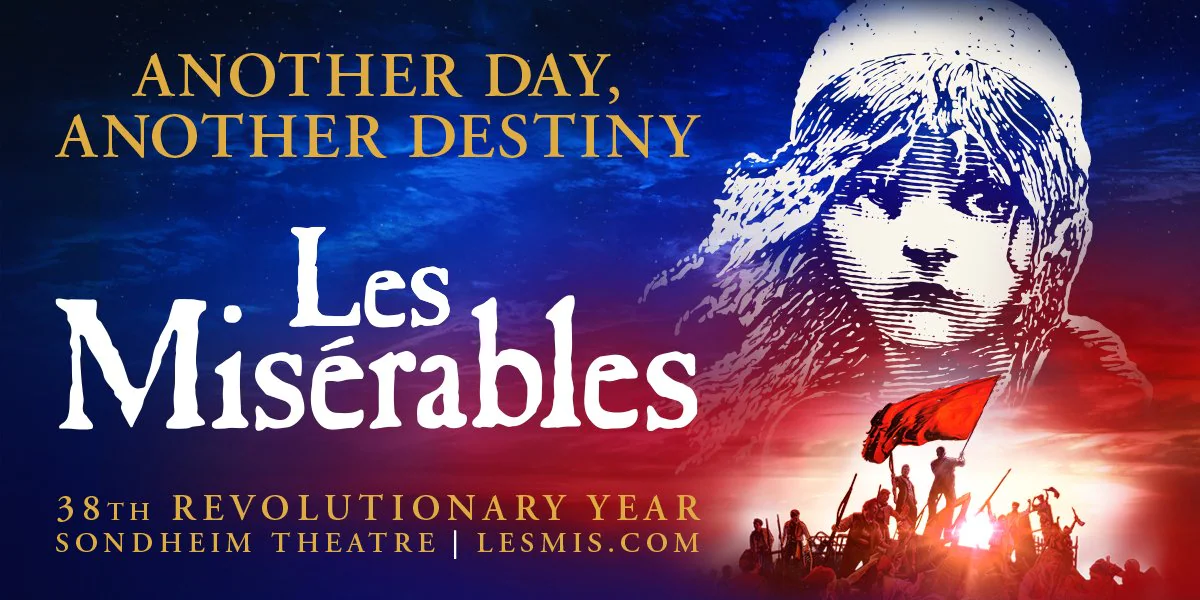
The musical’s emblem is a picture of the waif Cosette sweeping the Thénardiers’ inn, usually cropped to a head-and-shoulders portrait, superimposed on the French flag. The image is based on an etching by Gustave Brion, which in turn was based on a drawing by Émile Bayard that appeared in several of the novel’s earliest French-language editions.
Longest-Running Musical
The London production has played over 15,000 performances, making it the second longest-running musical in the world after The Fantasticks, the second longest-running West End show after The Mousetrap, and the longest-running musical in the West End. As of 2022, the original Broadway production remains the sixth longest-running Broadway show.
Tours & International Productions
The Third National Tour of the original Broadway production was one of the longest running American touring musical productions, opening on 28 November 1988 and closing on 23 July 2006 after seventeen years and 7,061 performances in 145 cities across 43 states. The tour also performed in Canada, made a 1994 diversion to Singapore, and in 2002 became the first Western musical production to visit China, opening in Shanghai.
Popular Culture
Songs from Les Misérables, including “I Dreamed a Dream”, “On My Own”, and “Do You Hear the People Sing?”, have been featured in various stage productions, recordings, and screen adaptations. “Do You Hear the People Sing?” has been adopted by protest movements worldwide and was used by Barack Obama supporters during his 2008 election campaign.
The show celebrated its 15,000th performance in London on 28 September 2023. A gala performance on 8 October 2025 marked the 40th anniversary, featuring an all-star cast.
Notable Performers
Over the decades, hundreds of performers have brought the characters of Les Misérables to life. Notable Valjeans include Colm Wilkinson (original London and Broadway), Alfie Boe, Ramin Karimloo, John Owen-Jones, and Hugh Jackman (2012 film). Javerts have included Philip Quast, Norm Lewis, Earl Carpenter, and Russell Crowe (film). Fantines include Patti LuPone, Lea Salonga, and Anne Hathaway (who won an Oscar for the role).
The role of Éponine has been played by Frances Ruffelle (original London and Broadway), Samantha Barks, Lea Salonga, Carrie Hope Fletcher, and many others. Young performers who went on to major careers include Lea Michele (Young Cosette on Broadway) and Nick Jonas (Marius and Gavroche at various times).