Hugh Jackman: Back on Broadway | The Ultimate One-Man Show
Memorabilia Available Here
HUGH JACKMAN
Back on Broadway
An Old-Fashioned Matinee Idol
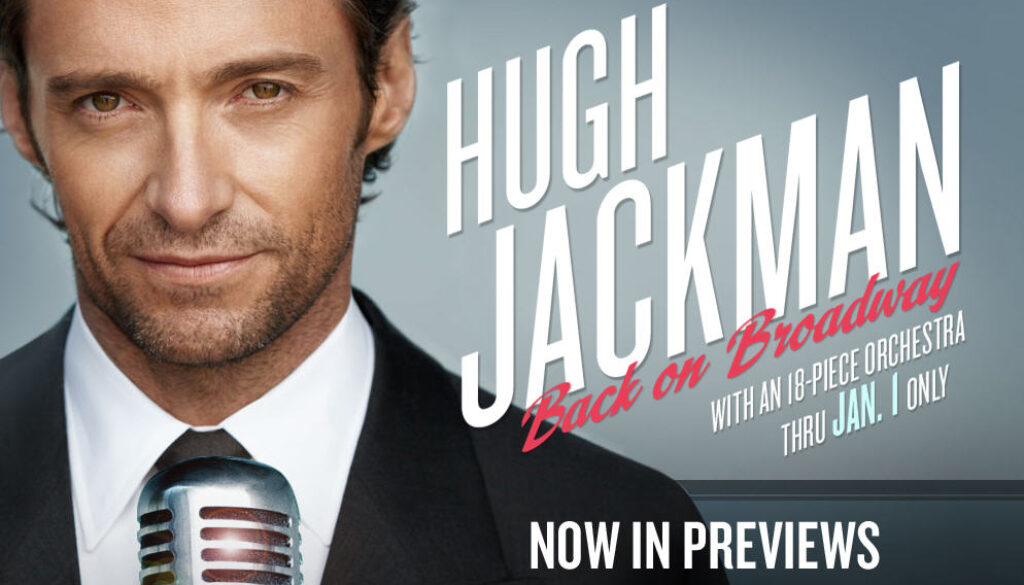
Hugh Jackman: Back on Broadway was a concert residency by Australian actor, singer, and producer Hugh Jackman. For this residency, Jackman performed Broadway and Hollywood musical numbers, backed by an 18-piece orchestra. The show was directed and choreographed by Warren Carlyle.
Running at the Broadhurst Theatre from October 25, 2011 (previews) through January 1, 2012, the 10-week limited engagement was a sold-out phenomenon that showcased Jackman’s extraordinary talents as a song-and-dance man and his genuine connection with audiences.
The show marked Jackman’s return to Broadway after his acclaimed run in A Steady Rain opposite Daniel Craig in 2009, and continued his tradition of combining world-class entertainment with extraordinary charitable giving.
Development & Journey to Broadway
San Francisco Premiere (May 2011)
Jackman had a one-man show at the Curran Theatre in San Francisco from May 3–15, 2011, titled “Hugh Jackman in Performance.” The production was a mixture of his favourite Broadway and Hollywood musical numbers, backed by a 17-piece orchestra, from shows including Oklahoma! and The Boy from Oz.
The show had a run-time of approximately 100 minutes, and also included slide shows of Jackman’s youth, family, and work, as well as some one-on-one interaction with the audience. Jackman was backed by fellow musical theatre veterans Merle Dandridge and Angel Reda.
Early reviews praised Jackman’s performances but suggested the material seemed hastily assembled and could benefit from further development.
Toronto Refinement (July 2011)
A revamped version titled “Hugh Jackman in Concert” played at the Prince of Wales Theatre in Toronto in July 2011. This iteration was reportedly much improved, with better pacing and stronger material selection.
The show had been developed between gaps in Jackman’s shooting schedule for the next installment in the Wolverine franchise, demonstrating his commitment to balancing his film career with his passion for live theater.
Broadway Production
The fully realized Broadway production opened with a new title: Hugh Jackman: Back on Broadway. The creative team assembled a polished evening that allowed Jackman to showcase his remarkable versatility while maintaining the intimate, personal quality that made his earlier versions special.
Creative Team
- Director/Choreographer: Warren Carlyle
- Musical Director: Patrick Vaccariello
- Scenic Design: John Lee Beatty
- Costume Design: William Ivey Long
- Lighting Design: Ken Billington
- Sound Design: John Shivers
- Video Design: Alexander V. Nichols
- Production Stage Manager: Kim Vernace
The Show
Format & Structure
The evening consisted of a two-act concert featuring Jackman’s personal selection of musical numbers that reflected on his remarkable life and career. The show ran approximately 1 hour, 55 minutes and was performed without an intermission in some versions, though the Broadway production had a traditional two-act structure.
Unlike typical Broadway shows, this was classified as a concert, making it ineligible for competitive Tony Award categories. However, the distinction between concert and theatrical performance often blurred, with Jackman’s stagecraft and the production’s polish rivaling any traditional musical.
Performance Elements
The show featured:
- Broadway classics from shows like Carousel, Oklahoma!, and The Boy from Oz
- Hollywood musical numbers
- Personal stories and anecdotes from Jackman’s life and career
- Multimedia elements including video projections and slide shows
- Extensive audience interaction, including sing-alongs
- Spectacular dance numbers showcasing Jackman’s tap dancing skills
Signature Moments
One of the show’s most celebrated moments was Jackman’s performance of “Soliloquy” from Carousel. Critics noted that while his voice occasionally showed signs of wear in the nightclub-style numbers, when he sang this ravishing ballad, he reminded audiences of the theater artist they truly wanted back.
His dancing sections were particularly impressive, showing off his “terrific dancing, his crazy-feet tapping, his ability to hover in the air and devour the expanse of the stage with dazzling insouciance.”
Supporting Cast
While billed as a one-man show, Jackman was supported by an ensemble of talented performers:
| Performer | Role |
|---|---|
| Hugh Jackman | Star Performer |
| Robin Campbell | Featured Ensemble |
| Kearran Giovanni | Featured Ensemble (Gypsy Robe Recipient) |
| Anne Otto | Featured Ensemble |
| Lara Seibert | Featured Ensemble |
| Hilary Michael Thompson | Featured Ensemble |
| Emily Tyra | Featured Ensemble |
| Olive Knight | Aboriginal Artist |
| Clifton Bieundurry | Aboriginal Artist |
| Paul Boon | Aboriginal Artist |
| Nathan Mundraby | Aboriginal Artist |
Six “slinkily dressed” female dancers provided visual appeal and support, though critics noted that Jackman hardly seemed to need the window-dressing given his charismatic stage presence.
Orchestra
The 18-piece orchestra, conducted by Patrick Vaccariello, featured some of Broadway’s finest musicians. The arrangements and orchestrations were provided by a team of legendary Broadway arrangers including August Eriksmoen, Michael Gibson, Larry Hochman, Mark Hummel, Michael John LaChiusa, Jim Laev, Richard Mann, Richard Marxx, JJ McGeehan, Danny Troob, Patrick Vaccariello, Don Walker, and Harold Wheeler.
The Broadway Engagement
Theatre Selection
The production was presented at the Broadhurst Theatre, a mid-sized Broadway house with approximately 1,186 seats—some 500 seats smaller than the Rialto’s larger venues. This strategic choice created a more intimate atmosphere.
As Variety noted: “The effect is heightened by the choice of the Shubert’s prime midsized house, the Broadhurst, which is some 500 seats smaller than the Rialto’s larger venues. Box office indicates the star could fill those houses as well, but here he is more up close and personal.”
Performance Schedule
- Previews Begin: October 25, 2011
- Official Opening: November 10, 2011
- Closing: January 1, 2012
- Total Performances: 10 weeks of sold-out shows
Box Office Success
The show was a complete commercial success, selling out its entire run. While box office figures indicated that Jackman could have filled much larger theaters, the decision to use the more intimate Broadhurst created a premium experience that commanded top ticket prices and created an unforgettable atmosphere.
Production Details
Producers: Robert Fox and The Shubert Organization
Theatre Ownership: The Shubert Organization (Philip J. Smith: Chairman; Robert E. Wankel: President)
General Manager: Bespoke Theatricals
Company Manager: Heidi Neven
Stage Managers: Kim Vernace, Charles Underhill
Extraordinary Charitable Impact
The Nightly Fundraising Ritual
Opening on November 10, 2011, Hugh Jackman: Back on Broadway played for 10 weeks to sold-out audiences through January 1, 2012. And for 51 of those performances beginning November 15, Jackman graciously concluded each show with what he slyly called “a bit of shameless exploitation in pursuit of the common good.”
Unbuttoning his shirt to expose his white undershirt, the Tony Award winner and movie star offered up his sweaty tank top each night to the highest bidder. Jackman would sign, date and hand-deliver the shirt to whomever offered what he encouraged would be “a very generous, tax-deductible donation to Broadway Cares.”
And hundreds of extraordinary donations were indeed made in response. Bringing his wit, charm and a little bit of playful cajoling, Hugh Jackman’s return to Broadway not only broke box office records, but also helped fill a widening gap of financial support for hundreds of AIDS and family service organizations across the country.
Record-Breaking Fundraising
In the end, Jackman, his cast and entire company at the Broadhurst Theatre raised an astounding $1,789,580 during the fundraising, which continued into the show’s final week of performances. The total surpassed the previous single-show fundraising record of $1,568,833 set during Jackman’s run with Daniel Craig of A Steady Rain in 2009.
Jackman’s first Broadway show, The Boy from Oz, raised $1,186,554 in 2003 and 2004, making this his third record-breaking fundraising effort for Broadway Cares.
The Entire Company’s Commitment
Jackman’s extraordinary generosity and amazing energy inspired the entire company of Hugh Jackman, Back on Broadway to join him nightly in these astounding fundraising efforts. Everyone—cast and crew, musicians and front-of-house personnel, wardrobe staff and security, company management, stage managers and production assistants—were part of what became Jackman’s nightly fundraising team.
A special acknowledgment went to Geoffrey Polischuck, Jackman’s dresser (“the best on Broadway,” Jackman said more than once from the stage) who made sure the T-shirts were signed and much more.
Nomad Two Worlds Grant
In appreciation of these phenomenal efforts, Broadway Cares announced a special $150,000 grant to Nomad Two Worlds, an organization founded by Australian photographer Russell James and championed by Jackman.
Nomad Two Worlds supports the indigenous Aboriginal and marginalized communities in Australia by supplying direct grants to emerging artists and addressing a variety of health issues they face. Jackman featured several of these artists in his Broadway show, including Olive Knight, Clifton Bieundurry, Paul Boon, and Nathan Mundraby.
Critical Reception
Rave Reviews
The critical response to Hugh Jackman: Back on Broadway was overwhelmingly positive, with reviewers praising Jackman’s charisma, talent, and genuine connection with his audience.
Variety declared: “Superlatives are superfluous regarding ‘Hugh Jackman Back on Broadway.’ Jackman could at this point likely sell out any show on sheer force of celebrity, but as it turns out, his vehicle is up to his talents. The evening, seemingly assembled out of the star’s grab-bag of song favorites, demands Jackman’s all, and he surpasses expectations.”
The review continued: “Show has been slickly assembled by a team headed by director-choreographer Warren Carlyle (‘Follies’). Patrick Vaccariello leads the excellent 18-piece orchestra through usually swinging charts (some new, some old). There is notably good work from lighting designer Ken Billington.”
The New York Times
The New York Times review captured the essence of Jackman’s appeal: “The impossibly talented, impossibly energetic Mr. Jackman is a glorious dinosaur among live entertainers of the 21st century: an honest-to-gosh old-fashioned matinee idol who connects to his audiences without a hint of contempt for them or for himself.”
The Washington Post
Peter Marks of The Washington Post offered an insightful comparison: “Whatever else he does, Jackman brings joy to the stage. Comparisons are being offered to the deep impression made by a solo artist such as [Judy] Garland. But the rapturous emotional intensity that lingers is not what this performer provides. Garland left blood on the stage. Jackman leaves sweat, and a smile.”
His headline said it all: “Hugh Jackman, back? He IS Broadway.”
Audience Interaction
Critics particularly praised Jackman’s ability to connect with his audience. As Variety noted: “The proceedings have been devised to allow extensive interaction with the aud. Jackman invites a sing-along in the opening number, makes a few detours into the house, brings a patron onstage, and is happily chatty.”
Performance Highlights According to Critics
- Vocal Performance: “A tangy — if occasionally pitch-wobbly — voice that can linger a bit monotonously in heady nasality,” but redeemed by emotional depth in ballads
- Dancing: “Terrific dancing, crazy-feet tapping, ability to hover in the air and devour the expanse of the stage with dazzling insouciance”
- Charisma: “Unstinting charisma and bottomless geniality”
- Stage Presence: “One of the most memorable performers ever to grace a Broadway stage”
- Audience Connection: “A master of mass flirtation”
Awards & Recognition
Special Tony Award (2012)
Jackman’s continued dedication to the Broadway community was fêted at the 2012 Tony Awards, where he received a Special Tony Award recognizing his accomplishments as a performer and humanitarian.
This award acknowledged not just his talent and star power, but his extraordinary commitment to using his platform to support the theater community and charitable causes. The award specifically cited his work as both a performer and humanitarian, recognizing the inseparability of these two aspects of his Broadway presence.
Gypsy Robe Tradition
In a long-standing opening night tradition on the Great White Way, the fabled Gypsy Robe is bestowed upon a veteran Broadway chorus member for each opening production. The recipient for Hugh Jackman: Back on Broadway was cast member Kearran Giovanni at the Broadhurst Theatre.
This theatrical ritual, originating on Broadway 60 years prior, connects each new production to the rich tradition of Broadway ensemble performers.
Complete Timeline
“Hugh Jackman in Performance” plays at the Curran Theatre with a 17-piece orchestra. The show features Merle Dandridge and Angel Reda, running approximately 100 minutes.
Revamped version titled “Hugh Jackman in Concert” plays at the Prince of Wales Theatre in Toronto, with significant improvements to pacing and material.
Hugh Jackman: Back on Broadway begins preview performances at the Broadhurst Theatre with an expanded 18-piece orchestra.
The show officially opens to rave reviews. Kearran Giovanni receives the Gypsy Robe.
Jackman begins his nightly ritual of auctioning off his sweaty tank top for Broadway Cares/Equity Fights AIDS, continuing for 51 performances.
The 10-week sold-out engagement concludes after raising a record-breaking $1,789,580 for charity.
At the 66th Annual Tony Awards, Jackman receives a Special Tony Award recognizing his accomplishments as a performer and humanitarian.
Legacy & Cultural Impact
A Throwback to Classic Showmanship
Hugh Jackman: Back on Broadway represented something increasingly rare on the modern Broadway stage: an old-fashioned variety show centered on pure star power and talent. In an era dominated by spectacle-driven productions and movie adaptations, Jackman proved that a single performer with genuine charisma and ability could fill a Broadway theater for months.
As The New York Times noted, he was “a glorious dinosaur among live entertainers of the 21st century”—but a dinosaur that audiences couldn’t get enough of.
The Humanitarian Star
The show cemented Jackman’s reputation not just as an extraordinary entertainer, but as one of Broadway’s greatest philanthropic forces. His three record-breaking fundraising campaigns—The Boy from Oz ($1.19M), A Steady Rain ($1.57M), and Back on Broadway ($1.79M)—have collectively raised over $4.5 million for Broadway Cares/Equity Fights AIDS.
The nightly t-shirt auction became legendary, demonstrating that Jackman understood his platform and used it generously. As Tom Viola of Broadway Cares noted, these efforts meant that “more doors will stay open, lights will stay on and lives will be saved.”
Bridging Theater and Film
The show came at an interesting point in Jackman’s career—he was at the height of his fame as Wolverine in the X-Men franchise, yet he carved out time between film shoots to return to his theatrical roots. This demonstrated to a generation of film actors that Broadway wasn’t a stepping stone but a destination worth returning to.
The fact that he developed the show between gaps in shooting the next Wolverine film showed his dedication to live theater, even as he commanded massive Hollywood paychecks.
Aboriginal Artists Platform
Jackman used his platform to showcase Aboriginal Australian artists, featuring Olive Knight, Clifton Bieundurry, Paul Boon, and Nathan Mundraby in the production. His championing of Nomad Two Worlds, which supports indigenous Aboriginal and marginalized communities in Australia, brought international attention to these artists and issues.
Broadway Cares’ special $150,000 grant to the organization in Jackman’s honor extended the show’s impact far beyond New York.
Setting the Template
While celebrity concert residencies on Broadway existed before Jackman, his 2011 engagement helped establish the template for how such shows could work in the modern era—intimate venues, premium pricing, extensive audience interaction, and integration of multimedia elements while maintaining theatrical polish.
The show’s success would influence later concert residencies and special engagements, proving that there was still appetite for pure showmanship on Broadway.
The Complete Entertainer
Ultimately, Hugh Jackman: Back on Broadway proved that in an age of auto-tune and digital enhancement, a live performer with genuine talent, preparation, and heart could still create theatrical magic. Jackman didn’t need gimmicks or elaborate staging—just an orchestra, a microphone, and his extraordinary ability to connect.
As The Washington Post perfectly summarized: “Hugh Jackman, back? He IS Broadway.”