Little Shop of Horrors Musical – Complete Guide & History
Little Shop of Horrors - Podcast
Memorabilia Available Here
Little Shop of Horrors
The Musical That Ate Off-Broadway
Off-Broadway Phenomenon
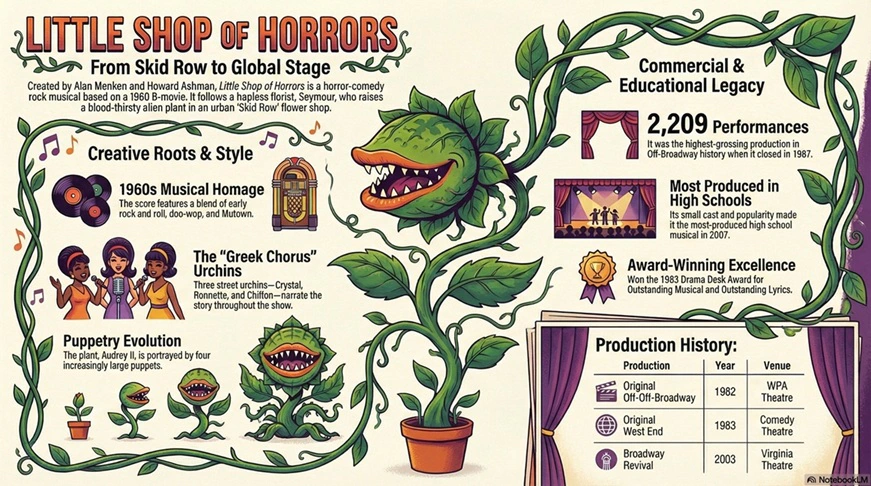
The musical premiered off-off-Broadway in 1982 before moving to the Orpheum Theatre off-Broadway, where it had a five-year run. It later received numerous productions in the U.S. and abroad, and a subsequent Broadway production. In part because of its small cast, it has become popular with school and other amateur theatre groups. The musical was also made into a 1986 film of the same name, directed by Frank Oz.
Plot Synopsis
Prologue: Skid Row
A trio of 1960s street urchins named Crystal, Ronette, and Chiffon set the scene and comment on the action throughout the show. Seymour Krelborn is a poor young man, an orphan living in an urban skid row. Audrey is a pretty blonde with a fashion sense that leans towards tackiness. They lament their stations in life and the urban blight in their neighborhood. They are co-workers at a run-down flower shop owned and operated by the cranky Mr. Mushnik.
After a sudden eclipse of the sun, Seymour finds a mysterious plant that looks like a large Venus flytrap. Seymour, who is secretly in love with Audrey, names the plant Audrey II in her honor.
Feed Me! The Plant’s Dark Secret
The plant does not thrive in its new environment and appears to be dying, though Seymour takes very good care of it. He accidentally pricks his finger on a rose thorn, which draws blood, and Audrey II’s pod opens thirstily. Seymour realizes that Audrey II requires blood to survive and allows the plant to suckle from his finger. As Audrey II grows, it becomes an attraction at the flower shop and starts generating brisk business for Mushnik. As the caretaker of the plant, the timid Seymour is suddenly regarded as a hero, while Audrey secretly longs to leave her abusive boyfriend.
Her dream is to lead an ideal suburban life with Seymour, complete with a tract home, frozen dinners, and plastic on the furniture.
The Dentist and His Demise
Meanwhile, the employees at Mushnik’s are sprucing up the flower shop because of the popularity of the rapidly growing Audrey II and the revenue that it is bringing in. Audrey’s abusive boyfriend, Orin Scrivello, a sadistic dentist, encourages Seymour to take the plant and get out of Skid Row. Realizing that his store’s sudden profitability is completely dependent on the plant (and therefore on Seymour), Mushnik takes advantage of Seymour’s innocence by offering to adopt him and make him a full partner in the business.
When Seymour, running out of blood, stops feeding the plant, Audrey II demands blood and promises that, if fed, it will make sure that all of Seymour’s dreams come true. Seymour sets up a late-night appointment with Orin, intending to kill him for his cruel treatment of Audrey. However, Seymour loses his nerve and decides not to commit the crime. Unfortunately for Orin, who is getting high on nitrous oxide, the gas device is stuck in the “on” position, and he suffocates while asking Seymour to save him. Though Seymour cannot bring himself to shoot Orin, he lets him die of asphyxiation. Seymour feeds Orin’s body to the now huge Audrey II, and the plant consumes it with ravenous glee.
Act Two: Success and Sacrifice
The flower shop is much busier, and Seymour and Audrey have trouble keeping up with the onslaught of orders. Audrey confides to Seymour that she feels guilty about Orin’s disappearance, because secretly she wished it. The two admit their feelings for one another, and Seymour promises that he will protect and care for Audrey from now on.
Before they can go, Mushnik confronts Seymour about Orin’s death. Seymour denies killing Orin, but Mushnik wants him to give a statement to the police, who have begun investigating. Audrey II tells Seymour that he has to be rid of Mushnik or he will lose everything, including Audrey. Seymour tells Mushnik that he put the days’ receipts inside Audrey II for safekeeping. Mushnik climbs inside the plant’s gaping maw to search for the money and screams as he is devoured.
The Tragic Ending
Seymour now runs the flower shop, and reporters, salesmen, lawyers and agents approach him, promising him fame and fortune. Seymour realizes that it is only a matter of time before Audrey II will kill again and that he is morally responsible, but he does nothing over fear that Audrey will no longer love him if he is not successful.
As Seymour works on his speech for a lecture tour, Audrey II again squalls for blood. Seymour threatens to kill it just as Audrey walks in asking when Mushnik will return from “visiting his sick sister”. Seymour learns that Audrey would still love him without the fame and resolves that following an upcoming LIFE magazine interview at the shop, Audrey II must die.
That night, unable to sleep and distressed by Seymour’s strange behavior, Audrey goes to the flower shop to talk with him. He is not there, and Audrey II begs her to water it. Not sensing the danger, she approaches to water it, and a vine pulls her into the plant’s gaping maw. Seymour arrives and pulls her out, but Audrey is mortally wounded. Her dying wish is for Seymour to feed her to the plant after she dies so that they can always be together. She dies in his arms, and he reluctantly honors her request.
World Domination
The next day, Patrick Martin from the World Botanical Enterprises tells Seymour that his company wishes to sell leaf cuttings of Audrey II in florist shops across America. Seymour realizes the plant’s evil plan: world conquest. He tries shooting, cutting, and poisoning the plant, but it has grown too hardy to kill. Seymour, in desperation, runs into its open jaws with a machete planning to kill it from the inside, but he is quickly eaten.
Crystal, Ronette, and Chiffon relate that, following these events, other plants appeared across America, tricking innocent people into feeding them blood in exchange for fame and fortune. Audrey II, bigger than ever, appears with opened new flowers revealing the faces of Seymour, Audrey, Mushnik and Orin, who beg that the plants must not be fed. Audrey II slithers towards the audience threateningly.
Characters
Main Characters
- Seymour Krelborn – A hapless orphan and florist shop worker who discovers and raises Audrey II. Timid, lovesick, and ultimately corrupted by fame
- Audrey – A pretty but troubled blonde who dreams of suburban life. Works at the flower shop and is in an abusive relationship with Orin
- Mr. Mushnik – Cranky owner of the failing flower shop who sees Audrey II as his ticket to success
- Orin Scrivello, D.D.S. – Audrey’s sadistic dentist boyfriend who enjoys causing pain
- Audrey II – An anthropomorphic Venus flytrap from outer space that feeds on human blood and flesh. Voice only (with puppeteers)
Street Urchins (Greek Chorus)
- Crystal – Named after The Crystals, a 1960s girl group
- Chiffon – Named after The Chiffons, a 1960s girl group
- Ronette – Named after The Ronettes, a 1960s girl group
Musical Numbers
Act I
- “Little Shop of Horrors” (Prologue)
- “Skid Row (Downtown)”
- “Da-Doo”
- “Grow For Me”
- “Ya Never Know”
- “Somewhere That’s Green”
- “Closed for Renovation”
- “Dentist!”
- “Mushnik and Son”
- “Feed Me (Git It)”
- “Now (It’s Just The Gas)”
- “Act I Finale”
Act II
- “Call Back in the Morning”
- “Suddenly, Seymour”
- “Suppertime”
- “The Meek Shall Inherit”
- “Sominex/Suppertime II”
- “Somewhere That’s Green” (Reprise)
- “Bigger Than Hula-hoops”
- “Finale Ultimo: Don’t Feed the Plants”
Original Off-Broadway Production (1982-1987)
The musical premiered off-off-Broadway, at the Workshop of the Players Art Foundation (WPA Theatre), playing there from May 6, 1982 to June 6, 1982. The show moved off-Broadway to the Orpheum Theatre in Manhattan’s East Village, opening on July 27, 1982. The production, directed by Ashman, with musical staging by Edie Cowan, received generally positive critical reviews.
Award-Winning Original Production
The original production won the 1982–1983 Drama Desk Award for Outstanding Musical, as well as the New York Drama Critics Circle Award for Best Musical and the Outer Critics Circle Award. In the original WPA cast were Lee Wilkof as Seymour, Ellen Greene as Audrey, Hy Anzell as Mr. Mushnik, Franc Luz as Orin, Jennifer Leigh Warren as Crystal, Sheila Kay Davis as Ronette and Leilani Jones as Chiffon; Ron Taylor was the voice of Audrey II, and Martin P. Robinson, the Audrey II puppeteer, designed the puppets.
Historic Run
The production ran for five years. When it closed on November 1, 1987, after 2,209 performances, it was the third-longest running musical and the highest-grossing production in off-Broadway history. Though a Broadway transfer had been proposed for the production, book writer Howard Ashman felt the show belonged where it was. Since it was not produced on Broadway, the original production was ineligible for the 1982 Tony Awards.
The producers were the WPA Theatre, David Geffen, Cameron Mackintosh and the Shubert Organization. Ashman wrote, in the introduction to the acting edition of the libretto, that the show portrays several themes and elements including science fiction, B movies, musical comedy itself, and even the Faust legend.
Original Cast Recording
An original cast recording, released in 1982, omitted some songs and had abridged versions of others. The recording features Leilani Jones, who originated the role of Chiffon at the WPA and replaced Marlene Danielle two weeks after the musical opened off-Broadway.
International Productions
West End (1983-1985)
A London West End production opened on October 12, 1983, at the Comedy Theatre, produced by Cameron Mackintosh. It ran for 813 performances, starring Barry James as Seymour, Greene reprising her role as Audrey and Harry Towb as Mr. Mushnik, with Sinitta (then surnamed Renet) understudying Chiffon, Crystal and Ronette. Zeeteah Massiah took over as Chiffon in 1984.
Greene was replaced as Audrey by Claire Moore (1984) then Sarah Payne (1985). Orin was played by Terence Hillyer (1983), David Burt (1984) and Bogdan Kominowski (1985). Audrey II was puppeteered by Anthony Asbury, and the costumes were designed by Tim Goodchild. It received the 1983 Evening Standard Award for Best Musical.
Australia (1984-1985)
An Australian production opened at Her Majesty’s Theatre, Perth on January 14, 1984, starring Christopher Pate as Seymour and Denise Kirby as Audrey. It then moved to the Theatre Royal in Sydney from November 7, 1984, and the Comedy Theatre in Melbourne from February, 1985.
Canada (1985)
A 1985 Canadian production starred Sheila McCarthy as Audrey and Michael Crossman as Seymour. Gerry Salsberg was Orin.
Broadway Production (2003-2004)
In 2003, an $8 million revival of Little Shop of Horrors was planned with the goal of opening on Broadway. A pre-Broadway production debuted at the Miracle Theatre in Coral Gables, Florida on May 16, 2003. Lee Wilkof, who originated the role of Seymour in 1982, was cast as Mr. Mushnik. The production was directed by Wilkof’s wife, Connie Grappo, who was the assistant to Howard Ashman during the original production.
Martin P. Robinson, who designed the original Audrey II puppets, enlisted fellow puppeteers and builders from The Jim Henson Company to create and operate new puppets for the show, ranging from the smallest plant (operated solely by Robinson) to the largest (requiring three additional puppeteers to fully control). Hunter Foster and Alice Ripley played Seymour and Audrey, and Billy Porter was the voice of Audrey II.
Creative Changes
Critics complained that by expanding the show to fit a larger theatre, its intimacy was lost; they also judged several actors as miscast, although the Miami Herald declared that Alice Ripley’s Audrey was “heartbreakingly adorable.” In June 2003, the producers announced that the Broadway production was cancelled. Nevertheless, within weeks, they ousted Grappo in favor of veteran Broadway director Jerry Zaks, who fired everyone in the cast, except Foster, and redirected the production from scratch.
The musical made its Broadway debut at the Virginia Theatre on October 2, 2003, with Hunter Foster as Seymour, Kerry Butler as Audrey, Rob Bartlett as Mr. Mushnik, Douglas Sills as Orin, Michael-Leon Wooley as the voice of Audrey II and DeQuina Moore as Chiffon.
Although this was the first time it had played on Broadway, the show’s success in film and numerous regional productions made it fall under the “Revival” category for the 2003 Tony Awards. Foster was nominated for the 2004 Tony Award for Best Actor in a Musical for his performance. The revival was fairly faithful to the original 1982 production, with some changes including the expanded version of the title song heard in the 1986 film.
The cast recording, recorded on September 15, 2003, was released on October 21. Demo recordings to five songs cut during the development process of the musical were included as bonus material for the album. The production closed on August 22, 2004, after 40 previews and 372 regular performances. The closing Broadway cast included Joey Fatone as Seymour.
U.S. National Tour (2004-2006)
On August 10, 2004, a U.S. national tour of the Broadway production began, with Anthony Rapp starring as Seymour, Tari Kelly as Audrey, Lenny Wolpe as Mushnik and Michael James Leslie as the voice of Audrey II. The tour closed April 16, 2006 in Columbus, Ohio.
London Revivals and Tours
2007 West End Revival
The first major London revival began previews on November 17, 2006, at the Menier Chocolate Factory, Off West End. This revival, directed by Matthew White, featured a new Audrey II designed by David Farley, resembling the pitcher plant. The production was a critical and commercial success and transferred to the Duke of York’s Theatre in London’s West End in March 2007. In June 2007, the show transferred to the Ambassadors Theatre, where it ended its run on September 8, 2007.
The West End cast featured Paul Keating as Seymour, Sheridan Smith as Audrey, Alistair McGowan as Orin, and Mike McShane providing the voice of Audrey II. Barry James, who portrayed Seymour in the original West End production, was Mr. Mushnik. Smith and McGowan received 2008 Laurence Olivier Award nominations, and the production was nominated for Best Musical Revival.
UK Tours (2009, 2016)
The production toured the UK in 2009 with a cast including Damian Humbley as Seymour, Clare Buckfield as Audrey, Alex Ferns as Orin, Sylvester McCoy as Mr Mushnik and Clive Rowe as the voice of Audrey II.
A UK tour began on August 4, 2016, directed by Tara Wilkinson, starring Sam Lupton as Seymour, Stephanie Clift as Audrey and Rhydian Roberts as Orin.
Regent’s Park Open Air Theatre (2018)
A revival at London’s Regent’s Park Open Air Theatre, from August 3 to September 22, 2018, was directed by Maria Aberg, choreographed by Lizzi Gee and designed by Tom Scutt. It starred Marc Antolin as Seymour, Jemima Rooper as Audrey, Forbes Masson as Mr Mushnik, Matt Willis as Orin and American drag performer Vicky Vox as Audrey II. The production included the song “Mean Green Mother from Outer Space”, written for the 1986 film, as an encore number.
Recent Notable Productions
Encores! Off-Center (2015)
A three-performance Encores! concert staging at New York City Center as part of its Off-Center series ran in July 2015. Directed by Dick Scanlan, the production starred Jake Gyllenhaal as Seymour, and Ellen Greene reprising her role as Audrey. Taran Killam played Orin, with Tracy Nicole Chapman, Marva Hicks and Ramona Keller as the urchins. Joe Grifasi was Mr. Mushnik, with Eddie Cooper as the plant.
Reviewers praised Greene, Gyllenhaal and the cast in general. Ben Brantley wrote in The New York Times: “A confluence of alchemical elements was at work, converging in ways that made a perfectly charming but small musical feel like a major event.”
Australian Tour (2016)
An Australian tour opened at the Hayes Theatre in Sydney on February 22, 2016, before touring to multiple cities. It starred Brent Hill as Seymour, Esther Hannaford as Audrey, Tyler Coppin as Mushnik and Scott Johnson as Orin. Hill also voiced Audrey II. The production was nominated for ten Sydney Theatre Awards, winning eight, including Best Production of a Musical, and five Helpmann Awards.
Cassie Tongue wrote of it in The Guardian: “Watching this show feels like a discovery, or a reaffirmation; to be reminded why musical theatre matters, to be assured that musicals are a difficult, exhilarating art. And all this from a campy cult classic. What magic.”
Pasadena Playhouse (2019)
Pasadena Playhouse staged a production from September 17 to October 20, 2019, directed by Mike Donahue. The cast included George Salazar as Seymour, Michaela Jaé Rodriguez as Audrey, Amber Riley as Audrey II, Kevin Chamberlin as Mr. Mushnik and Matthew Wilkas as Orin.
Current Off-Broadway Revival (2019-Present)
An off-Broadway revival at the Westside Theatre began previews on September 17, 2019, with an official opening on October 17, 2019. The cast starred Jonathan Groff as Seymour, Tammy Blanchard as Audrey, Christian Borle as Orin and Tom Alan Robbins as Mr. Mushnik. Michael Mayer directed, with choreography by Ellenore Scott. The plant for this production was voiced by Kingsley Leggs.
A cast album was released digitally on December 20, 2019. Gideon Glick began playing Seymour in early 2020. The production suspended performances on March 11, 2020, because of the COVID-19 pandemic, and reopened on September 21, 2021, with Jeremy Jordan as Seymour.
Long-Running Success
The revival has gone on to have a long run with rotating celebrity casts. Notable performers in the role of Seymour have included Conrad Ricamora, Skylar Astin, Rob McClure, Matt Doyle, Corbin Bleu, Darren Criss, Andrew Barth Feldman, Nicholas Christopher, Milo Manheim, Graham Phillips, and Thomas Doherty.
Audrey has been played by Lena Hall, Maude Apatow, Joy Woods, Constance Wu, Evan Rachel Wood, Jinkx Monsoon, Sarah Hyland, Sherie Rene Scott, Elizabeth Gillies, and Madeline Brewer. This rotating celebrity casting has kept the production fresh and brought in new audiences throughout its extended run.
The Iconic Audrey II Puppet
A Puppet Star is Born
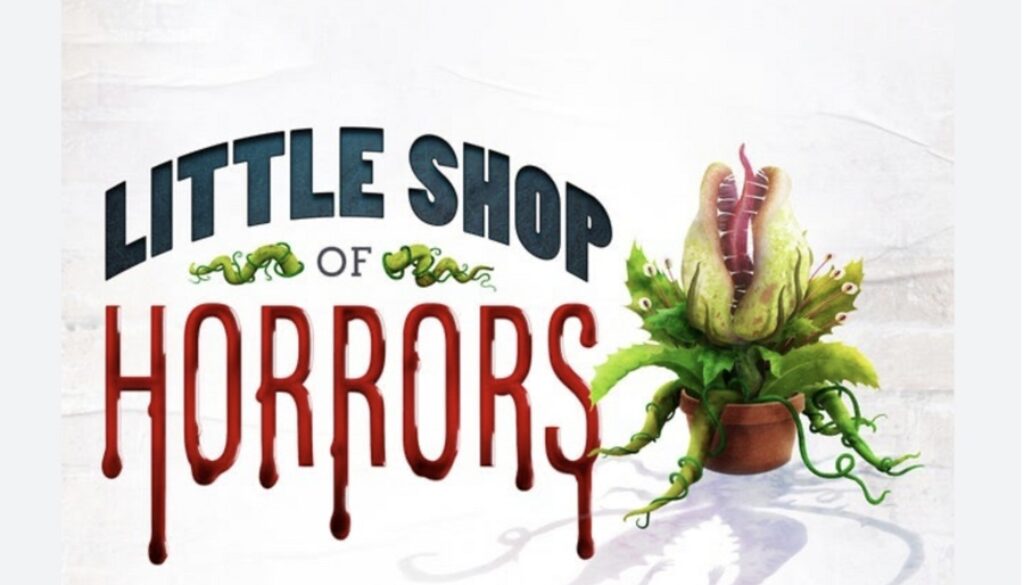
The character of Audrey II is described as being “An anthropomorphic cross between a Venus flytrap and an avocado. It has a huge, nasty-looking pod that gains a shark-like aspect when open and snapping at food. The creature is played by a series of increasingly large puppets.”
The Evolution of the Plant
In productions, the first puppet is a small potted plant “less than one foot tall” held by the actor portraying Seymour. He manipulates the plant himself with his hand and then sets it down, where it is moved by an unseen hand from beneath a shelf. The second puppet is slightly larger than the first and is operated by Seymour during a song. A fake arm in a sleeve matching Seymour’s jacket is attached to the plant’s pot, while the actor’s real arm operates the plant.
The third puppet sits on the floor and is large enough to hide a person inside, who moves the plant’s mouth in sync with Audrey II’s voice, which is supplied by an offstage actor on a microphone. The puppeteer’s legs are clad in green tights with “leaf” shoes that serve as part of the plant’s tendrils.
In Act II, the largest puppet again hides an actor inside, who manipulates the puppet’s mouth and often some of its branches. By this point, the head is at least six feet long and capable of “swallowing” characters. For the finale, additions can be made to make the plant appear taller and even bigger. Actors and stage hands are often used to move larger branches and roots, which, in the original off-Broadway production, spilled off the stage and into the audience.
The Creative Process
From the beginning of the musical’s creation, Ashman wanted Audrey II to be a puppet. Feeling it would be the centerpiece of the show, he wanted it to be designed well. He contacted Julie Taymor, who at the time moonlighted as a puppet designer. Taymor drew up designs involving a screen with multiple mouths that resembled flowers, but she eventually recommended Martin P. Robinson to design the puppet.
Robinson proposed, among other ideas, the fake arm puppet for a musical number, inspired by comedian Rod Hull’s Emu puppet routine. Robinson’s designs, or variations of them, have been used in the subsequent productions of Little Shop. Amateur productions of Little Shop of Horrors receive designs for building the puppets from Music Theatre International, as part of the rental scripts and scores, based on the original Martin P. Robinson designs.
Differences from the 1960 Film
Key Changes
The musical is based on the basic concept and dark comic tone of the 1960 film, although it changes much of the story. Seymour’s hypochondriacal Jewish mother is omitted in the musical, and Seymour becomes an orphan in the care of Mushnik. Also dropped is the subplot involving the two investigating police officers. The characters of Mrs. Siddie Shiva and Burson Fouch are also omitted.
In the musical, the sadistic dentist, Orin Scrivello, is killed by suffocation from laughing gas instead of being stabbed with a dental instrument as in the film. The musical shows him in an abusive relationship with Audrey, which gives Seymour a motive to kill him. In the film, Seymour murders several innocent bystanders, and Mushnik tricks a thief into looking for money inside the plant, which eats the thief. In the musical, Seymour tricks Mushnik in the same way when he learns that Mushnik plans to turn him over to the police.
The two neighborhood girls in the film are replaced in the musical by three street urchins who function as a modern Greek chorus: Crystal, Chiffon and Ronette, named after (and reminiscent of) girl groups of the 1960s. The plant is named “Audrey II” in the musical, rather than the film’s “Audrey Junior”, and instead of being a crossbreed of a butterwort and a Venus Flytrap, in the musical it is a creature from outer space intent on taking over the world.
The Ending
Perhaps the biggest difference is the ending. The musical ends with Orin, Mushnik, Audrey and Seymour all eaten by the plant, and the three girls report that Audrey II’s progeny continue to consume people. In the 1960 film, Mushnik and Audrey survive, and the plant’s carnivorous activities are discovered when its flowers bloom with the faces of its victims, including Seymour, imprinted on them. The musical refers to this ending in its finale, in which the faces of the Plant’s four victims are seen in its blooming flowers.
1986 Film Adaptation
Frank Oz’s Film Version
A film version of the musical was made in 1986. Directed by Frank Oz and noted as the only film written by Howard Ashman, it starred Rick Moranis as Seymour, Ellen Greene as Audrey, Vincent Gardenia as Mr. Mushnik, Steve Martin as Orin Scrivello, DDS, and the voice of Levi Stubbs as Audrey II. Bill Murray played the small comic role of the masochist, Arthur Denton.
The 1986 film follows the plot of the musical closely but omits several songs including “Mushnik and Son”, “Now (It’s Just the Gas)”, “Sudden Changes,” “Closed for Renovation” and “Call Back in the Morning”. Other changes include the removal of Mr. Mushnik’s adoption proposition and a new ending, in which Seymour is able to save Audrey from Audrey II and then electrocutes the plant after it has destroyed the shop. Seymour and Audrey marry and move to the tract home of her dreams, but a small Audrey II-type bud is seen in their garden, which portends a possible spread of the alien plants.
A new song for Audrey II, “Mean Green Mother from Outer Space”, was nominated for an Academy Award for Best Original Song.
Themes and Social Commentary
More Than Just a Plant
Marc Jensen, writing in Cinema Journal, believes that the change to the ending of the musical contributes to its portrayal of class struggles and moral values. While the 1986 film shows Seymour and Audrey escaping to a suburban house that encapsulates ideals of the 1950s American Dream, Jensen says the musical hints at a metaphorical portrayal in which the plant is Seymour’s greed, gradually consuming Audrey and himself.
An essay in the 2013 publication Marxism and the Movies argues that the musical engages with ideas relating to human values in the face of capitalist culture, disempowering those who are enveloped with motivations of personal monetary gain and overlook moral values; in their opinion, it serves as a social commentary on commodity fetishism.
Howard Ashman wrote in the introduction to the acting edition of the libretto that the show portrays and parodies science fiction, B movies, musical comedy itself, and even the Faust legend – the story of a man who makes a deal with the devil for worldly success, only to lose his soul.
Awards and Recognition
1983 Awards (Original Off-Broadway)
| Award | Category | Result |
|---|---|---|
| Drama Desk Awards | Outstanding Musical | WON |
| Drama Desk Awards | Outstanding Book of a Musical | Nominated |
| Drama Desk Awards | Outstanding Lyrics | Nominated |
| Drama Desk Awards | Outstanding Music | Nominated |
| Outer Critics Circle Awards | Best Musical | WON |
| NY Drama Critics Circle | Best Musical | WON |
| Grammy Awards | Best Cast Show Album | Nominated |
1983 Evening Standard Awards (West End)
| Award | Category | Result |
|---|---|---|
| Evening Standard Awards | Best Musical | WON |
2004 Tony Awards (Broadway)
| Award | Category | Nominee | Result |
|---|---|---|---|
| Tony Awards | Best Actor in a Musical | Hunter Foster | Nominated |
| Outer Critics Circle | Outstanding Revival of a Musical | Little Shop of Horrors | Nominated |
2008 Olivier Awards (West End Revival)
| Award | Category | Nominee | Result |
|---|---|---|---|
| Olivier Awards | Best Musical Revival | Little Shop of Horrors | Nominated |
| Olivier Awards | Best Actress in a Musical | Sheridan Smith | Nominated |
| Olivier Awards | Best Actor in a Supporting Role | Alistair McGowan | Nominated |
2020 Awards (Off-Broadway Revival)
| Award | Category | Result |
|---|---|---|
| Lucille Lortel Awards | Outstanding Revival | Nominated |
| Drama Desk Awards | Outstanding Revival of a Musical | Nominated |
| Drama League Awards | Outstanding Revival of a Musical | Nominated |
| Outer Critics Circle | Outstanding Revival of a Musical | Nominated |
| Grammy Awards | Best Musical Theater Album | WON |
Legacy and Cultural Impact
A Timeless Classic
Little Shop of Horrors has become one of the most beloved and frequently produced musicals in theatrical history. Its combination of horror, comedy, rock and roll, and genuine emotion creates a unique theatrical experience that continues to resonate with audiences of all ages. The musical’s small cast size (typically 6-8 actors), modest technical requirements, and rich character roles have made it especially popular with high schools, community theaters, and regional productions around the world.
The Menken-Ashman Partnership
Little Shop of Horrors marked the beginning of the legendary creative partnership between composer Alan Menken and lyricist/book writer Howard Ashman. This collaboration would later produce some of Disney’s most iconic animated musicals, including The Little Mermaid, Beauty and the Beast, and Aladdin. The success of Little Shop demonstrated their ability to blend different musical styles while creating deeply emotional and dramatically satisfying stories.
Ashman’s tragic death from AIDS in 1991 robbed the theater world of one of its most innovative voices, but his work on Little Shop of Horrors remains a testament to his genius for creating intelligent, entertaining, and emotionally resonant musical theater.
Enduring Popularity
The musical’s themes of greed, ambition, and the price of fame remain as relevant today as they were in 1982. Seymour’s Faustian bargain with Audrey II serves as a cautionary tale about the corrupting influence of success and the moral compromises people make in pursuit of their dreams. The show’s blend of campy B-movie aesthetics with genuine pathos creates a unique theatrical experience that can be both hilarious and heartbreaking.
From its humble off-off-Broadway beginnings to its status as one of the most produced musicals in the world, Little Shop of Horrors has proven that great theatrical storytelling transcends budget limitations and can find success through creativity, heart, and a man-eating plant from outer space. The show’s message remains clear: Don’t feed the plants!