Torch Song Trilogy – Harvey Fierstein LGBTQ+ Play Guide
Torch Song Trilogy - Podcast
Torch Song Trilogy
Harvey Fierstein’s Groundbreaking LGBTQ+ Theater Masterpiece
Breaking New Ground
The award-winning and popular work broke new ground in the theatre: “At the height of the post-Stonewall clone era, Harvey challenged both gay and straight audiences to champion an effeminate gay man’s longings for love and family.” The play addressed issues such as gay marriage and adoption before they were mainstream topics, and is now remembered as a groundbreaking moment for LGBTQ theatre.
The Three Acts
Act I: International Stud
The Beginning of Arnold’s Journey
The first act derives its name from an actual gay bar at 117 Perry Street in Greenwich Village in the 1960s and 1970s. The bar had a backroom where men engaged in anonymous sex, which plays a central role in the act. Arnold meets Ed Reiss, who is uncomfortable with his bisexuality. This becomes an increasing source of conflict between the two, causing Ed to eventually leave Arnold and settle down with a woman named Laurel. Arnold is heartbroken because he still loves Ed.
Act II: Fugue in a Nursery
One year later, Arnold meets Alan, and the two settle down into a blissful existence that includes plans to adopt a child. The couple visits Ed and Laurel in their country home, where the group deals with tensions resulting from Ed and Arnold’s previous relationship. The segment ends with Laurel telling Arnold she and Ed are engaged.
Act III: Widows and Children First!
Tragedy and Family
Several years later, Arnold is a single father raising gay teenager David. It is revealed that just before receiving David from the state, Alan was the victim of a violent hate crime, resulting in his death and leaving Arnold to raise a child on his own. Ed is separated from Laurel, and stays at Arnold’s to help him. The play revolves around Arnold’s struggle to move on following Alan’s death as he is forced to deal with his mother’s (“Ma”) intolerance and disrespect when she visits from Florida.
Characters
Main Characters
- Arnold Beckoff – The central character of the play. A Jewish homosexual, drag queen, and torch singer. Fierstein playfully describes him as a “kvetch (someone who complains habitually) of great wit and want.”
- Ed Reiss – Arnold’s bisexual lover and friend. Thirty-five and very handsome, he struggles with his sexuality and eventually chooses to marry a woman.
- Lady Blues – A character who appears between scenes in International Stud, dressed in period clothing and singing torch songs in the manner of Helen Morgan or Ruth Etting.
- Laurel – Ed’s lover and eventual fiancée, representing conventional heterosexual relationships.
- Alan – Arnold’s young lover, who is beaten to death by a group of homophobic boys in a hate crime.
- David Beckoff – Arnold’s 15-year-old adopted son, “a wonderfully bright and handsome boy.”
- Ma (Mrs. Beckoff) – Arnold’s extremely strict, traditional Jewish mother, around 60 years old, who struggles to accept her son’s sexuality and lifestyle.
Production History
Early Beginnings (1978-1979)
The first staging of International Stud opened on February 2, 1978, at La MaMa, E.T.C., an off-off-Broadway theater, where it ran for two weeks. The off-Broadway production opened on May 22, 1978, at the Players Theatre, where it ran for 72 performances.
The first staging of Fugue in a Nursery opened at LaMama on February 1, 1979.
The Glines’ Support
The Glines, a nonprofit organization dedicated to forwarding gay-themed cultural endeavors, financially supported Fierstein in reworking the three one-act plays as a singular theatrical event, which became Torch Song Trilogy and earned excited praise from critics.
Off-Broadway (1981-1982)
Torch Song Trilogy first opened at the uptown Richard Allen Center on October 16, 1981, produced by The Glines. On January 15, 1982, it transferred to the Actors’ Playhouse in Greenwich Village, where it ran for 117 performances. The cast included Fierstein as Arnold, Joel Crothers as Ed, Paul Joynt as Alan, Matthew Broderick as David, Diane Tarleton as Laurel/Lady Blues and Estelle Getty as Mrs. Beckoff.
Broadway Triumph (1982-1985)
Historic Broadway Run
The Broadway production, directed by Peter Pope, opened on June 10, 1982, at the Little Theatre, where it ran for 1,222 performances and 8 previews. Fierstein, Joynt, Tarleton, and Getty were joined by Court Miller as Ed and Fisher Stevens as David and Susan Edwards as Lady Blues. Later in the run, David Garrison and Jonathan Hadary portrayed Arnold, Craig Sheffer was cast as Alan, and Barbara Barrie replaced Getty.
Tony Award Sweep
The play won Fierstein two Tony Awards, for Best Play (with John Glines’ historic Tony speech that acknowledged his lover and co-producer Larry Lane) and Best Actor in Play; two Drama Desk Awards, for Outstanding New Play and Outstanding Actor in a Play; and the Theatre World Award.
West End Production (1985)
The West End production starring Antony Sher, with Barbara Rosenblat, Rupert Frazer (Ed), Belinda Sinclair (Laurel), Rupert Graves (Alan), Ian Sears (David) and Miriam Karlin (Mrs Beckoff) opened on October 1, 1985, at Albery Theatre on St. Martin’s Lane, where it ran for slightly more than seven months.
Sher left the production before the play closed, and Fierstein filled-in for the role that earned him a Tony. Sher later said: “his was a real Broadway-sized, scenery-eating, audience-eating, giant performance – I can understand that he might have found mine a bit restrained.”
Major Revivals and Productions
25th Anniversary (2006)
In 2006, the 25th anniversary production of Torch Song Trilogy was produced by the Gallery Players in Brooklyn; Harvey Fierstein was one of the founding members of the Players. Seth Rudetsky played Arnold in the production, directed by Stephen Nachamie.
2009 Revival
In late January 2009, it was revived at the American Theatre of Actors Sargent Theatre in New York City, by Black Henna Productions. Directed by Malini Singh McDonald, the production ran as a limited engagement until February 1, 2009, with each act being performed separately on weeknights and the entire series running on Saturdays and Sundays.
2012 Menier Chocolate Factory
The play was also revived at the Menier Chocolate Factory in London in 2012, with David Bedella playing Arnold.
2013 Studio Theatre Washington, D.C.
Torch Song Trilogy was produced by The Studio Theatre in Washington, D.C., as part of its subscription series in September and October 2013. It was directed by Michael Kahn, artistic director of The Shakespeare Theatre, also in Washington, D.C.
2017-2019: Torch Song Revival
Off-Broadway Revival (2017)
Reimagined for Modern Audiences
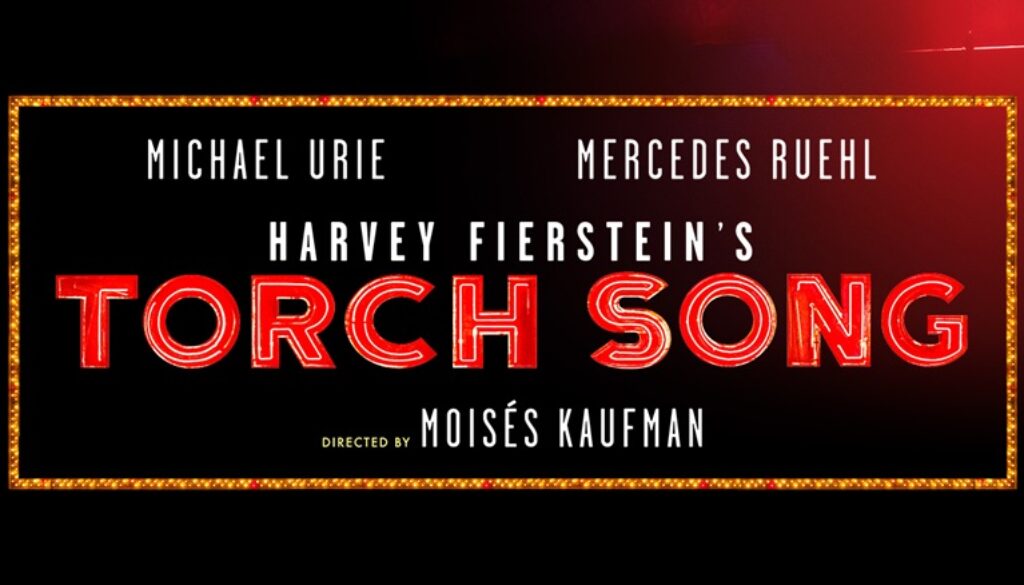
In the fall of 2017, a significantly revised version of the play, cut down by Fierstein from its original four-plus hours to two hours and forty-five minutes and retitled simply Torch Song, was produced Off Broadway by Second Stage Theatre, with Michael Urie as Arnold and Mercedes Ruehl as Mrs. Beckoff, and directed by Moises Kaufman.
Broadway Transfer (2018-2019)
In October 2018, the Urie-led production transferred to the Hayes Theater on Broadway. The revival-transfer had its first preview on October 9, 2018, and had its opening performance on November 1, 2018. The production had its final performance on January 6, 2019, playing 26 previews and 77 regular performances.
National Tour (2019)
In December 2018 (shortly before closing), the producers of the Broadway revival led by Richie Jackson announced a national tour starting in late 2019 at the Center Theater Group in Los Angeles, starring Michael Urie as Arnold Beckoff.
2019 London – Turbine Theatre
In London in 2019, the full three-act play was the first production in the Turbine Theatre’s inaugural season, opening on August 22. It was presented by Bill Kenwright and ran until October 13.
2021 Staged Reading
Hoboken Library produced a staged reading of ‘Torch Song Trilogy: Widows And Children First’ on August 28th, 2021. It featured NYC cabaret luminary Sidney Myer as Arnold, Florence Pape as Mrs. Beckoff, Michael Stever as Ed, Logann Grayce as David and was directed by Ethan Galvin.
2022 Spanish Production – Mexico City
On January 25th, 2022, a new production in Spanish opened at Teatro Milan, in Mexico City. This production is led by award-winning actors Rogelio Suarez as Arnold and Anahi Allue as Ma. It is directed by Alejandro Vilallobos in his directorial debut and produced by Gabriel Guevara; the cast included Jose Peralta as David.
Notable Cast Members Across Productions
| Character | Off-Broadway (1981) | Broadway (1982) | West End (1985) | Off-Broadway (2017) | Broadway (2018) |
|---|---|---|---|---|---|
| Arnold Beckoff | Harvey Fierstein | Harvey Fierstein | Antony Sher | Michael Urie | Michael Urie |
| Ed Reiss | Joel Crothers | Court Miller | Rupert Frazer | – | – |
| Mrs. Beckoff | Estelle Getty | Estelle Getty | Miriam Karlin | Mercedes Ruehl | Mercedes Ruehl |
| David | Matthew Broderick | Fisher Stevens | Ian Sears | – | – |
| Alan | Paul Joynt | Paul Joynt | Rupert Graves | – | – |
Critical Reception and Cultural Impact
Early Challenges
Fighting for Recognition
Fierstein has spoken about the difficulty he faced as an openly gay playwright. In an archived 1982 interview with Playbill republished to commemorate the show’s anniversary, he reminisced on the attitude producers and critics took towards his work: “Fabulous writer. Fabulous play. But gay. Goodbye.”
Mel Gussow of The New York Times initially panned the play as a “sincere but sentimentalized view of a transvestite extremes.” Despite the criticism, Ellen Stewart, founder of La MaMa, chose to produce A Fugue in the Nursery and Widows and Children First! in 1979, though she personally found the work “too talky.”
Critical Acclaim
The Glines financially supported Fierstein in reworking the three one-act plays as a singular theatrical event, which became Torch Song Trilogy and earned excited praise from Mel Gussow. “Arnold’s story becomes richer as it unfolds,” he wrote, saying that Fierstein’s performance “[was] an act of compelling virtuosity.”
Groundbreaking Themes
Conservative or Radical?
Theatre scholar Jordan Schildcrout notes that some critics viewed Torch Song Trilogy as “the most truly conservative play to come along in years” because of its focus on “fidelity and family” (Jack Kroll), while others declared the play a radical breakthrough because of its forthright depiction of gay sexuality, gay youth, and gay families during an era of political backlash against the gay rights movement.
Legacy and Influence
Today, the play is primarily remembered as a groundbreaking moment for LGBTQ theatre. It is lauded for touching on issues such as gay marriage and adoption before they were mainstream. In a 2018 review revisiting the play, PopMatters writer Elizabeth Woronzoff remarked that Torch Song Trilogy laid the groundwork for many modern queer television shows such as Queer as Folk, Modern Family, and Will and Grace.
Intersectionality
Jewish and Queer Identity
Additionally, the play addressed intersectionality in a newfound way. The inclusion of both the Jewish and queer identities allowed for the representation and (arguably) rejection of the stereotypes associated with each group. According to critic John Simon in a critique published in New York Magazine, the play highlights both the Jewish, melancholic humor and homosexual, flamboyant humor. Still, Simon argues that Fierstein rejects the common stereotypes of both identities and incites the audience to practice “warm empathy” towards every character.
1988 Film Adaptation
From Stage to Screen
Fierstein adapted his play for a feature film, released in 1988. It was directed by Paul Bogart and starred Fierstein (Arnold), Anne Bancroft (Ma Beckoff), Matthew Broderick (Alan), Brian Kerwin (Ed), and Eddie Castrodad (David).
The film adaptation brought the story to a wider audience and helped solidify its place in LGBTQ cultural history. Anne Bancroft’s performance as Ma Beckoff was particularly praised, bringing depth and complexity to the role of Arnold’s traditional Jewish mother struggling to accept her son.
Awards and Recognition
1983 Awards
| Year | Award | Category | Recipient | Result |
|---|---|---|---|---|
| 1983 | Tony Awards | Best Play | Harvey Fierstein | WON |
| 1983 | Tony Awards | Best Actor in a Play | Harvey Fierstein | WON |
| 1983 | Drama Desk Awards | Outstanding New Play | Torch Song Trilogy | WON |
| 1983 | Drama Desk Awards | Outstanding Actor in a Play | Harvey Fierstein | WON |
| 1983 | Theatre World Award | – | Harvey Fierstein | WON |
| 1982 | Drama Critics’ Circle | Runner-Up Best American Play | Torch Song Trilogy | Runner-Up |
Historic Significance
John Glines’ Historic Tony Speech
When accepting the Tony Award for Best Play, producer John Glines made history by publicly acknowledging his lover and co-producer Larry Lane during his acceptance speech—a groundbreaking moment of LGBTQ visibility at the Tony Awards.
Post-Stonewall Era Impact
At the height of the post-Stonewall clone era, Harvey Fierstein challenged both gay and straight audiences to champion an effeminate gay man’s longings for love and family. This was revolutionary at a time when mainstream gay culture often emphasized hypermasculinity. Arnold Beckoff’s character—a Jewish drag queen who wanted marriage, children, and family acceptance—represented a different vision of what it meant to be gay in America.
Pioneering LGBTQ+ Family Representation
Torch Song Trilogy was one of the first major theatrical works to seriously address:
- Gay adoption and parenting
- Gay marriage as a legitimate aspiration
- Anti-gay hate crimes and violence
- Bisexuality and its complexities
- Intergenerational LGBTQ+ relationships
- The intersection of Jewish and queer identities
- Gay men raising children as single parents
The Torch Song Explained
What is a Torch Song?
The trilogy derives its title from the “torch” musical style which are “popular sentimental song[s] of unrequited love.” The torch songs performed by Lady Blues throughout the play underscore Arnold’s emotional journey—his yearning for love, his heartbreak, and his eventual resilience. The metaphor of “carrying a torch” for someone represents holding onto love despite pain and rejection, which perfectly captures Arnold’s relationships with Ed and his grief over Alan.
Cultural Legacy
Paving the Way for LGBTQ+ Media
Torch Song Trilogy laid the groundwork for representation in modern LGBTQ+ media. The play’s frank discussions of gay life, family, and relationships influenced countless works that came after it, from television shows like Queer as Folk, Will & Grace, and Modern Family to films and plays that center LGBTQ+ characters and their desire for love, family, and acceptance.
Harvey Fierstein’s Performance
Harvey Fierstein’s virtuosic performance as Arnold Beckoff—both writing and starring in the role—created an indelible character in American theater. His distinctive gravelly voice, his ability to balance comedy and tragedy, and his fearless portrayal of an unapologetically effeminate gay man made Arnold one of the most memorable characters in modern drama. Fierstein’s dual Tony wins cemented his place in theater history.
Continuing Relevance
Despite being written in the late 1970s and early 1980s, Torch Song Trilogy continues to resonate with contemporary audiences. Issues of family acceptance, LGBTQ+ parenting, hate crimes, and the search for love and belonging remain relevant. The 2017-2019 revival, condensed and updated by Fierstein himself, proved that Arnold’s story still speaks powerfully to new generations navigating their own identities and relationships.
Enduring Themes
Universal Human Desires
At its heart, Torch Song Trilogy is about universal human desires: the need for love, family, acceptance, and dignity. Arnold’s journey from cynical disillusionment to finding love with Alan, to weathering tragedy and raising a child, to demanding respect from his mother represents the struggle of anyone seeking to live authentically while maintaining connections to family and community. The play’s genius lies in making Arnold’s specifically gay and Jewish experience resonate with anyone who has ever felt like an outsider or struggled for their family’s acceptance.