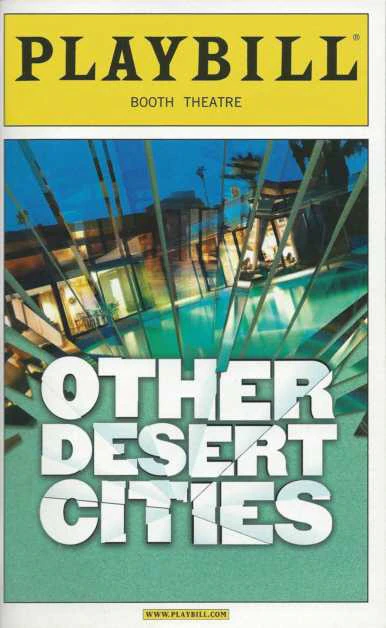
Other Desert Cities: Jon Robin Baitz’s Family Drama Guide
Memorabilia Available Here
A Play by Jon Robin Baitz
Other Desert Cities
Family Secrets. Political Divides. The Weight of What We Cannot Unsay.
A Family Torn Between Love and Truth
Other Desert Cities is a play by Jon Robin Baitz that premiered Off-Broadway in January 2011 and transferred to Broadway in November 2011, marking the Broadway debut of a Baitz play. The play was a finalist for the 2012 Pulitzer Prize for Drama.
The play involves a family with differing political views and a long-held family secret, set against the sun-bleached backdrop of Palm Springs, California at Christmas 2004. It is simultaneously a drawing-room comedy of barbed family wit and a devastating excavation of grief, guilt, and the silences that hold families together — and tear them apart.
The play’s title refers to a control city guide sign on eastbound Interstate 10 in California, which indicates that the freeway is headed towards Indio, California, and “Other Desert Cities” — the rest of the Coachella Valley and onward towards Phoenix, Arizona. The image of roads leading away from a place, towards elsewhere, perfectly encapsulates the emotional geography of Baitz’s drama: a family that has collectively chosen to look anywhere but at the truth.
Originally Titled Love and Mercy
The play was originally titled Love and Mercy — a phrase that resonates throughout the work in its examination of how far parental love can stretch before it curdles into something darker. The play was first presented at a staged reading at the Ojai Playwrights Conference in California in August 2010, before its Off-Broadway premiere the following January.
The Story
Christmas Eve, Palm Springs, 2004
The play’s events occur around Christmas Eve 2004, when the family of Polly and Lyman Wyeth gather at their Palm Springs home. Their daughter Brooke Wyeth returns home after six years in New York writing magazine pieces. Polly’s sister Silda is also visiting, fresh out of a stint in rehab.
Polly and Lyman are Republicans — former friends of the Reagan White House — while Silda is a liberal who has fallen into alcoholism. The sisters once co-wrote a series of MGM comedies together in the 1960s, but have since become estranged, chiefly due to Silda’s resentment of Polly for shifting social worldviews over time.
The Memoir Arrives
Brooke announces and presents to her family a memoir recounting a pivotal and tragic event in the family’s history: the suicide of her late brother Henry, who had been involved with the radical underground subculture in Venice, and a horrific incident resulting from their advocacy.
During the course of the story, Brooke experiences bitter conflict between her yearning for independent understanding and her parents’ doting yet secretive motives. She also comes to terms with her family’s sorrowing frustration in dealing with her post-divorce depressive episode, even years after Henry’s disappearance. Nonetheless, after absorbing the family’s perspectives, Brooke insists the memoir is vital for her continuing on in life, whether her family embraces her or not.
The Secret Unearthed
In an act of submission from Lyman, he and Polly finally recount the specifics surrounding the recruitment center bombing Henry was implicated in, after years of personal clashes and rejection from both parents and son. Henry showed up disheveled, begging for help and insisting he was unaware of his friends’ terrorism. When Lyman insisted Henry turn himself in nonetheless, another argument broke out and Lyman slapped him. Henry disappeared into the night, and wasn’t found until three weeks later by Polly.
She reveals that she made an interstate trip with Lyman and her son to the northern border — and the ferry he disappeared from. But Lyman painfully reveals they had also doctored Henry’s suicide note themselves, and stuck it in his shoes with a tearful goodbye. With their darkest secret unearthed, Lyman and Polly come to terms with their grief, and give Brooke their consent for publishing.
The Climax & Epilogue
Brooke, in the play’s penultimate moment, launches all the pages of her memoir into the air in anguish, screaming of her internal suffering since Henry left her life, and trying to spare her parents the potential pain of her suicide despite her continual grief. Lyman embraces his daughter in remorse.
An epilogue reveals Brooke at her memoir’s publishing, years after Polly and Lyman’s passing, per their initial request. She recounts a memory of her brother, wondering when she will see him again.
The Wyeth Family
Production History
The play received its first public airing at the Ojai Playwrights Conference in California, still under its original title Love and Mercy. The reading confirmed the play’s commercial and critical potential and set the Off-Broadway process in motion.
Other Desert Cities premiered Off-Broadway at the Mitzi E. Newhouse Theater at Lincoln Center Theater in a limited engagement. The production starred Stockard Channing as Polly Wyeth, Linda Lavin as Silda Grauman, Stacy Keach as Lyman Wyeth, Thomas Sadoski as Trip Wyeth, and Elizabeth Marvel as Brooke Wyeth. It was directed by Joe Mantello.
The production was named Outstanding New Off-Broadway Play by the Outer Critics Circle.
The play transferred to Broadway at the Booth Theatre on November 3, 2011. Two key cast changes elevated the production: Judith Light replaced Linda Lavin as Silda, and Rachel Griffiths replaced Elizabeth Marvel as Brooke, making her knockout New York stage debut. Joe Mantello returned to direct. The Broadway run received five Tony Award nominations.
At the 66th Annual Tony Awards, Judith Light won the Tony Award for Best Featured Actress in a Play for her performance as Silda Grauman — a career-defining stage triumph for the actress best known at the time for television work.
Other Desert Cities was named a finalist for the 2012 Pulitzer Prize for Drama, a significant recognition of the play’s literary and theatrical achievement. The prize that year went to Water by the Spoonful by Quiara Alegría Hudes.
Original Cast Comparison
| Character | Off-Broadway (Jan 2011) | Broadway (Nov 2011) |
|---|---|---|
| Polly Wyeth | Stockard Channing | Stockard Channing |
| Lyman Wyeth | Stacy Keach | Stacy Keach |
| Brooke Wyeth | Elizabeth Marvel | Rachel Griffiths ★ |
| Trip Wyeth | Thomas Sadoski | Thomas Sadoski |
| Silda Grauman | Linda Lavin | Judith Light ★ Tony Winner |
| Director | Joe Mantello | Joe Mantello |
| Scenic Design | John Lee Beatty | John Lee Beatty (Tony nom.) |
| Lighting Design | Kenneth Posner | Kenneth Posner (Tony nom.) |
The Creative Team
Jon Robin Baitz — Playwright
Jon Robin Baitz is one of America’s most celebrated dramatists, known for plays that examine power, family, and political conscience with sharp wit and emotional ruthlessness. Other Desert Cities marked his Broadway playwriting debut — a remarkable milestone for a writer who had long been considered one of the theatre’s most gifted voices.
Baitz is also known as the creator and executive producer of the television series Brothers & Sisters, and his plays include The Substance of Fire, The Film Society, and A Fair Country. Other Desert Cities was his first new play in six years, and critics agreed it was worth the wait.
Joe Mantello — Director
Joe Mantello, one of Broadway’s most distinguished directors, helmed both the Off-Broadway and Broadway productions. Notably, Mantello was Baitz’s former romantic partner — a biographical detail that adds another layer to the play’s examination of intimate relationships, long memories, and the weight of shared history.
Mantello’s credits include landmark Broadway productions of Wicked, Take Me Out, The Humans, and Assassins. His direction of Other Desert Cities was praised for its “masterly combination of shadow and shimmer.”
John Lee Beatty — Scenic Design
John Lee Beatty’s scenic design for the Broadway production received a Tony Award nomination for Best Scenic Design of a Play. His evocation of the Wyeth family’s Palm Springs home — affluent, sun-lit, and faintly suffocating — created the perfect physical environment for the play’s drawing-room tensions.
Kenneth Posner — Lighting Design
Kenneth Posner’s lighting design also received a Tony nomination. His work captured the shifting emotional temperatures of a family Christmas that becomes anything but festive.
Awards & Recognition
The Tony Race in Full
The five Tony nominations for Other Desert Cities placed it firmly in the conversation for the season’s best new play. The play was competing in a strong year — the same season that saw Once win eleven Tonys — and its recognition was a testament to Baitz’s writing and the exceptional calibre of the ensemble.
Judith Light’s win was particularly celebrated. For an actress whose fame had largely been built through television — including her iconic role in Who’s the Boss? and later Ugly Betty — it was a triumphant arrival on the stage of Broadway’s highest honor.
Stockard Channing’s nomination as Best Actress recognized a performance that had anchored the play from its first Off-Broadway outing. Channing’s Polly Wyeth — coiled, imperious, and ultimately shattered — was widely considered one of the finest acting performances of the season.
Critical Reception
Both major reviews highlighted the play’s evolution from Off-Broadway to Broadway — the tightening of the text, the deepening of the ensemble chemistry, and particularly the explosive addition of Rachel Griffiths as Brooke. Critics consistently singled out Joe Mantello’s direction as crucial to the play’s success, expertly calibrating the tone between the play’s considerable comic pleasures and its sudden, devastating turns.
Themes & Context
The American Family Divided
Set at Christmas 2004 — in the immediate aftermath of George W. Bush’s re-election — Other Desert Cities plants its family drama squarely within a specific American political moment. The Wyeths’ Republican conservatism is not presented as caricature but as a deeply held worldview shaped by decades of personal history. The play asks what happens when politics and personal grief become inextricably entangled, and how families navigate the fault lines that ideology creates.
Memoir as Weapon and Wound
Brooke’s memoir is the play’s central dramatic engine — at once an act of self-preservation and an act of violence against the people she loves most. The play interrogates the ethics of personal narrative: who owns a family’s story? Does the need to tell the truth outweigh the harm it causes? Baitz resists easy answers, allowing both sides of the argument to be heard with full emotional force.
Grief Deferred, Secrets Kept
At the heart of the play is Henry — the absent son, the ghost around whom all family dynamics revolve. His involvement in radical politics, his father’s unyielding insistence that he turn himself in, the slap, the disappearance, the doctored suicide note: each revelation arrives with the weight of years of suppression behind it. The play demonstrates the terrible cost of secrets kept in the name of love.
Women and Wit
The play is in some respects a showcase for its extraordinary women. Polly, Silda, and Brooke are all sharply drawn, fiercely intelligent, and given the play’s best and most devastating lines. The Wyeth sisters’ relationship — two women who once created together and now can barely occupy the same room — is as richly observed as any in contemporary American drama.
The Idea of “Elsewhere”
The play’s title carries a quiet, melancholy resonance. “Other Desert Cities” — places you’re headed towards, not where you are. The Wyeths have built their lives around looking elsewhere, away from truth, away from grief, toward the comfortable fictions of achievement, ideology, and family myth.
Film Adaptation
Still in Development
In 2011, producers Walter Parkes and Laurie MacDonald acquired the film rights to Other Desert Cities. Baitz was to write the script and was set to co-produce, with Parkes and MacDonald producing; at the time, a studio was not named.
No further word on a film adaptation has emerged since this initial announcement — placing the project firmly in what the industry calls development limbo. The play’s deeply theatrical structure — its unbroken Christmas Eve setting, its reliance on speech and silence rather than action — may prove a formidable challenge for screen adaptation.
Legacy
Baitz’s Broadway Debut
Other Desert Cities holds a particular place in American theatrical history as the Broadway debut of Jon Robin Baitz as a playwright — a long-overdue arrival for a writer whose work had been celebrated Off-Broadway and in regional theatre for years. That it arrived with five Tony nominations and a Pulitzer finalist citation was a fitting acknowledgment of the stature he had quietly accumulated.
A Defining Role for Judith Light
For Judith Light, the play was transformative. Her Tony-winning performance as Silda Grauman — a role she reportedly approached with ferocious commitment — reintroduced her to Broadway audiences and critics as a theatrical force of the first order. It was the beginning of a remarkable late-career stage renaissance.
Rachel Griffiths on Broadway
The Broadway production was also the New York stage debut of Australian actress Rachel Griffiths, whose performance as Brooke was hailed as a revelation. Having built a distinguished screen career in Six Feet Under and Brothers & Sisters, Griffiths demonstrated formidable stage presence in what reviewers called a “raw” and “riveting” performance.
The Play in Repertoire
Other Desert Cities has entered the repertoire of American regional theatre as one of the most significant American plays of the 2010s. Its ensemble-of-equals structure, its emotionally generous roles for women of a certain age, and its willingness to engage with political complexity without didacticism make it a perennial choice for serious dramatic companies.
As an examination of what American families do with the things they cannot say, Other Desert Cities stands alongside the great works of its genre: the drawing-room dramas of secrets and reckonings that stretch from O’Neill to Albee to Guare. It is a play about the past that refuses to stay buried — and in that refusal, it finds its profound and enduring power.