Shining City Play- Broadway & Cast Details
Memorabilia Available Here
A Play by Conor McPherson
Shining City
A Ghost Story About Faith, Grief, and the Dead Who Won’t Leave Us
The Dead Among the Living
Shining City is a play by Conor McPherson, set in Dublin, which was first performed in the West End in 2004. The play is a ghost story which recounts the visits of John, a widower, to Ian, a therapist, claiming he has seen his dead wife in their house.
Ian is a former priest who has just started his therapy practice, and is struggling with his loss of faith. Ian and his girlfriend Neasa have a child, but Ian leaves her in a search for another life. The play charts the parallel trajectories of the two men in their struggle to understand what’s happening.
McPherson’s play is characteristic of his work — deceptively simple in structure, devastating in emotional impact. It is a play about the ways we haunt ourselves, the impossibility of true connection, and the ghosts that arise not from supernatural forces but from our failures to properly grieve, to properly love, to properly see one another.
The Sessions
John is a widower who comes to see Ian, a newly practicing therapist. John’s wife has recently died in a car accident — an accident that occurred while John was driving. He is tormented by guilt, grief, and something else: he claims he has seen his dead wife in their house. She appears to him, a silent, ghostly presence. He cannot tell if she is real or if he is losing his mind.
Ian is a former Catholic priest who has recently left the priesthood. He has lost his faith — or perhaps faith has left him. He has started a relationship with a woman named Neasa, and they have a child together. But Ian is deeply ambivalent about his new life. He is not present in the relationship. He seems to be searching for something he cannot name.
As John recounts his story across several sessions, Ian listens — but Ian is struggling with his own crisis. The play moves between the therapy sessions and scenes from Ian’s life: his awkward, distant interactions with Neasa, his encounter with a male prostitute named Laurence, his inability to commit to the life he claims to want.
The Haunting
The ghost that John sees — his dead wife — may or may not be real. McPherson never resolves this. What is clear is that John is haunted by his failure to love her properly when she was alive, by the mundane cruelties and distances that accumulate in a long marriage, by the accident that took her life.
But Ian, too, is haunted — by the faith he has lost, by the vows he has broken, by his inability to love Neasa or their child in the way they deserve. The play suggests that the living can haunt us as much as the dead.
In the play’s final scene, after Ian has left Neasa and moved into a new apartment, we see what appears to be a ghost — a woman’s figure, silent and still, standing in Ian’s empty room. Is it John’s dead wife? Is it a different ghost? Or is it simply the inevitable result of how we live — the ghosts we create through our failures to connect, to love, to be present?
The Four Lost Souls
Royal Court Premiere (2004)
Shining City opened in the West End at the Royal Court Theatre on June 4, 2004, running to July 17. The play starred Stanley Townsend as John and Michael McElhatton as Ian, with Kathy Kiera Clarke, Jeannie Lewis and Tom Jordan Murphy.
The Royal Court Theatre — long a home for new writing and challenging drama — was the perfect venue for McPherson’s quiet, devastating ghost story. Critics immediately recognized the play as a significant work.
Michael Billington’s Insight
Guardian critic Michael Billington noted that the play captured something essential about Irish culture: “McPherson implies the Irish obsession with the dead is not just a religious hangover but a consequence of failure to achieve proper contact in life.”
This observation cuts to the heart of the play — it is not really about ghosts in the supernatural sense, but about the emotional ghosts created by our inability to truly connect with one another while alive.
Broadway (2006)
The play opened on Broadway at the Biltmore Theatre (now the Samuel J. Friedman Theatre) on May 9, 2006, and closed on July 18, 2006 after 80 performances and 21 previews. Directed by Robert Falls, the cast starred Brían F. O’Byrne as Ian, Oliver Platt as John, Martha Plimpton as Neasa, and Peter Scanavino as Laurence.
| Character | Royal Court (2004) | Broadway (2006) |
|---|---|---|
| John | Stanley Townsend | Oliver Platt |
| Ian | Michael McElhatton | Brían F. O’Byrne |
| Neasa | Kathy Kiera Clarke | Martha Plimpton |
| Laurence | Tom Jordan Murphy | Peter Scanavino |
| Director | — | Robert Falls |
The play received two 2006 Tony Award nominations: Best Play and Best Actor in a Play for Oliver Platt’s performance as John. While the play did not win either award, the nominations recognized the production’s exceptional quality.
Ben Brantley’s Rave
New York Times critic Ben Brantley described it as a “Quiet, haunting and absolutely glorious new play… Shining City is as close to perfection as contemporary playwriting gets.”
Brantley’s review captured what made the play so powerful: its refusal to provide easy answers, its exploration of loneliness even in the midst of connection, its understanding that the dead are not the only ones who haunt us.
Later Productions
Octagon Theatre, Bolton (2007)
Shining City was performed as part of the Octagon Theatre, Bolton 40th anniversary season in May/June 2007 starring George Irving as John, a performance for which he was nominated for Best Actor in the Manchester Evening News theatre awards in November 2007.
Irish Repertory Theatre (2016)
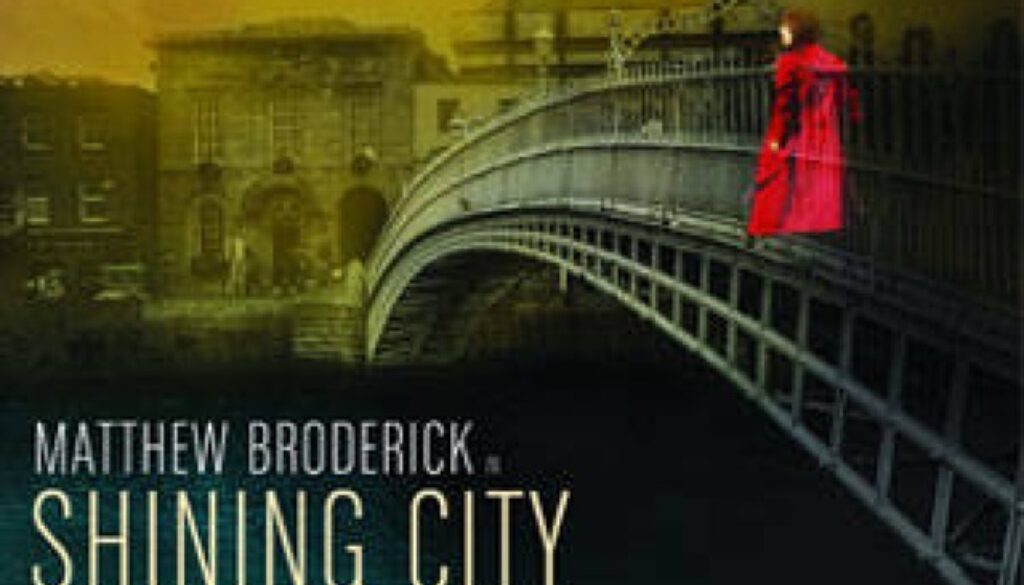
The Irish Repertory Theatre presented the play Off-Broadway in a limited engagement starting on May 17, 2016 in previews, officially opening on June 9 and closing on July 3. The cast featured Matthew Broderick as John, Billy Carter as Ian, Lisa Dwan and James Russell, with direction by Ciarán O’Reilly.
Matthew Broderick’s Obie Award
For his performance as John, Matthew Broderick won a 2017 Obie Award presented by the American Theatre Wing. The award recognized Broderick’s ability to bring vulnerability, complexity, and deep humanity to the role of the haunted widower.
For an actor best known for his work in comedy and light drama, the role was a revelation — a demonstration of his range and his capacity for inhabiting profound grief.
Theatre Royal Stratford East (2021)
The play was performed at Theatre Royal Stratford East in September 2021, directed by Nadia Fall and starring Brendan Coyle (known for his role in Downton Abbey). This production brought McPherson’s ghost story to a new generation of audiences.
Awards & Recognition
Themes & Meaning
The Failure of Connection
At its heart, Shining City is about the failure of human connection. John failed to truly connect with his wife when she was alive, and now she haunts him. Ian fails to connect with Neasa, with his child, with the faith he once held, with the life he claims to want. Even his encounter with Laurence is marked by distance and disconnection.
Faith Lost and Not Regained
Ian is a former priest who has lost his faith — but the play does not offer him redemption or a new faith to replace what he has lost. He is simply adrift. The play suggests that loss of faith is not necessarily followed by clarity or freedom, but often by a kind of emptiness that is difficult to fill.
The Irish Relationship with Death
As Michael Billington noted, the play explores the Irish relationship with death and the dead. But McPherson suggests that the obsession with the dead arises not from religious tradition alone, but from a failure to achieve proper contact with the living. We are haunted by those we failed to love properly, to know properly, to see properly.
The Ambiguity of the Ghost
McPherson never resolves whether the ghost John sees is real or a manifestation of his grief and guilt. This ambiguity is essential to the play. The ghost is both real and not real — it is a projection of John’s psychological state, but it is also undeniably there. The play refuses to choose between psychological realism and supernatural horror.
Loneliness in a Crowd
All four characters are profoundly lonely, even when they are with other people. John is alone with his ghost, Ian is alone even in bed with Neasa, Neasa is alone despite having a partner and a child, Laurence is alone in his transactions with clients. The play creates a portrait of modern urban loneliness — the kind of loneliness that exists even in the midst of connection.
Legacy & Significance
Conor McPherson’s Masterpiece
Shining City stands as one of Conor McPherson’s finest works — a play that demonstrates his mastery of quiet, devastating drama. Like his earlier plays The Weir and Dublin Carol, it explores Irish masculinity, faith, guilt, and the dead who refuse to stay buried.
A Play About Haunting
The play’s genius lies in its understanding that we are haunted not by supernatural forces but by our own failures — failures of love, of attention, of presence. The ghost in Shining City is not a horror movie monster but the manifestation of all the ways we fail to truly see the people we claim to love.
The Quietness That Devastates
In an era of loud, declarative theater, Shining City achieves its effects through quietness, through what is not said as much as what is said. The therapy sessions between John and Ian are marked by long silences, hesitations, the difficulty of articulating grief and guilt and longing.
A Universal Story
While rooted in Dublin and in Irish Catholicism, the play speaks to universal human experiences: the death of a loved one, the loss of faith, the inability to commit to the life we have chosen, the loneliness that persists even in relationships, the ghosts created by our own emotional failures.
The Final Image
The play ends with the image of a ghost — a silent, still figure standing in Ian’s new apartment. We don’t know who it is or what it means. But we understand that Ian, like John, is now haunted. He has created his own ghost through his failures to connect, to commit, to be present.
The shining city of the title — a reference to the biblical image of a city on a hill, a beacon of hope — remains out of reach. What we have instead is darkness, ghosts, and the ongoing struggle to make contact with the living before they become the dead who haunt us.
Enduring Power
More than twenty years after its premiere, Shining City continues to be produced and to move audiences. Its themes of disconnection, faith lost and not regained, and the haunting power of our failures remain profoundly relevant. In a world increasingly marked by loneliness despite constant connection, McPherson’s ghost story speaks to something essential about the human condition.
The dead walk among us — not because of supernatural forces, but because we failed to truly see them when they were alive. And in failing to see them, we have created ghosts that will haunt us forever.
Links
Torch Song Trilogy – Memorabilia
Cat on a Hot Tin Roof – Memorabilia
The Boys in the Band – Memorabilia