My Fair Lady | Lerner and Loewe’s Timeless Musical Masterpiece
My Fair Lady - Podcast
Memorabilia Available Here
Lerner & Loewe’s Masterpiece
MY FAIR LADY
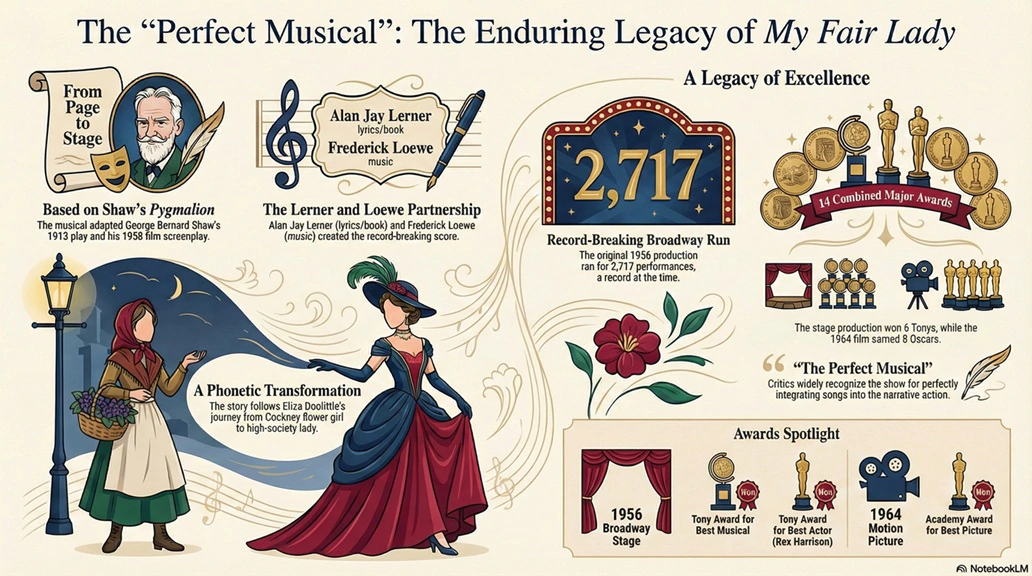
The rain in Spain stays mainly in the plain—and on Broadway for 2,717 performances.
The Perfect Musical
My Fair Lady is a musical with a book and lyrics by Alan Jay Lerner and music by Frederick Loewe. The story, based on George Bernard Shaw’s 1913 play Pygmalion and on the 1938 film adaptation, concerns Eliza Doolittle, a Cockney flower girl who takes speech lessons from Professor Henry Higgins, a phonetician, so that she may pass as a lady. Despite his cynical nature and difficulty understanding women, Higgins grows attached to her.
The musical’s 1956 Broadway production was a notable critical and popular success, winning six Tony Awards, including Best Musical. It set a record for the longest run of any musical on Broadway up to that time and was followed by a hit London production. Rex Harrison and Julie Andrews starred in both productions.
Steven Suskin wrote that the show was one of only eight musicals that opened on Broadway between 1943 and 1964 to receive unanimous raves from the major first-night newspaper critics. My Fair Lady was later called “the perfect musical.”
Wouldn’t It Be Loverly?
In Edwardian London, Eliza Doolittle is a flower girl with a thick Cockney accent. The noted phonetician Professor Henry Higgins encounters Eliza at Covent Garden and laments the vulgarity of her dialect. Higgins also meets Colonel Pickering, another linguist, and invites him to stay as his houseguest. Eliza and her friends wonder what it would be like to live a comfortable life.
Eliza’s dustman father, Alfred P. Doolittle, stops by the next morning searching for money for a drink. Soon after, Eliza comes to Higgins’s house, seeking elocution lessons so that she can get a job as an assistant in a florist’s shop. Higgins wagers Pickering that, within six months, by teaching Eliza to speak properly, he will enable her to pass for a proper lady.
The Transformation Begins
Eliza becomes part of Higgins’s household. Though Higgins sees himself as a kindhearted man who merely cannot get along with women, to others he appears self-absorbed and misogynistic. Eliza endures Higgins’s tyrannical speech tutoring. Frustrated, she dreams of different ways to kill him. Higgins’s servants lament the stressful atmosphere.
Just as Higgins is about to give up on her, Eliza suddenly recites one of her diction exercises in perfect upper-class style. Though Mrs Pearce, the housekeeper, insists that Eliza go to bed, she declares she is too excited to sleep.
The Ascot Test
For her first public tryout, Higgins takes Eliza to his mother’s box at Ascot Racecourse. Though Eliza shocks everyone when she forgets herself while watching a race and reverts to foul language, she does capture the heart of Freddy Eynsford-Hill. Freddy calls on Eliza that evening, and he declares that he will wait for her in the street outside Higgins’ house.
The Embassy Ball
Eliza’s final test requires her to pass as a lady at the Embassy Ball. After more weeks of preparation, she is ready. All the ladies and gentlemen at the ball admire her, and the Queen of Transylvania invites her to dance with the prince. A Hungarian phonetician, Zoltan Karpathy, attempts to discover Eliza’s origins. Higgins allows Karpathy to dance with Eliza.
The ball is a success; Karpathy has declared Eliza to be a Hungarian princess. Pickering and Higgins revel in their triumph, failing to pay attention to Eliza. Eliza is insulted at receiving no credit for her success, packing up and leaving the Higgins house.
Without You
As she leaves she finds Freddy, who begins to tell her how much he loves her, but she tells him that she has heard enough words; if he really loves her, he should show it. Eliza and Freddy return to Covent Garden but she finds she no longer feels at home there. Her father is there as well, and he tells her that he has received a surprise bequest from an American millionaire, which has raised him to middle-class respectability, and now must marry his lover.
Higgins awakens the next morning. He finds himself out of sorts without Eliza. He wonders why she left after the triumph at the ball and concludes that men (especially himself) are far superior to women. Col. Pickering is concerned about Eliza’s well-being, calling the police.
I’ve Grown Accustomed to Her Face
Higgins despondently visits his mother’s house, where he finds Eliza. Eliza declares she no longer needs Higgins. As Higgins walks home, he realizes he’s grown attached to Eliza. At home, he sentimentally reviews the recording he made the day Eliza first came to him for lessons, hearing his own harsh words.
Eliza suddenly appears in his home. In suppressed joy at their reunion, Professor Higgins scoffs and asks, “Eliza, where the devil are my slippers?”
The Players
The Impossible Musical
In the mid-1930s, film producer Gabriel Pascal acquired the rights to produce film versions of several of George Bernard Shaw’s plays, Pygmalion among them. However, Shaw, having had a bad experience with The Chocolate Soldier, a Viennese operetta based on his play Arms and the Man, refused permission for Pygmalion to be adapted into a musical.
After Shaw died in 1950, Pascal asked lyricist Alan Jay Lerner to write the musical adaptation. Lerner agreed, and he and his partner Frederick Loewe began work. But they quickly realized that the play violated several key rules for constructing a musical: the main story was not a love story, there was no subplot or secondary love story, and there was no place for an ensemble.
Oscar Hammerstein II himself, with Richard Rodgers, had tried his hand at adapting Pygmalion into a musical and had given up. So Lerner and Loewe abandoned the project for two years.
The Breakthrough
During this time, the collaborators separated, and Pascal died. Lerner had been trying to musicalize Li’l Abner when he read Pascal’s obituary and found himself thinking about Pygmalion again. When he and Loewe reunited, everything fell into place. All of the insurmountable obstacles that had stood in their way two years earlier disappeared when the team realized that the play needed few changes apart from adding the action that took place between the acts of the play.
However, Chase Manhattan Bank was in charge of Pascal’s estate, and the musical rights to Pygmalion were sought both by Lerner and Loewe and by Metro-Goldwyn-Mayer. Loewe decided: “We will write the show without the rights, and when the time comes for them to decide who is to get them, we will be so far ahead of everyone else that they will be forced to give them to us.” For five months Lerner and Loewe wrote, hired technical designers, and made casting decisions. The bank, in the end, granted them the musical rights.
The Title & The Casting
Various titles were suggested for the musical. During autumn 1955, the show was typically referred to as My Lady Liza. Lerner preferred My Fair Lady, relating both to one of Shaw’s provisional titles for Pygmalion and to the final line of every verse of the nursery rhyme “London Bridge Is Falling Down.”
Finding Eliza & Higgins
Noël Coward was the first to be offered the role of Henry Higgins, but he turned it down, suggesting the producers cast Rex Harrison instead. After much deliberation, Harrison agreed to accept the part.
Mary Martin was an early choice for the role of Eliza Doolittle, but declined the role. Young actress Julie Andrews was “discovered” and cast as Eliza after the show’s creative team went to see her Broadway debut in The Boy Friend.
Moss Hart agreed to direct after hearing only two songs.
Broadway 1956: The Triumph
The musical had its pre-Broadway tryout at New Haven’s Shubert Theatre. At the first preview Rex Harrison, who was unaccustomed to singing in front of a live orchestra, announced that under no circumstances would he go on that night. He locked himself in his dressing room and came out little more than an hour before curtain time. The whole company had been dismissed but were recalled, and opening night was a success.
My Fair Lady then played for four weeks at the Erlanger Theatre in Philadelphia, beginning on February 15, 1956.
The musical premiered on Broadway March 15, 1956, at the Mark Hellinger Theatre in New York City. It transferred to the Broadhurst Theatre and then The Broadway Theatre, where it closed on September 29, 1962, after 2,717 performances — a record at the time.
| Role | Original Broadway Cast |
|---|---|
| Eliza Doolittle | Julie Andrews |
| Henry Higgins | Rex Harrison |
| Alfred P. Doolittle | Stanley Holloway |
| Colonel Pickering | Robert Coote |
| Mrs. Higgins | Cathleen Nesbitt |
| Freddy | John Michael King |
| Mrs. Pearce | Philippa Bevans |
| Director | Moss Hart |
| Choreographer | Hanya Holm |
Harrison was replaced by Edward Mulhare in November 1957 and Sally Ann Howes replaced Andrews in February 1958. By the start of 1959, it was the biggest grossing Broadway show of all-time with a gross of $10 million.
The Original Cast Recording
The Original Cast Recording was released by Columbia Records on April 2, 1956, and Columbia declared it to be “the first long-playing recording in the industry’s history to sell more than a million copies.” It was the best-selling album in the United States in 1956.
London 1958: The Homecoming
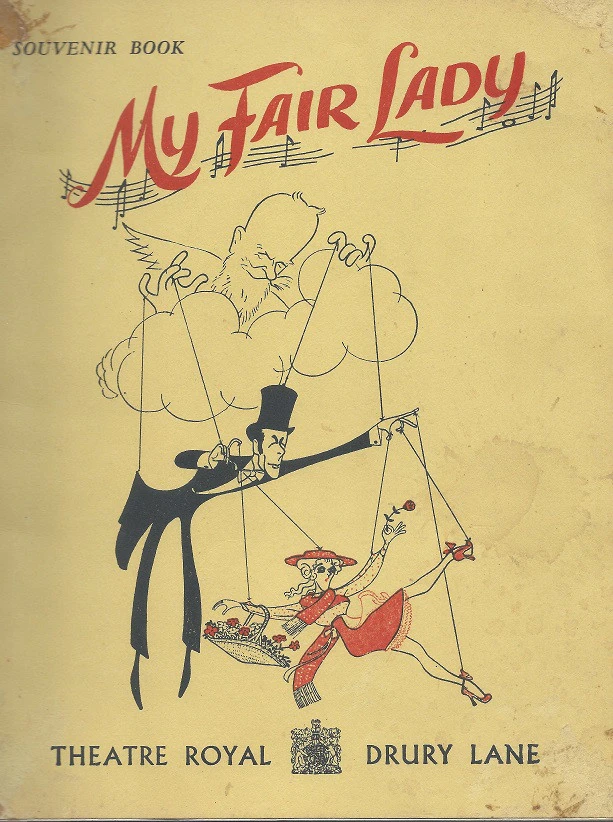
The West End production, in which Harrison, Andrews, Coote, and Holloway reprised their roles, opened on April 30, 1958, at the Theatre Royal, Drury Lane, where it ran for five and a half years (2,281 performances). Edwardian musical comedy star Zena Dare made her last appearance in the musical as Mrs. Higgins.
Harrison left the London cast in March 1959, followed by Andrews in August 1959 and Holloway in October 1959. The original London cast album (1959) was certified Gold in the US.
Shaw’s Pygmalion Returns to London
That My Fair Lady opened at the Theatre Royal, Drury Lane — one of London’s most historic and prestigious theatres — was particularly fitting. The musical adaptation of Shaw’s most popular play was, in a sense, coming home. London embraced it with the same fervor as New York had.
Revivals & Productions
First Broadway Revival (1976-1977)
The first Broadway revival opened at the St. James Theatre 20 years after the original, on March 25, 1976, running for 377 performances. Ian Richardson starred as Higgins, with Christine Andreas as Eliza, George Rose as Alfred P. Doolittle and Robert Coote recreating his role as Colonel Pickering. Both Richardson and Rose were nominated for the Tony Award for Best Actor in a Musical, with the award going to Rose.
Second Broadway Revival (1981)
The second Broadway revival opened at the Uris Theatre on August 18, 1981, and closed on November 29, 1981, after 119 performances. Rex Harrison recreated his role as Higgins, with Jack Gwillim as Pickering, Milo O’Shea as Doolittle, and Cathleen Nesbitt, at 93 years old, reprising her role as Mrs. Higgins.
Cameron Mackintosh Revival (1979 & 2001)
A Cameron Mackintosh revival opened at London’s Adelphi Theatre in October 1979, following a national tour. It featured Tony Britton as Higgins and Liz Robertson as Eliza. Both Britton and Robertson were nominated for Olivier Awards.
Mackintosh produced a new production on March 15, 2001, at the Royal National Theatre, which transferred to the Theatre Royal, Drury Lane on July 21. Directed by Trevor Nunn, with choreography by Matthew Bourne, the musical starred Martine McCutcheon as Eliza and Jonathan Pryce as Higgins, with Dennis Waterman as Alfred P. Doolittle. This revival won three Olivier Awards.
Lincoln Center Theater Revival (2018-2019)
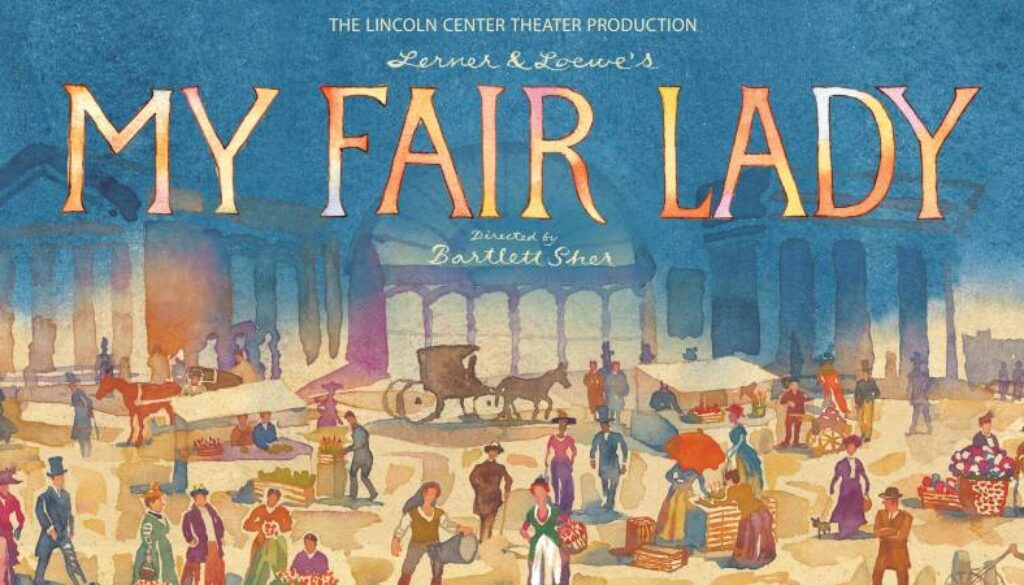
A Broadway revival produced by Lincoln Center Theater began previews on March 15, 2018, at the Vivian Beaumont Theater and officially opened on April 19, 2018. It was directed by Bartlett Sher with choreography by Christopher Gattelli. The cast included:
- Lauren Ambrose as Eliza
- Harry Hadden-Paton as Professor Henry Higgins
- Diana Rigg as Mrs. Higgins
- Norbert Leo Butz as Alfred P. Doolittle
Replacements included Rosemary Harris as Mrs. Higgins, Laura Benanti as Eliza, and Danny Burstein, then Alexander Gemignani, as Alfred P. Doolittle. The revival closed on July 7, 2019, after 39 previews and 509 regular performances.
English National Opera (2022)
The production was presented by the English National Opera at the London Coliseum with performances from May 7, 2022, for a 16-week run until August 27. It starred Amara Okereke as Eliza, with Hadden-Paton reprising the role of Higgins, Stephen K. Amos as Alfred P. Doolittle, and Vanessa Redgrave as Mrs. Higgins.
Awards & Accolades
The original Broadway production won six Tony Awards out of seven nominations in 1957. The 1964 film adaptation won eight Academy Awards, including Best Picture, Best Actor for Rex Harrison, and Best Director for George Cukor.
The Critics Swoon
According to Geoffrey Block: “Opening night critics immediately recognized that My Fair Lady fully measured up to the Rodgers and Hammerstein model of an integrated musical.” The musical opened to unanimously glowing reviews, one of which said “Don’t bother reading this review now. You’d better sit right down and send for those tickets.”
A sampling of praise from critics:
- “A felicitous blend of intellect, wit, rhythm and high spirits. A masterpiece of musical comedy… a terrific show.” — Robert Coleman, New York Daily Mirror
- “Fine, handsome, melodious, witty and beautifully acted… an exceptional show.” — George Jean Nathan, New York Journal American
- “Everything about My Fair Lady is distinctive and distinguished.” — John Chapman, New York Daily News
- “Wonderfully entertaining and extraordinarily welcomed… meritorious in every department.” — Wolcott Gibbs, The New Yorker
- “One of the ‘loverliest’ shows imaginable… a work of theatre magic.” — John Beaufort, The Christian Science Monitor
The reception from Shavians was more mixed, however. Eric Bentley called it “a terrible treatment of Mr. Shaw’s play,” even though he acknowledged it as “a delightful show.”
The Film (1964)
George Cukor directed the 1964 film adaptation, with Harrison returning in the role of Higgins. The casting of Audrey Hepburn as Eliza created controversy among theatregoers, both because Andrews was regarded as perfect in the part and because Hepburn’s singing voice was dubbed (by Marni Nixon).
The Julie Andrews Controversy
Jack L. Warner, the head of Warner Bros., wanted “a star with a great deal of name recognition”, but since Andrews did not have any film experience, he deemed success more likely with an established movie star. Andrews went on to star in Mary Poppins that same year for which she won both the Academy Award and the Golden Globe for Best Actress.
Lerner in particular disliked the film version of the musical, thinking it did not live up to the standards of Moss Hart’s original direction. He was also unhappy with the casting of Hepburn as Eliza Doolittle and that the film was shot in its entirety at the Warner Bros. studio rather than, as he would have preferred, in London.
Despite the controversy, My Fair Lady was considered a major critical and box-office success, and won eight Oscars, including Best Picture of the Year, Best Actor for Rex Harrison, and Best Director for George Cukor.
The Loverly Legacy
Broadway Record Breaker
When My Fair Lady opened in 1956, it set a new standard for what a Broadway musical could be. Its 2,717-performance run was a record that stood for years. By 1959, it was the biggest grossing Broadway show of all-time with a gross of $10 million — an astronomical sum for the era.
The Integrated Musical
Lerner and Loewe’s adaptation proved that Shaw’s “unmusical” play could not only be musicalized, but could become one of the greatest musicals ever written. Every song advances the plot or deepens character. There are no unnecessary interpolations. The score and book are seamlessly woven together.
Rex Harrison’s “Talk-Singing”
Harrison’s unique approach to the role — neither speaking nor singing, but a rhythmic patter that falls somewhere in between — became one of the most distinctive elements of the show. His performance created a template for how to handle a leading role when the actor cannot traditionally sing.
Julie Andrews: From Unknown to Star
My Fair Lady made Julie Andrews a star. At 20 years old, she was cast based on her performance in The Boy Friend. Her Eliza Doolittle — transforming from Cockney flower girl to elegant lady while maintaining the character’s spirit and dignity — became iconic. Though Warner Bros. passed her over for the film, she had the last laugh when she won the Best Actress Oscar for Mary Poppins the same year My Fair Lady won Best Picture.
Shaw’s Play Preserved and Enhanced
Lerner’s book stays remarkably faithful to Shaw’s text, preserving much of the original dialogue while adding musical sequences that Shaw himself might have approved of — if he hadn’t been so adamantly opposed to the idea of a musical Pygmalion. The musical uses several scenes that Shaw had written especially for the 1938 film version, including the Embassy Ball sequence.
Cultural Impact
Certain moments from My Fair Lady have entered the cultural lexicon: Eliza’s breakthrough moment (“The rain in Spain stays mainly in the plain”), Higgins’s final line (“Eliza, where the devil are my slippers?”), and Doolittle’s philosophy of the “undeserving poor.” The songs have become standards, performed and recorded by countless artists.
Countless Revivals
The show has been revived on Broadway four times since the original production, most recently in 2018. It has been produced countless times in regional theaters, amateur productions, and international stagings. From Berlin in 1961 (a symbol of West Berlin’s cultural renaissance during the Cold War) to Sydney in 2016 (where Julie Andrews directed a production that sold more tickets than any other in the Sydney Opera House’s history), My Fair Lady has proven its universal appeal.
More than sixty-five years after its premiere, My Fair Lady remains what Brooks Atkinson called it in 1956: one of the best musicals of the century. It is, quite simply, loverly.