Love Never Dies Musical: The Phantom’s Return — Cast, Story & Production History
Love Never Dies - Podcast
Memorabilia Available Here
Andrew Lloyd Webber • The Phantom Returns
Love Never Dies
The Phantom of Coney Island — A Sequel Ten Years in the Making
The Phantom Rises Again
Love Never Dies is a romantic musical with music by Andrew Lloyd Webber, lyrics by Glenn Slater, and a book by Lloyd Webber, Ben Elton, Frederick Forsyth, and Slater. It is a sequel to the long-running 1986 musical The Phantom of the Opera and was loosely adapted from Forsyth’s 1999 novel The Phantom of Manhattan.
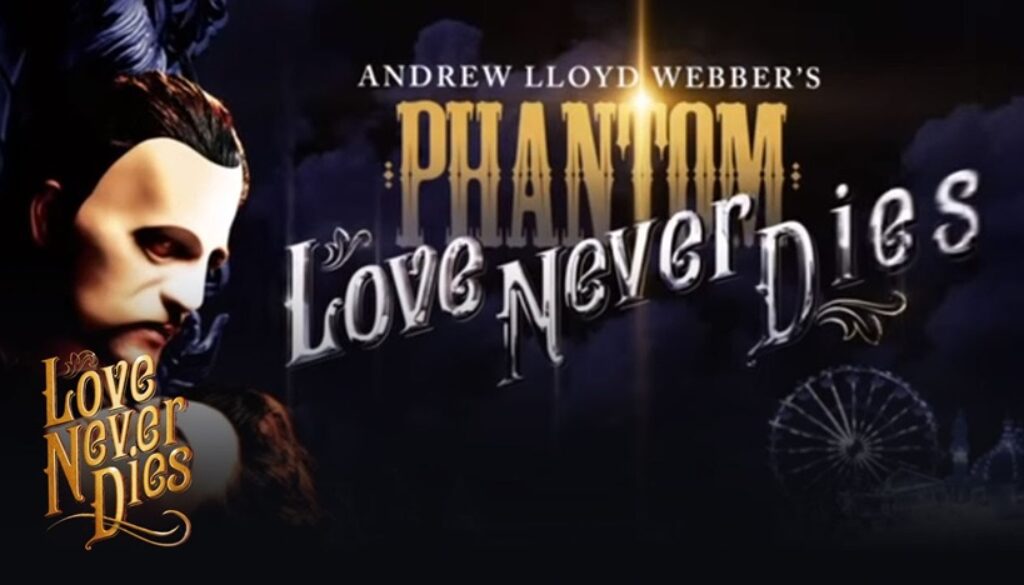
Set in 1907 — ten years after the events at the Paris Opera House — the show transports the Phantom to Coney Island, New York, where he has built Phantasma, a spectacular amusement park and pleasure palace. When Christine Daaé arrives in America for her debut, she discovers too late that it is the Phantom himself who has summoned her to sing once more.
Lloyd Webber himself was characteristically conflicted about the show’s nature: he initially stated it was not a sequel but a stand-alone piece, later clarified that it clearly was a sequel, and lyricist Glenn Slater explained that Lloyd Webber viewed it as simply “a second story with these characters.” The show opened at the Adelphi Theatre in London’s West End on 9 March 2010.
A Two-Decade Obsession
Lloyd Webber first began plans for a Phantom sequel as early as 1990. Following a conversation with Phantom of the Opera designer Maria Björnson, he envisioned a sequel set in New York at the turn of the 20th century. He initially considered having the Phantom live in Manhattan’s first penthouse, but abandoned the idea when he discovered a TV documentary about the Coney Island fairground — and the idea of a masked genius ruling a carnival kingdom was born.
He collaborated with novelist Frederick Forsyth on the project, but those ideas proved difficult to stage. Forsyth ultimately published his version as the 1999 novel The Phantom of Manhattan. Lloyd Webber returned to the project in 2006 and finally, in 2007, brought in Ben Elton to shape a workable synopsis — one that focused back on the original characters rather than the new ones Forsyth had introduced.
The Cat That Deleted the Score
One of musical theatre’s most unlikely stories: the sequel was significantly delayed when Lloyd Webber’s six-month-old kitten Otto, a rare Turkish Van, climbed onto his Clavinova digital piano and managed to delete the entire score. Lloyd Webber was unable to recover any of it from the instrument, but eventually reconstructed it from memory and other sources.
The Story: Phantasma
Prologue: Coney Island, 1907
Madame Giry walks alone at night on a desolate pier, reminiscing about an amusement park called Phantasma — Coney Island’s former “City of Wonders.” The ghost of Miss Fleck, a freak show performer who once worked with Giry at the park, appears out of the darkness. When Fleck urges Giry to recall the “good old days” and blames her for “what happened,” the audience is transported back in time as the billboards restore, the lights of Phantasma illuminate, and the park’s performers appear in a dreamlike sequence.
Heaven by the Sea
It is ten years after the events at the Paris Opera House. An excited group of vacationers arrive at Phantasma, overwhelmed by all it has to offer. They speculate about the park’s reclusive, masked owner — a wealthy tycoon known only as Mr. Y. Meg Giry, Christine’s former friend from the Opera, is now a headlining burlesque performer at Phantasma, while her mother Madame Giry serves as business manager and choreographer. Both are eager to secure their future with their mysterious employer.
The Phantom’s Longing
In a dark, private lair in a tower high above the park, the Phantom — now revealed as Phantasma’s owner and mastermind — interacts with an automaton that resembles Christine. Despite the years and his many successes, he still longs to hear her sing (“Till I Hear You Sing”). He dispatches a letter through his trio of freak show performers — Miss Fleck, Dr. Gangle, and Mr. Squelch — inviting Christine to perform at Phantasma.
Christine Arrives
Three months later, Christine arrives in New York with her husband Raoul and their son Gustave. Onlookers note that Christine has not performed for some time, and that Raoul has squandered much of their fortune through drinking and gambling. The Phantom’s trio whisk the family away to Coney Island in a strange carriage drawn by a ghost horse.
In their rooms, Raoul expresses disgust and storms out to find a bar, leaving Christine to explain his behavior to their son (“Look With Your Heart”). When Gustave goes to bed, the Phantom enters and reveals himself to a stunned Christine. As they recall their one night of passion before she married Raoul (“Beneath a Moonless Sky”), the Phantom reveals he fled out of fear she would reject him again when she saw his face in the morning light.
Gustave’s Paternity
The Phantom takes Gustave to his Aerie, where the boy is enthralled by curious inventions and creations. When Gustave plays a haunting melody of his own composition on the piano (“Beautiful”), the Phantom is struck by the possibility that this musically gifted child could be his son. He removes his mask to reveal his deformity — and to his dismay, Gustave is horrified and screams. Christine enters to calm the boy. When the Phantom confronts her, Christine confesses: Gustave is indeed his son. Madame Giry has overheard and is enraged, fearing that everything she and Meg have done for the Phantom has been for nothing.
The Wager
A drunken Raoul sits alone in a bar (“Why Does She Love Me?”). The Phantom slips in and replaces the barman, confronting Raoul with veiled remarks that cause him to question his paternity of Gustave. The Phantom offers a wager: if Christine fails to perform, he will pay off all their debts and let them leave together — but if she sings the aria he has written for her, Raoul must return to France alone. Raoul accepts (“Devil Take the Hindmost”).
The Climax
That night Christine must decide between her loyalty to Raoul and the magnetic pull of the Phantom’s music (“Before the Performance”). She performs — and sings magnificently. When she tries to leave with Gustave, Meg Giry — unhinged by years of being ignored in favour of Christine — appears with a gun. In the struggle, Christine is shot. As she lies dying, the Phantom sings to her. Gustave reaches out and removes the Phantom’s mask — and unlike before, accepts him. Christine dies in the Phantom’s arms as Gustave takes his father’s hand.
The Players
The Musical Score
Andrew Lloyd Webber’s score for Love Never Dies leans into sweeping romantic opera, lush orchestration, and the carnival sounds of early 20th-century Coney Island. The music was revised substantially between the London and Australian productions.
| Act | Song |
|---|---|
| Prologue | “Prologue” / “The Coney Island Waltz” |
| Act I | “Heaven by the Sea” |
| Act I | “Only for Him / Only for You” |
| Act I | “The Aerie” |
| Act I | “Till I Hear You Sing” |
| Act I | “Giry Confronts the Phantom” |
| Act I | “Christine Disembarks” |
| Act I | “Look With Your Heart” |
| Act I | “Beneath a Moonless Sky” |
| Act I | “Once Upon Another Time” |
| Act I | “Dear Old Friend” |
| Act I | “Beautiful” |
| Act I | “The Beauty Underneath” |
| Act II | “Why Does She Love Me?” |
| Act II | “Devil Take the Hindmost” |
| Act II | “Bathing Beauty” |
| Act II | “Mother, Did You Watch?” |
| Act II | “Before the Performance” |
| Act II | “Love Never Dies” |
| Act II | “Finale” |
The Signature Song
The title song “Love Never Dies” — Christine’s grand aria — is the emotional centrepiece of the show and widely regarded as one of Lloyd Webber’s most beautiful melodies. It originated as “The Heart Is Slow to Learn,” performed by Kiri Te Kanawa at Lloyd Webber’s 50th birthday concert in 1998, and was reworked over the following decade into the soaring soprano showpiece that closes the show.
West End Production (2010–2011)
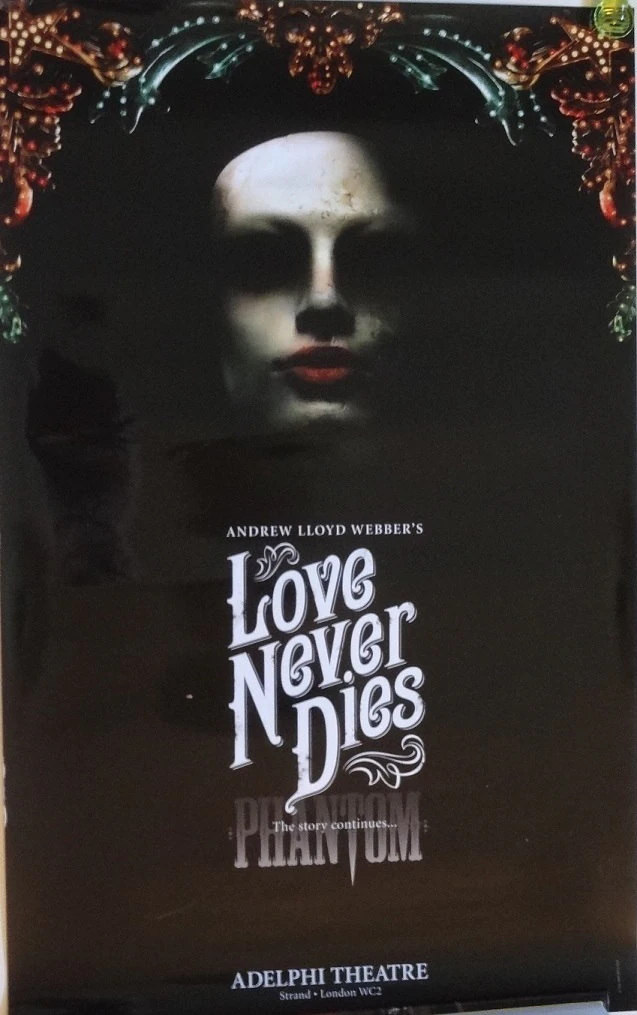
The show opened at the Adelphi Theatre, London on 9 March 2010, with previews from 22 February. It was directed by Jack O’Brien, choreographed by Jerry Mitchell, with set and costume designs by Bob Crowley.
| Role | Original West End Cast |
|---|---|
| The Phantom | Ramin Karimloo |
| Christine Daaé | Sierra Boggess |
| Raoul | Joseph Millson |
| Madame Giry | Liz Robertson |
| Meg Giry | Summer Strallen |
| Fleck | Niamh Perry |
| Director | Jack O’Brien |
| Choreographer | Jerry Mitchell |
| Set & Costumes | Bob Crowley |
Controversy & Rewrites
The original London production received mostly negative reviews. In November 2010, Lloyd Webber closed the production for several days to carry out substantial rewrites. Lyricist Charles Hart was brought in to adjust some of Glenn Slater’s original lyrics, and producer Bill Kenwright took over effective direction alongside new choreographer Bill Deamer.
In April 2010, Lloyd Webber was threatened with a £20,000 fine for illegally painting the Grade II-listed Adelphi Theatre black to promote the show.
The London production finally closed on 27 August 2011 after a disappointing run of fewer than eighteen months. In 2012 Lloyd Webber reflected that “something just went slightly wrong — I had cancer just before the production, and it was just that crucial 5% off-beam.”
Broadway — The Production That Never Happened
Lloyd Webber had originally planned simultaneous openings in London, New York, and Shanghai in autumn 2009. A Broadway production at the Neil Simon Theatre was announced and repeatedly postponed — first to spring 2011, then indefinitely. The negative press from London had deterred potential backers. To this day, Love Never Dies has never played Broadway.
Australian Production (2011–2012)
The Australian production — the first outside the UK — opened on 21 May 2011 at Melbourne’s Regent Theatre. It featured an entirely new design team and direction by Simon Phillips, with Ben Lewis and Anna O’Byrne in the lead roles. The production underwent heavy revisions and was generally better received than the West End version.
The Filmed Production
The Melbourne production was filmed on 15 September 2011 and released on DVD and Blu-ray (UK: 12 March 2012; US: 29 May 2012; Australia: 8 February 2012). The filmed production also played in select theatres on 28 February and 7 March 2012, and was screened again in US cinemas in May 2012. During the COVID-19 pandemic, it was made available on Lloyd Webber’s “The Shows Must Go On!” YouTube channel. This filmed version is widely regarded as the definitive record of the show.
The Melbourne production transferred to Sydney’s Capitol Theatre, opening 12 January 2012 and closing 1 April 2012. Despite the improved production, the show struggled with ticket sales throughout Australia, eventually closing with heavy discounting.
Worldwide Productions
Det Ny Teater production. Tomas Ambt Kofod and Bo Kristian Jensen shared the Phantom role; Danish coloratura soprano Louise Fribo as Christine. New design by Paul Farnsworth, translated into Danish by Karen Hoffmann.
Concert rendition translated entirely into German at the Raimund Theater. Starring Drew Sarich as the Phantom.
Multiple runs using the Australian production design. Starred Masachika Ichimura and Takeshi Kaga (2014); Masachika Ichimura and Kanji Ishimaru (2019 & 2025). Ayaka Hirahara and Megumi Hamada shared Christine across productions.
Stage Entertainment German production titled Liebe stirbt nie. Based on the Australian version. Closed prematurely due to low ticket sales.
Premiered at the Stanley Theatre, Utica, New York. Cast led by Gardar Thor Cortes and Meghan Picerno, with Karen Mason as Madame Giry. Closed at Bass Concert Hall, Austin, Texas.
Two-night concert production directed by Shaun Kerrison. First time the revised Australian version was performed in London. Starring Norm Lewis as the Phantom, Celinde Schoenmaker as Christine, Sally Dexter as Madame Giry, and Courtney Stapleton as Meg.
Reception & Awards
The critical response to Love Never Dies was predominantly negative in London, with reviewers finding fault with the book, the plot logic, and the handling of the beloved original characters. The Australian revival fared better, with praise for the reworked production values and the performances of Ben Lewis and Anna O’Byrne.
The Lighting Designer Who Almost Quit
In 2016, five years after the London production closed, Paule Constable — the production’s original lighting designer — publicly stated that working on Love Never Dies had almost led her to quit the theatre industry entirely. Her candid remarks shed light on the troubled nature of the production behind the scenes.
The Phantom Fandom Divide
Perhaps the most vocal opposition to Love Never Dies came not from critics but from devoted fans of the original Phantom. Many objected to key plot points — particularly the revelation that Christine and the Phantom had been intimate before her marriage to Raoul, and the reconception of Raoul as a drunk and a gambler. Australian director Simon Phillips addressed the issue directly: “The central plot idea is that the Phantom and Christine have slept together. If people don’t buy that, then they’re never going to come onboard with the show.”
Legacy & Continuing Life
The Show That Won’t Stay Dead
Despite its troubled London opening, negative reviews, and the Broadway production that never materialized, Love Never Dies has proven remarkably resilient. Productions have mounted across Denmark, Austria, Germany, Japan, Australia, North America, and the West End concert in 2023 — demonstrating that Lloyd Webber’s score, whatever the book’s failings, continues to attract performers and audiences worldwide.
The World Tour That COVID Stopped
In January 2020, it was announced that the Australian production would embark on its first ever world tour, opening in the UK in September 2020 at Leicester’s Curve theatre before moving to Manchester Opera House and then to Toronto’s Ed Mirvish Theatre. The tour was postponed due to the COVID-19 pandemic and has not yet been rescheduled.
Lloyd Webber’s Perspective
Lloyd Webber has remained proud of the work despite its difficulties. Regarding the filmed Australian production — which he considers the definitive version — he stated that it does not really matter to him if a Broadway production comes “tomorrow or five years’ time.” The filmed Melbourne version, widely available on DVD and streaming, has become the primary way audiences around the world experience the show.
The 2023 Drury Lane concert starring Norm Lewis and Celinde Schoenmaker marked the first time the revised Australian version had been seen in London — a final closing of the circle, giving the capital city that rejected the original a chance to appreciate what the show became.
A Sequel Still Seeking Its Stage
Twenty years after its London premiere, Love Never Dies remains one of musical theatre’s most debated sequels — a show with a score of genuine beauty, a staging history of genuine difficulty, and a fandom divided between those who cherish it as a worthy continuation of the Phantom’s story and those who believe the Phantom’s story should have ended in Paris. The music, however — particularly the soaring title song — has become a staple of soprano recitals and Lloyd Webber retrospectives worldwide.