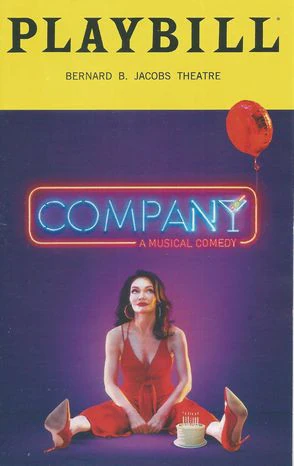
Company Complete Guide — Sondheim’s Brilliant Concept Musical | Songs & History
Company Musical - Podcast
Memorabilia Available Here
Stephen Sondheim • George Furth • Broadway 1970
COMPANY
Being Alive in New York City — a concept musical about marriage, commitment, and the terrifying beauty of connection
Music & Lyrics: Stephen Sondheim • Book: George Furth • Original Director: Harold Prince
Drop By Anytime
Company is a musical with music and lyrics by Stephen Sondheim and book by George Furth. One of the most acclaimed musicals ever written, it was among the first book musicals to deal candidly with contemporary dating, marriage, and divorce — and remains one of the defining examples of the concept musical, a form that prioritises theme and idea over linear narrative.
In a series of loosely connected vignettes, Company follows Bobby (or Bobbie, in recent productions), a bachelor living in New York City, as he visits with five married couples on the occasion of his 35th birthday. The show has no traditional plot — instead it offers a mosaic of modern relationships, each one dissected with Sondheim's characteristic wit, tenderness, and ferocity.
The original 1970 production was nominated for a record-setting 14 Tony Awards, winning six. It has since seen major revivals on Broadway and in the West End — most notably the celebrated 2018 Marianne Elliott production that gender-swapped the central role from Bobby to Bobbie and introduced a same-sex couple for the first time, with Jonathan Bailey as Jamie and Patti LuPone as Joanne.
How Company Began
George Furth wrote eleven one-act plays originally intended for actress Kim Stanley. Actor Anthony Perkins — interested in directing — gave the material to Sondheim, who in turn shared it with producer-director Harold Prince. Prince saw in the plays the potential for a musical about New York marriages viewed through the eyes of a single central figure. The result was Company — the show that changed what a Broadway musical could be.
The Story
Company has no conventional linear plot. Instead, it presents a series of disconnected vignettes — Robert visiting his five married couples, alone on dates, and finally alone — that together build a portrait of a man approaching a crossroads. The following is based on the revised libretto (revised by Furth and Sondheim in the early 1990s).
The Birthday Party
It is Robert's 35th birthday. His friends — five married couples — have gathered to throw him a surprise party. When Robert fails to blow out the candles on his birthday cake, the couples promise him his wish will still come true, though Robert wished for nothing: his friends are all he needs ("Company"). What follows is a series of vignettes in no chronological order.
Sarah & Harry — The Little Things
Robert visits Sarah, a foodie who is dieting, and her husband Harry, a recovering alcoholic. They taunt each other on their respective vices, escalating into karate-like play-fighting. The caustic Joanne sarcastically observes to the audience that it's the little things that make a marriage work ("The Little Things You Do Together"). Harry and the men all agree that most married people are simultaneously thankful and regretful about getting married — and that marriage changes everything and nothing ("Sorry – Grateful").
Peter & Susan — The Perfect Divorce
Robert visits Peter and Susan on their terrace. Peter is an Ivy League graduate; Susan is a Southern belle. They seem perfectly matched — and then they announce they are getting divorced. Meanwhile, at the home of Jenny and David, the three share marijuana and the couple turns to grilling Robert on why he hasn't married yet.
The Three Girlfriends
Robert is currently dating Kathy, Marta, and April. In a wry Andrews Sisters-style number, all three chastise him for his inability to commit ("You Could Drive a Person Crazy"). Robert's male friends, deeply envious of his freedom, each try to set him up with the perfect woman ("Have I Got a Girl for You") — while Robert himself imagines a woman who combines the best of all his married female friends ("Someone Is Waiting").
The Three Dates
Robert meets each girlfriend separately in a small park. Marta sings of New York — crowded, dirty, indifferent, yet magnificent ("Another Hundred People"). Robert dates April, a slow-witted flight attendant. He spends time with Kathy — they had previously considered marrying each other — and the idea suddenly strikes Robert as serious, but Kathy reveals she is engaged to someone else and leaving for Cape Cod. He meets Marta and is left stunned by her cheerful, relentless observations.
Getting Married Today — Amy & Paul
It is the day of Amy and Paul's wedding — they have lived together for years but are only now marrying. Amy has a spectacular case of cold feet, breaks the fourth wall, and in a virtuosic rapid-fire patter song declares she cannot go through with it ("Getting Married Today"). Robert — as best man — watches as Amy self-destructs. He unexpectedly offers to marry her himself, which jolts Amy back to reality. She runs out after Paul, finally ready to marry him, tossing her bouquet as she goes.
Side by Side
The birthday party resets. Robert is given his cake and this time wishes for something ("Marry Me A Little"). The couples share their conflicting views of Robert — complimentary and unflattering — as he reflects on being the eternal third wheel ("Side By Side By Side" / "What Would We Do Without You?"). In the show's most quietly devastating moment, each man does a dance step answered by his wife. Robert does his step — and there is no one to answer it.
Barcelona
Robert brings April back to his apartment after a date. The two sleep together. The next morning, April rises to report for duty on a flight to Barcelona. Robert initially tries to get her to stay — then, losing conviction, agrees she should go. That withdrawal of desire paradoxically makes April decide to stay: "Oh God!" says Robert — suffused with fear and regret ("Barcelona"). It is one of the most complex and funny endings to any scene in musical theatre.
The Ladies Who Lunch
Joanne and Larry take Robert to a nightclub. Joanne — drunk and savage — turns her glass in a mock toast and systematically demolishes every type of rich, middle-aged woman wasting her life. Her harshest criticism is for those who "just watch" — like herself — bound together by the terror that "everybody dies" ("The Ladies Who Lunch"). When Larry returns, Robert's observation — "But who will I take care of?" — surprises even himself and registers as a breakthrough. Joanne offers Robert an affair. He turns her down.
Being Alive — The Finale
The couples' musical motif resumes, all inviting Robert to "drop by anytime." Robert suddenly shouts "STOP!" In a towering final number, he first enumerates all the dangers and compromises of marriage — before his words shift, expressing a desperate longing for loving intimacy, even with all its terrors ("Being Alive"). The show ends with Robert's friends waiting for him at his party, then leaving. Robert appears alone — smiles — and blows out his candles.
The Songs
Sondheim's score for Company is one of the most admired in musical theatre history — a series of sharply observed character studies, comic set-pieces, and devastating emotional songs that collectively define what it means to be alone in New York City. The Menken-Rice discussion of hybrid scores doesn't apply here: every song is pure Sondheim, and each one cuts precisely to the bone.
"Being Alive" — The Finale That Almost Wasn't
The original intended finale was "Multitude of Amys", but it was cut due to structural changes. "Happily Ever After" — a bitter, unresolved song — was used as the finale for the first few performances. Audiences and critics found it too cynical. Sondheim wrote "Being Alive" as its replacement — and it became one of the most celebrated songs in musical theatre history: a man who has spent a whole evening listing all the reasons not to love, finally admitting he wants love anyway.
The People at the Party
The Original 1970 Production
Directed by Harold Prince with musical staging by Michael Bennett (assisted by Bob Avian), Company opened at the Alvin Theatre on 26 April 1970 and ran for 705 performances, closing 1 January 1972.
The opening cast included Dean Jones as Bobby (replacing Anthony Perkins, who had been originally attached), Elaine Stritch, Donna McKechnie, Susan Browning, Barbara Barrie, Charles Kimbrough, Merle Louise, Beth Howland, and Pamela Myers.
Dean Jones Leaves — Larry Kert Steps In
Displeased with the show and struggling with personal issues — his own marriage had recently collapsed — Dean Jones left the production on 28 May 1970, just a month into the run. He was replaced by his understudy Larry Kert, who had originally created the role of Tony in West Side Story. Kert earned rave reviews and the Tony committee made the unusual decision to declare him eligible for Best Actor, an honour normally reserved for original cast members. Jones later wrote in his autobiography that Company's "underlying message declared that marriage was, at best, a vapid compromise, insoluble and finally destructive."
Boris Aronson's Set Design
Set designer Boris Aronson created one of the most celebrated designs in Broadway history: two working elevators and various vertical platforms that emphasised the musical's themes of isolation and disconnection in the vertical city of New York. The set won the Tony Award for Best Scenic Design.
The Original Cast Recording
Award-winning documentary filmmaker D.A. Pennebaker captured the making of the original cast recording shortly after opening night. His 1970 film Original Cast Album: Company — featuring Elaine Stritch, Sondheim, and producer Thomas Z. Shepard — earned early accolades and a cult following for its unvarnished look at a gruelling recording session. It remains one of the most compelling behind-the-scenes documents of Broadway history.
Production History
Directed by Harold Prince. Dean Jones opened, replaced by Larry Kert. Elaine Stritch as Joanne. 14 Tony nominations — a record — winning six including Best Musical. The first national tour opened May 1971 at the Ahmanson Theatre, Los Angeles, with George Chakiris as Bobby.
Directed by Harold Prince, choreographed by Michael Bennett. Cast included Larry Kert, Elaine Stritch, Beth Howland, and Donna McKechnie. So many original Broadway cast members reprised their roles that producers simply re-released the Broadway album with Kert's vocals replacing Jones's.
Sydney Theatre Company production at the Drama Theatre, directed by Richard Wherrett. Featured John O'May as Bobby and Geraldine Turner as Joanne, with Tony Sheldon and Simon Burke.
Directed by Scott Ellis, choreographed by Rob Marshall. Cast included Boyd Gaines (Bobby), Jane Krakowski, LaChanze, Charlotte d'Amboise, Debra Monk (Joanne), Danny Burstein, and Veanne Cox (Amy). "Marry Me A Little" was restored as the Act One finale — a change made permanent in all subsequent productions. Nominated for Tony Award, Best Revival of a Musical.
Directed by Sam Mendes. Starred Adrian Lester as the first Black actor to play Bobby in a major production. Transferred from the Donmar to the Albery Theatre. Broadcast by BBC Two, March 1997. A one-off reunion concert with much of the same cast was held at the Queen's Theatre in November 2010.
Directed and choreographed by John Doyle. Won the Tony Award for Best Revival of a Musical. The landmark production in which the actors themselves provided all orchestral accompaniment — Raúl Esparza (Bobby) played percussion, Barbara Walsh (Joanne) played orchestra bells and percussion, Heather Laws (Amy) played French horn, trumpet and flute. Filmed for PBS's Great Performances, broadcast 2008. Sondheim travelled to Australia for the first time in thirty years for the Sydney production the same year.
Staged concert directed by Lonny Price. Starred Neil Patrick Harris (Robert), Patti LuPone (Joanne), Stephen Colbert (Harry), Jon Cryer (David), Christina Hendricks (April), Martha Plimpton (Sarah), and Anika Noni Rose (Marta). Paul Gemignani conducted a 35-piece orchestra. Filmed and released on DVD/Blu-ray. The cast reunited to perform "Side by Side by Side" at the 65th Tony Awards, hosted by Harris.
Directed by Marianne Elliott — the landmark reimagining that changed Bobby to Bobbie (played by Rosalie Craig) and cast Jonathan Bailey as the cold-footed groom Jamie (the former Amy) alongside Alex Gaumond as Paul. Patti LuPone as Joanne. Sondheim personally approved all changes and collaborated on revisions. Topped the 2019 Olivier Award nominations with nine, winning Best Musical Revival, Best Supporting Actress (LuPone) and Best Supporting Actor (Bailey). Sondheim called it definitively proving the show's enduring vitality.
Transfer of the 2018 West End production, again directed by Marianne Elliott. Originally slated to open on Sondheim's 90th birthday (22 March 2020), it halted after nine previews due to COVID-19. Resumed November 2021 with Sondheim in attendance shortly before his death on 26 November 2021. The entire run was dedicated to Sondheim. Katrina Lenk as Bobbie; Patti LuPone as Joanne; Matt Doyle as Jamie. Won five of nine Tony nominations including Best Revival of a Musical and Best Featured Actor (Doyle).
Notable Cast Across Productions
| Production | Bobby / Bobbie | Joanne | Notable |
|---|---|---|---|
| 1970 Broadway (original) | Dean Jones → Larry Kert | Elaine Stritch | 14 Tony noms, 6 wins; record-setting |
| 1971 US Tour | George Chakiris | — | Ahmanson Theatre, LA |
| 1972 West End | Larry Kert | Elaine Stritch | Her Majesty's Theatre, 344 perfs |
| 1995 Broadway Revival | Boyd Gaines | Debra Monk | "Marry Me A Little" restored; Jane Krakowski |
| 1995 London (Donmar) | Adrian Lester | — | Sam Mendes; first Black actor as Bobby |
| 2002 Kennedy Center | John Barrowman | Lynn Redgrave | Alice Ripley, Emily Skinner |
| 2006 Broadway Revival | Raúl Esparza | Barbara Walsh | John Doyle; actors played instruments; Tony win |
| 2011 NY Philharmonic | Neil Patrick Harris | Patti LuPone | Stephen Colbert; Christina Hendricks; filmed |
| 2018 West End (Gielgud) | Rosalie Craig (as Bobbie) | Patti LuPone | Jonathan Bailey as Jamie; gender-swapped; 3 Oliviers |
| 2021 Broadway Revival | Katrina Lenk (as Bobbie) | Patti LuPone | Matt Doyle as Jamie; dedicated to Sondheim |
The Gender Revolution — 2018 & 2021
The 2018 Marianne Elliott production at the Gielgud Theatre was the most discussed revival in the show's history. Elliott changed Bobby to Bobbie — making the central character a woman — and, unable to cast the Amy role (a woman panicking about marriage) convincingly, she made a "crazy" decision: she called her friend Jonathan Bailey and asked if he would try the role as a man. The result was Jamie — a gay man having a pre-wedding breakdown — and one of the most electrifying stage performances in recent West End memory.
Sondheim's Response
Sondheim not only approved the changes but actively worked with Elliott on revisions. When the 2021 Broadway transfer opened — with Sondheim in the audience during previews — he was visibly moved. Five days before his death on 26 November 2021, he reflected that what keeps theatre alive is not just fresh casts but fresh viewpoints: "It's not just a matter of changing pronouns, but attitudes." He praised Jonathan Bailey's performance as definitively proving what the show's book could achieve. The entire 2021 Broadway run was dedicated to his memory.
Around the World
Company has been staged in dozens of countries and translated into multiple languages. Notable international productions include:
Antonio Banderas in Spain (2021)
A 2021 Spanish production at Teatro del Soho Caixabank in Malaga — directed by and starring Antonio Banderas as Bobby — was one of the show's most talked-about international productions. Sondheim reportedly approved Banderas's request to age Bobby from 35 to 50. The production subsequently played Barcelona and Madrid in 2022.
Sydney 2007 — Sondheim Returns to Australia
A 2007 Kookaburra Musical Theatre production starring David Campbell as Bobby was so well-received that Sondheim travelled to Australia for the first time in thirty years to attend the opening night. The production became briefly controversial when a performer playing April fell sick with no understudy: the chief executive insisted the show go on — without the character of April — cutting multiple scenes with no explanation, ending the performance twenty minutes early. Sondheim threatened to revoke the production rights. The story became one of the most cited examples of understudying failures in musical theatre history.
Awards & Recognition
Sondheim's Masterpiece
Company is widely regarded as one of the greatest musicals ever written — and one of the most important. It proved that a Broadway musical could be a concept piece without a linear plot, could deal with adult relationships without sentimentality, could be simultaneously funny and devastating. It launched Sondheim's mature period and established his reputation as the theatre's most sophisticated songwriter.
Its songs have become standards of the concert repertoire — particularly "The Ladies Who Lunch" (so associated with Elaine Stritch and later Patti LuPone that it has become a kind of litmus test for any Joanne), "Being Alive" (the show's emotional climax and one of the most performed Sondheim songs in auditions), and "Another Hundred People" (New York's unofficial anthem for the perpetually transplanted).
The Show That Keeps Reinventing Itself
Few musicals have proved as durable or as reimaginable as Company. From Harold Prince's stark original to John Doyle's actors-as-orchestra concept to Marianne Elliott's gender revolution — each major production has found something genuinely new to say about Bobby's question. Perhaps because the question itself never ages: What do you get? The answer, Sondheim insists, is everything. The terror. The joy. Being alive.