Caroline, or Change Musical: The Complete Guide — Cast, Songs & History
Caroline or Change Theatregold Podcast
Memorabilia Available Here
Jeanine Tesori • Tony Kushner • Broadway 2004 • Lake Charles, Louisiana 1963
Caroline,orChange
Music by Jeanine Tesori · Book & Lyrics by Tony Kushner
Sixteen Feet Beneath the Sea
Caroline, or Change is a musical with music by Jeanine Tesori and book and lyrics by Tony Kushner. Set in Lake Charles, Louisiana, November 1963, it tells the story of Caroline Thibodeaux, a 39-year-old Black maid working in the basement of a middle-class Jewish family for $30 a week.
The score blends spirituals, blues, Motown, classical music, and Jewish klezmer into a through-composed operatic whole. Characters include human beings and household appliances alike — the Radio, the Washing Machine, the Dryer, the Bus, the Moon — all given voice and dramatic weight. Premiered Off-Broadway at the Public Theater in 2003, it transferred to Broadway in 2004 and won the Olivier Award for Best New Musical in London. The 2017 revival starring Sharon D. Clarke became one of the most celebrated theatrical events of the decade.
Origins — Tony Kushner’s Louisiana Childhood
Tony Kushner — author of Angels in America — drew directly on his childhood in Lake Charles, Louisiana. The boy Noah Gellman is a version of Kushner himself: Jewish, eight years old, recently motherless, fascinated by the Black woman who works in his family’s basement. The show was first workshopped in 1999 at the Public Theater under director George C. Wolfe and developed across four years before its 2003 premiere.
The Characters
The world of Caroline, or Change is populated by human beings and household objects alike — the appliances are theatrical presences that give voice to Caroline’s inner world.
39-year-old African-American maid for the Gellmans. Single parent raising four children on $30 a week. Intelligent, dignified, trapped. The still centre of the storm.
The Gellmans’ 8-year-old son. Curious, sympathetic, neurotic. His mother died of cancer. Drawn to Caroline with the uncomplicated love of a child.
Caroline’s 16-year-old daughter — fierce, free-spirited, politically awakened. A supporter of Martin Luther King Jr. who sees a world beyond her mother’s limitations.
Noah’s new stepmother, transplanted from New York City to Louisiana. Concerned, well-meaning, and unable to understand Caroline’s world.
A professional clarinet player and Noah’s father. Still mourning his first wife. Unable to give either Rose or Noah what they need.
Caroline’s friend and fellow maid. Takes night classes at the University — a different path, a different possibility.
A Supremes-like trio — Greek Chorus for the show. The popular music of the era filtered through Caroline’s consciousness in the basement.
A calming, healing presence throughout the show. Rises over the bus stop, the Chanukah party, the aftermath. Eternal. Impartial. Beautiful.
The Washing Machine urges Caroline forward; the Dryer torments her. Both represent the psychic reality of a woman whose inner life must be lived alongside relentless physical labour.
Primary transport for African-American characters. Brings not just movement but news — it is the Bus that delivers word of President Kennedy’s assassination.
Rose’s father — a Jewish man with socialist ideology from New York. His Chanukah gift of a $20 bill to Noah sets the catastrophic events of Act Two in motion.
The Story
Act One — The Basement, the Money, the Bus
On a hot day in November 1963 in Lake Charles, Louisiana, Caroline does laundry in the basement of the Gellman family — sixteen feet beneath the sea, as she imagines it. She earns $30 a week. She has worked in houses for 22 years. She has four children. The Radio sings. The Dryer taunts.
Noah is drawn to Caroline. They share a secret: she lets him light her one cigarette each day. Rose tells Caroline she may keep any change she finds in Noah’s pockets. Noah, aware of Caroline’s poverty, begins deliberately leaving money in his pockets. Caroline takes it. She needs it. It feels like shame.
The Assassination
Caroline and Dotty wait for the bus. The Moon rises. Then the Bus arrives with devastating news: President Kennedy has been assassinated. The Gellmans mourn what Kennedy meant for the Jews. Caroline’s daughter Emmie refuses to grieve — Kennedy made promises to Black America and never kept them. The political fracture between mother and daughter has begun.
Act Two — The Twenty Dollar Bill
At the Chanukah party, when Rose’s father Mr. Stopnick belittles Martin Luther King Jr.’s nonviolent methods, Emmie tells him white people have no right to criticise. Caroline slaps Emmie. Slavery is over, Emmie retorts. The slap echoes through everything that follows.
The $20 Bill
Mr. Stopnick gives Noah a $20 bill as a Chanukah present. Noah inadvertently leaves it in his pockets. Caroline finds it and says she is keeping it. Noah and Caroline exchange racial insults — the ugliest moment in the show. Caroline returns the money and leaves. For five days she does not return. That Sunday, on her way to church, she realises the laundry money had only fostered greed and hatefulness. She prays to be freed from earthly desires.
Epilogue — Emmie’s Future
Caroline returns to work and tells Noah he will learn to live with sorrow. Emmie reveals she helped take down the Confederate soldier statue at the courthouse. She sings proudly: she is the daughter of a maid — but she will work for a greater cause. Her children will have a brighter future. It is up to the children of Caroline Thibodeaux to change the future. And they will.
The Music — Jeanine Tesori’s Extraordinary Score
Jeanine Tesori’s score combines African-American spirituals, blues, Motown, classical composition, and Jewish klezmer and folk music into a single through-composed whole. The show is more opera than musical in its structure. The score embeds the history of two communities — Black and Jewish — into every scene, reflecting the cultural world of Lake Charles in 1963.
The Appliances as Voices
The Radio — a Supremes-like trio — represents popular music penetrating Caroline’s basement. The Washing Machine has its own rhythmic, insistent voice. The Dryer is sinister. The Moon sings with unearthly calm. These are not gimmicks but dramaturgical necessities — they give voice to the inner life of a woman who can never fully express herself in the world above.
Production History
Directed by George C. Wolfe. Starred Tonya Pinkins as Caroline, Anika Noni Rose as Emmie, Harrison Chad as Noah, Veanne Cox as Rose, Chandra Wilson as Dotty. Final weekend sold out. Immediate Broadway transfer.
Critically acclaimed. Nominated for six Tony Awards including Best Musical. Anika Noni Rose won Best Featured Actress in a Musical; Tonya Pinkins nominated for Best Actress. Scenic design by Riccardo Hernandez, costumes by Paul Tazewell, lighting by Jules Fisher and Peggy Eisenhauer.
Pinkins and Rose reprised their roles at the Ahmanson Theatre (LA) and Curran Theatre (San Francisco). Washington D.C. premiere at The Studio Theatre (2006) won Helen Hayes Awards for Outstanding Lead Actress and Outstanding Resident Musical. Chicago premiere at the Court Theatre (2008) won four Jeff Awards.
Directed by George C. Wolfe. Starred Tonya Pinkins. Pippa Bennett-Warner, Anna Francolini, Hilton McRae, Clive Rowe. Ran in repertory with Marianne Elliott’s Thérèse Raquin. Did not transfer to the West End but won the Olivier Award for Best New Musical.
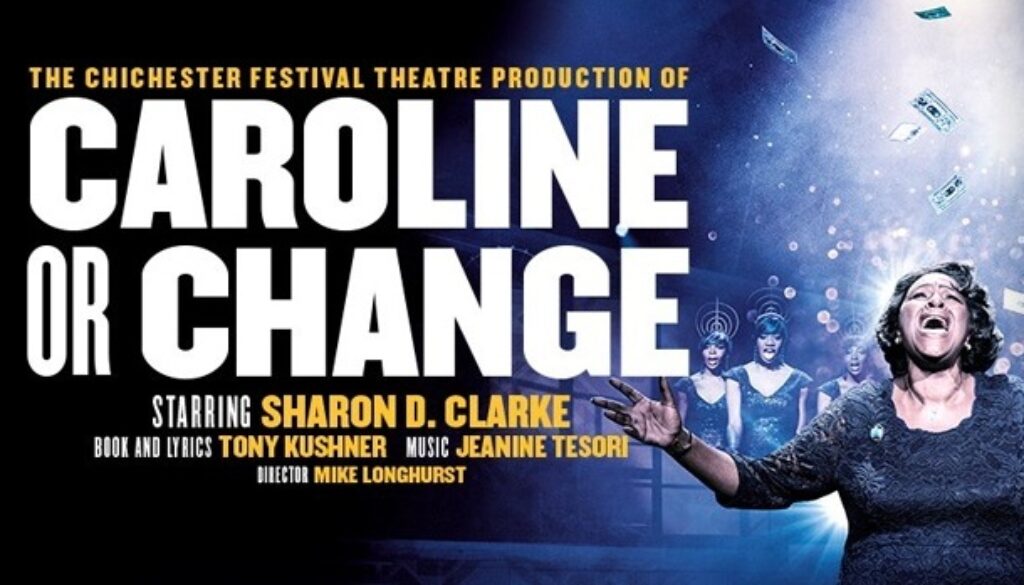
Directed by Michael Longhurst. Sharon D. Clarke as Caroline. Five-star reviews. Part of Daniel Evans’ inaugural season at Chichester Festival Theatre. Critics described it as a once-in-a-generation performance.
The Chichester production transferred with Sharon D. Clarke — described as one of the most powerful performances on the London stage. West End transfer immediately announced.
Transferred to the Playhouse Theatre with Sharon D. Clarke. Won multiple awards including the Black British Theatre Award for Best Actress. One of the most celebrated West End musicals of the decade.
Announced for March 2020; halted by COVID-19. Officially opened October 27, 2021. Directed by Michael Longhurst, choreographed by Ann Yee. Sharon D. Clarke as Caroline, Samantha Williams as Emmie. Nominated for Tony Awards, Drama Desk Awards, and Drama League Awards. Clarke’s performance described as transcendent.
2012 production won Dora Mavor Moore Awards for Outstanding Production and Outstanding Lead Actress. 2020 production starred Jully Black as Caroline and soprano Measha Brueggergosman as The Moon at the Elgin and Winter Garden Theatres.
Major productions at Guthrie Theatre Minneapolis; Center Stage Baltimore; Main Street Theater Houston; Dayton Ohio; Syracuse NY; Brooklyn; Colorado; and many more. The show continues to receive major productions internationally.
Awards & Recognition
| Year | Award | Category | Nominee / Show | Result |
|---|---|---|---|---|
| 2004 | Tony Award | Best Musical | Caroline, or Change | Nominated |
| 2004 | Tony Award | Best Actress in a Musical | Tonya Pinkins | Nominated |
| 2004 | Tony Award | Best Featured Actress in a Musical | Anika Noni Rose | Won ✦ |
| 2004 | Tony Award | Best Book of a Musical | Tony Kushner | Nominated |
| 2004 | Tony Award | Best Original Score | Tesori & Kushner | Nominated |
| 2004 | Tony Award | Best Lighting Design | Jules Fisher & Peggy Eisenhauer | Nominated |
| 2007 | Olivier Award | Best New Musical | Caroline, or Change — National Theatre | Won ✦ |
| 2019 | Black British Theatre Award | Best Actress in a Musical | Sharon D. Clarke | Won ✦ |
| 2019 | Olivier Award | Best Actress in a Musical | Sharon D. Clarke (West End) | Nominated |
| 2022 | Tony Award | Best Revival of a Musical | Caroline, or Change | Nominated |
| 2022 | Tony Award | Best Actress in a Musical | Sharon D. Clarke | Nominated |
| 2022 | Theatre World Award | Outstanding Performance | Samantha Williams (Emmie) | Won ✦ |
| 2006 | Helen Hayes Award | Outstanding Lead Actress & Production | Julia Nixon / Studio Theatre D.C. | Won ✦ |
| 2008 | Jeff Award | Best Production & Best Director | Court Theatre Chicago | Won ✦ |
| 2012 | Dora Mavor Moore Award | Outstanding Musical Production | Acting Up Stage, Toronto | Won ✦ |
Tonya Pinkins & Sharon D. Clarke — Two Iconic Carolines
Tonya Pinkins created the role and performed it at the Public Theater, on Broadway, and at the National Theatre London. Sharon D. Clarke — who took up the role in Chichester in 2017 — became one of the most celebrated performers of her generation, playing Caroline across Chichester, Hampstead, the West End’s Playhouse Theatre, and Broadway’s Studio 54. Critics consistently described her performance as a landmark in theatre history.
Legacy — Change and No Change
Caroline, or Change is one of the most formally radical musicals ever produced. In its structure — through-composed, operatic, with household objects as singing characters — it defies every convention of the form. In its subject — race, class, the psychic cost of poverty, the bonds between a Jewish family and the Black woman who works for them — it addresses the American condition with rare depth.
The title is a pun: the coins in Noah’s pocket; the historical change demanded by the Civil Rights Movement; the change Caroline cannot allow herself to want. The musical asks what it costs a person to endure — and what it costs a community to change too slowly. Caroline does not transform. Emmie does. The future belongs to the children.
Tesori and Kushner — A Singular Collaboration
Tony Kushner brought childhood memory, moral seriousness, and language that is simultaneously lyrical and politically exact. Jeanine Tesori brought a musical intelligence vast enough to hold spirituals and klezmer and Motown and classical music in the same breath — using that breadth not as eclecticism but as argument. The score says: these communities share a history, a geography, a moment in American time — and how they treat each other in that moment matters enormously. It is a musical that will endure.