Wish You Were Here Musical: The Complete Guide — Harold Rome’s 1952 Broadway Summer Hit
Harold Rome • Arthur Kober • Joshua Logan • Imperial Theatre, Broadway 1952
♪ Wish You Were Here Original Cast
Book by Arthur Kober & Joshua Logan
Music & Lyrics by Harold Rome
Directed & Choreographed by Joshua Logan
Set & Lighting Design by Jo Mielziner
Sunshine, Swimming
and Summer Love
on Broadway
Wish You Were Here is a musical with book by Arthur Kober and Joshua Logan and music and lyrics by Harold Rome. Adapted from Kober’s celebrated 1937 comedy play Having Wonderful Time, the show is set at Camp Karefree — a two-week summer camp for adults in the Catskill Mountains — and follows young Teddy Stern as she navigates love, an inconvenient engagement, and the question of whether to follow her heart or her obligations.
The show opened at the Imperial Theatre on Broadway on 25 June 1952, directed and choreographed by Joshua Logan, with scenic and lighting design by the legendary Jo Mielziner. Its original cast included Patricia Marand as Teddy Stern, Jack Cassidy as Chick Miller, Sheila Bond as Fay Fromkin, and — in her Broadway debut as “The New Girl” with a single line — a young Florence Henderson, who would go on to worldwide fame as Carol Brady on The Brady Bunch.
The show’s path to its eventual 598-performance run was rocky: initial reviews were mixed, and it came close to closing early. It was saved by a combination of Jerome Robbins’s uncredited emergency choreography, aggressive book rewrites, a title song that became a No. 1 pop hit for Eddie Fisher, and — most dramatically — a single appearance on The Ed Sullivan Show that turned near-failure into a Broadway hit overnight. It is one of the great second-act comeback stories in Broadway history.
The Source — Arthur Kober’s Having Wonderful Time (1937)
Wish You Were Here is adapted from Arthur Kober’s 1937 Broadway play Having Wonderful Time — a warmly observed comedy set in the same Catskills summer camp world, dealing with similar themes of class, romance, and Jewish-American social aspiration. The adaptation involved considerable reworking, as Kober and co-writer Joshua Logan expanded the material into a full musical with Harold Rome’s score. According to critics Cecil Michener Smith and Glenn Litton, the original “warmth and unpretentiousness” of the play were somewhat lost in the elaboration — the “monumental stage spectacle” with its swimming pool, basketball game, fire, and rainstorm caused early critical resistance. But the team responded with revisions, additional songs, and emergency help from Jerome Robbins that ultimately turned the tide.
The People
of Camp Karefree
A young woman who arrives at Camp Karefree on the verge of marriage to an older, stuffy man — Herman Fabricant — whose engagement she is already having serious doubts about. Her two weeks at camp, and her growing love for Chick, force her to face the truth of what she really wants from her life.
A college student working as a waiter at Camp Karefree to fund his law school education. Principled, idealistic, and wary of entanglements — until Teddy. Jack Cassidy’s star-making performance established him as one of Broadway’s most attractive leading men of the era.
Teddy’s irrepressible, flirtatious best friend who takes Teddy’s engagement ring at the start of camp so that Teddy can enjoy a carefree holiday. A warm comic performance by Sheila Bond that won her the Tony Award for Best Featured Actress in a Musical.
Camp Karefree’s resident social director, entertainer, schemer, and romantic disaster. He can do imitations, sing, dance, and tell stories — and he is always in the middle of everyone else’s affairs. His combination of jealousy over Fay and devotion to his campers drives much of the show’s comedy.
The new athletic director whose physical charms captivate Fay, sending Itchy into spirals of jealousy. His rivalry with Itchy for Fay’s attention, and his over-enthusiastic sports programme that exhausts the entire camp, provide the show’s central comic subplot.
A dashing, womanizing fellow who sets his sights on Teddy from the moment she arrives. His attempts to manipulate situations to his romantic advantage — including spiking Teddy’s drink — drive the second act’s central crisis, and his ultimate admission of the truth provides the resolution.
Teddy’s stuffy, older fiancé — the man she cannot quite bring herself to marry, even though she cannot quite bring herself to leave him either. His eventual generous gesture — returning Teddy’s ring to Chick — provides the show’s happy ending.
The genial proprietor of Camp Karefree, who opens the show welcoming guests and spends much of the action trying to keep his social director and athletic director from destroying the camp’s operations and reputation.
Florence Henderson — Broadway Debut
Wish You Were Here launched the career of Florence Henderson — best known to the world as Carol Brady on the long-running ABC television sitcom The Brady Bunch. In her chorus role as “The New Girl” (which she originated), Henderson had but one line to deliver. That one line, which started it all for her, was simply: “Can I see the game?” From that single moment in the 1952 Imperial Theatre company, Henderson would go on to become one of the most beloved figures in American television history.
The Story —
Two Weeks
at Camp Karefree
Act One — Arrivals and Entanglements
A PA announcement welcomes a new busload of guests to Camp Karefree in the Catskills. Camp host Lou Kandel introduces the two rules of the camp: Karefree cares for you, and when the lights flicker, girls go to the girls’ side and boys to the boys’. Enter Teddy Stern — soon to marry the stuffy Herman Fabricant, but already crying and full of doubt. Her best friend Fay takes her under her wing and, crucially, takes Teddy’s engagement ring so she can enjoy a “real” holiday as a single woman.
Teddy meets Itchy Flexner, the irrepressible social director, and then Pinky Harris — a charming, womanizing fellow who immediately sets his sights on her. The camp’s waiters — mostly college men putting themselves through school — mingle with the female guests at Kandel’s insistence. Chick Miller, a law student and reluctant gigolo, is manoeuvred into dancing with the reluctant Teddy to save himself from being fired. They connect. Walking through the woods, they hear the band play the song that will haunt the evening — “Wish You Were Here”.
Chick proposes an arrangement: since neither of them can get emotionally involved — he has law school, and she has an engagement ring she hasn’t mentioned — they agree to spend the two weeks together with no expectations. They dance the last dance and go to bed, alone. A week passes. Muscles exhausts everyone with athletics. Itchy risks his job. Pinky schemes to get Teddy into the Miss Karefree bathing beauty contest, for which he is a judge. When Chick realises he has fallen in love and finds out about Teddy’s engagement, the first act climaxes in jealousy, competing humiliations — Teddy pushes Pinky into the pool — and Chick departing, hurt, with another girl.
Act Two — Misunderstandings and the Happy Ending
The evening after the beauty contest. Campfires, jealousy, and a rousing performance from Itchy. Chick returns to apologize to Pinky, though tension remains. Fay plays peacemaker. When Teddy’s name is called for a long-distance call, Pinky convinces Chick to sing to her — and Chick does, swallowing his pride and his drink: “Wish You Were Here.” Teddy enters. The two do not speak. It starts raining. Teddy shelters in Pinky’s cabin, ostensibly for an umbrella. Pinky spikes Teddy’s drink and prepares to take advantage of her. Itchy arrives and interrupts. By the time he leaves, Teddy — still conscious but wearing the evening’s contest dress — falls asleep before anything can happen.
The following morning, Herman arrives to take Teddy home. Nobody knows where she is — the girls have been up all night dancing to be-bop records in the music library. When Teddy appears and discovers that Pinky has been accepting congratulations for a conquest that never happened, a confrontation follows. Herman hears the truth and forgives Teddy. She gets in the car to leave with Herman. But at the crucial moment, Herman re-enters — and hands Teddy’s engagement ring to Chick. Teddy runs from the car into Chick’s arms. Camp Karefree erupts in joy. Itchy organises everyone into a dance. The summer is saved.
The Music —
Harold Rome’s
Summer Score
Harold Rome (1908–1993) was one of Broadway’s most socially engaged and melodically gifted composers and lyricists — the creator of Pins and Needles (1937), Call Me Mister (1946), Destry Rides Again (1959), and I Can Get It for You Wholesale (1962, featuring the Broadway debut of Barbra Streisand). For Wish You Were Here, he created a score of warm, tuneful charm perfectly suited to its sunny Catskills setting — breezy enough to feel like summer, and just tender enough to carry the show’s romantic heart.
The score’s centrepiece, “Wish You Were Here”, became far more important than anyone anticipated. In Joshua Logan’s memoir Josh (1976), he recalls urging Rome — after several attempts — to write a genuine hit song for the show. When Eddie Fisher recorded the title song, it reached No. 1 on the pop charts — and its ubiquitous airplay drove audiences to the theatre in sufficient numbers to reverse the show’s fortunes entirely. The song and the show became mutually sustaining — one of Broadway history’s most striking examples of a pop hit saving a musical.
Songs from Wish You Were Here
The Real Swimming Pool — Broadway’s Most Famous Set Piece
Among the most discussed features of the original Broadway production was its fully functional, centre-stage swimming pool — a genuine engineering marvel designed by scenic designer Jo Mielziner. At a time when Broadway sets were already known for their ambition, a working pool large enough for genuine swimming sequences was extraordinary. Critics marvelled at it; the production cost of the elaborate set contributed to early financial pressures. Yet it also became the show’s most memorable selling point — the element that made audiences feel they had genuinely been transported to Camp Karefree — and was recreated in miniature for The Ed Sullivan Show, with mirrors simulating depth, to help sell the musical to a national television audience.
The Ed Sullivan Show — How Television Saved a Broadway Musical
The story of how Wish You Were Here was rescued by a single television appearance is one of the most extraordinary in Broadway history. In 1952, the show — which had already received mixed reviews and was struggling in the summer heat — appeared on The Ed Sullivan Show (then known as Toast of the Town). The producers had a replica swimming pool constructed in the studio, with mirrors to simulate depth. The broadcast reached a national audience. According to the visual history of the Ed Sullivan Show: “The next day, lines formed early at the theater, the closing notice came down, and Wish You Were Here lasted 587 additional performances” — at that point only 11 performances had already taken place. It is a defining example of early television’s power to transform Broadway’s fortunes, and of the symbiosis between the two media in the early 1950s.
Production
History
The Broadway production opens at the Imperial Theatre (249 West 45th Street) on 25 June 1952, directed and choreographed by Joshua Logan. Uncredited show doctoring and restaging of dances — including a new ballet — is provided by Jerome Robbins. Scenic and lighting design by Jo Mielziner. The elaborate set includes a fully functional onstage swimming pool. Original cast: Patricia Marand (Teddy), Jack Cassidy (Chick), Sheila Bond (Fay), Sidney Armus (Itchy), Paul Valentine (Pinky), Harry Clark (Herman), Phyllis Newman (Sarah), Larry Blyden, Reid Shelton, Tom Tryon, and — in her debut — Florence Henderson as The New Girl. Also in the cast: John Perkins (Muscles). The show closes 28 November 1953 after 598 performances.
After mixed initial reviews and slow summer business, the original Broadway cast performs on The Ed Sullivan Show (then called Toast of the Town). A replica swimming pool — with mirrors to simulate depth — is constructed in the studio for the broadcast. The national exposure produces an immediate and dramatic reversal: lines form at the Imperial Theatre the next morning, the closing notice is removed, and the show runs for a further 587 performances. An early and defining demonstration of television’s power to save — or destroy — a Broadway production.
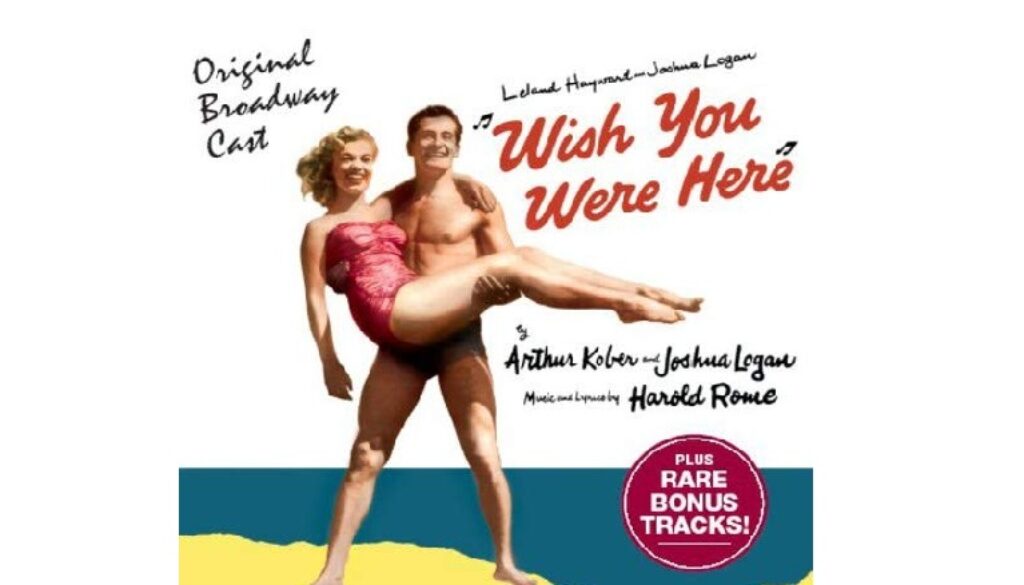
The West End production opens at the London Casino (now the Prince Edward Theatre) on 10 October 1953, running for 282 performances. The London cast recording is later reissued by Sepia Records in 2004 (Sepia 1030). The West End production coincides with the original Broadway recording being available on RCA Victor — including the artwork seen on the cast album cover uploaded for this post.
The Equity Library Theatre in New York City presents an off-off-Broadway revival in May 1987, reviewed by Stephen Holden in The New York Times. One of several small-scale US revivals that have kept the show alive for devotees of the 1950s Broadway repertoire.
The York Theatre Company presents a concert version of the show in January 2000 as part of their celebrated Musicals in Mufti series — which is dedicated to presenting rarely revived works from the Broadway canon in stripped-back form. The production runs 21–23 January.
Stage Door Records reissues the original Broadway cast recording in 2008 — one of four vintage releases that launched the label. The original RCA Victor release (shown on the cast album cover above) had been out of print for many years; the Stage Door reissue returned this score to wider availability. The London cast recording had previously been reissued by Sepia Records in 2004.
Awards &
Recognition
| Year | Award | Category | Nominee | Result |
|---|---|---|---|---|
| 1953 | Tony Award ★ | Best Featured Actress in a Musical | Sheila Bond (Fay Fromkin) | Won ★ |
| 1953 | Tony Award ★ | Best Stage Technician | Abe Kurnit | Won ★ |
| 1952–53 | Pop Charts ★ | Number One Hit Song | “Wish You Were Here” — Eddie Fisher | No. 1 ★ |
| 1952 | Ed Sullivan Show | Toast of the Town Television Feature | Wish You Were Here Cast | Aired — Show Saved ★ |
Harold Rome — Songwriter Hall of Fame
Harold Rome (1908–1993) is a member of the Songwriters Hall of Fame. His Broadway career spanned from the revue Pins and Needles (1937) — the longest-running musical of the 1930s — through Call Me Mister (1946), Wish You Were Here (1952), Fanny (1954), Destry Rides Again (1959), and I Can Get It for You Wholesale (1962). He was also known for Gone with the Wind (1972, London). The title song of Wish You Were Here — in Eddie Fisher’s recording — became the most commercially successful single generated by any Broadway show up to that point.
Legacy —
A Postwar
Summer Dream
Wish You Were Here holds a distinctive place in the Broadway canon: it is the musical that television saved. Its story of early failure, mid-run rescue, and eventual long-run success encapsulates the anxious, collaborative, constantly adaptive world of 1950s Broadway with unusual clarity. The cast album released by RCA Victor — whose distinctive 1953 cover, showing the couple above the sunny yellow and blue horizon, is one of the most evocative images in the history of Broadway original cast recordings — remains the show’s most enduring artefact.
The show also has an outsized significance in the history of careers launched. Florence Henderson’s debut — one line, one show, one spring into a life of fame — is a story that every aspiring actor in the chorus of a Broadway show can hold close. Jack Cassidy‘s leading man charisma was established here. Sheila Bond won a Tony. Phyllis Newman and Tom Tryon were in the company. The 1952 Imperial Theatre cast of Wish You Were Here was, quietly, a nursery of significant talent.
The Cast Recording — RCA Victor & Reissues
The original Broadway cast album was released by RCA Victor — whose signature red label and Victor logo appear at the top of the famous cast album cover (as seen on your poster). The recording features the original Broadway cast: Patricia Marand, Jack Cassidy, Sheila Bond and Sidney Armus. It was reissued by Stage Door Records in 2008, and the London cast recording was reissued by Sepia Records in 2004 (Sepia 1030). The show is licensed for production by Music Theatre International (MTI).