Sweet Charity Musical: The Complete Guide — Bob Fosse’s Broadway Masterpiece
Sweet Charity Musical - Podcast
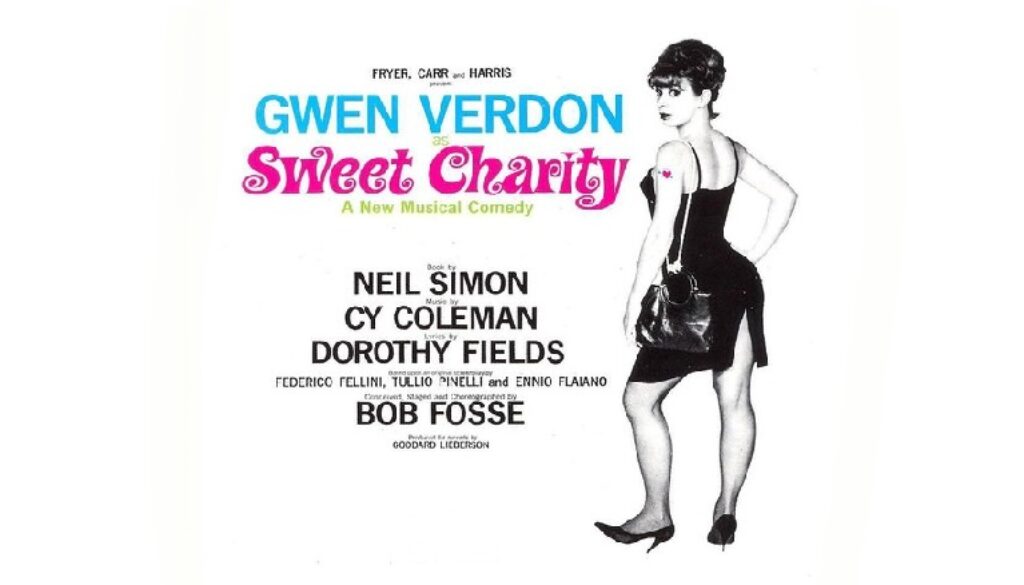
Fryer, Carr and Harris present
Gwen Verdon
Sweet Charity♥
A Timeless Musical Comedy
Music by Cy Coleman • Lyrics by Dorothy Fields
Based on the screenplay by Federico Fellini, Tullio Pinelli and Ennio Flaiano
Directed and Choreographed by Bob Fosse
Produced under the supervision of Goddard Lieberson
The Girl Who
Wanted to Be
Loved
Sweet Charity is a musical with music by Cy Coleman, lyrics by Dorothy Fields, and book by Neil Simon. Conceived, directed, and choreographed by Bob Fosse, it is based on the screenplay for Federico Fellini’s 1957 Italian film Nights of Cabiria — the story of a warm-hearted, hopelessly romantic taxi dancer at a Times Square dance hall who keeps falling for men who abandon her, yet never stops hoping.
The show premiered on Broadway at the Palace Theatre on 29 January 1966, starring Gwen Verdon as Charity Hope Valentine, alongside John McMartin as Oscar Lindquist. It was nominated for nine Tony Awards, winning for Fosse’s choreography. It ran for 608 performances and launched one of the most beloved scores in Broadway history: “Big Spender,” “If My Friends Could See Me Now,” “There’s Gotta Be Something Better Than This,” “Where Am I Going?”
It was adapted into a 1969 film directed by Fosse — his feature-film directorial debut — starring Shirley MacLaine. It has had three major Broadway revivals (1986, 2005, Off-Broadway 2016), West End productions across five decades, and has been performed across the world continuously since 1966.
The Source — Fellini’s Nights of Cabiria (1957)
Sweet Charity is based on the Oscar-winning screenplay for Federico Fellini’s 1957 Italian film Nights of Cabiria, written by Fellini, Tullio Pinelli and Ennio Flaiano. The film follows Cabiria — a Roman street prostitute played by Giulietta Masina — with irrepressible goodness and fatal romantic optimism. Neil Simon transplanted the story to New York City, making Cabiria into Charity Hope Valentine, a taxi dancer at the Fandango Ballroom in Times Square, and shaping Fellini’s picaresque episodes into a musical comedy structure. The show retains Fellini’s bittersweet ending — Charity loses the man she loves — but adds its own layer of defiant American hopefulness in its final neon signs: “And so she lived… hopefully… ever after.”
Bob Fosse — The Show He Made for Gwen
Sweet Charity was created by Bob Fosse as a vehicle for his wife and creative partner Gwen Verdon. Fosse wrote the original libretto under the pen-name “Bert Lewis” (from Robert Lewis Fosse). The show crystallised everything that defined the Fosse style: the derby hats, angular isolations, jazz-inflected sexuality, bent wrists, turned-in toes, the glittering precision of a company moving as one body. His choreography for Sweet Charity — “Big Spender,” “Rich Man’s Frug,” “There’s Gotta Be Something Better Than This,” “Rhythm of Life” — is as defining a body of work as exists in Broadway history. He won the Tony. He then directed the 1969 film, launching a cinema career that produced Cabaret (1972) and All That Jazz (1979).
The People of
The Fandango Ballroom
A taxi dancer at the Fandango Ballroom with a heart tattooed on her shoulder and a seemingly bottomless capacity for romantic hope. Pushed into the lake twice — and twice she climbs out. Also played by Debbie Allen (1986), Christina Applegate (2005), Sutton Foster (Off-Broadway 2016), Tamzin Outhwaite (West End 2009–10), Anne-Marie Duff (Donmar 2019).
A shy, claustrophobic tax accountant whom Charity meets in a broken elevator at the 92nd Street Y. He knows about her job, loves her anyway, proposes — and then cannot go through with the wedding. Played by John McMartin (original and 1969 film), Michael Rupert (1986), Denis O’Hare (2005), Shuler Hensley (2016), Arthur Darvill (2019).
Charity’s closest friend at the Fandango — sharp-tongued, warmly loyal, and the first to see things clearly. Her number “There’s Gotta Be Something Better Than This” is one of Broadway’s great feminist anthems. Played by Helen Gallagher (1966), Bebe Neuwirth (1986).
A famous Italian movie star who takes Charity home after a street encounter. Charmed by her honesty, he gives her the adventure of her life — then bundles her into a closet when his mistress Ursula returns. His apartment scenes are the show’s great comic centrepiece.
The third member of the trio of Fandango dancers. Helene’s presence anchors the communal numbers and deepens the portrait of the Fandango as a real community of women watching out for each other.
The authoritarian owner of the Fandango Ballroom — Charity’s perpetually exasperated boss, who has to bring his dancers back down to earth whenever they begin to dream of something better.
Charity’s boyfriend who steals her handbag and pushes her into the lake in the opening minutes. The name tattooed on her shoulder. He is the show’s inciting wound and the reason that everything which follows is both necessary and heartbreaking.
The enigmatic leader of the Rhythm of Life Church — a thin veneer over hippie culture. His scene provides the show’s most extravagant comedy number, broken up by a police raid. In the 2019 Donmar production, guest actors including Adrian Lester and Beverley Knight shared the role.
The Story —
New York City,
Charity’s New York
Act One — The Lake, The Film Star, and The Elevator
In Central Park, Charity Hope Valentine is with her boyfriend Charlie. He steals her handbag and pushes her into the lake. Rescued by a stranger while passers-by do nothing, she returns to the Fandango Ballroom and convinces herself Charlie tried to save her. The girls hostess the front room: “Big Spender.”
After work, Charity encounters Vittorio Vidal — a famous Italian film star pursuing his furious mistress. He takes Charity into the glamorous Pompeii Club instead. She faints from hunger; he takes her to his apartment; she is starstruck: “If My Friends Could See Me Now.” Ursula returns. Charity is bundled into a closet and watches Vittorio and Ursula make love in the four-poster bed. In the morning she is escorted out. The girls are disappointed she got nothing more out of it.
Seeking improvement, Charity goes to the 92nd Street Y and gets stuck in a broken elevator with Oscar Lindquist — shy, claustrophobic, not married. She helps him through his panic: “I’m the Bravest Individual.” After rescue, Oscar invites her to church. The Rhythm of Life Church is a hippie commune: “The Rhythm of Life.” A police raid ends the evening. On the subway home, Oscar kisses her hand and names her Sweet Charity. Two weeks of dating follow. At the Parachute Jump at Coney Island, she still cannot tell him what she does. On a slow night at the Fandango, she quits — then wonders what the alternative is: “Where Am I Going?”
Act Two — The Proposal, The Farewell Party, and the Lake Again
At Barney’s Chile Hacienda, Charity tells Oscar she is a dance hall hostess. He already knows — he followed her one night and watched. He does not care. He wants to marry her. She is overwhelmed: “I’m a Brass Band.” She packs a suitcase marked “Almost Married” and the girls throw a farewell party: “I Love to Cry at Weddings.”
Walking in the park, Oscar announces he cannot go through with the wedding. He cannot stop thinking about the other men. He pushes Charity into the lake — exactly as Charlie did at the start — and runs off. She emerges. She notices Oscar has not stolen her bag, unlike Charlie. She shrugs. She reprises her opening dance. Three neon signs read: “And so she lived… hopefully… ever after.”
The Score —
Coleman, Fields
& Pure Broadway
The score of Sweet Charity by Cy Coleman and Dorothy Fields is one of the most purely enjoyable in Broadway history. Coleman brings a jazz musician’s rhythmic sophistication — syncopation, unexpected harmonic turns, the feeling of a live big band — while Fields delivers lyrics that balance wry New York wit with genuine emotional directness. Three of the numbers have become American standards. “Big Spender” — with its insinuating half-time groove and the dancers draped on the front rail — is one of the most recognised opening numbers ever written. “If My Friends Could See Me Now” is pure infectious joy. “Where Am I Going?” is heartbreak dressed in a jazz outfit.
Production
History
The Broadway production opens at the Palace Theatre on 29 January 1966, after tryouts in Philadelphia and Detroit. Conceived, directed, and choreographed by Bob Fosse. Costumes by Irene Sharaff. Cast: Gwen Verdon (Charity), John McMartin (Oscar), Helen Gallagher (Nickie), Thelma Oliver (Helene), James Luisi (Vittorio), Arnold Soboloff (Herman), Ruth Buzzi, Barbara Sharma. Nominated for 9 Tony Awards, winning Best Choreography. Closes 15 July 1967 after 608 performances. Cast album enters the Billboard 200 on 12 March 1966.
The West End production opens at the Prince of Wales Theatre in October 1967, running 476 performances. Juliet Prowse stars as Charity, succeeded by Gretchen Wyler. The Australian production (produced by J.C. Williamson) opens 21 January 1967 at Her Majesty’s Theatre, Sydney, starring Nancye Hayes as Charity, with seasons in Melbourne and Adelaide.
Shirley MacLaine stars as Charity; John McMartin reprises his Broadway role as Oscar. Directed and choreographed by Bob Fosse in his feature-film directorial debut. The film is a visual tour de force — Fosse’s cinematic vocabulary, which would reach its apex in Cabaret (1972), is fully formed here.
Again directed and choreographed by Bob Fosse. Stars: Debbie Allen (Charity), Bebe Neuwirth (Nickie), Michael Rupert (Oscar). Gwen Verdon — the original Charity — remounts the choreography with Fosse and teaches the ensemble numbers. Wins four Tony Awards including Best Reproduction. When Allen leaves, Ann Reinking takes over. On 15 June 1998, Broadway Cares/Equity Fights AIDS presents an all-star Lincoln Center concert with Chita Rivera, Bebe Neuwirth, Donna McKechnie, Debbie Allen and, in her last public stage appearance, Gwen Verdon, all sharing the role of Charity.
Stars Christina Applegate as Charity, after a troubled tour during which she broke her foot in Chicago and was replaced by understudy Charlotte d’Amboise. Applegate personally persuaded the producers to continue to Broadway. Cast also includes Denis O’Hare (Oscar), Ernie Sabella (Herman). Nominated for three Tonys. National tour September 2006–August 2007 starring Molly Ringwald, later Paige Davis.
Opens at the Menier Chocolate Factory starring Tamzin Outhwaite. Transfers to the Theatre Royal, Haymarket on 4 May 2010. First production to have one actor — Mark Umbers — play all three of Charity’s love interests: Charlie, Vittorio, and Oscar. Three 2011 Olivier Award nominations: Best Revival, Best Choreography (Stephen Mear), Best Supporting Actress (Josefina Gabrielle). Closes 6 November 2010.
Directed by Leigh Silverman, choreography by Joshua Bergasse. Stars Sutton Foster as Charity, Shuler Hensley as Oscar, Asmeret Ghebremichael (Nickie), Emily Padgett (Helene), Joel Perez.
Directed by Josie Rourke — her final production as Donmar artistic director. Anne-Marie Duff as Charity; Arthur Darvill as Oscar; guest actors including Adrian Lester and Beverley Knight as Daddy Brubeck. Limited run: 6 April–8 June 2019.
First production of the new Hayes Theatre, Potts Point. Directed by Dean Bryant; choreographed by Andrew Hallsworth. Stars Verity Hunt-Ballard (Charity), Martin Crewes (all three male roles). Wins Helpmann Awards for Best Female Actor, Best Direction, Best Choreography. Transfers to the Sydney Opera House Playhouse January–February 2015.
Awards &
Recognition
| Year | Award | Category | Nominee | Result |
|---|---|---|---|---|
| 1966 | Tony Award ♥ | Best Choreography | Bob Fosse | Won ♥ |
| 1966 | Tony Award | Best Musical | Sweet Charity | Nominated |
| 1966 | Tony Award | Best Actress in a Musical | Gwen Verdon (Charity) | Nominated |
| 1966 | Tony Award | Best Score | Cy Coleman & Dorothy Fields | Nominated |
| 1966 | Tony Award | Best Book of a Musical | Neil Simon | Nominated |
| 1966 | Tony Award | Best Direction of a Musical | Bob Fosse | Nominated |
| 1966 | Tony Award | Best Featured Actor in a Musical | John McMartin (Oscar) | Nominated |
| 1966 | Tony Award | Best Featured Actress in a Musical | Helen Gallagher (Nickie) | Nominated |
| 1966 | Tony Award | Best Scenic Design of a Musical | Robert Randolph | Nominated |
| 1966 | Billboard 200 ♥ | Album Chart Entry | Original Broadway Cast Recording | Charted ♥ |
| 1986 | Tony Award ♥ | Best Reproduction (Play or Musical) | Sweet Charity Revival | Won ♥ |
| 1986 | Tony Award ♥ | Best Actress in a Musical | Debbie Allen (Charity) | Won ♥ |
| 1986 | Tony Award ♥ | Best Featured Actress in a Musical | Bebe Neuwirth (Nickie) | Won ♥ |
| 1986 | Tony Award ♥ | Best Choreography (Revival) | Bob Fosse | Won ♥ |
| 2005 | Tony Award | Best Revival of a Musical | Sweet Charity 2005 | Nominated |
| 2005 | Tony Award | Best Actress in a Musical | Christina Applegate (Charity) | Nominated |
| 2005 | Tony Award | Best Featured Actor in a Musical | Denis O’Hare (Oscar) | Nominated |
| 2011 | Olivier Award | Best Revival of a Musical | Theatre Royal Haymarket Production | Nominated |
| 2011 | Olivier Award | Best Theatre Choreography | Stephen Mear | Nominated |
| 2011 | Olivier Award | Best Supporting Actress in a Musical | Josefina Gabrielle | Nominated |
| 2014 | Helpmann Award ♥ | Best Female Actor in a Musical | Verity Hunt-Ballard (Charity) | Won ♥ |
| 2014 | Helpmann Award ♥ | Best Direction of a Musical | Dean Bryant | Won ♥ |
| 2014 | Helpmann Award ♥ | Best Choreography in a Musical | Andrew Hallsworth | Won ♥ |
The Recordings
The score of Sweet Charity has been recorded in multiple versions spanning six decades. The original Columbia Records Broadway cast album — whose cover, shown in your uploaded poster image, features Gwen Verdon against the clean white and fuchsia pink graphic design — entered the Billboard 200 on 12 March 1966.
Columbia Records. Starring Gwen Verdon. The defining recording — jazz-inflected, vivid, and with Verdon’s incomparable voice. Entered the Billboard 200. The cover shown on your uploaded poster.
Starring Shirley MacLaine. Fosse’s film adaptation soundtrack, with MacLaine’s vocals on the classic numbers, adapted for cinema.
Starring Debbie Allen and Bebe Neuwirth. The Tony Award-winning revival cast recording, capturing the electrifying energy of Allen’s Charity.
Conducted by Martin Yates. The first complete recording of the full score with bonus tracks from the film. The definitive archive document.
Starring Christina Applegate and Denis O’Hare. The most recent Broadway revival cast recording, with fresh contemporary production values.