Bent (Play) by Martin Sherman | Full Plot, Cast, & Stage History
Bent - Play Podcast
Bent
A Masterpiece by Martin Sherman
Love. Survival. Dignity.
View Production Memorabilia
The Genesis of a Revolution
When Martin Sherman wrote Bent in 1978, the world was largely unaware of the extent of the Nazi persecution of homosexuals. Sherman, an American playwright living in London, was inspired by the “Night of the Long Knives”—the 1934 purge where Hitler eliminated the gay SA leader Ernst Röhm and used his sexuality as a pretext to begin the systematic round-up of gay men across Germany.
Originally written for a small “fringe” theatre, the play’s raw emotional power propelled it to the West End and Broadway, forever reclaiming the **Pink Triangle** from a symbol of shame to one of defiant pride.
The Narrative: From Decadence to Dachau
Act I: The Flight
Berlin, 1934. Max is a hedonistic grifter living with his boyfriend, Rudy. After a night of cocaine and debauchery, they wake up to find their one-night stand—an SA trooper—brutally murdered in their apartment by the SS. The purge has begun. Forced to flee, Max and Rudy seek help from Max’s discreet Uncle Freddie, who offers Max a chance to escape alone. Max refuses to leave Rudy behind.
Act II: The Survival
Captured and placed on a train to Dachau, Max is forced to witness Rudy’s brutal murder. In a desperate bid for survival, Max manages to secure a Yellow Star (identifying him as Jewish) rather than a Pink Triangle, believing the “lowest of the low” in the camp hierarchy are the homosexuals.
In the camp, Max meets Horst, a prisoner who wears his Pink Triangle with dignity. Assigned to the soul-crushing task of moving heavy rocks back and forth for no reason, the two men fall in love. In the play’s most famous scene, they achieve physical intimacy through words alone, standing perfectly still while the guards watch. The play concludes with a searing act of self-acceptance as Max finally chooses his identity over mere survival.
West End Premiere (1979)
Debuting at the **Royal Court Theatre** before moving to the **Criterion**, this production starred **Ian McKellen** as Max and **Tom Bell** as Horst. McKellen’s performance was hailed as a career-defining moment, helping to launch his advocacy for LGBTQ rights.
Broadway Debut (1979)
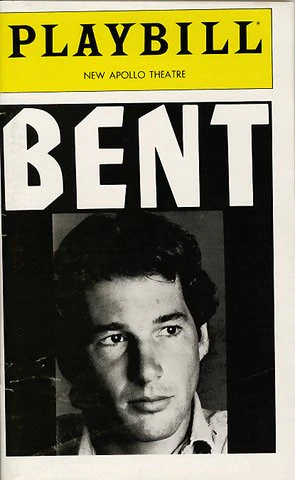
Opening at the **New Apollo Theatre**, the Broadway production featured **Richard Gere** in the lead role of Max, with **David Dukes** as Horst. The production was nominated for the **Tony Award for Best Play** and established the work as a global phenomenon.
The Faces of Resistance: Original Casts
| Character | London (1979) | Broadway (1979) |
|---|---|---|
| Max | Ian McKellen | Richard Gere |
| Horst | Tom Bell | David Dukes |
| Rudy | Jeff Rawle | David Marshall Grant |
| Greta | Ken Shorter | Michael Gross |
| Uncle Freddie | Hayne Ryan | George Hall |
Cinematic Legacy (1997)
In 1997, Bent was adapted into a major motion picture directed by **Sean Mathias**. The film starred **Clive Owen** as Max and **Lothaire Bluteau** as Horst, with an unforgettable cameo by **Mick Jagger** as Greta. **Ian McKellen** returned to the story, this time playing Uncle Freddie. The film won the “Award of the Youth” at the Cannes Film Festival and introduced the story to a new generation.
‘Bent’ to Dramatize Little‐Told Nazi Horror – New York Times 1979 Review
FOUR or five years ago, Martin Sherman was saying, he had even stopped fantasizing about getting one of his plays produced on Broadway. He had been at it full‐time for 12 years, his works had been produced in workshops, at university theaters, Off Off Broadway and even once, disastrously, Off Broadway, but the bigtime seemed farther away than ever. HERE for More