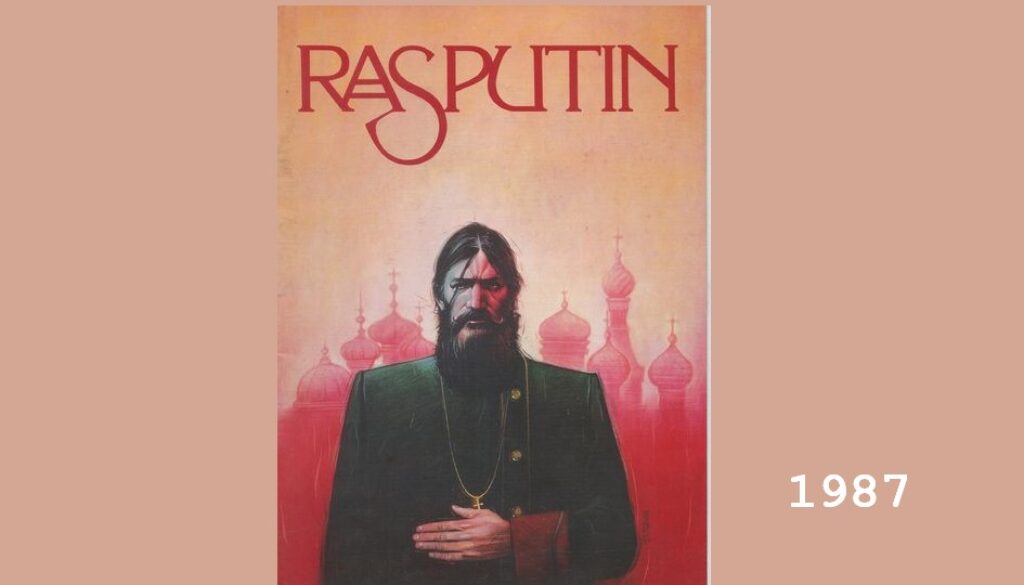
Rasputin The Musical Revolution: Australia’s 1987 Rock Musical | Jon English, Angry Anderson
Australia’s $3 Million Musical Revolution • State Theatre, Sydney • 1987
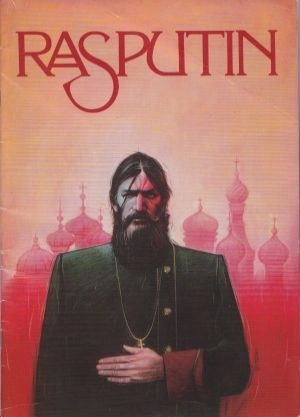
Rasputin
The Musical Revolution
Jon English • Angry Anderson • Danielle Spencer • Terry Serio
Musical Director Mike Wade • Choreography by Pamela French
Directed & Designed by Stephen Hopkins
Opened 22 August 1987 • State Theatre, Sydney
The Mad Monk
Comes to Broadway
— Down Under
Rasputin: The Musical Revolution is a 1987 Australian rock musical exploring the life and death of Grigori Efimovitch Rasputin — the enigmatic Russian peasant monk whose strange mystical healing powers and scandalous relationship with the Imperial Romanov family helped bring about the end of the Tsarist era. The show is framed around the connection between Rasputin and the haemophiliac Tsarevitch Alexei, while drawing in the sweep of Russian Imperial history: the Tsar and Tsarina, the royal daughters, the cunning Prince Felix Yussopov, and the revolutionary forces of Lenin and Stalin gathering in the streets.
The musical opened at the State Theatre in Sydney on 22 August 1987, produced as Australia’s most ambitious attempt at a home-grown mega-musical. With a budget reported at $3 million Australian dollars and backed by South African computer entrepreneur Patrick Shaw, it aimed to compete with the imported West End blockbusters then dominating Australian theatre. The show starred rock and television icon Jon English in the title role, with hard rock legend Angry Anderson (Rose Tattoo) as Lenin, and featured a large ensemble cast including Danielle Spencer as Princess Anastasia and Terry Serio as Prince Felix Yussopov.
Music and concept were by David Tydd, with lyrics and dialogue by David Lucas and musical direction by Mike Wade. Crucially, the show was directed and designed by Stephen Hopkins — a Jamaican-born British director then making his name in Australian music videos and commercials, who would go on to direct A Nightmare on Elm Street 5, Predator 2, Lost in Space, and several episodes of the first season of 24. For Hopkins, Rasputin was described as “a $3 million rock musical” that he directed “almost like a video clip.”
Background &
Creation
The Subject — Rasputin and the Romanovs
Rasputin: The Musical Revolution is described on its own programme as “a musical exploration of the people, places and events surrounding the Royal Romanov Family and their relationship with the infamous Russian peasant Grigori Efimovitch Rasputin.” At the show’s centre is Rasputin’s relationship with Tsarevitch Alexei — the heir to the throne who suffered from haemophilia and saw Rasputin as a mysterious healer. To others at court, Rasputin was an unscrupulous opportunist exploiting his access to the Imperial family. Rasputin’s philosophy — that to achieve salvation one must first sin excessively — and his enigmatic mixture of sensuality and spirituality made him one of the most extraordinary figures in modern European history. His assassination in December 1916 by Prince Felix Yussopov and co-conspirators became as legendary as his life.
The Backstage Drama — A Production Fraught with Trauma
The genesis of Rasputin was, as the Sydney Morning Herald reported in August 1987, “fraught with trauma and controversy, probably because of the theatrical inexperience of many key personnel, including the producers and director.” The show’s original producers were David Tydd (who also conceived it and composed the music) and Patrick Shaw — a South African computer entrepreneur. Their status was subsequently reduced to a program credit when financier Harry Vogelsanger effectively took over as executive producer. Tydd was reportedly banned from rehearsals, though he said he “hadn’t been in the mood” to attend after the cast staged a three-day boycott of rehearsals — a mutiny whose cause was never fully explained publicly.
Among the other casualties: the original publicists, the original advertising agency, the original graphic designers who created the poster artwork, and the original sound engineers. Sound engineer Ron Barlow — a theatrical specialist — quit when, after Tydd’s diminishment, the show moved from being “a musical to a rock concert.” He was replaced by Jands Concert Productions. In its chaotic assembly — with credits for “additional” music and lyrics from multiple hands — the show mirrored the political chaos of its subject matter.
Stephen Hopkins — The Director Who Went to Hollywood
Director and designer Stephen Hopkins was a Jamaican-born British creative who had come to Australia to direct music videos for artists including Elton John (notably “Sad Songs”), as well as commercials for clients including Pizza Hut and David Jones. He had worked as a storyboard artist and art director with director Russell Mulcahy on Highlander (1986). In Australia he also made the thriller Dangerous Game (1987). His direction of Rasputin was described by Variety as being “almost like a video clip — and when it works it’s outstanding theatre; when it fails it’s abysmal.” Rasputin was Hopkins’s springboard: it demonstrated his large-scale visual capabilities and led directly to his Hollywood career, beginning with A Nightmare on Elm Street 5: The Dream Child (1989).
The Kurzweil Music System — State-of-the-Art Sound
One of the show’s notable technical achievements was its use of the Kurzweil Music System — then at the cutting edge of computerised musical arrangement — managed by musical director Mike Wade. The system allowed Wade to produce computerised orchestral arrangements that gave the show’s rock score a sophisticated musical backing. Variety noted: “Music is clear due to Mike Wade’s computerised arrangements via the Kurzweil Music System. Lighting is state-of-the-art brilliance, sets are striking, and costumes appropriately classy.” Technically, the show was considered impressive despite first-night microphone failures.
The Story —
Rise, Power
& Revolution
The musical is set across the final years of Imperial Russia, from Rasputin’s rise to power through the chaos of World War One, Revolution and the fall of the Romanov dynasty. The narrative follows Rasputin’s journey from peasant monk to the inner sanctum of the Russian Imperial court, tracing his complex relationships with the Tsar, the Tsarina, their children, and his eventual destruction at the hands of Prince Felix Yussopov.
Rasputin — The Mad Monk
Grigori Rasputin is portrayed as a man of genuine enigma: a peasant monk whose philosophy holds that salvation can only be achieved through the experience of sin, and whose reputed healing powers over the haemophiliac Tsarevitch Alexei give him extraordinary access to the Imperial family. The show explores whether Rasputin is a genuine holy man, a cynical manipulator, or something more complex — a figure who genuinely believes in his own powers but exploits the access they give him. As Variety noted, “the weakest link of all is the character of Rasputin, with no sense of his motivation or the source of his power or attraction” — a criticism of the writing rather than the concept.
The Romanovs and the Revolution
Tsar Nicholas II and Tsarina Alexandra are portrayed as “weak and powerless, hypnotised and manipulated by the monk.” Prince Felix Yussopov — described as Rasputin’s antagonist and the wealthiest man in the world, controller of the secret police — schemes to bring about Rasputin’s downfall. Against this backdrop of court intrigue, the revolutionary forces of Lenin and Stalin are gathering momentum in the streets, “mesmerising the masses.” The show dramatises the final dissolution of the Romanov world, culminating in Rasputin’s assassination. Throughout, as Variety reported, the exposition presents “events if not accurately, then at least graphically, with the magic of the period well encapsulated.”
The Spectacular Set Pieces
Variety‘s review highlighted several outstanding theatrical moments: a spectacular juxtaposition of “discontented masses singing ‘Romanoff Ice Cream’ while the Imperial Romanov family plays indulgently” and “a breathtaking World War I battle scene” — both receiving “world-class treatment” from choreographer Pamela French. The Tsarina’s nightmare sequence, complete with a video screen backdrop depicting dripping blood, was singled out as visually striking. These were counterbalanced by “awful interludes of dialogue, nonsensical characters like the three ‘holy men,’ and scenes which are interesting in isolation but add nothing to the show’s movement.”
The Original Cast —
State Theatre, Sydney
22 August 1987
Rock and television icon Jon English brought his commanding stage presence to the title role. Variety noted English’s lackluster portrayal was likely “a casualty of poor writing” — though he was “the only performer at ease with the dialogue,” looked the part with his immense stature and haunting eyes, and showed his customary humour. English’s singing was described as “uninspired” — a disappointment given his known capabilities.
Angry Anderson — lead vocalist of Rose Tattoo and one of Australia’s most recognisable rock personalities — played Lenin with what Variety called a “terrific” performance. Despite “an untrained rock and roll voice which sometimes misses the mark, he evokes much sympathy. There’s not enough of him.” Anderson was also that year charting with his solo hit “Suddenly.”
Karyn O’Neill’s portrayal of the Tsarina was described as “delightful, her voice crystal clear” — one of the production’s strongest performances. Her character represents the Imperial family’s naïve and fatal dependence on Rasputin.
Terry Serio played Rasputin’s great antagonist — the wealthiest man in Russia and controller of the secret police. Variety noted his delivery of dialogue was wooden and he “has to deal with some of the tackiest scenes in the show — swashbuckling at nobles and indulging in Romanesque orgies.”
Robbie Krupski was considered “too young for the Tsar, but compensates with exciting singing” — a castability issue rather than a performance failure. The Tsar is portrayed as weak and manipulated by those around him.
Danielle Spencer — later to become better known as an actress and the former wife of Russell Crowe — played Princess Anastasia at the very start of her career. This was one of her earliest professional stage roles.
Darell Hopson played Stalin — representing the broader revolutionary forces gathering to sweep away the Romanov dynasty. The inclusion of Stalin alongside Lenin reflects the show’s interest in the full sweep of Russian political history.
The haemophiliac heir to the Russian throne whose condition gives Rasputin his crucial foothold in the Imperial household. Alexei’s need for Rasputin’s apparent healing powers is the pivot on which the entire story turns.
Full Original Cast — State Theatre, Sydney 1987
| Role | Actor |
|---|---|
| Grigori Rasputin | Jon English |
| Tsar Nicholas II | Robbie Krupski |
| Tsarina Alexandra | Karyn O’Neill |
| Prince Felix Yussopov | Terry Serio |
| Tsarevitch Alexei | Nigel Travers |
| Princess Tatiana | Simone Hardy |
| Princess Anastasia | Danielle Spencer |
| Lenin | Angry Anderson |
| Stalin | Darell Hopson |
| Russian Holy Man / Civil Servant | Andrew Doyle |
| Russian Holy Man / Doctor | Warren Jones |
| Russian Holy Man / Spy | Seon Blake |
| Spies | Jo-Anne Cahill, Jonothon Rosten, Anthony Wong |
| General | Darren Holt |
| Cabinet Minister | Dein Perry |
| Nurse | Raquel Suarstzman |
| Butler | Glenn Dumbrell |
| Ensemble | Drew Anthony, Helen Anton, Aaron James Cash, Stephen Clarke, Michelle Curtis, Ramon Doringo, Meaghan Frances, Joanna Hicks, Vesna Hindley-Noble, Yvonne Hopson, Renee Isaacs, Caroline Kaspar, Manny Katts, Elizabeth Mavric, Kathryn Morrison, Delia Robins, Lisa Schembri, Tiaho Selwyn, Caryn Shipp, Lisa Wright |
Creative Team
Music & Concept: David Tydd • Lyrics & Dialogue: David Lucas • Director & Designer: Stephen Hopkins • Musical Director: Mike Wade • Choreographer: Pamela French • Lighting: Peta Rooney • Costumes: Maria Fowler • Sound: Jands Concert Productions • Production Director: Keith Percival • Production Supervisor: Don Spencer • Executive Producer: Harry Vogelsanger • Original Producers: David Tydd & Patrick Shaw (South African computer entrepreneur)
The Songs —
A Rock Score of
Revolution
The score of Rasputin drew on rock, pop and theatrical styles to reflect the sweep of Russian Imperial history from court opulence to revolutionary upheaval. Variety noted: “The music is neither awful nor brilliant, while the lyrics are quite banal.” The show’s strongest musical moments were described as its large-scale chorus numbers. The score featured 22 numbers across two acts.
★ = noted as outstanding theatrical highlight by Variety
Reception &
Critical Reviews
Critical reaction to Rasputin was genuinely divided — split between those who saw a courageous and visually spectacular Australian achievement and those who felt the writing could not match the ambition of the production. Most reviews acknowledged the technical brilliance and some extraordinary theatrical moments, while pointing to weaknesses in the score, libretto and the central portrayal.
The Variety Review — In Detail
Variety‘s extensive review — published 2 September 1987 — provides the most detailed surviving assessment of the production. The reviewer acknowledged the show’s premiere audience was won over despite pre-opening scepticism: “It is a credit to all involved in ‘Rasputin’ that audience reaction was favourable.” The material was praised as “certainly the stuff the best musicals are made of” — particularly the potential of its characters. However, the writing was identified as the weakest element: “the exposition is too long… the weakest link of all is the character of Rasputin, with no sense of his motivation or the source of his power or attraction.”
Performance highlights cited: Karyn O’Neill’s Tsarina (voice “crystal clear”), Angry Anderson’s Lenin (“terrific… evokes much sympathy… there’s not enough of him”), and the spectacular chorus numbers by choreographer Pamela French. The show’s technical elements — Mike Wade’s computerised arrangements, lighting design by Peta Rooney, striking sets and costumes — were consistently praised. The review concluded: “Predicting the future of this $A3,000,000 extravaganza is difficult. Initial interest should be strong, but its ability to stand the competition of the likes of ‘Les Miserables’ will depend primarily on extensive cutting and fine tuning, and Sydney’s willingness to give it a chance.”
Legacy — Australia’s Ambitious Home-Grown Musical
Rasputin: The Musical Revolution stands as one of the most ambitious original Australian musicals ever mounted. In an era when Sydney’s stages were dominated by imported West End productions — Les Misérables, Cats, Starlight Express — the show’s creators genuinely attempted to compete on scale, ambition and theatrical spectacle with something entirely Australian-made. Its $3 million budget, state-of-the-art technology, rock star cast and internationally connected director placed it in genuine contention. That its writing ultimately did not match its production values is the show’s central tragedy — a reminder that no amount of spectacular staging can compensate for weak material at the dramatic core. The show has since become a collector’s item, with programme programmes and cast recordings sought by devotees of Australian theatrical history and fans of Jon English and Angry Anderson.