Equus: Peter Shaffer’s Masterpiece Returns — The Complete Guide to the Acclaimed Revival
Equus
Peter Shaffer’s mesmerising psychological thriller — from its scandalous 1973 debut to Ned Bennett’s dazzling, five-star West End reimagining and beyond.
At a Glance
| Written by | Peter Shaffer (1926–2016) |
| World Premiere | 26 July 1973 — National Theatre, London (Old Vic) |
| Broadway Premiere | 24 October 1974 — Plymouth Theatre, New York |
| Broadway Run | 1,809 performances (Plymouth & Helen Hayes Theatres) |
| Tony Awards | Best Play 1975 (plus Drama Desk Award for Outstanding Play) |
| 2019 Revival Director | Ned Bennett |
| 2019 Revival Producers | English Touring Theatre & Theatre Royal Stratford East |
| West End Transfer | 6 July – 7 September 2019, Trafalgar Studios |
| International Producer | GWB Entertainment (alongside Trafalgar Theatre Productions, Hill Street Productions) |
| Running Time | Approximately 2 hours 40 minutes (including interval) |
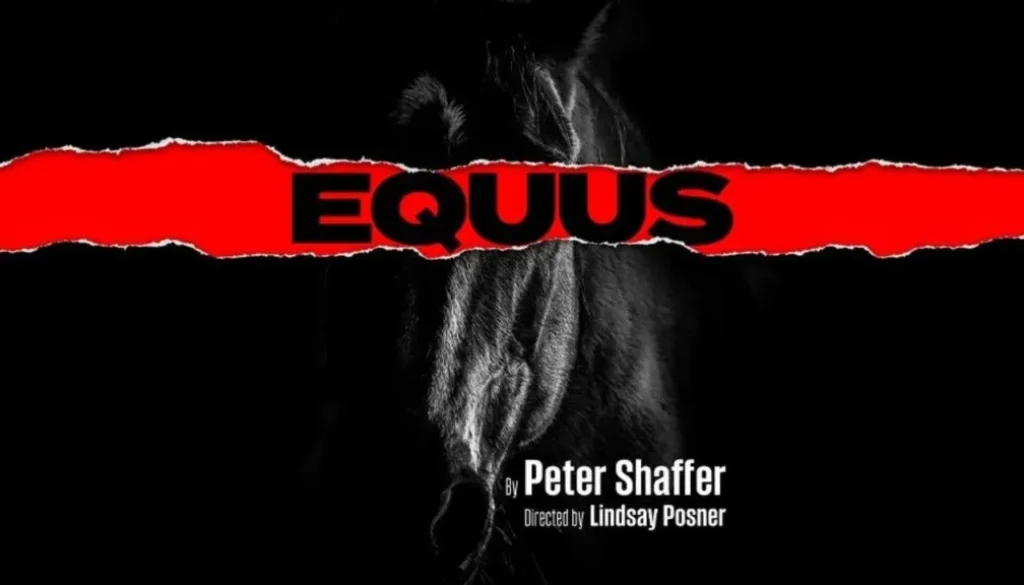
| 2026 Revival | Menier Chocolate Factory, London — 8 May to 4 July 2026. Dir: Lindsay Posner. Starring: Toby Stephens |
| Content Advisory | Themes of violence, mental health, sexual violence, nudity, strong language, strobe lighting, haze |
Introduction
Few plays in the modern theatrical canon provoke as immediate and as unsettling a response as Peter Shaffer’s Equus. Written in 1973 and instantly celebrated as a landmark of contemporary drama, the play presents an apparently simple premise — a psychiatrist must determine why a disturbed teenager blinded six horses — and uses it to excavate the deepest and most uncomfortable questions of human existence: What is the relationship between passion and sanity? Between worship and sexuality? Between the desire to heal and the impulse to destroy what makes us uniquely ourselves?
When teenager Alan Strang’s pathological fascination leads him to blind six horses in a Hampshire stable, psychiatrist Dr. Martin Dysart is tasked with uncovering the motive behind the boy’s actions. As Dysart delves into Alan’s world of twisted spirituality, passion and sexuality, he begins to question his own sanity and motivations in a world driven by consumerism. The result is one of the most intellectually daring, emotionally devastating and theatrically inventive works of the past century.
The play has been revived many times, most famously with Daniel Radcliffe in 2007, but the production that has drawn the most unanimous critical acclaim in recent years is Ned Bennett’s bold reimagining — originally produced by English Touring Theatre and Theatre Royal Stratford East in 2019. Described as “mesmerising” by the Evening Standard and awarded five stars by The Telegraph, The Observer, WhatsOnStage and BroadwayWorld, Bennett’s production stripped the play back to its raw philosophical core while infusing it with an athletic, visceral physicality that made Shaffer’s text feel entirely new. GWB Entertainment presented the production internationally, and the play’s global reputation has only continued to grow.
Background — Peter Shaffer & the True Story
Playwright Peter Shaffer (1926–2016) was one of the most celebrated and decorated dramatists of the twentieth century. His plays include Five Finger Exercise (Evening Standard Drama Award), The Royal Hunt of the Sun, Amadeus (Evening Standard Drama Award and Tony Award for Best Play) and Equus. He was awarded the CBE in 1987, knighted in 2001, and adapted both Equus and Amadeus as Academy Award-winning screenplays.
Shaffer was inspired to write Equus when he heard of a crime involving a 17-year-old boy who blinded 26 horses in a small town in northern England. He set out to construct a fictional account of what might have caused the incident — deliberately without knowing any of the details of the crime — and to evoke the same “air of mystery” and “numinous” qualities as his 1964 play The Royal Hunt of the Sun, but in a more modern setting. He changed the number of injured horses to six, and enlisted a distinguished child psychiatrist to ensure the clinical dimensions of the play were psychologically credible.
What Shaffer constructed was not a documentary or a police procedural but a philosophical meditation. The play’s central concern is not really Alan Strang at all, but the crisis of his doctor — a middle-aged psychiatrist confronting the emptiness of his own life, the sterility of his marriage, and the disturbing possibility that the boy’s passionate, if destructive, relationship with something he worships might represent a form of life more intense than anything Dysart himself has ever experienced.
For almost 30 years after the original run, Shaffer resisted all requests for a West End revival, insisting on veto power over any new production’s casting of Alan Strang — a sign of how personally invested he remained in the work.
Plot
Equus is structured as a series of sessions between psychiatrist Dr. Martin Dysart and his new patient, 17-year-old Alan Strang. Alan has been referred by magistrate Hesther Saloman after being arrested for blinding six horses in a stable in Hampshire where he worked as a stableboy. The play unfolds as Dysart gradually extracts the truth of Alan’s inner world through a series of revelatory interviews, reconstructed scenes, and hypnotic flashbacks.
As the sessions progress, Dysart uncovers how Alan’s passions and psychological disturbances have been shaped by competing and irreconcilable influences. His mother Dora is deeply religious, filling his childhood with biblical imagery. His father Frank is a secular atheist, rigid and repressive about sexuality. Without an outlet for his developing spiritual and erotic impulses, Alan transfers them onto horses — the animals he encounters first through a chance childhood meeting and then through his stable work.
Alan constructs an entire private mythology around horses and, in particular, around a specific horse he calls Equus — his god. His relationship with the horses becomes simultaneously religious and erotic, reaching an ecstatic, mystical intensity. When stable-girl Jill Mason attempts to seduce him in the stables, Alan is unable to perform — watched, he believes, by the eyes of Equus and the other horses. In a moment of shattered passion and unbearable shame, he seizes a metal spike and blinds all six horses.
The play’s most devastating dimension is Dysart’s own psychological crisis. As he unravels Alan’s world, Dysart becomes increasingly uncertain whether “curing” the boy — making him “normal” — is actually an act of healing or an act of destruction. Alan, for all his violence and disturbance, has experienced something Dysart recognises as genuine worship, genuine passion, genuine intensity. Dysart, by contrast, leads a life he regards as hollow. In the play’s final monologue, Dysart delivers a shattering reflection on what it means to strip someone of their pain when their pain is also the source of everything that makes them feel alive.
Original Production History (1973–1977)
Equus premiered at the Royal National Theatre in London on 26 July 1973, under the direction of John Dexter. The original production featured Alec McCowen as the psychiatrist Martin Dysart and a young Peter Firth as the disturbed teenager Alan Strang. It was an immediate sensation — audiences and critics alike recognised that something new and genuinely disturbing had arrived on the British stage, and the production ran at the National Theatre from 1973 to 1975.
The play opened on Broadway at the Plymouth Theatre on 24 October 1974, with Anthony Hopkins making his Broadway debut as Dysart — a performance of such power that the production was one of the defining theatrical events of the decade. Peter Firth reprised his role as Alan Strang. The Broadway run was historic: it ran for 1,209 performances at the Plymouth before transferring to the Helen Hayes Theatre on 5 October 1976, where it continued until 2 October 1977 — a total of 1,809 consecutive performances.
The Broadway production featured an extraordinary roster of replacements for the role of Dysart: Richard Burton, Leonard Nimoy, and Anthony Perkins all took on the role during the run. Most remarkably, actress Marian Seldes appeared in every single performance, playing both Hesther Saloman and Dora Strang. The play won the Tony Award for Best Play in 1975, along with the Drama Desk Award for Outstanding Play, three Outer Critics Circle Awards, three Drama Desk Awards, and the Theatre World Award.
The 1977 Film Adaptation
In 1977, director Sidney Lumet adapted Equus for the screen, with Shaffer himself writing the screenplay. Richard Burton and Peter Firth reprised their stage roles — Burton as Dysart, Firth as Alan Strang — and both earned Academy Award nominations: Best Actor for Burton and Best Supporting Actor for Firth. The film also received an Academy Award nomination for Shaffer’s screenplay.
The film was, however, a mixed critical experience. Critics argued that the use of real horses — rather than the abstract theatrical representation employed on stage — undermined the play’s mythic power. The decision to show the actual blinding was considered by many to be counterproductive, with the theatrical suggestion far more powerful than the cinematic reality. Even Shaffer admitted to being horrified by certain directorial choices. Professor James M. Welsh noted that showing the actual blinding was “potentially repulsive” and that “much of the spirit of the play” was lost in translation from stage to screen.
The film nevertheless remains valuable as a record of Burton’s searing performance as Dysart — one of the finest of his late career — and Firth’s extraordinary physical and emotional commitment to Alan Strang.
The 2007–2009 Daniel Radcliffe Revival
For almost 30 years, Shaffer resisted a major West End revival. When producers David Pugh and Dafydd Rogers finally secured the rights after nearly a decade of negotiations, the resulting production generated more press coverage than almost any theatrical event in years — primarily because of its lead casting. West End producers revived Equus in 2007, starring Richard Griffiths as Dysart and Daniel Radcliffe as Alan Strang. The production was directed by Thea Sharrock and opened in February 2007 at the Gielgud Theatre.
The casting generated unprecedented media attention. Radcliffe, then 17 years old and globally famous as Harry Potter, was making a dramatic transition to adult roles. The role of Alan Strang required him to appear fully nude on stage. The resulting frenzy of tabloid speculation overshadowed the production itself to some degree, though Radcliffe publicly insisted that the nude scene was not “gratuitous” but essential to Shaffer’s meaning. He had been required to pass a private read-through with Shaffer himself before being given the role.
This revival was subsequently transferred to Broadway, running at the Broadhurst Theatre through 8 February 2009. Radcliffe and Griffiths reprised their roles, and Thea Sharrock returned as director. Radcliffe was nominated for the Drama Desk Award for Outstanding Actor in a Play — a genuine recognition of his courageous and committed stage debut. Kate Mulgrew, Anna Camp, Carolyn McCormick, Lorenzo Pisoni and T. Ryder Smith rounded out the cast.
The Ned Bennett Revival — English Touring Theatre (2019)
The production most closely associated with GWB Entertainment’s international presentation of Equus is Ned Bennett’s bold reimagining, which premiered at Theatre Royal Stratford East in February 2019 before embarking on a UK-wide tour and transferring to the West End’s Trafalgar Studios on 6 July 2019 for a strictly limited nine-week run, closing on 7 September 2019. It was produced by English Touring Theatre and Theatre Royal Stratford East and produced in the West End by Trafalgar Theatre Productions, alongside Mallory Factor for Hill Street Productions, Emmanuel Ciolfi, Francis Hellyer and GWB Entertainment.
Bennett’s approach was radically different from the papier-mâché horse masks associated with previous productions. Director du jour Ned Bennett binned the horse masks, delved into the homoerotic subtext and hit audiences with a claustrophobic white curtained box, blasted by occasional searing flashes of light and sound. Cleverly, the horses were brought to life by dance and movement rather than costumes — a hypnotic feat of muscular contortion, according to the Londonist. Designer Georgia Lowe’s stark, white-curtained stage was deliberately stripped of all theatrical ornament, allowing the language, the performances and Giles Thomas’s extraordinary sound and composition to do the work.
The production also made a conscious choice to move away from the sense of victimhood felt by Alan’s family and instead dive deep into the text’s rich philosophical connections — presenting Alan not primarily as a victim of bad parenting but as a creature whose psyche represents an amalgamation of the belief systems that society has tried to impose on him and then steal away.
The production won the Off West End Award (Offie) for Best Production and Best Director (Ned Bennett), along with two additional Offie Awards — a total of four — cementing its reputation as one of the defining theatrical events of its year. The production was also toured internationally, with GWB Entertainment presenting it in Australia and other territories.
Cast & Creative Team — The Ned Bennett Production
| Character | Actor | Note |
|---|---|---|
| Dr. Martin Dysart | Zubin Varla | Tony Award–winning career; extraordinary intimacy and vulnerability |
| Alan Strang | Ethan Kai | Breakthrough performance; “staggering animal intensity” |
| Jill Mason / Horse | Norah Lopez Holden | “Spirited performance” — Love London Love Culture |
| Frank Strang / Horse | Robert Fitch | Alan’s repressive, secular father |
| Harry Dalton / Nurse / Horse | Keith Gilmore | Stable owner |
| Young Horseman / Nugget | Ira Mandela Siobhan | “Almost naked, swivelling from the hips with the grace of a horse poured into a man’s body” |
| Hesther Saloman | Natalie Radmall-Quirke | The magistrate who refers Alan to Dysart |
| Dora Strang | Doreene Blackstock | Alan’s deeply religious mother |
Creative Team:
| Role | Person |
|---|---|
| Director | Ned Bennett |
| Designer | Georgia Lowe |
| Lighting Designer | Jessica Hung Han Yun |
| Composer & Sound Designer | Giles Thomas |
| Choreographer & Movement Director | Shelley Maxwell |
| Associate Director | Denzel Westley-Sanderson |
| Casting Director | Anne McNulty |
Critical Reception — West End Reviews
The Ned Bennett production at Trafalgar Studios received some of the most unanimously enthusiastic notices any play has garnered in recent memory. Five different major publications awarded it their top five-star rating, with reviewers consistently singling out the central performances, Bennett’s direction, and the production’s radical but wholly successful reimagining of Shaffer’s theatrical conventions.
“You will not see a better production of this masterpiece.”
“Troubling, rich and riveting, it’s a must-see.”
“Still has the power to shock and provoke shivers.”
“Mesmerising intensity and intimacy.”
“Tremendous. Something that should be seen by everyone.”
“A dazzling new revival.”
“Exhilarating — enabled me to see the play through fresh eyes.”
“Stark, striking and really quite brilliant.”
Among the many specific performances singled out, Zubin Varla’s Dysart drew particular attention. Here, Zubin Varla is quiet, nervous, twitchy. At first his Dysart seems ineffectual, but slowly his compelling performance commands attention, and without any actorly bombast, becomes one of the best of the year. His portrayal of a man who cannot “gallop” — who sits every night resenting his wife, who dreams of ancient sacrifices he will never make — provided the production with its devastating emotional core.
Ethan Kai’s Alan Strang was equally revelatory. Described by LouReviews as providing “a staggering breakthrough performance of animal intensity,” Kai brought to the role a social chameleon quality — mimicking TV adverts, biblical stories, his own obsessions — that suggested a psyche assembled entirely from the fragments of other people’s meaning systems, never permitted to develop any of its own. And Ira Mandela Siobhan as Nugget — the horse with whom Alan develops his most intense relationship — was almost naked and swivelling from the hips with the grace of a horse poured into a man’s body, according to the ETT’s own international touring materials.
GWB Entertainment & International Productions
GWB Entertainment is one of Australia’s most prominent theatre producers, with a distinguished track record of presenting major international productions across Australia, New Zealand and the wider Asia-Pacific region. Their connection to Equus reflects the company’s commitment to bringing critically acclaimed, challenging theatrical work to international audiences who might not otherwise have the opportunity to experience it.
The West End production of Equus was presented by Trafalgar Theatre Productions, Mallory Factor for Hill Street Productions, Emmanuel Ciolfi, Francis Hellyer and GWB Entertainment. GWB’s recent Australian credits include The Rocky Horror Show, Ghost The Musical, and productions featuring Broadway stars such as Kristin Chenoweth. In Asia, GWB has toured Disney’s High School Musical, West Side Story, Ghost The Musical, Avenue Q and Jesus Christ Superstar, among many others.
GWB’s involvement with Equus represents the company’s ongoing investment in serious, award-winning dramatic work alongside its musical theatre portfolio. The play’s combination of psychological depth, theatrical innovation and the extraordinary critical pedigree of the Ned Bennett production made it an ideal candidate for international presentation to the discerning audiences GWB serves across the region.
2026 — A New Revival at the Menier Chocolate Factory
Directed by Lindsay Posner — formerly associate director of the Royal Court Theatre, where his production of Death and the Maiden won two Olivier Awards — this new revival stars Toby Stephens as Dr. Martin Dysart. The production opened at the Menier Chocolate Factory on 8 May 2026 in a co-production with Theatre Royal Bath. Please note this production contains nudity, sexual themes, themes of animal cruelty and violence, onstage smoking, haze and flashing lights.
The 2026 revival represents the play’s continuing relevance more than half a century after its premiere. Each generation finds new resonances in Shaffer’s central questions — about the relationship between conformity and passion, between psychiatric “cure” and the destruction of individual identity, between the god we need and the god society permits us to have.
Toby Stephens, a stage actor of considerable range and experience, brings a very different quality to Dysart than Varla’s nervous, twitchy intensity or Burton’s thunderous gravitas. Posner’s production at the intimate Menier Chocolate Factory — a venue known for its close audience-performer relationship and its willingness to stage demanding, non-commercial work — promises another distinctive reinvention of one of modern drama’s most enduring and provocative plays.
Legacy & Themes
Equus endures because its central questions are unanswerable and permanent. It asks whether “normality” — the goal of psychiatric treatment, of education, of social conformity — is actually a form of impoverishment. It asks whether the passion that makes violence possible is the same passion that makes joy possible. It asks whether a psychiatrist who removes a young man’s obsession is healing him or murdering the most vital thing he has.
These are not comfortable questions, and Shaffer’s genius is to embed them in a story that never provides easy answers. Dysart is not presented as wrong to treat Alan — but he is not presented as right, either. The play occupies an ethical and psychological no-man’s land that forces the audience to confront their own assumptions about health, happiness, passion and the price of belonging to a society that demands conformity.
The play also carries a profound meditation on religion, sexuality and the human need for ecstasy. Alan’s worship of horses is simultaneously absurd, terrifying and strangely moving. Shaffer presents it not as mere delusion but as a genuine spiritual experience — one that mainstream religion and mainstream sexuality have both failed to provide. This makes Equus not just a psychological drama but a theological one, and it is this dimension that continues to make the play feel urgent and alive, production after production, decade after decade.
Peter Shaffer died in 2016, but Equus continues to be produced regularly around the world. It is testament to the unique power of Shaffer’s script, and Ned Bennett’s deft revival, that almost half a century on from its first performance, Equus continues to provoke shivers.
Frequently Asked Questions
What is the play Equus about?
Equus is a psychological thriller by Peter Shaffer following psychiatrist Dr. Martin Dysart, who is tasked with understanding why a disturbed 17-year-old boy, Alan Strang, blinded six horses in a Hampshire stable. As Dysart unravels Alan’s world of twisted spirituality, sexuality and obsession, he begins to question the nature and value of his own work — and whether “curing” Alan will help or destroy him.
Is Equus based on a true story?
Yes, in its origins. Peter Shaffer was inspired by a newspaper story about a 17-year-old boy who blinded 26 horses in northern England. However, Shaffer deliberately did not research the real case, instead constructing an entirely fictional account of what psychological and spiritual forces might have driven such an act. The play is fiction inspired by fact.
Who directed the acclaimed 2019 West End revival of Equus?
The 2019 West End revival at Trafalgar Studios was directed by award-winning director Ned Bennett, produced by English Touring Theatre and Theatre Royal Stratford East. It starred Ethan Kai as Alan Strang and Zubin Varla as Dr. Martin Dysart. The production won five-star reviews from The Telegraph, Evening Standard, Observer, WhatsOnStage and BroadwayWorld, and won four Off West End Awards (Offies) including Best Production and Best Director.
Did Daniel Radcliffe appear in Equus?
Yes. Daniel Radcliffe starred as Alan Strang in the 2007 West End revival at the Gielgud Theatre alongside Richard Griffiths as Dr. Dysart, directed by Thea Sharrock. The production transferred to Broadway in 2008 at the Broadhurst Theatre, where Radcliffe was nominated for the Drama Desk Award for Outstanding Actor in a Play.
Who is GWB Entertainment and what is their connection to Equus?
GWB Entertainment is an Australian theatre producer that co-presented the English Touring Theatre and Theatre Royal Stratford East production of Equus for its international run, alongside Trafalgar Theatre Productions, Mallory Factor for Hill Street Productions, Emmanuel Ciolfi and Francis Hellyer. GWB is one of Australia’s leading producers of international touring theatre.
Is there a new production of Equus in 2026?
Yes. A new production of Equus directed by Lindsay Posner and starring Toby Stephens as Dr. Martin Dysart opened at the Menier Chocolate Factory in London on 8 May 2026, running through 4 July 2026, in a co-production with Theatre Royal Bath.
Does Equus contain nudity?
Yes. Equus contains scenes of full frontal nudity, as well as themes of sexual violence, violence, discussions of mental health, strong language, strobe lighting and haze. The production is recommended for audiences aged 14 and above (some productions specify 15+).