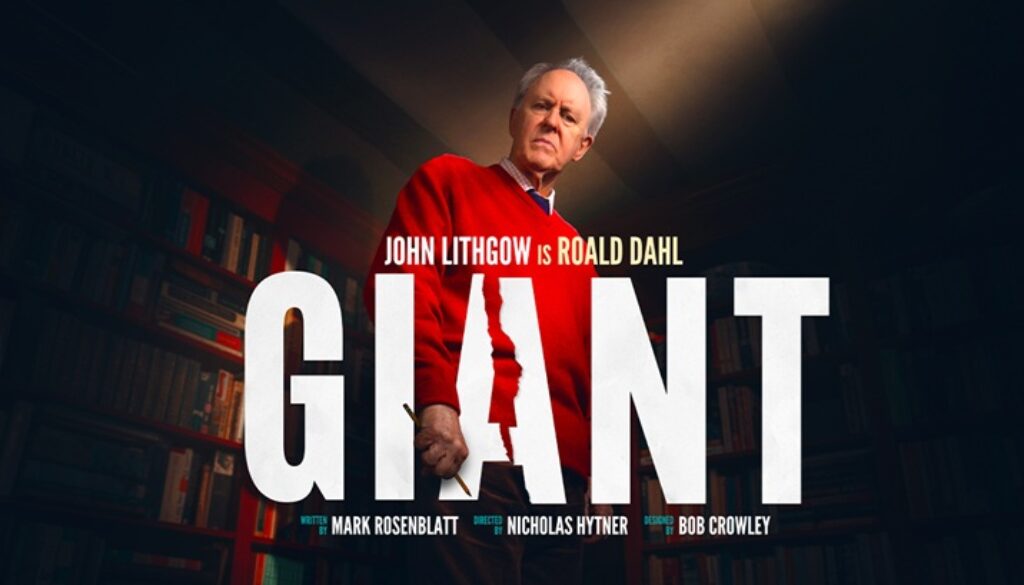
Giant – Mark Rosenblatt’s Award-Winning Play about Roald Dahl Complete Guild
Broadway Play · Currently Playing 2026
Giant: The Olivier Award-Winning Play About Roald Dahl’s Darkest Side — and John Lithgow’s Career-Defining Performance on Broadway
Mark Rosenblatt’s extraordinary debut play dares to ask the question that haunts every admirer of a beloved but deeply flawed artist: can you separate the work from the man? Set over one afternoon in 1983, Giant places Roald Dahl — the children’s writer who gave us Charlie Bucket, James, and the BFG — in a room with the people who need him to apologise for his antisemitism, and watches with terrible fascination as he refuses.
Show at a Glance
| Written by | Mark Rosenblatt (debut play) |
| Director | Nicholas Hytner (two-time Tony winner) |
| Designer | Bob Crowley |
| Broadway Theatre | Music Box Theatre, 239 West 45th Street, New York |
| Broadway Previews | 11 March 2026 |
| Broadway Opening | 23 March 2026 |
| Broadway Closing | 28 June 2026 (16-week limited run) |
| World Premiere | Royal Court Theatre, London — 20 September 2024 |
| West End Run | Harold Pinter Theatre — April–July 2025 (record-breaking) |
| Running time | 2 hours 20 minutes, with one interval |
| Recommended age | 14 and above |
| Tony nominations | 4 — Best Play, Best Actor (Lithgow), Best Featured Actress (Cash), Best Direction |
Mark Rosenblatt: The Director Who Became a Playwright — and Won Three Olivier Awards on His Debut
Giant is the debut play of Mark Rosenblatt — a British theatre director and filmmaker who spent more than two decades working as a director before turning to playwriting. His directing credits span the National Theatre, Shakespeare’s Globe, the Edinburgh Fringe Festival, and numerous other prestigious venues across the British theatrical landscape. He has also worked in film and television. But it is with Giant — his first play as a writer — that he has claimed a place among the most significant new voices in British drama of the past decade.
Rosenblatt has spoken in interviews about the specific impulse that led him to write the play. He was inspired, in part, by reports that Roald Dahl’s children’s books were being retrospectively edited to remove offensive content — a development that reignited debate about Dahl’s well-documented antisemitism and the question of whether his books can be separated from the person who wrote them. That editorial controversy, combined with Rosenblatt’s own deep engagement with questions of Jewish identity and antisemitism — he is Jewish himself — gave the play its personal urgency alongside its dramatic architecture.
The result was described by Nick Hern Books as offering “a nuanced portrait of a fiendishly charismatic icon — and exploring with dark humour the difference between considered opinion and dangerous rhetoric.” That Rosenblatt pulled this off in his debut as a playwright — producing a work that was structurally sophisticated, dramatically taut, theatrically bold, and philosophically rigorous — is remarkable by any standard. He won the Critics’ Circle Award for Best New Play and the Stage Debut Award for Best Creative West End Debut in 2025. His Olivier Award for Best New Play at a ceremony celebrating his debut work stands as one of the more extraordinary achievements in recent British theatre.
💡 About the Real Roald Dahl Scandal
In 1983, Roald Dahl wrote a literary review of the picture book God Cried about the Israeli army’s siege of West Beirut during the 1982 Lebanon War. The review was widely condemned as antisemitic — Dahl condemned Israel’s invasion and then went further, implying that Jewish people bore collective responsibility for not speaking out. The review damaged his reputation significantly and became one of the most cited examples of his documented antisemitic views. Dahl later made public antisemitic statements in other contexts. Giant dramatises an imagined version of the immediate aftermath of this incident.
From the Royal Court to the West End to Broadway: The Production’s Journey
Giant‘s journey from a relatively small but prestigious theatre in Chelsea to one of Broadway’s most historic venues is one of the more rapid and triumphant trajectories in recent theatrical history. The production has been, at every stage, the same creative team: playwright Rosenblatt, director Nicholas Hytner, designer Bob Crowley, and — most centrally — star John Lithgow, who originated the role of Roald Dahl and has carried it across three productions on two continents.
The world premiere took place at the Royal Court Theatre in London’s Chelsea on 20 September 2024, running until 16 November 2024. The Royal Court — one of Britain’s most distinguished producing theatres, with a fifty-year tradition of commissioning and developing new writing — was an entirely appropriate home for a debut play of this ambition and quality. The production sold out its entire run and generated the kind of critical response that makes West End transfers not merely desirable but inevitable.
The Royal Court reviews were extraordinary. The Evening Standard called it “shocking, challenging and spectacularly good.” The Guardian described it as “a slowly brilliant play.” West End Best Friend called it “powerful and poignant.” The Observer gave it five stars and called it “an extraordinary debut play.” At the Olivier Awards in April 2025, the production won three awards: Best New Play, Best Actor in a Play (John Lithgow), and Best Supporting Actor in a Play (Elliot Levey) — the three most significant performance and writing awards available at Britain’s premier theatrical honours.
The West End transfer to the Harold Pinter Theatre — named after the great British playwright and one of the West End’s most distinguished venues — opened in April 2025 for a 14-week limited season that broke the theatre’s box office records. Mark Rosenblatt’s own website describes it as a “box-office record-breaking limited 14-week season.” The West End production featured a largely identical cast to the Royal Court run, with one significant addition: Aya Cash (The Boys) replacing Romola Garai as the American publisher Jessie Stone, a change that London Theatre described as producing “a seismic jolt” that made the already-excellent production even more powerful.
The Broadway transfer to the Music Box Theatre — one of Broadway’s most intimate and historically significant houses — was announced in October 2025, with previews beginning 11 March 2026 and the official opening on 23 March 2026. The 16-week limited engagement is scheduled to close 28 June 2026.
The Plot: One Afternoon, One Confrontation, One Unanswerable Question
The dramatic action of Giant is compressed into a single afternoon in 1983, set almost entirely in the dining room of Gipsy House, Roald Dahl’s home in Great Missenden, Buckinghamshire. (The real writing hut where Dahl wrote — custom-built for his 6’6″ frame — is now on display at the Roald Dahl Museum and Story Centre in the village.) Designer Bob Crowley’s set has been widely praised: the dining table where all the action occurs is surrounded by walls that have been ripped out and covered in plastic, creating, as the British Theatre Guide noted, a visual metaphor for “tragedy under the surface of success.”
The occasion is the imminent publication of Dahl’s new book The Witches — one of his most beloved works for children, featuring the Grand High Witch and her plan to turn all the children of England into mice. The problem is that Dahl is under a cloud: his 1983 book review condemning Israel’s invasion of Lebanon has been widely read as antisemitic, and his American publisher is urgently concerned that the controversy will destroy the book’s commercial prospects in the United States, where the Jewish community represents a significant portion of the literary market.
Into this tense domestic situation arrives Jessie Stone — a Jewish American sales executive sent by the US publishing house to persuade Dahl to issue a public apology for his review. Jessie is not a polemicist or an activist; she is a publishing professional trying to solve a commercial problem, and her motivation is at least as much financial as moral. But the conversation she has come to broker quickly escalates far beyond its practical starting point, as Dahl’s genuine views — his conviction that Israel’s behaviour is equivalent to what was done to Jews in the Holocaust, his anger at what he sees as Jewish communal silence, and — most disturbingly — his willingness to say things that reveal a deeper and more personal antisemitism — begin to surface with increasing frankness.
The play’s other characters provide the dramatic context around this central confrontation. Tom Maschler — Dahl’s Jewish British publisher, played in all productions by the Olivier-winning Elliot Levey — is the exhausted intermediary: a man who has managed Dahl for years, who is well aware of his author’s views, and who represents the specifically British Jewish experience of secular assimilation and the uncomfortable position of the Jew who is not identified with Israel but cannot entirely separate himself from the accusation being levelled. Felicity Crosland — Dahl’s second wife-to-be — is the loyal partner trying to manage the situation without being able to control it. And various other household members and publishing figures complete the cast of this intensely focused chamber drama.
What makes the play extraordinary — and what elevates it above what might have been a merely provocative thesis drama — is Rosenblatt’s refusal to offer easy resolutions. The play does not exonerate Dahl. His views are presented with full clarity, and Lithgow’s performance ensures that the audience never forgets the human damage those views represent. But the play also does not reduce Dahl to a simple villain. It presents him as a complex, damaged, self-aware, and — in certain moments — genuinely charming man whose beliefs are inseparable from a specific biographical and psychological history. The question the play poses — can you separate the work from the man? can you separate criticism of a government from hatred of a people? — is never definitively answered, because in Rosenblatt’s view it cannot be.
The ferocity of John Lithgow’s explosive performance as Roald Dahl seems to show itself right from the start. He gives a tour de force performance that nails every slight shift in mood and tone — from “broken boy” to the hateful creep who almost playfully suggests that Hitler got some things right.
Deadline Hollywood, Broadway Opening Night Review, March 2026The Broadway Cast: Olivier Winners Return to New York
One of the most distinctive aspects of Giant‘s Broadway production is that three of its four principal performers are reprising roles they have played in London — bringing to the Broadway stage the particular depth and specificity that only comes from having lived with a character through multiple productions and months of performance. The Broadway cast represents one of the strongest ensembles of the 2025-26 Broadway season.
| Performer | Role | Notes |
|---|---|---|
| John Lithgow | Roald Dahl | ★ Olivier Award — Best Actor in a Play 2025Tony, Golden Globe, Emmy, and Olivier Award winner. Known for The Crown (Churchill), Conclave, Killers of the Flower Moon, 3rd Rock from the Sun, and multiple previous Broadway productions. His portrayal of Dahl — towering physically (Lithgow stands over six feet tall) and dramatically devastating — has been universally described as the performance of his career. Nominated for the 2026 Tony Award for Best Actor in a Leading Role in a Play. |
| Elliot Levey | Tom Maschler | ★ Olivier Award — Best Supporting Actor in a Play 2025British actor reprising his Olivier-winning performance as Dahl’s Jewish British publisher. Levey’s Tom Maschler — tired, resigned, privately conflicted — has been described as one of the most complex supporting performances in recent London and Broadway theatre. Previously known for his work in Cabaret. |
| Aya Cash | Jessie Stone | American actress best known for playing Stormfront in the Amazon series The Boys. Joined the production for the West End run after Romola Garai’s Royal Court performance, and is reprising the role on Broadway. Cash’s casting created what London Theatre described as “a seismic jolt” — her Jessie is a more confrontational, dynamically powerful foil for Lithgow’s Dahl. Nominated for the 2026 Tony Award for Best Featured Actress in a Play. |
| Rachael Stirling | Felicity Crosland | British actress reprising her West End performance as Dahl’s second wife-to-be. Daughter of Dame Diana Rigg, Stirling has built a distinguished screen and stage career. Her Felicity — loyal, protective, and ultimately unable to shield her partner from his own worst impulses — provides the domestic warmth against which Dahl’s monstrous views play. |
| Stella Everett | Hallie | Known for Running Point on Netflix. New to the production for Broadway, playing a household member whose presence provides an additional perspective on the play’s central confrontation. |
| David Manis | Wally | Broadway and television veteran known for To Kill a Mockingbird. Joins the production for the Broadway run in the supporting role. |
The creative team — writer Mark Rosenblatt, director Nicholas Hytner (two-time Tony winner for The History Boys and Guys & Dolls, founder of the Bridge Theatre in London), and designer Bob Crowley (multiple Tony winner for scenic and costume design) — gives the production an institutional quality that few Broadway plays can match.
The Awards: Three Oliviers, Four Tony Nominations, and a Critics’ Sweep
🏆 Giant — Olivier Award Winner 2025
| Best New PlayMark Rosenblatt | Best Actor in a PlayJohn Lithgow (Roald Dahl) | Best Supporting ActorElliot Levey (Tom Maschler) |
Also won: Critics’ Circle Award for Best New Play 2025 · Stage Debut Award for Best Creative West End Debut (Mark Rosenblatt) 2025
79th Annual Tony Award Nominations 2026: Best Play · Best Actor in a Leading Role in a Play (John Lithgow) · Best Featured Actress in a Play (Aya Cash) · Best Direction of a Play (Nicholas Hytner)
What the Critics Said: The Reviews That Built a Legend
The critical response to Giant across all three productions — Royal Court 2024, Harold Pinter Theatre 2025, and Music Box Theatre 2026 — has been one of the most sustained critical consensuses for a new play in recent theatrical memory. The Broadway reviews are gathered here alongside key London notices that defined the production’s reputation before it crossed the Atlantic.
Deadline Hollywood — Broadway Opening Night
“The ferocity of John Lithgow’s explosive performance as Roald Dahl seems to show itself right from the start of Mark Rosenblatt’s extraordinary play Giant. Lithgow’s remarkable Olivier Award-winning performance is a terrifically nuanced affair, as indeed are Rosenblatt’s play and the note-perfect direction of Nicholas Hytner. Giant, thrilling and abrasive, is full of rewards.” The review described Lithgow’s performance as “tour de force” — capturing “every slight shift in mood and tone, from broken boy to the hateful creep who almost playfully suggests that Hitler got some things right.”
New York Theatre Guide — Broadway Review
“Giant follows an imagined conversation between children’s author Roald Dahl and his personal and professional inner circle as they debate how to respond to accusations of Dahl’s antisemitism. He’s charming, chilling, snarling, and reprehensible until he finally, intentionally, digs himself into a deeper hole. While the play eerily echoes current world events, Dahl’s antisemitism isn’t exactly a giant reveal. But the show raises provocative questions: Can you separate a nation from a people? Can you separate an artist from their work?”
Theatrely — Broadway Review
“Mark Rosenblatt’s play Giant is brilliantly structured, quite funny and, in Nicholas Hytner’s production, superbly acted by a cast led by John Lithgow. How personalities are conveyed, revelations meted, and momentum sustained is a testament to Rosenblatt’s immense talent. The Dahl he and Lithgow create is a towering dramatic figure and a completely rounded character.”
Daily Telegraph — World Premiere Review
“An unslayable hit… hugely impressive… a complex plethora of thought-provoking little details… a summer smash… this is the play to see.” The Telegraph’s five-star notice was one of the most enthusiastic critical responses to any new play in London that season, and set the tone for the production’s subsequent commercial and critical dominance.
The Observer — World Premiere Review
“An extraordinary debut play.” The Observer’s five-star notice placed Rosenblatt in the company of the finest debut playwrights of recent decades, and proved prescient in light of the Olivier and Critics’ Circle Awards that followed.
London Theatre — West End Review
“John Lithgow gives a career-best performance in this blisteringly topical colossus of a play. A big play has got bigger still in the West End upgrade of Giant, which arrives bearing three Olivier Awards and announces itself as a colossus. The drama, set 40 years ago but blisteringly topical to our times now, has been seasoned by the deepening of John Lithgow’s altogether astonishing performance. Topical, challenging, and easily my best play of 2025.”
British Theatre Guide — West End Review
“Giant is a thought-provoking, powerful play with razor-sharp dialogue that will make you laugh, cringe and gasp out in incredulous outrage. It’s brilliant theatre and brilliant writing. Nicholas Hytner’s production is paced to perfection and uncannily timely given the continual flurry of headlines in the Middle East. Stars American actor John Lithgow in a ruthless portrayal of Dahl — a complex, somewhat charming schoolboy bully, engaging raconteur and alarmingly loud and proud antisemite. This is a monumental play that well deserves the Olivier and Critics’ Circle awards it has already won.”
The Guardian — World Premiere Review
“An exploration of Roald Dahl and antisemitism that speaks to our times.” The Guardian’s notice — which the production’s own publicity has used — captured the essential quality that distinguishes Giant from other biographical dramas: its refusal to remain safely in the past. The play is set in 1983, but its questions are urgently contemporary, and the Guardian’s notice understood this from the production’s first night.
John Lithgow: The Performance of a Lifetime
The critical consensus on John Lithgow’s performance in Giant — “the performance of his career,” “a career-best,” “tour de force,” “towering,” “Olivier-winning” — is as complete and consistent as any such consensus in recent theatrical history. What makes this particularly remarkable is that Lithgow is an actor of fifty-plus years of professional experience, with a résumé that includes Tony Awards for The Changing Room (1973) and M. Butterfly (1988), multiple Emmy Awards for 3rd Rock from the Sun and The Crown, a Golden Globe, and acclaimed film work in projects ranging from Terms of Endearment to Killers of the Flower Moon. To describe any single performance as his finest after such a career is a strong claim. Every critic who has seen him in Giant makes it without qualification.
The physical dimension of the performance is central to its impact. Lithgow stands over six feet tall — a height that gives his Dahl an imposing physical presence that mirrors the character’s psychological dominance of every room he enters. Dahl’s own writing hut was custom-built for his 6’6″ frame, a detail that the play itself references as it establishes the ways in which Dahl has always occupied physical and cultural space that was explicitly shaped around him. Watching Lithgow move through Bob Crowley’s set — contorting and bending to suggest the physical infirmities of an older man while simultaneously projecting the colossal authority of a person who has spent his entire life being the most important person in the room — is to watch an actor using every physical and technical resource at his considerable disposal.
As Deadline noted, the performance “nails every slight shift in mood and tone” — from the charming, avuncular storyteller who has enchanted generations of children to the man who “almost playfully suggests that Hitler got some things right.” The ability to hold those two registers simultaneously, and to move between them with a fluency that makes the audience understand how both can exist in the same person, is the central achievement of the performance — and of the play itself.
Why Giant Matters: Art, Antisemitism, and the Questions We Can’t Stop Asking
The timing of Giant‘s various productions — Royal Court 2024, West End 2025, Broadway 2026 — has been, for better or worse, impeccably aligned with a moment in world history when the questions the play raises feel not merely relevant but urgent. The play was written in the context of debates about whether Roald Dahl’s books should be edited or contextualised. It was first performed as the conflict in Gaza was generating daily headlines about Israel, antisemitism, and the question of how criticism of a government relates to attitudes toward a people. It opened on Broadway as those debates continued with undiminished intensity.
Rosenblatt has been careful in interviews not to reduce his play to a polemic on either side of these debates. The play presents Dahl’s views with full clarity and full condemnation — he is shown as an antisemite, not merely as someone guilty of an imprudent comparison — while also taking seriously the questions that his situation raises about art, responsibility, and the limits of public apology. Jessie Stone, the American publisher sent to extract an apology, is not a straightforward hero: her motivations are partly commercial, her approach is partly strategic, and her eventual confrontation with Dahl produces what Theatrely called a “smoothing out into a righteous heroine” that the review found reductive. Not all critics agreed, but the fact that the debate about the play’s moral architecture has been a feature of its reception speaks to Rosenblatt’s achievement in creating genuine dramatic complexity.
What is not in dispute is the play’s theatrical quality. It is brilliantly structured — building from comedy and social awkwardness to genuine moral horror with a precision that reflects twenty years of directorial experience being brought to bear on a debut text. It is superbly acted, in all its incarnations. And it raises, without resolution, questions that Broadway audiences in 2026 are encountering in their daily lives. The Music Box Theatre, for its 16-week run, has become one of the places in New York where those questions are being asked most directly and most honestly.
Rosenblatt is admirably unafraid to plunge into fierce arguments. Giant offers a nuanced portrait of a fiendishly charismatic icon — and explores with dark humour the difference between considered opinion and dangerous rhetoric.
Nick Hern Books, publisher of the Giant play text
Links
La Cage Aux Follies – Memorabilia
Chess the Musical – Memorabilia
Little Shop of Horrors – Memorabilia
Starlight Express – Memorabilia
Dear Evan Hansen – Memorabilia
How to Succeed in Business Without Really Trying – Memorabilia
Terrence McNally – Memorabilia