Broadway Show FAQ: What to Wear, Bring & Expect (2026)

Whether it’s your first trip down the aisle of a Times Square theatre or your fiftieth, the practical logistics of a Broadway show rarely make it into the glossy marketing photos. What should you actually wear? Can you sneak in a snack? Will your seven-year-old sit still for two and a half hours? Below, we’ve pulled together answers to the ten questions Broadway first-timers — and even seasoned regulars — ask most often, straight from theatre operators, ticketing platforms, and official venue policies.
What Should I Wear to a Broadway Show?
The short answer: whatever you want. Broadway theatres do not enforce dress codes, and jeans, shorts, and sneakers are just as welcome in the orchestra section as suits and cocktail dresses. Business casual has become the unofficial norm for evening performances, while matinees skew more casual, since they draw a heavier mix of families and daytime tourists.
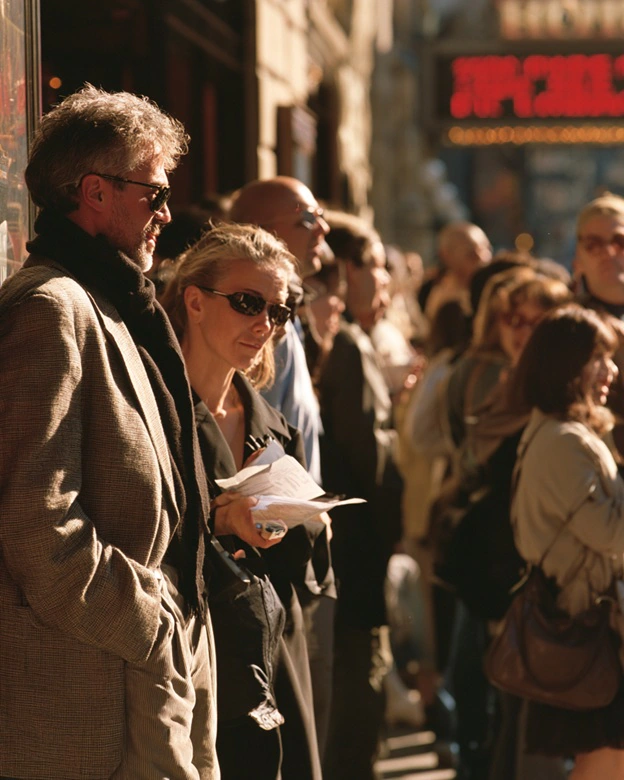
That said, most regular theatregoers still dress a notch above their everyday errands attire. Think dress pants or dark denim, a button-up shirt or blouse, and comfortable-but-presentable shoes — you’re not going to a club, but you’re also not required to break out a gown or tuxedo unless it’s opening night or another special occasion. Costumes tied to a specific show are generally fine too; fans of “Six” and “Harry Potter and the Cursed Child” regularly show up in character-inspired outfits, though extravagant pieces like tall headpieces or oversized props can block the view of other patrons and are best left at home.
The one detail nearly every guide agrees on: bring a layer. Broadway houses are famously over-air-conditioned, and even a warm summer evening outside can feel chilly once you’re seated for two-plus hours indoors. A cardigan, light jacket, or pashmina is the most consistently recommended accessory across seasons, useful for winter warmth as much as for summer air conditioning.
Season also shapes what makes practical sense. In spring and summer, lightweight fabrics work well for the walk to the theatre, but it’s worth packing that cardigan or wrap regardless of how warm it is outside. In fall and winter, layering becomes less optional and more essential — a stylish coat over a warm sweater, paired with closed-toe shoes, covers both the chilly walk through Times Square and the cold theatre interior. Whatever the season, comfort should outrank fashion: you’ll be seated for at least ninety minutes, so an outfit you can sit in without fidgeting matters more than any particular hemline or heel height. Consider, too, the length of your top, skirt, or shorts once you’re actually sitting down, and think twice about tall hats or oversized headpieces, which can block the sightlines of the people seated behind you.
How Early Should I Arrive?
Plan to arrive at least 30 minutes before curtain. That window gives you enough time to get through security screening, find your seats, and get your bearings in the theatre, and it also lets you take advantage of pre-show concessions or merchandise stands if you’re interested. Some sources recommend an even wider cushion — doors at many theatres open approximately 45 minutes prior to performance time, and guests with mobility needs or accessibility requirements are generally encouraged to arrive early and check in with front-of-house staff so they can be seated before the general rush.

Remember that Broadway sits in the middle of Times Square, one of the most heavily trafficked areas in the world. Subway delays, street closures, and sheer pedestrian congestion can easily eat into a tight timeline, so building in extra buffer time — especially on a Friday or Saturday night — is always the safer bet.
Part of that 30-minute cushion goes toward security. Most Broadway theatres conduct bag checks and screening for every ticket holder, and some use metal detectors. Backpacks and bags are generally permitted, but they’re subject to inspection and should be sized to fit comfortably under your seat without spilling into the aisle or blocking a walkway — theatres will not check or hold bags during the performance, and large items like luggage or oversized shopping bags typically aren’t allowed inside at all. If you’re arriving with shopping bags from a day in Manhattan, plan to either drop them off beforehand or choose a smaller venue-friendly bag instead. A number of theatres also offer coat check for a small fee, which can be worth using during colder months if you’re wearing a bulkier coat you don’t want on your lap for two-plus hours.
Can I Bring Food Into a Broadway Theatre?
No. Broadway theatres do not permit outside food, and you may be asked to dispose of it before entering. This is a fairly consistent rule across all 41 Broadway houses, though enforcement can vary — a small candy bar tucked in a bag is unlikely to draw attention, but anything resembling a meal or a large food item will not make it past the door.
The good news is that you won’t go hungry. Nearly every Broadway theatre operates a concession stand in the lobby, selling snacks, candy, and drinks both before the show and during intermission. Some venues, like the Gershwin Theatre, make a specific exception for food or drink required for medical reasons, so if you have a health-related need, it’s worth contacting the box office ahead of time to confirm the theatre’s policy.

If you’re planning to eat before curtain, the safest bet is to build dinner into your pre-theatre schedule with enough buffer to still make that 30-minute arrival window. Grabbing a quick bite from a nearby restaurant or a fast, walkable spot in the Theatre District tends to work better than trying to eat something substantial in the lobby, where space and time are both limited.
Allergy note: Because theatres can’t control what food patrons bring in — and many concession stands sell peanut-related products — venues generally cannot guarantee allergen-free seating zones. If you have a serious food allergy, it’s worth flagging this with the box office when you purchase tickets.
Can I Bring Drinks Into a Broadway Theatre?
Outside beverages face the same restriction as outside food — they’re generally not permitted, and open containers in particular will be turned away at the door. The one common exception is sealed bottled water, which many theatres will allow through, along with sturdy, sealed reusable water bottles in some venues. Soda cups, coffee cups, and fast-food-style drink containers are typically not allowed, sealed or not.
Once inside, though, you’re covered. Broadway theatre bars sell everything from soft drinks to wine, beer, and cocktails before curtain and during intermission, and a number of theatres now offer at-seat drink service as well. If a drink is important to your evening, buy it inside rather than trying to bring one from the street.

How Long Are Broadway Shows?
There’s no single answer — run times vary widely depending on the show. Some performances clock in around 90 minutes with no break, while big musical spectacles can run three hours or more. As a general benchmark, many long-running musicals sit in the two-and-a-half to three-hour range including intermission: “Hamilton” runs two hours and 45 minutes, “Harry Potter and the Cursed Child” runs two hours and 55 minutes (across its combined parts), and “MJ the Musical” runs two hours and 30 minutes.
The safest approach is to check the specific run time for the show you’re seeing rather than assume — most official show pages and ticketing platforms list exact running times, and it’s worth checking before you plan dinner reservations or your subway trip home.
Run time matters for more than just your evening schedule. It also affects how you plan around dinner (a pre-theatre prix fixe makes more sense before a three-hour epic than a 90-minute one-act), how you brief kids on what to expect, and how tightly you should budget your trip if you’re catching a matinee before an evening flight or train. When in doubt, the show’s official website, Broadway.com, or the box office can confirm the exact runtime, including whether that figure includes intermission or not.
Do Broadway Shows Have Intermissions?
Most do, but not all. Longer productions are likely to include at least one intermission, typically lasting 10 to 20 minutes, though some run longer. Shorter shows — particularly one-act plays or shows under 90–100 minutes — are increasingly staged straight through with no break at all, a trend that has become more common on Broadway in recent years.
During intermission, most theatres allow guests to leave their seats and re-enter the auditorium, giving you time to hit the restroom, grab a drink from the lobby bar, or simply stretch your legs. If you do step out mid-performance for any reason outside of a scheduled intermission, be aware that re-entry to your seat is not always guaranteed until a natural break in the show — front-of-house staff will typically ask you to wait in the lobby until an appropriate pause.
One practical note worth planning around: because so many Broadway theatres are historic buildings, restroom facilities can be limited relative to a full house of a few thousand people. Lines at intermission are common, especially for the women’s restroom, so if a quick trip matters to you, it’s often worth heading there as soon as the house lights come up rather than browsing the merchandise stand first. Some theatres also only have restrooms on a single floor or accessible via stairs, so it’s worth locating them during your pre-show arrival rather than searching for the first time under a ten-minute clock.
Are Broadway Theatres Air Conditioned?
Yes — and, according to just about every seasoned theatregoer, aggressively so. Broadway houses are consistently described as running cold, regardless of the season outside, which is why a light jacket, sweater, or shawl shows up on nearly every packing list for a night at the theatre. It’s less a design flaw than a practical necessity: a full house of a few thousand bodies packed into an enclosed, historic space generates a lot of heat, and theatres tend to compensate by running the air conditioning on the stronger side.
Whether you’re seeing a summer matinee or a winter evening performance, don’t assume the temperature outside tells you anything about the temperature inside. Bringing a layer is one of the most consistently repeated pieces of advice across nearly every Broadway guide, and for good reason.
There’s a practical explanation behind the chill, beyond simple over-correction. Stage lighting rigs generate significant heat, and a full house packed shoulder-to-shoulder for two or three hours adds a lot of ambient warmth to a relatively enclosed, historic space. Theatres compensate by keeping the air conditioning running strong throughout the performance, which is why the temperature at curtain can feel noticeably cooler than the temperature in the lobby just minutes earlier. If you tend to run cold, err on the side of an extra layer rather than assuming you’ll be fine in short sleeves, even in July.
Are Broadway Theatres Wheelchair Accessible?
All 41 Broadway theatres offer some form of wheelchair-accessible seating, but accessibility features vary significantly from venue to venue. Many Broadway houses are close to a century old, and their original architecture wasn’t built with modern accessibility standards in mind — so while accessible seating is universal, elevators and escalators are not, and upper seating levels like the mezzanine or balcony may only be reachable by stairs at some theatres.
| Accessibility Feature | What to Know |
|---|---|
| Wheelchair seating | Available at every Broadway theatre, most often on the ground-floor orchestra level. |
| Companion seats | Typically bookable alongside wheelchair locations for a caregiver or guest. |
| Elevators/escalators | Not standard; many historic theatres rely on stairs to reach upper levels. |
| Assistive listening & captioning | Devices available for many shows; open and handheld captioning offered at select performances. |
| Audio description | Offered for many shows, including via the GalaPro app. |
| Service animals | Welcome; theatres request advance notice when a service animal will attend. |
For patrons planning an accessible visit, Theatre Access NYC is the most comprehensive resource, offering theatre-by-theatre details on wheelchair seating locations, step-free paths of travel, captioning, audio description, and sign-language-interpreted performances. Theatre Development Fund’s Theatre Accessibility Program (TAP) also offers a membership service specifically for patrons who are Deaf or hard of hearing, blind or low-vision, or who require aisle seating or wheelchair locations. Because accommodations vary so widely by building, it’s always worth booking accessible seating in advance and contacting the individual theatre directly with specific questions.
Can Children Attend Broadway Shows?
Yes, and plenty of shows are specifically designed with family audiences in mind — but there are near-universal age restrictions to know about. Most Broadway theatres do not admit children under the age of five, regardless of the show being performed, largely because young children can struggle to sit quietly through a full-length performance in a packed, dark auditorium. Some individual shows set their own, stricter age recommendations on top of that baseline.
“Hamilton,” for instance, recommends an audience of ages 10 and up given its themes and simulated gunfire, while “Harry Potter and the Cursed Child” is recommended for ages 8 and up and also requires that children under 15 be accompanied by an adult. Family-friendly musicals like “& Juliet” or “Aladdin” are built for a younger crowd, but even shows marketed toward families often carry their own specific age guidance around content, loud noises, or flashing lights, so it’s worth checking a show’s individual FAQ page before booking for a child.
If a young theatregoer does get overwhelmed mid-performance, most theatres allow you to step into the lobby or restroom together — though, as with any late departure, re-entry to your seats may need to wait until intermission or another natural pause in the show.
When choosing a show for a family outing, it helps to think beyond just the age recommendation and consider the specific content. Some “family-friendly” musicals still include brief strong language, references to death, or themes that may prompt questions from younger viewers, so it’s worth skimming a show’s official content advisories in addition to its recommended age range. Loud noises, gunshots, strobe lights, and fog effects are also flagged on most show pages, which can matter for children who are sensitive to sensory stimulation. Booking seats on the aisle can also make a big difference for families, giving you an easier, less disruptive path in and out if a bathroom break or a meltdown interrupts the show.
What Happens If I’m Late to a Broadway Show?
Most Broadway shows will still seat you if you arrive after curtain, but on the theatre’s terms, not yours. Late arrivals are typically asked to wait in the lobby until an appropriate pause in the performance — often the first scene break or intermission — before an usher walks them to their seats. Some theatres offer standing-room or temporary seating near the back of the house for latecomers until that natural break arrives, so you don’t miss the whole first act waiting in the lobby.
Crucially, your original ticketed seats are not guaranteed if you’re seated late — house management has discretion over exactly when and where you’re placed once the show is underway. A smaller number of productions enforce a strict no-late-seating policy, meaning latecomers may not be admitted to the auditorium at all until intermission; these policies are typically posted clearly at the theatre and noted on the show’s official information page, so it’s worth checking in advance if you’re worried about cutting it close.
The simplest way to avoid the issue entirely: build in that 30-minute cushion before curtain, account for Times Square foot traffic, and treat “on time” as “early” whenever you’re heading to a show.
If you know in advance that you might run late — a delayed flight, an early dinner reservation that’s running long, a work commitment that won’t wrap up in time — it’s worth calling the box office ahead of your performance. Staff can tell you the specific theatre’s late-seating policy for that show, and in some cases can give you a better sense of when you’re likely to be let in if you do arrive after curtain. It’s a small step that can save you from standing in a lobby wondering how much of Act One you’re going to miss.
The Bottom Line
Most of what trips up first-time Broadway audiences comes down to a handful of consistent rules: dress comfortably (there’s no real dress code, but bring a layer for the air conditioning), arrive at least half an hour early, plan to buy food and drinks inside rather than bringing your own, and check the specific show’s run time, intermission, and age guidance before you go. Beyond that, the logistics of a Broadway theatre — accessible seating, late-seating policies, bag checks — vary somewhat by venue, so when in doubt, a quick look at the show’s official FAQ page or a call to the box office will answer nearly anything this guide didn’t cover.
Links
Phantom of the Opera – Memorabilia
Phantom of the Opera – Musical
Sunset Boulevard – Memorabilia
La Cage Aux Follies – Memorabilia
Chess the Musical – Memorabilia
Little Shop of Horrors – Memorabilia
Starlight Express – Memorabilia
Dear Evan Hansen – Memorabilia
How to Succeed in Business Without Really Trying – Memorabilia
Terrence McNally – Memorabilia