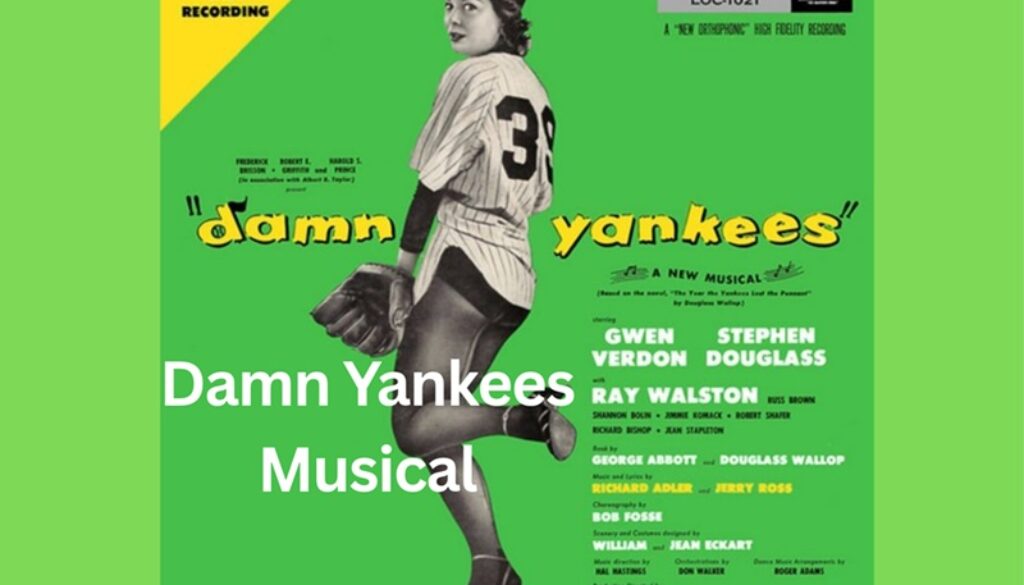
Damn Yankees Musical Guide: Original Broadway Run, Songs, Cast & History
Damn Yankees: The Definitive Guide to the Classic Musical, Original Run & History
An exhaustive exploration of George Abbott, Douglass Wallop, Richard Adler, and Jerry Ross’s Tony Award-winning Faustian baseball musical—from its 1,019-performance Broadway premiere and Bob Fosse choreography to its 1958 film adaptation and enduring legacy.
In the mid-1950s, American musical theater was experiencing an unparalleled golden era. Among its most vibrant masterpieces stands Damn Yankees, a high-spirited, Faustian musical comedy that deftly merged two quintessential American obsessions: national pastime baseball and the temptation of supernatural bargains. Adapted from Douglass Wallop’s popular 1954 novel The Year the Yankees Lost the Pennant, the show brought together a legendary creative team. Master director and playwright George Abbott joined forces with Wallop to write the book, while the composer-lyricist duo of Richard Adler and Jerry Ross supplied an irresistible, hit-filled score.
Opening at Broadway’s 46th Street Theatre on May 5, 1955, Damn Yankees proved to be an immediate juggernaut. The production cemented the star status of Gwen Verdon as the irresistible seductress Lola, immortalized Ray Walston as the devilish Mr. Applegate, and introduced the groundbreaking, athletic choreography of Bob Fosse. Sweeping seven Tony Awards in 1956—including Best Musical—the show ran for 1,019 performances and spawned a celebrated 1958 Hollywood film adaptation. Below is the ultimate, comprehensive guide to Damn Yankees, encompassing its plot synopsis, character breakdowns, song score, production history, film adaptation, awards ledger, and performance stats.
Damn Yankees at a Glance: Essential Historical Facts
- Book: George Abbott and Douglass Wallop
- Music & Lyrics: Richard Adler and Jerry Ross
- Based On: The Year the Yankees Lost the Pennant (1954 novel by Douglass Wallop)
- Original Broadway Theatre: 46th Street Theatre (moved to the Adelphi Theatre on May 6, 1957)
- Original Opening Date: May 5, 1955
- Original Closing Date: October 12, 1957
- Total Original Performance Count: 1,019 Regular Performances
- Director: George Abbott
- Choreographer: Bob Fosse
- Original Broadway Leads: Gwen Verdon (Lola), Ray Walston (Applegate), Stephen Douglass (Joe Hardy), Shannon Bolin (Meg Boyd), Robert Shafer (Joe Boyd)
- Major Accolades: Winner of 7 Tony Awards (1956) including Best Musical, Best Actor (Ray Walston), Best Actress (Gwen Verdon), and Best Choreography (Bob Fosse)
Full Plot Synopsis: The Faustian Bargain for the Pennant
Set in Washington, D.C., during the mid-1950s, Damn Yankees retells the classic German Faust legend through the lens of Major League Baseball. During this era, the formidable New York Yankees dominated professional baseball, leaving fans of rival teams in perpetual heartbreak.
Act I: The Deal and the Phenom
The story opens in the comfortable suburban home of Joe Boyd, a middle-aged, overweight real estate agent, and his devoted, traditional wife, Meg. Joe is a fanatical supporter of the struggling Washington Senators baseball team. As Meg laments how baseball consumes her husband’s attention during the summer months (“Six Months Out of Every Year”), Joe watches another Senators defeat on television and angrily declares that he would sell his soul to the Devil if his team had a “long-hitting slugger” who could beat the “damn Yankees”.
Suddenly, a slick, suave, red-socked stranger named Mr. Applegate appears in Joe’s living room. Applegate is the Devil in modern executive clothing. He offers Joe an extraordinary bargain: Joe will be transformed into a handsome, 22-year-old baseball prodigy named Joe Hardy, endowed with the power to lead the Washington Senators to the pennant. Being a cautious real estate businessman, Joe insists on an “escape clause.” Applegate agrees that Joe can walk away from the contract and return to his old life at any time before 9:00 PM on September 24—the eve of the final game of the season. Joe bids a silent, poignant farewell to his sleeping wife (“Goodbye, Old Girl”) and transforms into young Joe Hardy.
Joe Hardy arrives at the Washington Senators’ ballpark, where the struggling players and their manager, Benny Van Buren, are trying to maintain morale despite their dismal standing (“Heart”). Joe secures a tryout and amazes everyone by hitting balls completely out of the stadium. Ambitious sports reporter Gloria Thorpe senses a major story and christens Joe “Shoeless Joe from Hannibal, Mo.” after inventing a colorful backstory for the unknown hitter (“Shoeless Joe from Hannibal, Mo.”).
Joe’s home-run streak propels the Senators up the league standings, making him a national celebrity. However, Joe misses Meg terribly. To be near her without revealing his true identity, he rents a spare room in her house as a border. Concerned that Joe’s lingering attachment to his wife might cause him to use his escape clause on September 24, Applegate summons his top demonic assistant—the stunningly beautiful 172-year-old temptress Lola. Applegate commands Lola to seduce Joe Hardy and make him forget Meg entirely. Lola boasts of her flawless record of corrupting men (“A Little Brains, A Little Talent”), but when she attempts to seduce Joe in the team’s locker room (“Whatever Lola Wants”), his genuine love for Meg makes him completely immune to her charms.
Act II: Scandal, Suspensions, and Game 154
Frustrated by Joe’s resistance, Applegate shifts to a darker scheme. If Joe cannot be seduced, he will be framed. Applegate leaks a rumor to reporter Gloria Thorpe suggesting that “Joe Hardy” is actually an alias for Shults, an banned corrupt player from an illegal league. Gloria publishes the allegation, throwing the baseball world into chaos and threatening Joe’s eligibility right before the final series against the Yankees.
Meanwhile, Lola finds herself deeply moved by Joe’s moral integrity and true love for his wife. Realizing she has fallen in love with him, Lola decides to betray Applegate. At a hearing held by the baseball commissioner on the afternoon of September 24, Meg and her suburban friends present testimony defending Joe’s character, stalling the hearing until the 9:00 PM deadline passes. To celebrate, Lola takes Applegate to a night club and drugs his drink, keeping him asleep so Joe can quietly execute his escape clause. Before falling asleep, Applegate and Lola perform a vaudeville dance duet celebrating bad behavior (“Who’s Got the Pain?”).
However, Applegate awakens just before midnight and realizes Lola’s betrayal. Furious, he transforms Lola into an ugly crone as punishment and vows that Joe will be humiliated on the field. On September 25, the Senators play the crucial final game against the New York Yankees. In the bottom of the ninth inning, with two outs and the Senators leading by a single run, a Yankee batter hits a deep fly ball to the outfield. Just as Joe Hardy leaps into the air to catch the ball, Applegate invokes his demonic power, instantly transforming Joe back into his old, overweight, middle-aged self.
Despite his sudden physical transformation, middle-aged Joe Boyd makes a miraculous leaping catch, securing the final out and winning the pennant for the Washington Senators! Before the cheering crowd or photographers can reach him, Joe slips out of the stadium and runs home. That evening, middle-aged Joe Boyd returns to his house, falling into the arms of his overjoyed wife Meg. Applegate arrives at the house in a fury, offering Joe youth, wealth, and glory if he will return to baseball, but Joe ignores him entirely and joins Meg in singing “There’s Something About an Empty Chair” and “Heart”. Defeated by the power of genuine human love, a baffled Applegate vanishes into the night.
Song Score: Musical Numbers Breakdown
The score by Richard Adler and Jerry Ross remains one of the most celebrated of Broadway’s Golden Age, packed with athletic ensemble numbers, romantic ballads, and comedic showstoppers:
| Song Title | Song Type & Scene Context | Original Performers (1955) |
|---|---|---|
| “Six Months Out of Every Year” | Opening Ensemble – Suburban Wives vs. Baseball Husbands | Meg Boyd, Joe Boyd, Sister, Husband Ensemble |
| “Goodbye, Old Girl” | Poignant Soliloquy – Joe’s Farewell to Middle-Age | Joe Boyd, Joe Hardy |
| “Heart” | Comedic Showstopper – Manager’s Locker Room Pep Talk | Benny Van Buren, Smokey, Rocky, Vernon |
| “Shoeless Joe from Hannibal, Mo.” | High-Energy Dance Number – Reporter Praises the Phenom | Gloria Thorpe, Joe Hardy, Baseball Ensemble |
| “A Little Brains, A Little Talent” | Character Soliloquy – Lola’s Seduction Credentials | Lola |
| “A Man Doesn’t Know” | Romantic Ballad – Appreciating True Domestic Love | Joe Hardy, Meg Boyd |
| “Whatever Lola Wants (Lola Gets)” | Iconic Tango Seduction – Bob Fosse Choreography Showcase | Lola, Joe Hardy |
| “Who’s Got the Pain?” | Vaudeville Specialty Dance – Night Club Mambo Specialty | Lola, Eddie (Dance Partner) |
| “Those Were the Good Old Days” | Comedic Soliloquy – Applegate Reminisces Over Historic Calamities | Applegate |
| “Two Lost Souls” | Sultry Night Club Duet – Joe & Lola Bonding | Lola, Joe Hardy, Night Club Dancers |
Original Broadway Cast & Character Directory
The original 1955 Broadway production featured a extraordinary cast that set the gold standard for comedic character acting and musical staging:
| Character Name | Character Description | Original Broadway Cast (1955) |
|---|---|---|
| Lola | The Devil’s top 172-year-old seductress assistant who falls in love with Joe. | Gwen Verdon |
| Mr. Applegate | The Devil in a modern suit, slick, sarcastic, and scheming. | Ray Walston |
| Joe Hardy | The 22-year-old, home-run hitting transformation of Joe Boyd. | Stephen Douglass |
| Joe Boyd | A middle-aged, overweight married real estate agent and fanatical fan. | Robert Shafer |
| Meg Boyd | Joe’s traditional, loyal, and loving suburban wife. | Shannon Bolin |
| Gloria Thorpe | A sharp, ambitious female sports reporter searching for a scoop. | Rae Allen |
| Benny Van Buren | The optimistic manager of the Washington Senators baseball team. | Russ Brown |
| Sister Miller | Meg’s opinionated suburban friend and neighbor. | Jean Stapleton |
| Soho Vic / Smokey / Rocky | Players on the Washington Senators squad. | Nathaniel Frey, Jimmie Komack, Albert Linville |
Comprehensive Production History: 1955 to Present
The 46th Street & Adelphi Theatre Engagements
Following tryout performances at the Shubert Theatre in Boston, Damn Yankees opened on Broadway at the 46th Street Theatre on May 5, 1955. The production was an unmitigated triumph, praised for its sharp book, catchy score, and Bob Fosse’s revolutionary choreography. Gwen Verdon’s performance as Lola catapulted her to major Broadway stardom, while Ray Walston’s comedic performance as Applegate defined the role. On May 6, 1957, the production moved to the Adelphi Theatre, playing a total of 1,019 performances before closing on October 12, 1957.
London’s Coliseum Theatre Run
The musical made its West End debut at the London Coliseum on March 28, 1957. Featuring British and Australian performers, the production ran for 258 performances, introducing United Kingdom audiences to Adler and Ross’s score and Bob Fosse’s signature dance style.
The Marquis Theatre Production
In 1994, director Jack O’Brien mounted a major Broadway revival at the Marquis Theatre featuring an updated book. Starring Bebe Neuwirth as Lola, Victor Garber as Applegate, and Jarrod Emick as Joe Hardy, the revival was nominated for four Tony Awards. Jarrod Emick won the Tony Award for Best Featured Actor in a Musical. During the run, comedy legend Jerry Lewis took over the role of Applegate, making his Broadway debut and subsequently headlining a successful national tour and West End engagement.
The 1958 Hollywood Film Adaptation
Warner Bros. Pictures Release (1958)
In 1958, Warner Bros. adapted Damn Yankees into a major Technicolor movie musical directed by George Abbott and Stanley Donen. Unusually for a Hollywood musical adaptation of the era, almost the entire original Broadway cast was preserved for the screen, including Gwen Verdon, Ray Walston, Russ Brown, Shannon Bolin, and Rae Allen. The primary casting change was Hollywood star Tab Hunter, who took over the role of Joe Hardy to provide box-office star power. Bob Fosse recreated his iconic stage choreography for the camera and personally appeared on screen alongside Gwen Verdon in the “Who’s Got the Pain?” specialty dance number.
Awards, Honors, and Critical Nominations
During the 1956 theatrical award season, Damn Yankees swept the major categories at the 10th Tony Awards:
1956 Tony Award Wins
- Tony Award: Winner – Best Musical
- Tony Award: Winner – Best Actor in a Musical (Ray Walston)
- Tony Award: Winner – Best Actress in a Musical (Gwen Verdon)
- Tony Award: Winner – Best Featured Actor in a Musical (Russ Brown)
- Tony Award: Winner – Best Choreography (Bob Fosse)
- Tony Award: Winner – Best Conductor and Musical Director (Hal Hastings)
- Tony Award: Winner – Best Stage Technician (Harry Green)
1994 Revival & Secondary Accolades
- 1994 Tony Award: Winner – Best Featured Actor in a Musical (Jarrod Emick)
- 1994 Drama Desk Award: Winner – Outstanding Featured Actor (Jarrod Emick)
- Theatre World Award: Winner – Jarrod Emick (1994)
- Academy Awards (1958 Film): Nominee – Best Scoring of a Musical Picture
Themes and Critical Legacy: Why Damn Yankees Endures
Seven decades after its premiere, Damn Yankees remains a cornerstone of classic American theater for several key reasons:
- The Triumph of Domestic Devotion: Unlike traditional Faustian legends where the protagonist suffers eternal damnation, Damn Yankees asserts that genuine human love and suburban loyalty are powerful enough to defeat the Devil himself.
- Bob Fosse’s Choreographic Style: The show served as a crucial laboratory for Bob Fosse’s emerging signature dance style—featuring turned-in knees, derby hats, isolated movements, and sultry tango rhythms in “Whatever Lola Wants”.
- The Bittersweet Legacy of Adler and Ross: Following their consecutive smash hits The Pajama Game (1954) and Damn Yankees (1955), composer-lyricist Jerry Ross tragically died of chronic bronchiectasis at age 29 just months after the show opened, ending one of Broadway’s most promising songwriting partnerships.
Reporting, cast data, performance metrics, historical information, and awards records compiled from Wikipedia, IBDB (Internet Broadway Database), Playbill, Broadway Musical Home, and TheatreGold Archives.
Explore Authentic Broadway Memorabilia
Discover historic Playbills, rare original cast recordings, and authentic theatrical souvenirs from Golden Age Broadway musicals at TheatreGold’s store: