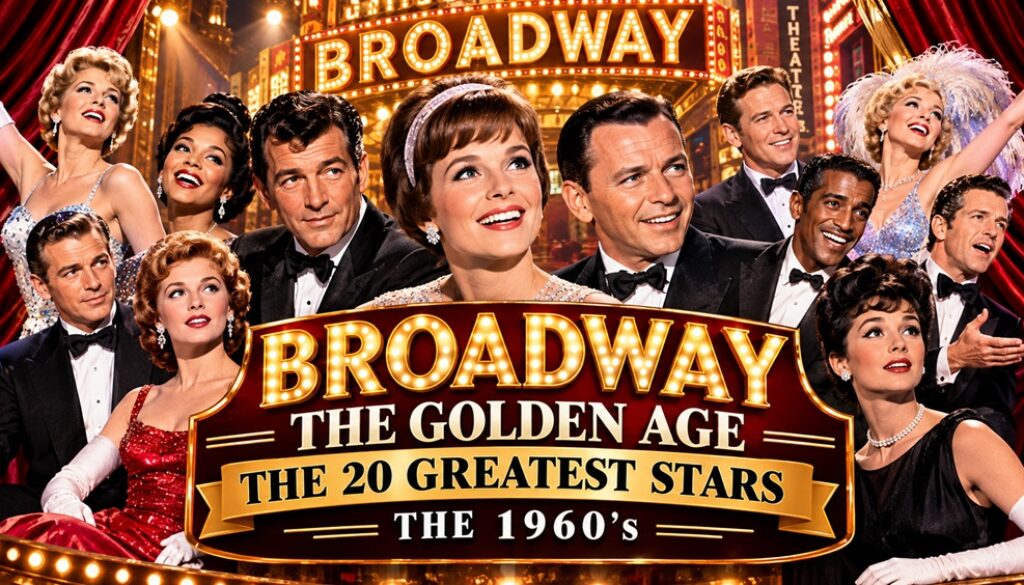
The 20 Greatest Broadway Entertainers of the 1960s: Legends of a Decade
The 20 Greatest Broadway Entertainers of the 1960s
A complete celebration of the showstoppers, vocal powerhouses, ground-breakers, and larger-than-life icons who transformed musical theatre during Broadway’s most dynamic decade.
The 1960s was a decade of monumental transformation for the American musical theatre. As the cultural landscape shifted dramatically outside the theater doors—marked by social revolution, counter-culture movements, and changing musical tastes—Broadway responded with an unparalleled wave of artistic innovation. The classic Golden Age formula evolved into bolder, morally complex, and conceptually daring musicals. Orchestrations rocked, staging grew more physical, and the performer took center stage as a raw, electrifying force of nature.
From meteoric vocal debuts that launched international superstardom to definitive character portrayals that defined an entire era, the performers of the 1960s set a breathtaking benchmark for stagecraft. Drawing from historical theatre archives, original newspaper reviews, Tony Award records, and the Internet Broadway Database (IBDB), here is the comprehensive ranking and retrospective of the 20 greatest Broadway entertainers of the 1960s.
1960s Broadway at a Glance
- The Era: The transition from the Golden Age into the Concept Musical and Rock Revolution.
- Landmark Shows: Camelot (1960), How to Succeed in Business Without Really Trying (1961), Hello, Dolly! (1964), Fiddler on the Roof (1964), Funny Girl (1964), Man of La Mancha (1965), Mame (1966), Cabaret (1966), and Hair (1968).
- Musical Evolution: Traditional Rodgers & Hammerstein symphonic scores met the driving rhythms of pop, rock, jazz, and vaudeville revivals.
- Performance Trend: Unfiltered emotional honesty, intense physical comedy, and show-stopping vocal belt technique.
A Revolution on the Great White Way
During the 1960s, Broadway was forced to compete with the meteoric rise of television, rock and roll, and Hollywood cinema. Rather than shrinking, Midtown Manhattan responded by producing some of the most vibrant, iconic, and long-running productions in history. A new generation of directors and choreographers—such as Bob Fosse, Jerome Robbins, Gower Champion, and Harold Prince—demanded extraordinary versatility from their casts. Actors in the 1960s had to deliver razor-sharp comedic timing, handle demanding vocal ranges, and execute groundbreaking choreography, all while conveying intense dramatic vulnerability.
The 20 Greatest Broadway Entertainers of the 1960s
1. Angela Lansbury
Angela Lansbury’s ascent to Broadway royalty in the 1960s is one of the most glorious chapters in theatre history. Already a respected film actress, Lansbury proved her musical credentials in Stephen Sondheim’s cult favorite Anyone Can Whistle (1964) before achieving absolute superstardom in Jerry Herman’s 1966 smash hit Mame. As the eccentric, life-loving Auntie Mame, Lansbury commanded the stage with razor-sharp wit, glamour, and boundless warmth, earning her first Tony Award for Best Actress in a Musical. She closed out the decade by winning her second Tony Award for her deeply moving performance in Dear World (1969), firmly establishing her as Broadway’s premier musical leading lady.
2. Barbra Streisand
Few debuts in entertainment history were as instantly volcanic as Barbra Streisand’s impact on 1960s Broadway. After stealing scenes and earning a Tony nomination as Miss Marmelstein in I Can Get It for You Wholesale (1962), Streisand landed the role of legendary vaudeville star Fanny Brice in 1964’s Funny Girl. At just 21 years old, her astonishing vocal range, unique comedic delivery, and sheer emotional power stopped the show every night with anthems like “Don’t Rain on My Parade” and “People.” Her performance transcended theatre, making her an international icon overnight and permanently altering the standard for musical theatre vocals.
3. Zero Mostel
A larger-than-life actor with matchless comic physical dexterity and overwhelming theatrical authority, Zero Mostel was the undisputed king of Broadway comedy during the 1960s. He dominated the decade with two historic, Tony-winning performances: first as the cunning, hilarious slave Pseudolus in Stephen Sondheim’s A Funny Thing Happened on the Way to the Forum (1962), and second as Tevye the milkman in Bock and Harnick’s Fiddler on the Roof (1964). Mostel’s Tevye became one of the most famous character portrayals in world theatre history, blending heart-wrenching dramatic pathos with belly-laugh humor.
4. Carol Channing
Having established herself in the 1950s in Gentlemen Prefer Blondes, Carol Channing achieved cultural immortality on January 16, 1964, when she marched down the staircase of the St. James Theatre in Jerry Herman’s Hello, Dolly!. With her wide-eyed innocence, signature rasp, and unbeatable comedic timing, Channing created a Dolly Levi for the ages. She won the 1964 Tony Award for Best Actress in a Musical over Barbra Streisand, lead the show for hundreds of performances, and embarked on legendary national tours that defined her career for decades.
5. Joel Grey
Joel Grey’s performance as the sinister, chalk-faced Master of Ceremonies in Kander and Ebb’s revolutionary 1966 musical Cabaret remains one of the most terrifyingly brilliant character creations in theatrical history. Under the direction of Harold Prince and choreography of Ron Field, Grey’s eerie, menacing, yet hypnotic presence anchored the show’s dark exploration of Weimar Germany. Grey earned the 1967 Tony Award for Best Featured Actor in a Musical, later winning an Academy Award for the film adaptation, making him one of a select few to win both awards for the same role.
6. Richard Burton
The legendary Welsh actor Richard Burton brought magnetic Shakespearean grandeur, commanding vocal authority, and rugged romantic power to the musical stage in 1960 as King Arthur in Lerner and Loewe’s Camelot. Starring alongside Julie Andrews and Robert Goulet, Burton’s subtle, emotionally rich portrayal of the idealist king captivated audiences and critics alike. He won the 1961 Tony Award for Best Actor in a Musical, and his definitive recording of the title song became forever linked with the idealist spirit of the Kennedy presidency.
7. Jerry Orbach
Long before becoming a beloved television icon on Law & Order, Jerry Orbach was one of Broadway’s absolute favorite leading men and versatile song-and-dance anchors. Orbach began the decade off-Broadway originating El Gallo in The Fantasticks (1960), introducing the classic song “Try to Remember.” He went on to dominate Broadway in 1961’s Carnival!, 1965’s revival of Guys and Dolls, and ultimately achieved star status as Chuck Baxter in Burt Bacharach’s hit 1968 musical Promises, Promises, winning the Tony Award for Best Actor in a Musical.
8. Robert Goulet
With his rich, operatic baritone voice, dark good looks, and classic stage presence, Robert Goulet was the breakthrough romantic sensation of 1960. Making his Broadway debut as Sir Lancelot in Camelot, Goulet melted hearts every night with his soaring rendition of “If Ever I Would Leave You.” His overnight success catapulted him into top-tier stardom across recordings and television. He returned to Broadway in 1968 to star in Kander and Ebb’s The Happy Time, winning the Tony Award for Best Actor in a Musical.
9. Robert Morse
Possessing boundless boyish energy, a wicked impish grin, and flawless comedic instincts, Robert Morse defined the modern corporate satirical hero in 1961 as J. Pierrepont Finch in Frank Loesser’s Pulitzer Prize-winning How to Succeed in Business Without Really Trying. Morse’s brilliant physical comedy and joyful performance of “I Believe in You” earned him the 1962 Tony Award for Best Actor in a Musical and established him as one of the most gifted comedic actors of his generation.
10. Richard Kiley
Richard Kiley possessed one of the most resonant, powerful baritone voices in American theatre history. In 1965, he achieved theatrical immortality by originating the dual roles of Miguel de Cervantes and Don Quixote in Mitch Leigh and Joe Darion’s Man of La Mancha. Kiley’s soaring, heroic rendition of “The Impossible Dream (The Quest)” became a landmark moment of 1960s culture. His deeply moving performance earned him the 1966 Tony Award for Best Actor in a Musical, cementing his status as a titan of the stage.
Key 1960s Tony Winners
- 1961: Richard Burton (Camelot)
- 1962: Robert Morse (How to Succeed…)
- 1964: Carol Channing (Hello, Dolly!)
- 1965: Zero Mostel (Fiddler on the Roof)
- 1966: Angela Lansbury (Mame)
- 1969: Jerry Orbach (Promises, Promises)
1960s Showstoppers
- “Don’t Rain on My Parade” – Barbra Streisand
- “If I Were a Rich Man” – Zero Mostel
- “If Ever I Would Leave You” – Robert Goulet
- “Open a New Window” – Angela Lansbury
- “The Impossible Dream” – Richard Kiley
- “Willkommen” – Joel Grey
11. Gwen Verdon
After dominating the 1950s, Gwen Verdon continued her reign as Broadway’s undisputed dance icon into the 1960s. In 1966, she reteamed with husband and director-choreographer Bob Fosse to star as Charity Hope Valentine in Sweet Charity. Verdon’s matchless dance technique, quirky charm, and heart-wrenching emotional vulnerability brought numbers like “If My Friends Could See Me Now” and “There’s Gotta Be Something Better Than This” to vibrant life, earning her another Tony Award nomination and continuing her legendary legacy.
12. Bernadette Peters
The late 1960s saw the luminous debut of a teenager who would become one of musical theatre’s most beloved divas: Bernadette Peters. After appearing in minor roles, Peters captured the hearts of New York theatregoers in the 1968 Off-Broadway parody Dames at Sea, winning a Drama Desk Award. That same year, she made her major Broadway impression starring as Ruby in The Most Happy Fella and opposite Joel Grey in George M! (1968), earning her first Tony Award nomination and launching an legendary multi-decade career.
13. Elaine Stritch
Brash, brutally honest, and possessing razor-sharp comic delivery, Elaine Stritch was a unique theatrical force. In 1961, she starred as Mimi Paragon in Noël Coward’s musical Sail Away, where Coward famously expanded her role during out-of-town tryouts because her comic instincts were so brilliant. Her show-stopping performance of “Why Do the Wrong People Travel?” earned her a Tony nomination. Stritch capped off the decade preparing for her most famous role in Stephen Sondheim’s Company (1970).
14. Tammy Grimes
With her eccentric husky voice, sharp wit, and captivating stage presence, Tammy Grimes became an overnight sensation in 1960 when she originated the title role of the stubborn, unyielding socialite Molly Tobin in Meredith Willson’s The Unsinkable Molly Brown. Grimes carried the high-energy show with incredible vigor, introducing “I Ain’t Down Yet” and winning the Tony Award for Best Featured Actress in a Musical, launching a stellar stage career.
15. Leslie Uggams
Leslie Uggams made history in 1967 when she starred as Georgina Holmes in the Jule Styne musical Hallelujah, Baby!. Showing off soaring vocals, dramatic poise, and radiant charm, Uggams led a narrative that chronicled an African American woman’s journey through six decades of American history. Her performance won the 1968 Tony Award for Best Actress in a Musical, making her one of the most celebrated young leading ladies of the era.
16. Georgia Brown
British actress and singer Georgia Brown brought raw emotional power and gravelly vocal intensity to Broadway in 1963 when she originated the role of Nancy in Lionel Bart’s London sensation Oliver!. Her heartbreaking, powerful rendition of “As Long as He Needs Me” stopped the show nightly at the Imperial Theatre, earning her a Tony nomination and setting the definitive standard for one of theatre’s most famous tragic roles.
17. Beatrice Arthur
Long before starring on Maude and The Golden Girls, Bea Arthur was a formidable Broadway character actress with unmatched deadpan comedic delivery. In 1964, she created the role of Yente the Matchmaker in Fiddler on the Roof. In 1966, she achieved musical triumph as Vera Charles, the booze-hound best friend and stage rival to Angela Lansbury’s Mame Dennis in Mame. Her hilarious duet “Bosom Buddies” with Lansbury earned Arthur the 1966 Tony Award for Best Featured Actress.
18. John Cullum
Possessing a magnificent, crystal-clear tenor-baritone voice, John Cullum emerged as one of Broadway’s most reliable and talented leading men in the 1960s. After understudying Richard Burton in Camelot, Cullum achieved his breakthrough in Lerner and Lane’s 1965 musical On a Clear Day You Can See Forever opposite Barbara Harris. His breathtaking rendition of the title song earned him a Tony nomination and established him as a premier leading man.
19. Barbara Harris
Barbara Harris was one of the most brilliant, unpredictable, and delightful comedic actresses to grace the 1960s stage. After earning raves in From the Second City and On a Clear Day You Can See Forever, Harris delivered a masterclass performance in Jerry Bock and Sheldon Harnick’s 1966 three-part musical The Apple Tree. Her incredible versatility across three different roles earned her the 1967 Tony Award for Best Actress in a Musical.
20. Liza Minnelli
Daughter of Judy Garland and director Vincente Minnelli, Liza Minnelli proved in the mid-1960s that she possessed a theatrical firepower all her own. In 1965, at the age of just 19, Minnelli made her Broadway musical debut starring in Kander and Ebb’s Flora the Red Menace. Her dynamic energy, expressive belt voice, and emotional vulnerability won her the 1965 Tony Award for Best Actress in a Musical—making her the youngest actress in history at the time to receive the honor.
The Enduring Legacy of 1960s Broadway Stars
The 20 performers highlighted in this retrospective navigated a pivotal decade in American cultural history. They took the traditional Broadway musical and breathed dynamic new life into it—paving the way for the conceptual masterpieces, rock operas, and sung-through dramas that would define the 1970s and beyond.
Through their iconic original cast albums, historic television appearances, and unforgettable stage performances, legends like Angela Lansbury, Barbra Streisand, Carol Channing, and Zero Mostel proved that the stage performer remains the vital, beating heart of the live theatre experience. Their extraordinary talent continues to inspire performers and thrill theatre lovers around the world.
Reporting compiled from Playbill, Internet Broadway Database (IBDB), BroadwayWorld, TheatreGold Archives, Time Out New York, Musicals101, and the Rodgers & Hammerstein Organization.
Explore More Theatre Memorabilia & Musicals
Browse authentic memorabilia and further reading from TheatreGold’s archive: