Carol Channing Biography: Life, Broadway Shows, Movies & Legacy
Broadway Legend Retrospective · Deep Dive · Musical Theatre History
Carol Channing: The Definitive Biography of Broadway’s Dolly Levi, Lorelei Lee & Larger-Than-Life Legend
From a San Francisco schoolgirl who fell in love with the theatre to the woman who played Dolly Gallagher Levi more than 5,000 times, here is the complete life, career and legacy of Carol Channing.
| Jan 31, 1921Born, Seattle | Jan 15, 2019Died, Rancho Mirage | 5,000+Times as Dolly | 3 Tonys1 Competitive, 2 Special | 1981Theater Hall of Fame |
Few performers in Broadway history have been as instantly recognisable as Carol Channing. The saucer-wide eyes, the platinum hair, the enormous grin and, above all, that husky, gravel-and-honey voice made her a star the moment audiences saw her. Theatregoers knew her as Lorelei Lee, the gold-digging blonde from Little Rock who declared that “Diamonds Are a Girl’s Best Friend”, and above all as Dolly Gallagher Levi, the matchmaking widow who swept down the staircase of the Harmonia Gardens to the title song of Hello, Dolly!
Channing’s career stretched across almost eight decades, from a Marc Blitzstein musical in 1941 to birthday celebrations and benefit concerts in her nineties. She won a Tony Award, a Golden Globe and two special Tonys, earned an Academy Award nomination, and was inducted into the American Theater Hall of Fame. Yet her fame rested less on trophies than on her devotion to live performance. Hollywood twice gave her signature roles to other stars, first Marilyn Monroe and then Barbra Streisand. Channing responded by taking her characters on the road and playing them, by her own count, thousands of times for audiences around the world. Below is the complete biography of Carol Channing: her early life, every major stage show, her films and television work, her personal life, death, legacy, popular culture and awards.
Carol Channing at a Glance: Essential Life & Career Facts
- Full Name: Carol Elaine Channing
- Born: January 31, 1921, in Seattle, Washington
- Died: January 15, 2019 (aged 97), in Rancho Mirage, California
- Education: Lowell High School, San Francisco (1938); Bennington College, Vermont (drama and dance)
- Spouses: Theodore Naidish (1941–1944), Alexander Carson (1950s–1956), Charles Lowe (1956–1999), Harry Kullijian (2003–2011)
- Child: Channing “Chan” Lowe, editorial cartoonist and Pulitzer Prize finalist
- Signature Roles: Lorelei Lee (Gentlemen Prefer Blondes, Lorelei); Dolly Gallagher Levi (Hello, Dolly!)
- Major Awards: Tony Award for Best Actress in a Musical (1964); Golden Globe for Best Supporting Actress (1968); Special Tony Awards (1968 and 1995)
- Honours: American Theater Hall of Fame (1981); Hollywood Walk of Fame (1977); Palm Springs Walk of Stars (2010)
- Tribute: Broadway’s marquee lights dimmed in her memory on January 16, 2019
Life and Early Years: A Seattle Birth and a San Francisco Childhood
Carol Elaine Channing was born on January 31, 1921, in Seattle, Washington, the only child of Adelaide Glaser and George Channing. Her father, who had been born George Christian Stucker, was a Christian Science practitioner, editor and teacher. When Carol was two, the family moved to San Francisco, and she was raised in the Christian Science faith, which shaped her outlook on health and life for decades.
The theatre captured her early. Channing later said she knew she wanted to sing on stage after seeing the great Ethel Waters perform. San Francisco’s cheap school-day tickets for touring productions gave her a steady diet of professional theatre. At school she discovered another talent, talking to a crowd. Elected class secretary in fourth grade, she kept the post year after year, and the job of addressing her classmates taught her how to hold a room. She attended Aptos Junior High and Lowell High School, graduating in 1938. In 1937 she won the Crusaders’ Oratorical Contest, earning herself and her mother a trip to Hawaii.
At 17, Channing left California for Bennington College in Vermont, where she majored in drama and dance. Just before she departed, her mother told her a family secret: her father had Black ancestry. Her mother warned that it might show if she ever had children. Channing kept the fact private for more than 60 years, revealing it publicly only in 2002, in her memoir Just Lucky I Guess. The 2011 documentary Carol Channing: Larger Than Life also stated that her mother was Jewish. Channing said she was proud of her heritage and felt it explained some of her talent.
Career: From Understudy to Broadway Star
First Steps in New York (1941)
Channing’s first New York job came at the age of 19 in Marc Blitzstein’s No for an Answer (1941), staged at the Mecca Temple, the building now known as New York City Center. Later that year she served as understudy to Eve Arden in Cole Porter’s Let’s Face It!, covering the role of Maggie Watson. The 1940s were lean years of auditions, small parts, revue sketches and nightclub dates. Her voice and look were so unusual that some producers didn’t know what to do with her.
The Breakthrough: Lend an Ear (1948)
Everything changed with the 1948 revue Lend an Ear, written by Charles Gaynor and directed and choreographed by a young Gower Champion, who would later direct her greatest triumph. In a series of comic sketches, including the role of Mrs. Playgoer, Channing stopped the show night after night. She won a Theatre World Award, and critics hailed a comedienne with no obvious precedent. The caricaturist Al Hirschfeld drew her for The New York Times, and his drawing, with its huge eyes and wide smile, helped fix her image in the public mind. Hirschfeld’s caricatures followed her for the rest of her career.
Gentlemen Prefer Blondes (1949): Lorelei Lee
Producers adapting Anita Loos’s comic novel Gentlemen Prefer Blondes as a musical cast Channing as Lorelei Lee, the shrewd, sweet-voiced blonde from Little Rock. With music by Jule Styne, lyrics by Leo Robin, a book by Joseph Fields and Anita Loos, direction by John C. Wilson and choreography by Agnes de Mille, the show opened at the Ziegfeld Theatre on December 8, 1949. It ran for 740 performances, closing on September 15, 1951. Channing’s numbers included “I’m Just a Little Girl from Little Rock”, “Bye Bye Baby” and the song that would follow her forever, “Diamonds Are a Girl’s Best Friend”. Time magazine put her on its cover, and Lorelei made her a star. When Twentieth Century Fox filmed the story in 1953, however, the role went to Marilyn Monroe, the first of two times Hollywood would pass her over for a role she had made famous.
The 1950s: Replacements, Tours and The Vamp
After Blondes, Channing kept busy on stage. She played Eliza Doolittle in Shaw’s Pygmalion (1953) and Mehitabel the cat in Archy and Mehitabel (1954). In 1954 she succeeded Rosalind Russell as Ruth Sherwood in Leonard Bernstein’s Wonderful Town, playing the role on Broadway and on tour. In 1955 she starred as Flora Weems in The Vamp, a musical about the silent-film era that ran only briefly but earned her a first Tony nomination for Best Actress in a Musical. She also appeared in the revue Show Business (1959) and toured with George Burns in a nightclub act that sharpened her comic timing.
Show Girl (1961) and The Millionairess (1963)
The revue Show Girl (1961), essentially a showcase for Channing’s comic monologues and songs, played a short Broadway run and brought her a second Tony nomination. In 1963 she took on Shaw again, playing the formidable heiress Epifania Ognisanti di Parerga in The Millionairess. By now she was one of the best-known comic actresses in America, but she had not yet found the role that would define her.
Hello, Dolly! (1964): The Role of a Lifetime
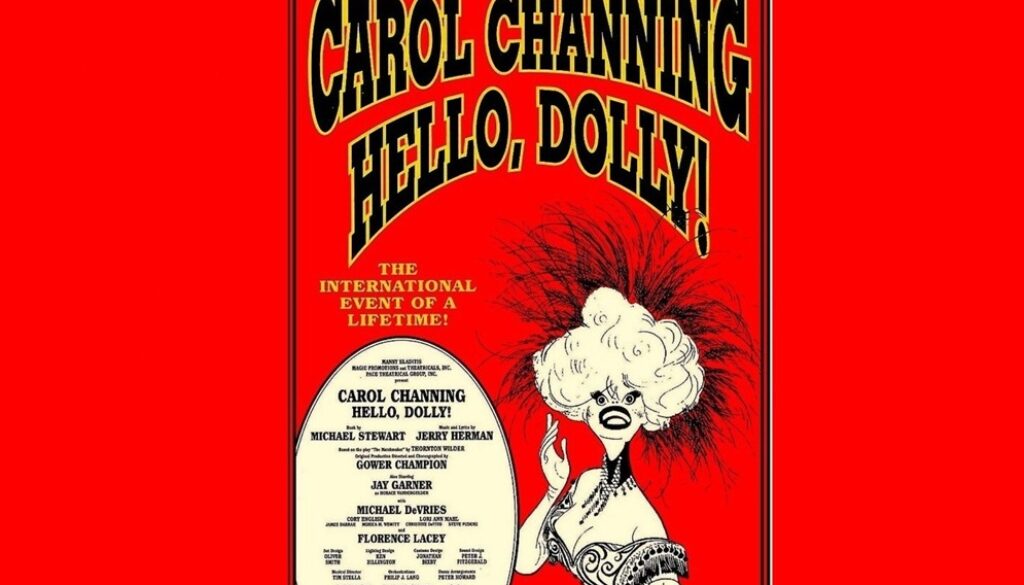
Producer David Merrick’s new musical, based on Thornton Wilder’s farce The Matchmaker, had a score by Jerry Herman and a book by Michael Stewart. The role of Dolly Gallagher Levi, the widowed matchmaker who sets her cap at Yonkers merchant Horace Vandergelder, had been written with Ethel Merman in mind, but Merman turned it down. Director and choreographer Gower Champion, who remembered Channing from Lend an Ear, championed her for the part.
Hello, Dolly! opened at the St. James Theatre on January 16, 1964. Channing’s descent down the red staircase of the Harmonia Gardens restaurant, greeted by a line of singing waiters, became one of the most famous entrances in Broadway history. The show was a phenomenon. Louis Armstrong’s recording of the title song knocked the Beatles off the top of the Billboard chart, and the musical won 10 of its 11 Tony nominations, including Best Musical, a record that stood for 37 years. Channing won the Tony Award for Best Actress in a Musical, beating Barbra Streisand, nominated for Funny Girl.
The original production ran until December 27, 1970, for 2,844 performances, becoming at the time the longest-running musical in Broadway history. A remarkable line of stars succeeded Channing on Broadway, including Ginger Rogers, Martha Raye, Betty Grable, Pearl Bailey, Phyllis Diller and finally Ethel Merman. Meanwhile, Channing led the national tour. When the film version arrived in 1969, Dolly went to Barbra Streisand. Channing later said that watching it felt like attending her own funeral.
She never let Dolly go. Channing headlined Broadway revivals at the Lunt-Fontanne Theatre in 1978 (with Eddie Bracken as Horace) and again in 1995 (with Jay Garner), and toured the role extensively in between, including a London engagement that earned her an Olivier Award nomination in 1979. By the end of her career she had played Dolly more than 5,000 times. In 1964 she even performed a rewritten version, “Hello, Lyndon”, for Lyndon B. Johnson’s presidential campaign, becoming a favourite of Lady Bird Johnson.
Four on a Garden (1971) and Lorelei (1974)
Between Dollys, Channing co-starred with Sid Caesar in Four on a Garden (1971), a set of four comic one-act plays in which she played several characters. Then she returned to her first great role. Lorelei, a reworking of Gentlemen Prefer Blondes that framed the story as the memories of an older Lorelei Lee and added new songs by Jule Styne with lyrics by Betty Comden and Adolph Green, premiered in Oklahoma City in 1973 and broke box office records on a long pre-Broadway tour. It opened at the Palace Theatre on January 27, 1974, ran for 320 performances, and brought Channing her fourth Tony nomination.
Later Stage Work
Channing appeared in Ben Travers’s comedy The Bed Before Yesterday (1976) and in 1985 toured opposite Mary Martin in James Kirkwood’s comedy Legends!, playing faded film star Sylvia Glenn. Although the play never reached Broadway, the pairing of two great musical stars drew big audiences across the country. In later decades she appeared in countless galas and tributes, including Jerry’s Girls (1984), Happy Birthday, Mr. Abbott! (1987), Broadway at the Bowl (1988) and the Hello, Dolly! 50th anniversary celebration in 2014. Fans also packed concerts celebrating her 95th birthday in 2016.
Film and Television Career
Films
- Paid in Full (1950): Channing’s first credited screen role, as Charlotte Hendricks.
- The First Traveling Saleslady (1956): Co-starring with Ginger Rogers in this Western comedy, Channing gave a young Clint Eastwood his first onscreen kiss.
- Thoroughly Modern Millie (1967): As the flamboyant millionairess Muzzy Van Hossmere, opposite Julie Andrews, Mary Tyler Moore and Beatrice Lillie, Channing won the Golden Globe for Best Supporting Actress and earned an Academy Award nomination in the same category. It was her most acclaimed film performance.
- Skidoo (1968): Otto Preminger’s notorious counterculture comedy, co-starring Jackie Gleason and Groucho Marx, has become a cult favourite.
- Sgt. Pepper’s Lonely Hearts Club Band (1978): A cameo in the star-packed Beatles musical.
- The Line King: The Al Hirschfeld Story (1996): She appeared in this documentary about the caricaturist who helped make her famous.
Television
Television brought Channing into homes across America. She was a regular guest on variety shows such as The Ed Sullivan Show and The Andy Williams Show, and appeared on the panel game What’s My Line? 11 times between 1962 and 1966. Her first special, An Evening with Carol Channing, aired in 1966, the same year she filmed a sitcom pilot, The Carol Channing Show, at Desilu, though it was never picked up. Highlights of later decades include:
- Free to Be… You and Me (1974): Marlo Thomas’s landmark children’s special.
- The Love Boat: Guest appearances as Aunt Sylvia.
- The Muppet Show (1980): A memorable duet with Miss Piggy.
- Alice in Wonderland (1985): The White Queen in a star-studded CBS adaptation.
- Sesame Street (1986): A “Hello, Dolly!” parody sung to Sammy the Snake.
- The Addams Family (1992–1995): She voiced Grandmama in the animated series.
- The Nanny (1993): Playing herself in the episode “Smoke Gets in Your Lies”.
- Family Guy (2006): Playing herself in a boxing match against Mike Tyson. Famously, she refused to say the scripted swear word and settled on “friggen” instead.
She also made history as one of the first celebrity performers at a Super Bowl halftime show, and her television work earned her a star on the Hollywood Walk of Fame in 1977.
Personal Life: Four Marriages and a Late-Life Romance
Channing married four times. Her first husband was the writer Theodore Naidish, whom she married in 1941. They divorced in 1944, but she grew close to his family and picked up Yiddish from her in-laws. Her second husband was Alexander “Axe” Carson, a Canadian football centre for the Ottawa Rough Riders who also worked as a private detective. They had one son, Channing, and divorced in 1956. The boy later took the surname of his stepfather and grew up to be Chan Lowe, the editorial cartoonist for the South Florida Sun-Sentinel and a Pulitzer Prize finalist.
In 1956 Channing married Charles Lowe, a television producer who had worked on The Burns and Allen Show and who became her manager and publicist. The marriage lasted more than four decades, and Lowe shaped much of her career and public image. In 1998 Channing filed for divorce, alleging that he had controlled her finances and life, but Lowe died in 1999 before the divorce was finalised.
The final chapter of her love life read like a musical comedy. While writing her memoir, Channing mentioned her junior high school sweetheart, Harry Kullijian. The two reconnected after more than 70 years and married on May 10, 2003. They lived together in Modesto and later in the Palm Springs area until his death on December 26, 2011. Together they founded the Dr. Carol Channing and Harry Kullijian Foundation, which campaigned to restore arts education in California’s public schools.
Away from the stage, Channing was famously disciplined. She did not drink alcohol, and for many years she carried her own food in sealed containers rather than eat in restaurants, a habit rooted in her strict health beliefs. She survived ovarian cancer and continued performing well into her eighties.
The Nixon Enemies List
In 1973, during the Watergate hearings, Americans learned that Carol Channing appeared on President Richard Nixon’s “enemies list”, the White House roster of political opponents. Channing, a longtime Democratic supporter, said being on the list was the highest honour of her career.
Death and Legacy
Carol Channing died of natural causes in the early hours of January 15, 2019, at her home in Rancho Mirage, California, two weeks before her 98th birthday. She had suffered two strokes in the preceding year. The next evening, Broadway’s theatres dimmed their marquee lights in her memory, an honour reserved for the theatre’s greatest figures. In San Diego, Betty Buckley dedicated that night’s performance of the Hello, Dolly! national tour to her. Her ashes were scattered between the Curran and Geary theatres in San Francisco, the playhouses where her love of the stage began.
Her legacy lives on in several ways:
- The defining Dolly: Many stars have played Dolly Levi, from Pearl Bailey and Ethel Merman to Bette Midler and Bernadette Peters in the 2017 revival. But the role remains inseparable from Channing, who played it more than 5,000 times and toured it across America and beyond.
- Champion of live theatre: Unlike most stars of her era, Channing built her career on touring and stage work rather than film, carrying Broadway to audiences who might never visit New York.
- Arts education: Through the foundation she founded with Harry Kullijian, she campaigned for arts in schools. She received an honorary doctorate from California State University, Stanislaus, in 2004.
- Honours: She was inducted into the American Theater Hall of Fame in 1981. Her alma mater, Lowell High School, named its auditorium after her in 1984, and San Francisco declared February 14, 1988, “Carol Channing Day”. She received the Oscar Hammerstein Award for Lifetime Achievement in Musical Theatre in 2004 and a star on the Palm Springs Walk of Stars in 2010.
- On film: The documentary Carol Channing: Larger Than Life tells her story through interviews, performance footage and appearances by fellow stars.
Carol Channing in Popular Culture
Channing’s voice and look were among the most imitated in show business. Impressionists and drag performers caricatured her for decades, and she loved it, regarding every impression as a measure of her fame. She once recalled attending a Las Vegas drag show with George Burns in which she herself was the theme. Her look, with its huge eyes, platinum wig and broad smile, was a gift to cartoonists. Al Hirschfeld drew her repeatedly over the years, and his 1948 sketch remains one of his best-known theatre caricatures.
Her songs entered the wider culture too. “Diamonds Are a Girl’s Best Friend” became a standard performed by generations of singers, and “Hello, Dolly!” became one of the most recognisable show tunes ever written. On television, Channing was happy to send herself up. She duetted with Miss Piggy, serenaded a snake on Sesame Street, and boxed Mike Tyson on Family Guy. Her place on Nixon’s enemies list, her famous homemade meals and her decades-long run as Dolly all became part of a legend she enjoyed as much as her audiences did. Her 2002 memoir Just Lucky I Guess: A Memoir of Sorts, which she also recorded as an audiobook, was full of the same self-deprecating humour.
Work List: Carol Channing’s Stage Shows
| Year | Production | Role | Notes |
|---|---|---|---|
| 1941 | No for an Answer | Ensemble | Marc Blitzstein musical; first New York stage job |
| 1941 | Let’s Face It! | Maggie Watson (understudy) | Understudy to Eve Arden |
| 1948 | Lend an Ear | Mrs. Playgoer and others | Revue directed by Gower Champion; Theatre World Award |
| 1949 | Gentlemen Prefer Blondes | Lorelei Lee | Ziegfeld Theatre; 740 performances; introduced “Diamonds Are a Girl’s Best Friend” |
| 1953 | Pygmalion | Eliza Doolittle | Shaw’s comedy |
| 1954 | Archy and Mehitabel | Mehitabel | Musical based on Don Marquis’s stories |
| 1954 | Wonderful Town | Ruth Sherwood | Replaced Rosalind Russell; also toured |
| 1955 | The Vamp | Flora Weems | Tony nomination |
| 1959 | Show Business | Performer | Revue |
| 1961 | Show Girl | Lynn | Revue; Tony nomination |
| 1963 | The Millionairess | Epifania | Shaw’s comedy |
| 1964 | Hello, Dolly! | Dolly Gallagher Levi | St. James Theatre; 2,844 performances; Tony Award for Best Actress |
| 1971 | Four on a Garden | Multiple roles | Four one-act comedies with Sid Caesar |
| 1974 | Lorelei | Lorelei Lee | Palace Theatre; 320 performances; Tony nomination |
| 1976 | The Bed Before Yesterday | Lead role | Ben Travers comedy |
| 1978 | Hello, Dolly! (revival) | Dolly Gallagher Levi | Lunt-Fontanne Theatre; 147 performances |
| 1979 | Hello, Dolly! (London) | Dolly Gallagher Levi | Olivier Award nomination |
| 1985 | Legends! | Sylvia Glenn | National tour with Mary Martin |
| 1995 | Hello, Dolly! (revival) | Dolly Gallagher Levi | Lunt-Fontanne Theatre; 116 performances; her final Broadway run |
Selected Film and Television Work
| Year | Title | Role |
|---|---|---|
| 1950 | Paid in Full | Charlotte Hendricks |
| 1956 | The First Traveling Saleslady | Molly Wade |
| 1966 | An Evening with Carol Channing (TV) | Herself |
| 1967 | Thoroughly Modern Millie | Muzzy Van Hossmere |
| 1968 | Skidoo | Flo Banks |
| 1978 | Sgt. Pepper’s Lonely Hearts Club Band | Cameo |
| 1985 | Alice in Wonderland (TV) | The White Queen |
| 1992–95 | The Addams Family (animated TV) | Grandmama (voice) |
| 2006 | Family Guy (TV) | Herself (voice) |
Awards and Nominations
| Year | Award | Category | Work | Result |
|---|---|---|---|---|
| 1948 | Theatre World Award | Outstanding Performance | Lend an Ear | Won |
| 1956 | Tony Award | Best Actress in a Musical | The Vamp | Nominated |
| 1961 | Tony Award | Best Actress in a Musical | Show Girl | Nominated |
| 1964 | Tony Award | Best Actress in a Musical | Hello, Dolly! | Won |
| 1966 | Sarah Siddons Award | — | Chicago theatre honour | Won |
| 1968 | Golden Globe Award | Best Supporting Actress – Motion Picture | Thoroughly Modern Millie | Won |
| 1968 | Academy Award | Best Supporting Actress | Thoroughly Modern Millie | Nominated |
| 1968 | Tony Award | Special Tony Award | — | Won |
| 1974 | Tony Award | Best Actress in a Musical | Lorelei | Nominated |
| 1977 | Hollywood Walk of Fame | Television | — | Honoured |
| 1979 | Olivier Award | Best Actress in a Musical | Hello, Dolly! | Nominated |
| 1981 | American Theater Hall of Fame | Induction | Career | Inducted |
| 1991 | Grammy Award | Best Album for Children | Peter and the Wolf / A Zoo Called Earth / Gerald McBoing Boing | Nominated |
| 1995 | Tony Award | Special Tony Award for Lifetime Achievement | — | Won |
| 1996 | Drama Critics’ Circle | Lifetime Achievement | — | Won |
| 2002 | Grammy Hall of Fame | Recording | Hello, Dolly! Original Broadway Cast Album | Inducted |
| 2004 | Oscar Hammerstein Award | Lifetime Achievement in Musical Theatre | — | Won |
| 2010 | Palm Springs Walk of Stars | — | — | Honoured |
The Final Curtain: Why Carol Channing Still Matters
Carol Channing was never a conventional leading lady, and that was the secret of her success. She didn’t rely on glamour or conventional beauty. Instead she built a stage persona so original that it couldn’t be copied, only imitated. She turned a voice that some early producers found strange into one of the most beloved sounds in American entertainment. Losing two great screen roles didn’t discourage her; she simply took her characters to the people, playing Lorelei and Dolly in theatres from coast to coast for more than half a century.
Her story spans the whole history of the modern Broadway musical. She began in the era of Cole Porter and Marc Blitzstein, starred in two landmark hits of the Golden Age, lived to see her Dolly revived by a new generation of stars, and remained a beloved presence at galas and tributes into the 21st century. When the lights of Broadway dimmed for her in January 2019, they honoured a performer who gave her life to the stage, the woman who will always be, for millions of theatregoers, the one and only Dolly.
Biographical data, stage credits, filmography and awards listings compiled from Wikipedia, The Hollywood Reporter, TheaterMania, the Tony Awards archive, the Internet Broadway Database (IBDB) and the TheatreGold archives.
Explore Authentic Broadway Memorabilia
Discover historic Playbills, rare original cast recordings and authentic theatrical souvenirs from Carol Channing’s legendary Broadway shows at TheatreGold’s store:
Carol Channing – Playbills & Collectibles Hello, Dolly! – Memorabilia Phantom of the Opera – Memorabilia Lorelei – Vintage Playbills/Programs Jerry Herman Musicals – Collectibles Broadway Playbills – Rare Editions