Julie Andrews: The Legendary Life, Broadway Triumphs, and Cinematic Legacy of an Icon
Dame Julie Andrews: The Definitive Life Story, Broadway Masterpieces, and Cinema Legacy of a Global Icon
Key Retrospective Highlights
- Child Prodigy & Voice: Boasted a legendary four-octave vocal range as a young Vaudeville performer in Britain.
- Broadway Milestones: Originated the iconic roles of Eliza Doolittle in My Fair Lady (1956) and Queen Guenevere in Camelot (1960).
- Hollywood Immortality: Won the Best Actress Academy Award for her film debut in Disney’s Mary Poppins (1964) and cemented her global stardom in The Sound of Music (1965).
- Screen Versatility: Starred in ground-breaking cinema including The Americanization of Emily, Thoroughly Modern Millie, and her Oscar-nominated dual role in Victor/Victoria (1982).
- Modern Resurgence: Loved by younger generations for playing Queen Clarisse Renaldi in The Princess Diaries and voicing Lady Whistledown in Netflix’s Bridgerton.
- Honors: Made a Dame Commander of the Order of the British Empire (DBE) in 2000 and recipient of the AFI Life Achievement Award, Grammy Lifetime Achievement Award, and Kennedy Center Honors.
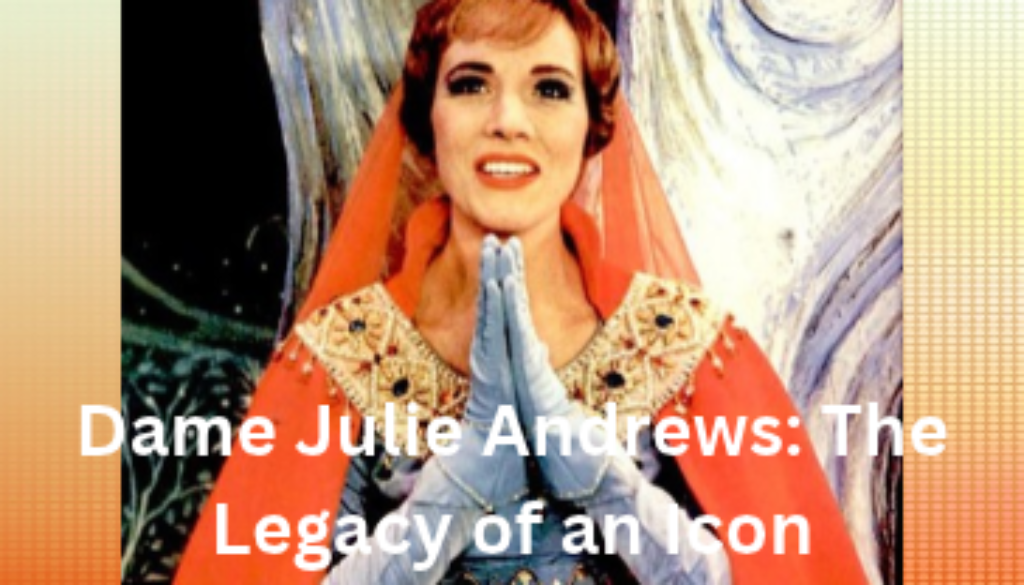
There are stars who capture the spirit of an era, and then there are performers who become part of the world’s collective cultural heart. Dame Julie Andrews belongs to that rarest tier of artistic royalty. With a crystalline, four-octave soprano voice, impeccable comedic timing, and an undeniable warmth of spirit, Andrews defined the golden standard of musical performance across stage, television, and cinema for more than seven decades.
From her early days singing in British vaudeville halls as a young child prodigy to dominating Broadway in My Fair Lady, and from floating into cinema history carrying a carpetbag as Mary Poppins to running across the Austrian Alps as Maria von Trapp, her career is a testament to extraordinary talent, grit, and grace. Her story encompasses triumphs that broke box-office records around the globe, creative partnerships with film giant Blake Edwards, deeply personal resilience in the face of vocal loss, and an enduring reign as an author and pop-culture icon.
1. Early Life, Vaudeville Beginnings, and Child Stardom
Julia Elizabeth Wells was born on October 1, 1935, in Walton-on-Thames, Surrey, England. Her early childhood unfolded against the turbulent backdrop of World War II. Her mother, Barbara Ward Wells (née Morris), was a pianist, and her father, Edward Charles “Ted” Wells, was a teacher of metalwork and woodwork. Her parents divorced during the war, and her mother remarried Ted Andrews, a charismatic but alcoholic vaudeville singer. Julia took her stepfather’s surname, becoming known as Julie Andrews.
During the Blitz, the family lived in working-class London, where her parents performed regularly in music halls. It was during childhood voice lessons that her stepfather and mother made a staggering discovery: young Julie possessed an extraordinarily rare, near-perfect pitch and an astonishing four-octave vocal range.
The Vocal Prodigy of the London Stage
At just twelve years old, Andrews made her professional solo debut at the London Hippodrome in 1947, singing a demanding operatic aria (“Je suis Titania” from Mignon) as part of the revue Starlight Roof. Her staggering vocal agility stunned British theatergoers and critics alike.
On October 1, 1948—her thirteenth birthday—she became the youngest solo performer ever chosen to appear in the Royal Variety Performance at the London Palladium, singing before King George VI and Queen Elizabeth (the Queen Mother). Over the next six years, she toured extensively across Britain in pantomimes, radio broadcasts, and music halls, refining her disciplined stage technique.
2. Broadway Breakthrough: From London to NY Stardom
In 1954, just shy of her nineteenth birthday, Andrews caught the attention of director Vidal Morris and producer Cy Feuer, who were mounting an American production of Sandy Wilson’s hit West End musical comedy The Boy Friend.
The Boy Friend (1954)
Andrews traveled to New York to make her Broadway debut playing Polly Browne, a wealthy English heiress in a 1920s finishing school. Her deadpan comedic sensibility, flawless diction, and beautiful voice earned ecstatic reviews. Critics praised her as the standout revelation of the season. The Boy Friend ran for 485 performances, establishing Andrews as one of Broadway’s most promising new talents.
My Fair Lady (1956): Legendary Stardom
As her run in The Boy Friend neared its end, composer Frederick Loewe and lyricist Alan Jay Lerner approached Andrews to star in their musical adaptation of George Bernard Shaw’s Pygmalion, titled My Fair Lady.
Cast as Eliza Doolittle—the cockney flower girl transformed into a high-society lady by phonetics professor Henry Higgins (played by Rex Harrison)—Andrews faced a grueling rehearsal process under director Moss Hart. Hart famously spent an entire weekend working privately with Andrews to unlock the emotional depth and fiery spirit required for the role.
When My Fair Lady opened at the Mark Hellinger Theatre on March 15, 1956, it was a colossal success. It became a cultural phenomenon, breaking records to become the longest-running Broadway musical of its era. Andrews earned her first Tony Award nomination for Best Actress in a Musical and became an international celebrity. She later repeated her triumphant performance in the West End at the Theatre Royal, Drury Lane in 1958.
“Moss Hart gave me the greatest gift a director could give an actor: he gave me confidence. He taught me to dig inside myself and find Eliza’s rage, her pride, and her passion.” — Julie Andrews on rehearsing My Fair Lady
Camelot (1960)
Lerner and Loewe reunited with Andrews for their next grand Broadway venture, Camelot, co-starring Richard Burton as King Arthur and Robert Goulet as Lancelot. Andrews played Queen Guenevere, delivering regal elegance and singing classics like “The Simple Joys of Maidenhood” and “What Do the Simple Folk Do?”
Although initial reviews were mixed, a special performance featured on The Ed Sullivan Show turned the production into an enormous box-office hit. Camelot earned Andrews her second Tony Award nomination and caught the attention of Hollywood executives—most notably Walt Disney.
3. The Golden Age of Hollywood & Movie Stardom
Despite her status as Broadway’s premier musical star, studio head Jack Warner famously decided against casting Andrews in the 1964 film adaptation of My Fair Lady, believing she lacked sufficient film name recognition. Warner instead hired Audrey Hepburn (with Marni Nixon dubbing Hepburn’s singing). While disappointed, Andrews’ path crossed with Walt Disney, leading to one of the most famous debuts in cinema history.
Mary Poppins (1964)
Impact & Legacy: Disney flew to New York to see Andrews in Camelot and immediately offered her the title role of the magical English nanny in his big-budget combination of live-action and animation. Andrews initially hesitated because she was pregnant with her first child, but Disney insisted on waiting for her. Co-starring Dick Van Dyke, the film featured immortal songs by the Sherman Brothers (“A Spoonful of Sugar,” “Supercalifragilisticexpialidocious,” “Feed the Birds”). Mary Poppins became the biggest box-office hit in Disney history up to that time, receiving 13 Academy Award nominations.
At the 37th Academy Awards in 1965, Julie Andrews won the Academy Award for Best Actress in her very first feature film. In her famous Golden Globe acceptance speech earlier that season, she famously thanked Jack Warner for making her film career possible.
The Americanization of Emily (1964)
Impact & Legacy: Demonstrating her dramatic versatility immediately after Mary Poppins, Andrews starred opposite James Garner in Paddy Chayefsky’s satirical anti-war comedy-drama. Playing a widowed British driver in WWII London who falls for an American officer, Andrews often cited this as her favorite personal film role.
The Sound of Music (1965)
Impact & Legacy: Director Robert Wise cast Andrews as Maria in the film adaptation of Rodgers and Hammerstein’s stage musical. Filmed on location in Salzburg, Austria, Andrews’ opening sequence—running across a mountain meadow singing “The Hills Are Alive”—became one of the most iconic images in cinema history. The film shattered box-office records around the world, surpassing Gone with the Wind as the highest-grossing film of all time (unadjusted for inflation). Andrews received her second consecutive Academy Award nomination and won her second Golden Globe Award.
Hawaii (1966) & Torn Curtain (1966)
Impact & Legacy: Andrews proved her drawing power outside of musicals. She starred alongside Max von Sydow and Gene Hackman in the epic drama Hawaii (the highest-grossing film of 1966) and starred opposite Paul Newman in Alfred Hitchcock’s Cold War thriller Torn Curtain, proving her status as the top-grossing movie star in the world from 1966 through 1968.
Thoroughly Modern Millie (1967)
Impact & Legacy: A roaring-twenties musical comedy directed by George Roy Hill, pairing Andrews with Mary Tyler Moore and Carol Channing. The film was a major commercial and critical success, earning seven Academy Award nominations.
4. Creative Partnership with Blake Edwards & Career Evolution
In the late 1960s, as Hollywood studios shifted away from large-scale roadshow musicals following box-office disappointments like Star! (1968) and Darling Lili (1970), Andrews reinvented her career. Key to this transition was her personal and professional partnership with writer-director Blake Edwards, whom she married in 1969.
Together, Andrews and Edwards set out to dismantle her squeaky-clean “nanny” image, taking on satirical, sophisticated, and dramatic projects that highlighted her range:
- The Tamarind Seed (1974): A romantic Cold War espionage drama pairing Andrews with Omar Sharif.
- 10 (1979): A smash-hit romantic comedy starring Dudley Moore, featuring Andrews as his sensible, supportive partner.
- S.O.B. (1981): A biting Hollywood satire in which Andrews played an actress mocking her own wholesome image, famously going topless in a movie-within-a-movie sequence that shocked and amused the public.
Victor/Victoria (1982): A Cinematic Triumph
The pinnacle of the Andrews-Edwards creative partnership was the gender-bending musical comedy Victor/Victoria. Andrews played Victoria Grant, an impoverished English soprano in 1930s Paris who, at the suggestion of a cabaret performer (played by Robert Preston), pretends to be a male female-impersonator named Count Victor Grazinski.
Her brilliant physical comedy, vocal virtuosity (including a soaring high-C in “Le Jazz Hot!”), and emotional depth won critical acclaim. Andrews earned her third Academy Award nomination for Best Actress and won her third Golden Globe Award.
5. Broadway Return, Medical Tragedy, and Career Resurgence
Broadway Return: Victor/Victoria (1995)
Thirteen years after the film, Blake Edwards adapted Victor/Victoria into a major Broadway musical. Andrews returned to the New York stage for the first time in 35 years, anchoring the show with her charismatic performance.
When the 1996 Tony Award nominations were announced, the production received only a single nomination: Julie Andrews for Best Lead Actress in a Musical. Demonstrating her fierce loyalty to her fellow cast and crew, Andrews made international headlines by publicly declining her nomination during a curtain call speech, stating that she could not accept it because the show had been egregiously overlooked by the nominating committee.
Tragedy and Loss of Singing Voice (1997)
Towards the end of the Broadway run of Victor/Victoria in 1997, Andrews developed vocal hoarseness and underwent surgery at Mount Sinai Hospital to remove non-cancerous vocal nodules. Tragically, the surgery resulted in irreversible damage to her vocal cords, stripping her of her four-octave singing range.
The loss of her singing voice caused immense grief. She filed a medical malpractice lawsuit that was settled confidentially in 2000. Refusing to succumb to despair, Andrews pivoted her creative energies toward acting, voice-over work, writing children’s books, and directing stage productions.
“I fell into a deep depression when my singing voice was taken. But eventually, I realized that I hadn’t lost my heart, my mind, or my love for performing. One door closed, but a hundred others opened.” — Dame Julie Andrews on surviving vocal surgery
Modern Career Resurgence: Queen Clarisse & Shrek
In 2001, Andrews experienced a massive career renaissance among a new generation of filmgoers when she starred opposite Anne Hathaway in Disney’s The Princess Diaries, playing Queen Clarisse Renaldi of Genovia. The film was a worldwide box-office hit, leading to a successful 2004 sequel, The Princess Diaries 2: Royal Engagement (where she performed a spoken-sung duet, marking her first vocal performance on screen since her surgery).
Andrews also lent her distinctively warm voice to major animated blockbusters:
- Shrek Franchise (2004–2010): Voiced Queen Lillian alongside John Cleese’s King Harold in Shrek 2, Shrek the Third, and Shrek Forever After.
- Despicable Me Franchise (2010–2024): Voiced Gru’s formidable mother, Marlena Gru.
- Bridgerton (2020–Present): Serves as the narrator, voicing the mysterious gossip columnist Lady Whistledown in Netflix’s hit period drama, winning widespread praise for her sharp, witty delivery.
6. Personal Life, Marriages, and Family
Julie Andrews has been married twice and built a close-knit, artistic family:
Marriages and Family Life
Tony Walton (m. 1959–1968): Andrews married her childhood sweetheart, set and costume designer Tony Walton (who designed costumes for Mary Poppins). They had one daughter, Emma Walton Hamilton (born 1962), who became an author and theater director. They remained close friends until Walton’s death in 2022.
Blake Edwards (m. 1969–2010): Andrews married film director Blake Edwards in 1969, combining their families (including Edwards’ two children from a previous marriage, Jennifer and Geoffrey). In the mid-1970s, the couple adopted two Vietnamese daughters, Amy (1974) and Joanna (1975). Their marriage lasted 41 years until Edwards’ death in December 2010.
Together with her daughter Emma Walton Hamilton, Andrews has co-authored over 30 acclaimed children’s books, including the popular Little Bo series and the Very Fairy Princess series, as well as two best-selling memoirs: Home: A Memoir of My Early Years (2008) and Home Work: A Memoir of My Hollywood Years (2019).
7. Legacy, Honors, and Cultural Impact
Dame Julie Andrews stands as an enduring emblem of artistic integrity, vocal perfection, and warmth. Her performances in Mary Poppins and The Sound of Music remain cultural milestones passed down from generation to generation.
Her major lifetime achievements include:
- Dame Commander of the Order of the British Empire (DBE): Appointed by Queen Elizabeth II in the 2000 New Year Honours list for services to the performing arts.
- Kennedy Center Honors (2001): Recognized for her lifetime of contributions to American culture.
- Grammy Lifetime Achievement Award (2011): Honored for her iconic vocal recordings and cast albums.
- AFI Life Achievement Award (2022): Awarded by the American Film Institute in a star-studded gala honoring her cinematic body of work.
8. Complete Work List & Key Accolades
Select Stage Productions
| Year | Show Title | Role | Venue / Production Details |
|---|---|---|---|
| 1947 | Starlight Roof | Soloist (Child Prodigy) | London Hippodrome (West End Debut) |
| 1953 | Cinderella | Cinderella | London Palladium Pantomime |
| 1954–55 | The Boy Friend | Polly Browne | Royale Theatre (Broadway Debut) |
| 1956–59 | My Fair Lady | Eliza Doolittle | Mark Hellinger Theatre (Broadway) & West End |
| 1960–62 | Camelot | Queen Guenevere | Majestic Theatre (Broadway) |
| 1993 | Putting It Together | Amy | Manhattan Theatre Club (Off-Broadway) |
| 1995–97 | Victor/Victoria | Victoria Grant / Count Victor Grazinski | Marquis Theatre (Broadway) |
Selected Filmography
| Year | Film Title | Role | Notes / Awards |
|---|---|---|---|
| 1964 | Mary Poppins | Mary Poppins | Won Academy Award & Golden Globe for Best Actress |
| 1964 | The Americanization of Emily | Emily Barham | Nominated for BAFTA Best Actress |
| 1965 | The Sound of Music | Maria von Trapp | Nominated for Academy Award; Won Golden Globe |
| 1966 | Torn Curtain | Dr. Sarah Sherman | Directed by Alfred Hitchcock; co-starring Paul Newman |
| 1966 | Hawaii | Jerusha Bromley | Highest-grossing film of 1966 |
| 1967 | Thoroughly Modern Millie | Millie Dillmount | Nominated for Golden Globe |
| 1968 | Star! | Gertrude Lawrence | Biographical musical directed by Robert Wise |
| 1970 | Darling Lili | Lili Smith | Directed by Blake Edwards |
| 1979 | 10 | Samantha Taylor | Co-starring Dudley Moore |
| 1981 | S.O.B. | Sally Miles | Satirical comedy directed by Blake Edwards |
| 1982 | Victor/Victoria | Victoria Grant / Count Victor Grazinski | Nominated for Academy Award; Won Golden Globe |
| 1986 | That’s Life! | Gillian Fairchild | Nominated for Golden Globe |
| 1986 | Duet for One | Stephanie Anderson | Nominated for Golden Globe |
| 2001 | The Princess Diaries | Queen Clarisse Renaldi | Co-starring Anne Hathaway |
| 2004 | Shrek 2 | Queen Lillian (Voice) | Worldwide Animated Blockbuster |
| 2004 | The Princess Diaries 2: Royal Engagement | Queen Clarisse Renaldi | Performed first on-screen song since vocal surgery |
| 2010 | Despicable Me | Marlena Gru (Voice) | Animated Blockbuster |
| 2020–present | Bridgerton (TV Series) | Lady Whistledown (Voice) | Netflix Drama Series Narrator |
9. Awards and Major Nominations
Major Industry Recognition
- Academy Awards:
- 1965: WON Best Actress in a Leading Role (Mary Poppins)
- 1966: Nominated for Best Actress in a Leading Role (The Sound of Music)
- 1983: Nominated for Best Actress in a Leading Role (Victor/Victoria)
- Golden Globe Awards:
- Won 5 Golden Globe Awards (including Best Actress for Mary Poppins, The Sound of Music, and Victor/Victoria, plus the Henrietta Award for World Film Favorite).
- Tony Awards:
- 1957: Nominated for Best Lead Actress in a Musical (My Fair Lady)
- 1961: Nominated for Best Lead Actress in a Musical (Camelot)
- 1996: Nominated for Best Lead Actress in a Musical (Victor/Victoria) — [Declined nomination]
- Emmy Awards:
- 1973: WON Outstanding Variety Musical Series (The Julie Andrews Hour)
- 2005: WON Outstanding Individual Achievement in Children’s Programming (Eloise at Christmastime)
- Grammy Awards:
- 1965: WON Best Recording for Children (Mary Poppins Original Soundtrack)
- 2011: Lifetime Achievement Award
Conclusion: The Eternal Music of Julie Andrews
Dame Julie Andrews remains a shining beacon of musical genius, warmth, and resilience. Whether floating down from the clouds in a black hat with a parrot-headed umbrella, standing atop a sunny mountain peak in Austria, commanding a court as Queen of Genovia, or narrating high-society scandal as Lady Whistledown, her work continues to enrich our world with joy and grace. Her extraordinary career stands as a monument to the timeless power of song, storytelling, and the human spirit.