The Curious Case of Benjamin Button Musical: Full Guide (Plot, Cast, Reviews)
Musicals, Theatre News Andrew Durand, Australia New Zealand Tour, Broadway, Broadway Musical History, Broadway Musicals, Broadway Theatre, Darren Clark, Jethro Compton, Kelsee Kimmel, Off Broadway, off-broadway, Olivier Awards, Public Theater, The Curious Case of Benjamin Button, Theatregold, West End Musicals
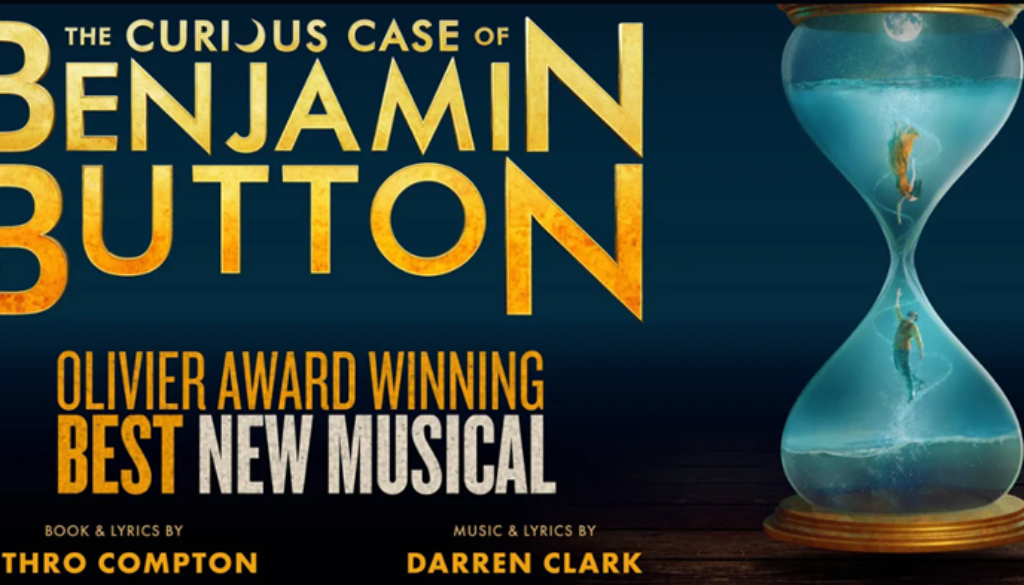
Some stories about time get told once and fade. The Curious Case of Benjamin Button keeps finding new audiences to tell it to. What began as a scrappy, fringe-sized production above a London pub in 2019 has since collected three Olivier Awards, sold out an Off-Broadway transfer at the Public Theater, and is now heading to a six-city tour of Australia and New Zealand in 2027 — with a Broadway berth widely expected to follow. Here’s everything to know about the musical that turned F. Scott Fitzgerald’s strangest short story into one of the most acclaimed new musicals of the decade.
Show at a Glance
Title: The Curious Case of Benjamin Button
Book & Lyrics: Jethro Compton
Music & Lyrics: Darren Clark
Based On: “The Curious Case of Benjamin Button” (1922), a short story by F. Scott Fitzgerald
Director: Jethro Compton
Choreographer: Chi-San Howard
World Premiere: 15 May 2019, Southwark Playhouse, London
Off-Broadway: The Public Theater, New York — previews from 8 October 2026, opened 21 October 2026, running through 6 December 2026
Upcoming: Australia & New Zealand tour, May–October 2027
Awards: 2025 Olivier Award for Best New Musical, plus Best Actor in a Musical and Outstanding Musical Contribution
Background: From a 1922 Short Story to a Fringe Theatre Hit
F. Scott Fitzgerald published “The Curious Case of Benjamin Button” in 1922, a satirical short story imagining a man born as an elderly infant who ages in reverse across his entire life. Most readers today know the premise through David Fincher’s 2008 film adaptation starring Brad Pitt, which relocated the story to New Orleans and expanded it into a sprawling, decades-spanning romance. The stage musical takes a markedly different path: rather than adapting Fincher’s film, writers Jethro Compton and Darren Clark returned to Fitzgerald’s original conceit and transplanted it somewhere else entirely — a small fishing village on the north coast of Cornwall, England, beginning at the tail end of the First World War.
That relocation turned out to be the show’s defining creative choice. Rather than Hollywood gloss, Compton and Clark built a stripped-back, folk-inflected world of fishing boats, pub nights, and a close-knit coastal community, scored with Celtic- and folk-accented music performed live by an ensemble of actor-musicians who play their own instruments — mandolin, accordion, pennywhistle, fiddle, and more — while also stepping in and out of multiple roles throughout the show. New Zealand-born composer Darren Clark wrote a score rooted in traditional folk forms, while Compton, who also directed and designed the original production, built the show’s intimate, communal staging style from the ground up at London’s small Southwark Playhouse.
The musical made its world premiere on 15 May 2019 at the Southwark Playhouse for a limited run through 8 June, directed by Compton with a cast led by James Marlowe as Benjamin Button, alongside Matthew Burns, Rosalind Ford, Joey Hickman, and Philippa Hogg. It was a modest beginning for a show that would go on to sweep London’s most prestigious theatre honors within six years.
What distinguishes Benjamin Button from most adaptations of Fitzgerald’s story is how little it actually borrows from its most famous screen version. Fincher’s 2008 film, which earned Brad Pitt an Oscar nomination, treats the premise largely as a vehicle for sweeping romance and visual spectacle, following Benjamin from early-20th-century New Orleans through decades of American history. Compton and Clark’s stage version keeps only the bones of Fitzgerald’s conceit — a man born old who grows younger with time — and builds an almost entirely new story around it, down to the setting, the central romance with Elowen, and the devastating losses that punctuate Benjamin’s reverse journey through life. The result reads less as a Fitzgerald adaptation in the traditional sense and more as an original folk tale that happens to share its premise with a story written over a century ago.
The Plot
At the end of World War I, on 17 December 1918 in a small Cornish fishing village, Roger Button attends the birth of his first child (“Rag Ty Yw Tre”/”The Western Wind”). To his horror, the midwife hands him not a baby but an elderly man in a three-piece suit and bowler hat, who already speaks perfect English and introduces himself as “Benjamin.” Shocked, Roger and his wife Mary hide Benjamin away in their attic rather than face the village’s judgment. Unable to cope with the trauma, Mary takes her own life just two months later (“The Kraken’s Lullaby”).
Benjamin spends a decade confined to the attic, forbidden by Roger from ever leaving, all the while dreaming of a normal life (“A Little Life”). But rather than dying as everyone expected, Benjamin begins ageing backwards. At 59 (looking a decade younger), he finally escapes to the village pub for his first pint of beer (“The Pickled Crab”), where he meets and instantly falls for barmaid Elowen Keene (“When E’re She Looked At Me”). Years later, after a bar fight draws them closer (“Matter of Time I”), Benjamin and Elowen fall in love beneath the moonlight (“The Moon and the Sea”) — only for both sets of parents to forbid the match, and a failed attempt to elope leaves the pair convinced the other has given up on them (“Will You Go?”).
Benjamin lies his way into a job as a fisherman on the Salty Maid (“Home”), and when World War II arrives, he survives a Luftwaffe bombing raid that sinks the boat and kills a crewmate. He and his surviving shipmate, “Little Jack” Trenlee, enlist in the Royal Navy. On the eve of D-Day, Benjamin writes a message in a bottle to Elowen and casts it to sea (“To Be Cast to the Sea”), then unexpectedly reunites with her at a Portsmouth navy ball (“Shippin’ Out Tomorrow”). That reunion leaves Elowen pregnant, and after the war Benjamin returns home to raise a family with her, concealing his reverse-ageing behind grey hair dye and drawn-on wrinkles (“The Tide Is Comin’ In”).
Tragedy strikes again in 1958 when the couple’s young daughter Lowen drowns in the harbour while in Benjamin’s care (“Matter of Time II”). Devastated and exposed — Elowen has long since worked out his secret — Benjamin abandons his family to travel the world in search of a cure for his condition (“Rollin’ Away”). Years later, a chance reunion with an older Little Jack ends in rejection when his old friend refuses to believe who he is (“Rollin’ Away (Reprise)”), driving Benjamin to the brink of suicide — until his own message in a bottle, adrift for nineteen years, resurfaces at the exact moment he nearly drowns himself (“A Glass Bottle”). Resolved to make things right, Benjamin returns home to Elowen, now dying of a brain tumor, and the family spends her final years making the most of their remaining time together (“Time”). As Benjamin continues ageing backwards through childhood and finally infancy, the show closes with his quiet disappearance exactly seventy years after his birth — and a company-wide reprise urging the audience to make the most of their own time, “It’s what we do today!”
Musical Numbers
The score is almost entirely sung-through, built from folk, Celtic, and pub-music influences, with 23 songs across two acts by most counts (including reprises). Exact song listings have varied slightly by production and between the theatre programme and the 2025 Cast Recording; the list below reflects the most commonly cited running order.
Act One
Rag Ty Yw Tre / The Western Wind · The Kraken’s Lullaby · A Little Life · The Pickled Crab · When E’re She Looked at Me · Matter of Time I · The Moon and the Sea · Will You Go? · Home · To Be Cast to the Sea · Shippin’ Out Tomorrow
Act Two
The Western Wind (Reprise) · The Tide Is Comin’ In · Matter of Time II · The Tide Is Comin’ In (Reprise) · Rollin’ Away · Rollin’ Away (Reprise) · The Kraken’s Lullaby (Reprise) · A Glass Bottle · Home (Reprise) · Time · A Little Life (Reprise) · The Western Wind (Reprise) · Rag Ty Yw Tre (Reprise) · Rollin’ Away (Company Bows Reprise)
One recurring review note: because the score is so thoroughly sung-through and leans on similar vocal runs and instrumentation across its folk-inspired palette, several critics have observed that individual numbers can blend together on a first listen — though the emotional high points, particularly “A Little Life” and the Act Two reprises, have been singled out by multiple reviewers as the show’s strongest moments.
Production History
| Year | Production | Notes |
|---|---|---|
| 2019 | World premiere, Southwark Playhouse | 15 May–8 June 2019. Directed by Jethro Compton; James Marlowe as Benjamin. |
| 2023 | Southwark Playhouse revival | 22 May–1 July 2023. Expanded cast led by Jamie Parker as Benjamin. |
| 2024–25 | West End transfer, Ambassadors Theatre | Performances began 10 October 2024, closed 11 October 2025. John Dagleish as Benjamin, Clare Foster as Elowen. Won 2025 Olivier Award for Best New Musical. |
| 2026 | North American debut, The Public Theater, New York | Previews from 8 October, opened 21 October, extended through 6 December 2026. Andrew Durand as Benjamin, Kelsee Kimmel as Elowen. |
| 2027 | Australia & New Zealand tour | Six cities, May–October 2027. The show’s first staging outside London and New York. |
| 2027 | Korean-language production, Seoul | Planned all-Korean cast staging, announced for 2027. |
The show’s journey from a 100-seat London fringe venue to an international touring production is, by West End standards, remarkably fast. Its 2023 Southwark Playhouse revival won the 2024 Offie for Best Musical Production, setting the stage for a West End transfer to the Ambassadors Theatre the following year. That production, led by John Dagleish and Clare Foster, became a genuine sensation — extended multiple times before finally closing in October 2025 after taking home three Olivier Awards the previous spring.
Its Off-Broadway transfer to the Public Theater carries particular significance: the production is backed in part by ATG, the Broadway theatre owner and operator, a detail several critics have pointed to as a strong signal that a full Broadway transfer is being actively considered following the Public Theater engagement. The Australia and New Zealand tour, announced in October 2026, will mark the show’s first production outside London and New York, opening in Wellington in May 2027 before travelling to Christchurch, Auckland, Sydney, Melbourne, and finally Brisbane’s Queensland Performing Arts Centre through October 2027. The Sydney season will run at the Sydney Opera House’s Drama Theatre from 16 July to 29 August 2027, with the Melbourne season at Arts Centre Melbourne’s Playhouse following in September.
Cast Across Productions
| Character | 2019 World Premiere | 2023 Southwark | 2024–25 West End | 2026 Off-Broadway |
|---|---|---|---|---|
| Benjamin Button | James Marlowe | Jamie Parker | John Dagleish | Andrew Durand |
| Elowen Keene | Rosalind Ford / Philippa Hogg | Molly Osborne | Clare Foster | Kelsee Kimmel |
The 2026 Off-Broadway company at the Public Theater features an 11-person actor-musician ensemble led by Andrew Durand and Kelsee Kimmel, with the full cast playing across multiple roles and instruments throughout the performance — a hallmark of the production’s style since its original Southwark staging. The creative team for the Public Theater run includes choreographer Chi-San Howard, costume designer Anna Kelsey, lighting designer Zoe Spurr, and sound designer Luke Swaffield, alongside Jethro Compton reprising his roles as writer, director, and set designer. Casting for the 2027 Australia and New Zealand tour has not yet been announced.
This actor-musician format, in which the cast doubles as the show’s onstage band, has been a defining feature of the production across every iteration since Southwark, and reviewers of the Public Theater run were quick to note its scale: the Australia and New Zealand tour is set to field a company of 15 actor-musicians performing across some 30 instruments, a step up from the Off-Broadway company’s 11 performers. Durand himself takes on narrator duties and plays guitar in addition to the central role, a doubling that several critics singled out as emblematic of the show’s resourceful, communal staging style — closer in spirit to a folk hootenanny than a conventional book musical.
Awards
The West End production was nominated for four categories at the 2025 Laurence Olivier Awards and won three. The Curious Case of Benjamin Button took home Best New Musical, John Dagleish won Best Actor in a Musical, and Darren Clark (alongside musical director Mark Aspinall) won Outstanding Musical Contribution for music supervision, orchestrations, and arrangements. Clare Foster was nominated for Best Actress in a Musical but did not win. Earlier, the show’s 2023 Southwark Playhouse revival won the 2024 Offie (Off West End Award) for Best Musical Production, and its original 2019 run drew five-star reviews from WhatsOnStage, BroadwayWorld, The Reviews Hub, and The Upcoming.
Reviews: What Critics Are Saying
The Off-Broadway opening at the Public Theater drew a broad spread of reviews — overwhelmingly positive, with a few notable dissenters. New York Stage Review awarded the production four stars, with critic Frank Scheck praising the “entertaining, urgent, psychologically complex, moving” show and its ensemble cast who “double both in their roles and on the instruments,” ultimately predicting the musical “can eagerly await a tidal wave of long-run audiences.” A companion review at the same outlet similarly praised the show as one that “will make you feel younger,” while noting the story “can feel the seams fraying” over its two-and-a-half-hour running time due to heavy reliance on narration.
TheaterMania’s Hayley Levitt called it “a musical fable that jigs to the rhythm of life,” while The New York Post’s review — headlined “a sweet and folksy musical that wants to go to Broadway” — singled out leads Andrew Durand and Kelsee Kimmel as “sublimely romantic… and not in that prescribed musical-theater way.” The Wall Street Journal’s Charles Isherwood offered a “warmly imagined” assessment. Culture Sauce’s review, while noting the collection of 23 songs can “occasionally blur together” across the show’s folk-inflected score, concluded that a Broadway transfer “seems inevitable,” pointing directly to ATG’s involvement as a producer on the Public Theater run as evidence.
Not every critic was won over. New York magazine’s Vulture ran a more skeptical review under the headline “‘Benjamin Button’ Needs More Bite Than This,” with critic Sara Holdren memorably writing that Durand’s performance was “so aggressively cozy it might as well be a corgi in a Fair Isle sweater.” Exeunt Magazine’s Lane Williamson drew a comparison to Come From Away, noting the ensemble’s “stilted, declamatory” narration style initially put him off, though he ultimately concluded the show “is tightly focused on the idea that time is passing, that we only have one life,” and that “it wouldn’t be a waste to spend part of it at this musical.” Across the reviews, Durand and Kimmel’s central performances were consistently singled out as the production’s strongest element, with most critics agreeing the show gains real emotional power in its second act as the stakes of Benjamin’s reverse-ageing condition come into sharper focus.
A recurring thread across nearly every review, positive or mixed, is the comparison to Come From Away — another folk-infused, true-story-adjacent musical built around an ensemble cast playing instruments and narrating directly to the audience. Several critics drew that parallel as a compliment, pointing to the warmth and communal energy both shows generate; others, like Exeunt’s Williamson, used the comparison more cautiously, distinguishing Benjamin Button‘s darker, more melancholic undertow from Come From Away‘s unabashed feel-good sentimentality. New York Stage Review’s Frank Scheck went further, noting the absence of any credited makeup designer as a quiet testament to how convincingly the production’s ageing effects — achieved largely through performance, lighting, and costuming rather than elaborate prosthetics — are pulled off across Durand’s journey from elderly infant to young child.
What’s Next: Australia, New Zealand, and a Possible Broadway Run
Australia & New Zealand Tour Dates (2027)
Wellington, NZ: St James Theatre — 14–22 May
Christchurch, NZ: Isaac Theatre Royal — 27 May–6 June
Auckland, NZ: ASB Waterfront Theatre — 11–27 June
Sydney, NSW: Drama Theatre, Sydney Opera House — 16 July–29 August
Melbourne, VIC: Playhouse, Arts Centre Melbourne — 3 September–2 October
Brisbane, QLD: Playhouse, Queensland Performing Arts Centre — 7–31 October
Announced in mid-October 2026, the Australasian tour will be the production’s first staging outside London and New York — a significant vote of confidence given the show started life above a pub theatre with fewer than 100 seats. Director and writer Jethro Compton, speaking about the announcement, said the show has “had such an incredible journey so far” and that the creative team is “excited to bring it to Australian shores.” Tickets for the Sydney Opera House season opened to the public on 23 October 2026 following an earlier presale, with waitlists currently open for the remaining five cities.
Meanwhile, back in New York, the Public Theater engagement has already been extended twice — first from its original 15 November closing date to 22 November, and then again through 6 December 2026 — a strong indicator of audience demand. With ATG, a major Broadway theatre operator, among the production’s backers, speculation about a full Broadway transfer has followed the show since well before its Off-Broadway opening. Whether that transfer materializes, The Curious Case of Benjamin Button has already achieved something unusual for a show that started in a 100-seat London venue: in the space of seven years, it’s become one of the most travelled, awarded, and talked-about new musicals of its generation.