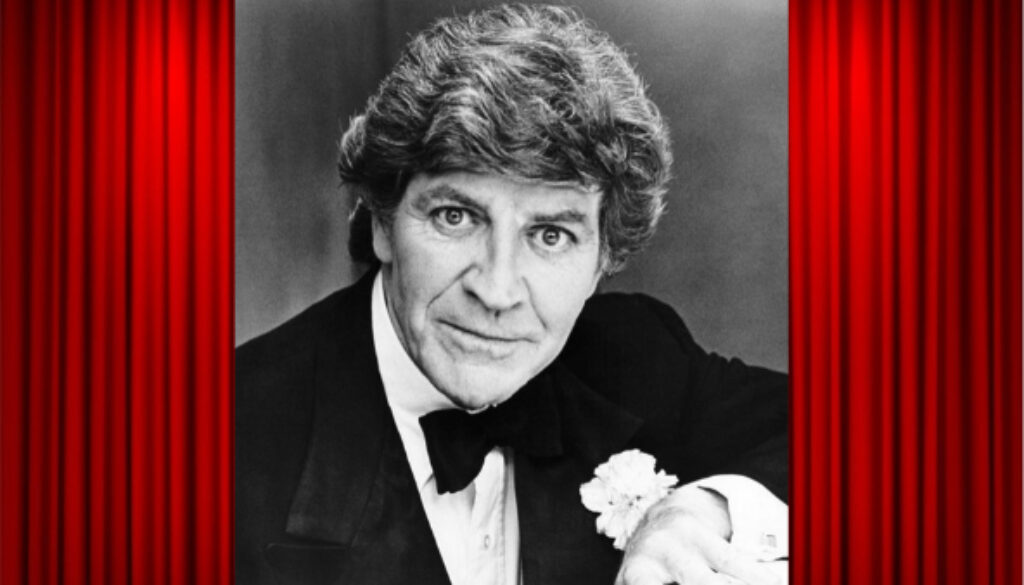
Robert Preston: The Definitive Biography of Broadway’s Music Man, Two-Time Tony Winner & Hollywood Star
Broadway Legend Retrospective · Deep Dive · Musical Theatre History
Robert Preston: The Definitive Biography of Broadway’s Music Man, Two-Time Tony Winner & Hollywood Star
From Paramount’s dependable B-movie leading man to the fast-talking con artist who led seventy-six trombones into Broadway history, here is the complete life, career and legacy of Robert Preston.
| Jun 8, 1918Born, Newton, MA | Mar 21, 1987Died, Montecito, CA | 2 TonysBest Actor in a Musical | 1 Oscar NomVictor/Victoria | 1,375Music Man Performances |
For two decades Robert Preston was one of Hollywood’s busiest and least celebrated leading men. He rode through Westerns, fought in war pictures and played the second lead in big Cecil B. DeMille epics. Then, at the age of 39, an actor who had never sung professionally strode onto the stage of the Majestic Theatre as “Professor” Harold Hill in Meredith Willson’s The Music Man, and he became a Broadway legend overnight. His rapid-fire delivery of “Ya Got Trouble” and his swaggering “Seventy-Six Trombones” won him the Tony Award and made Harold Hill one of the defining roles of the American musical.
Preston spent the rest of his career moving easily between stage and screen. He won a second Tony opposite Mary Martin in I Do! I Do!, originated Henry II in The Lion in Winter, played Mack Sennett in Jerry Herman’s Mack & Mabel, and earned an Academy Award nomination late in life as the worldly nightclub performer Toddy in Blake Edwards’s Victor/Victoria. Below is the complete biography of Robert Preston: his early life, war service, every Broadway show, his films and television work, his long marriage, death, legacy, popular culture, work list and awards.
Robert Preston at a Glance: Essential Life & Career Facts
- Birth Name: Robert Preston Meservey
- Born: June 8, 1918, in Newton, Massachusetts
- Died: March 21, 1987 (aged 68), in Montecito, California, of lung cancer
- Training: The Pasadena Playhouse, California
- Spouse: Catherine Craig, actress (married 1940 until his death)
- Military Service: U.S. Army Air Forces, 1942–1945; intelligence officer with the 386th Bombardment Group, Ninth Air Force; rose to captain
- Signature Role: “Professor” Harold Hill in The Music Man (Broadway 1957; film 1962)
- Tony Awards: Best Actor in a Musical for The Music Man (1958) and I Do! I Do! (1967)
- Academy Award Nomination: Best Supporting Actor for Victor/Victoria (1982)
- Magazine Cover: Time, July 21, 1958
Life and Early Years: From Massachusetts to the Pasadena Playhouse
Robert Preston Meservey was born on June 8, 1918, in Newton, Massachusetts, to Frank Wesley Meservey, a garment worker and billing clerk for American Express, and Ruth Rea Meservey. While Robert was still young, the family moved across the country to Los Angeles, where he grew up in a working-class neighbourhood. He graduated from Abraham Lincoln High School in January 1935. He described himself as having had little formal education, but he had a passion for acting and a strong, resonant speaking voice.
As a teenager he joined a stock company production of Julius Caesar, then moved on to the Pasadena Playhouse, the famous Southern California training ground where he appeared in productions including Robert E. Sherwood’s Idiot’s Delight. Accounts of his discovery differ. One story credits a Paramount attorney who admired his work. According to the Los Angeles Times, his mother, who worked at Decca Records, knew Everett Crosby, Bing Crosby’s brother and agent, and persuaded him to see her son perform at Pasadena. Either way, the result was a contract with Paramount Pictures. The studio insisted he drop the surname Meservey, and from then on he was Robert Preston.
Career: Paramount’s Leading Man of the B-Pictures
Early Films (1938–1942)
Preston made his screen debut in 1938 in two crime dramas, King of Alcatraz and Illegal Traffic. Big studio pictures soon followed. In 1939 he appeared in Cecil B. DeMille’s railroad epic Union Pacific and played Digby Geste, the youngest of three brothers in the French Foreign Legion, opposite Gary Cooper and Ray Milland in William Wellman’s classic Beau Geste. DeMille cast him again in North West Mounted Police (1940) and Reap the Wild Wind (1942), and he played a Marine in the wartime hit Wake Island (1942).
His most remembered film of the period is This Gun for Hire (1942). Preston received top billing as the Los Angeles detective Michael Crane, but it was the film that made Alan Ladd a star. The pattern summed up his Hollywood career. He later joked, “I was the lead in all the ‘B’ pictures and the villain in all the epics.”
World War II Service (1942–1945)
After Pearl Harbor, Preston joined the United States Army Air Forces. He served from 1942 to 1945 as an intelligence (S-2) officer with the 386th Bombardment Group (Medium) of the Ninth Air Force. His job was to receive intelligence reports from headquarters and brief bomber crews on what they would face on their missions. He rose to the rank of captain, and when the war in Europe ended his unit was based at Sint-Truiden in Belgium.
Postwar Films (1947–1955)
Back in Hollywood, Preston worked as a freelance character actor for Paramount, RKO, MGM and independent producers. He starred opposite Gregory Peck and Joan Bennett as the doomed hunter Francis Macomber in The Macomber Affair (1947), based on Ernest Hemingway’s story. Westerns filled much of the decade: he played the charming villain Tate Riling opposite Robert Mitchum in Blood on the Moon (1948), Murray Sinclair in Whispering Smith (1948) with Alan Ladd, and leading roles in Tulsa (1949), The Sundowners (1950), Best of the Badmen (1951) and The Last Frontier (1955). He was a reliable and likable presence, but genuine stardom eluded him, and in the early 1950s he began looking to the New York stage and live television.
Broadway Career: Every Show Robert Preston Starred In
Twentieth Century (1951) and The Male Animal (1952)
Preston’s first major New York role was as the flamboyant, near-bankrupt theatre producer Oscar Jaffe in a revival of Hecht and MacArthur’s farce Twentieth Century at the Fulton Theatre in 1951. In 1952 he played Joe Ferguson, the former football hero, in James Thurber and Elliott Nugent’s comedy The Male Animal, which transferred from City Center to Broadway and became a hit.
A Run of Plays (1953–1957)
Over the next five years Preston became one of Broadway’s busiest leading men in straight plays, most of them modest comedies and dramas:
- Men of Distinction (1953): As Peter Hogarth, in a short-lived comedy at the 48th Street Theatre.
- His and Hers (1954): As playwright Clem Scott, opposite Celeste Holm, in a comedy by Fay and Michael Kanin.
- The Magic and the Loss (1954): As George Wilson, in a drama at the Booth Theatre.
- The Tender Trap (1954): As Joe McCall, the bachelor caught between women, in Max Shulman and Robert Paul Smith’s comedy at the Longacre, later filmed with Frank Sinatra.
- Janus (1955): As Gil, in Carolyn Green’s comedy at the Plymouth Theatre.
- The Hidden River (1957): As Jean Monnerie, in Ruth and Augustus Goetz’s drama of the French Resistance, set in occupied France.
The Music Man (1957): The Role of a Lifetime
Meredith Willson spent years writing The Music Man, his affectionate musical portrait of a con man who arrives in River City, Iowa, in 1912, promising to organise a boys’ band and planning to skip town with the money for instruments and uniforms. Finding a leading man proved difficult. Several established musical stars were considered for “Professor” Harold Hill, but Willson and director Morton DaCosta took a chance on Preston, a film actor with no musical theatre experience. Willson’s score suited him perfectly. Songs such as “Ya Got Trouble” and “Rock Island” depend on rhythm rather than a singing voice, and Preston delivered them in a driving, half-spoken style.
The Music Man opened at the Majestic Theatre on December 19, 1957, and was an immediate sensation. Preston won the 1958 Tony Award for Best Actor in a Musical, and the show won five Tonys including Best Musical, beating West Side Story. He appeared on the cover of Time on July 21, 1958. Preston played Harold Hill until January 1959, when Eddie Albert took over, and returned briefly in June 1960. The production ran until April 15, 1961, for 1,375 performances.
When Warner Bros. began planning the film, the studio reportedly wanted Frank Sinatra. Willson insisted that Preston play the role, and the 1962 film, co-starring Shirley Jones as Marian the librarian, preserved his performance for posterity. It earned him a Golden Globe nomination and remains one of the best-loved movie musicals.
We Take the Town (1962) and Too True to Be Good (1963)
Preston followed The Music Man with an ambitious musical about the Mexican Revolution, We Take the Town (1962), in which he played Pancho Villa. The show closed during its pre-Broadway tryout. In 1963 he returned to Broadway in a starry revival of George Bernard Shaw’s Too True to Be Good, playing the Burglar alongside Lillian Gish, Cedric Hardwicke and Glynis Johns.
Nobody Loves an Albatross (1963)
In Ronald Alexander’s comedy Nobody Loves an Albatross at the Lyceum Theatre, Preston played Nat Bentley, a charming television writer-producer who takes credit for other people’s work. The play gave him a long and successful run in a role that drew on Harold Hill’s charm and nerve.
Ben Franklin in Paris (1964)
For the musical Ben Franklin in Paris at the Lunt-Fontanne Theatre, Preston, then 46, shaved his head to play the elderly American statesman negotiating for French support during the Revolutionary War. The reviews were mixed. The New York Times wrote that “not even Mr. Preston’s superb salesmanship can con one into thinking that there is magic in this musical’s pitch”. Even so, his performance was widely praised and the show ran for several months.
The Lion in Winter (1966)
In March 1966 Preston originated the role of King Henry II in James Goldman’s The Lion in Winter at the Ambassador Theatre, opposite Rosemary Harris as Eleanor of Aquitaine. Harris won the Tony Award for her performance. The play ran only briefly on Broadway, but it became a classic after the 1968 film with Peter O’Toole and Katharine Hepburn. Preston’s original Henry is often cited as one of his finest dramatic performances.
I Do! I Do! (1966): A Second Tony
Later in 1966 Preston starred with Mary Martin in I Do! I Do!, Tom Jones and Harvey Schmidt’s two-character musical based on the play The Fourposter, which follows a married couple, Michael and Agnes, through fifty years. Directed and choreographed by Gower Champion, it opened at the 46th Street Theatre on December 5, 1966. Carrying an entire musical between them, the two stars sang, danced, fought and reconciled. Preston won his second Tony Award for Best Actor in a Musical in 1967, and the show ran until 1968.
Mack & Mabel (1974)
Preston’s last great Broadway musical was Mack & Mabel, with a score by Jerry Herman and direction by Gower Champion. Preston played the silent-film pioneer Mack Sennett, opposite Bernadette Peters as his star and lover, Mabel Normand. The show opened at the Majestic Theatre in October 1974 and closed after just 66 performances. Preston received a Tony nomination, and the score, including “I Won’t Send Roses” and “Time Heals Everything”, became a cult favourite, especially in Britain.
Sly Fox (1977) and The Prince of Grand Street (1978)
Preston took over the dual role of the scheming Foxwell J. Sly and the Judge from George C. Scott in Larry Gelbart’s comedy Sly Fox at the Broadhurst Theatre. In 1978 he starred in Bob Merrill’s musical The Prince of Grand Street, directed by Gene Saks, as an ageing matinee idol of New York’s Yiddish theatre who refuses to give up his youthful roles. It closed during tryouts in Philadelphia and Boston, and Preston never appeared on Broadway again.
Film and Television Career After The Music Man
Films
- The Dark at the Top of the Stairs (1960): As travelling salesman Rubin Flood in William Inge’s family drama.
- How the West Was Won (1962): As wagonmaster Roger Morgan in the Cinerama epic.
- All the Way Home (1963): As Jay Follet in the adaptation of James Agee’s A Death in the Family, one of his most moving screen performances.
- Junior Bonner (1972): As Ace Bonner, the rodeo star’s father, opposite Steve McQueen in Sam Peckinpah’s film.
- Child’s Play (1972): As Joseph Dobbs in Sidney Lumet’s drama.
- Mame (1974): As Beauregard Jackson Pickett Burnside opposite Lucille Ball.
- Semi-Tough (1977): As Big Ed Bookman in the football comedy with Burt Reynolds.
- S.O.B. (1981): As Dr. Irving Finegarten in Blake Edwards’s Hollywood satire, winning the National Society of Film Critics Award for Best Supporting Actor.
- Victor/Victoria (1982): As Carroll “Toddy” Todd, the warm, witty gay performer who helps Julie Andrews’s character pose as a female impersonator in 1930s Paris. The role earned him an Academy Award nomination for Best Supporting Actor, the National Board of Review Award and a Golden Globe nomination. His rendition of “The Shady Dame from Seville” is a highlight.
- The Last Starfighter (1984): As Centauri, a fast-talking alien recruiter written with his Harold Hill in mind. It was his final big-screen role and earned him a Saturn Award nomination.
Television
Live television of the 1950s gave Preston some of his best early dramatic roles, and he returned to the small screen in his final decade. He played the pioneer patriarch Hadley Chisholm opposite Rosemary Harris in the CBS Western series The Chisholms (1979–1980). His TV films included Rehearsal for Murder (1982), as a playwright investigating his fiancée’s death; September Gun (1983), as an ageing gunfighter opposite Patty Duke; Finnegan Begin Again (1985), opposite Mary Tyler Moore; and Outrage! (1986), as a grieving father seeking justice for his murdered daughter. Outrage! was his final role.
“Chicken Fat”: Robert Preston’s Unlikely Hit
In the early 1960s Meredith Willson wrote “Chicken Fat” (also known as “The Youth Fitness Song”) for President John F. Kennedy’s physical fitness campaign, and Preston recorded it. Capitol Records distributed the recording to elementary schools across America, and a generation of children did their calisthenics to Preston’s voice, chanting “Go, you chicken fat, go!” The song is still remembered with nostalgia, and sometimes dread, by millions who grew up in the 1960s.
Personal Life: A Forty-Seven-Year Marriage
In 1940 Preston married actress Catherine Craig, whom he had met when both were young performers at the Pasadena Playhouse. Craig appeared in a number of Paramount films in the early 1940s before largely retiring from acting. The couple stayed married until Preston’s death in 1987, one of the longest and most stable marriages in Hollywood. They had no children.
Preston was known throughout the industry as a generous, disciplined professional. Co-stars including Carol Burnett and Bernadette Peters spoke of his intensity, his preparation and his kindness to younger actors. He avoided Hollywood’s party circuit, preferring a quiet life with Craig at their home in Montecito, near Santa Barbara. He said his career choices were driven by the search for lively, fascinating characters rather than by star billing, which explains why he moved so freely between musicals, comedies, dramas, Westerns and science fiction.
Death and Legacy
Robert Preston was diagnosed with lung cancer in 1986. He continued working almost to the end, filming Outrage! that year. He died on March 21, 1987, in Montecito, California, at the age of 68. Catherine Craig survived him.
His legacy is defined above all by Harold Hill. Preston’s performance became the benchmark against which every later Music Man has been measured. Dick Van Dyke played the role in a 1980 revival at City Center, Craig Bierko in a 2000 Broadway revival that ran for 699 performances, Matthew Broderick in a 2003 television film with Kristin Chenoweth, and Hugh Jackman in the 2022 Broadway revival at the Winter Garden Theatre opposite Sutton Foster. Each brought something new, but the 1962 film keeps Preston’s original performance as a permanent reference point.
- A model for actors in musicals: Alongside Rex Harrison in My Fair Lady, which had opened the year before, Preston proved that a strong actor with charisma and rhythm could carry a major Broadway musical without a trained singing voice. Many later stars have followed the path they opened.
- Two Tonys, two very different musicals: His wins for the big ensemble comedy of The Music Man and the intimate two-hander I Do! I Do! show his range.
- A late-career renaissance: His Oscar-nominated performance in Victor/Victoria introduced him to a new generation and was widely praised for its warmth and dignity in an era when gay characters were rarely portrayed sympathetically in Hollywood.
- Centenary tributes: In 2018, on the 100th anniversary of his birth, publications including The Saturday Evening Post celebrated him as “Forever the Music Man”.
Robert Preston in Popular Culture
Harold Hill’s patter and the songs Preston introduced have become a permanent part of American popular culture. The most famous tribute is The Simpsons episode “Marge vs. the Monorail” (1993), written by Conan O’Brien. In it, the slick salesman Lyle Lanley, voiced by Phil Hartman, sells Springfield a useless monorail with a musical number that is a direct homage to “Ya Got Trouble”. O’Brien was later offered the chance to play Harold Hill on Broadway during the 2000 revival but turned it down because of his late-night commitments.
The Music Man has been referenced or parodied in Family Guy, Ally McBeal, Boston Legal and Grace and Frankie. Political commentators have used “Harold Hill” as shorthand for a smooth-talking huckster. “Seventy-Six Trombones” became a marching band staple played at parades and football games across the United States, and Disney theme parks use the score to evoke turn-of-the-century Main Street. Preston’s “Chicken Fat” recording remains a nostalgic touchstone, and his role as Centauri in The Last Starfighter gave him a devoted following among science fiction fans.
Work List: Robert Preston’s Stage Shows
| Year | Production | Role | Notes |
|---|---|---|---|
| 1951 | Twentieth Century | Oscar Jaffe | Fulton Theatre; revival |
| 1952 | The Male Animal | Joe Ferguson | City Center, then Broadway |
| 1953 | Men of Distinction | Peter Hogarth | 48th Street Theatre |
| 1954 | His and Hers | Clem Scott | Comedy with Celeste Holm |
| 1954 | The Magic and the Loss | George Wilson | Booth Theatre |
| 1954 | The Tender Trap | Joe McCall | Longacre Theatre |
| 1955 | Janus | Gil | Plymouth Theatre |
| 1957 | The Hidden River | Jean Monnerie | Playhouse Theatre |
| 1957 | The Music Man | Harold Hill | Majestic Theatre; 1,375 performances; Tony Award |
| 1962 | We Take the Town | Pancho Villa | Closed in pre-Broadway tryout |
| 1963 | Too True to Be Good | The Burglar | 54th Street Theatre; Shaw revival |
| 1963 | Nobody Loves an Albatross | Nat Bentley | Lyceum Theatre |
| 1964 | Ben Franklin in Paris | Benjamin Franklin | Lunt-Fontanne Theatre |
| 1966 | The Lion in Winter | Henry II | Ambassador Theatre; originated the role |
| 1966 | I Do! I Do! | Michael | 46th Street Theatre; with Mary Martin; Tony Award |
| 1974 | Mack & Mabel | Mack Sennett | Majestic Theatre; Tony nomination |
| 1977 | Sly Fox | Foxwell J. Sly / The Judge | Broadhurst Theatre; replacement |
| 1978 | The Prince of Grand Street | Yiddish theatre matinee idol | Closed in tryouts in Philadelphia and Boston |
Selected Film and Television Work
| Year | Title | Role |
|---|---|---|
| 1939 | Union Pacific | Dick Allen |
| 1939 | Beau Geste | Digby Geste |
| 1942 | Reap the Wild Wind | Dan Cutler |
| 1942 | This Gun for Hire | Michael Crane |
| 1942 | Wake Island | Pvt. Joe Doyle |
| 1947 | The Macomber Affair | Francis Macomber |
| 1948 | Blood on the Moon | Tate Riling |
| 1960 | The Dark at the Top of the Stairs | Rubin Flood |
| 1962 | The Music Man | Harold Hill |
| 1962 | How the West Was Won | Roger Morgan |
| 1963 | All the Way Home | Jay Follet |
| 1972 | Junior Bonner | Ace Bonner |
| 1974 | Mame | Beauregard Burnside |
| 1979–80 | The Chisholms (TV) | Hadley Chisholm |
| 1981 | S.O.B. | Dr. Irving Finegarten |
| 1982 | Victor/Victoria | Carroll “Toddy” Todd |
| 1984 | The Last Starfighter | Centauri |
| 1986 | Outrage! (TV) | Dennis Riordan |
Awards and Nominations
| Year | Award | Category | Work | Result |
|---|---|---|---|---|
| 1958 | Tony Award | Best Actor in a Musical | The Music Man | Won |
| 1963 | Golden Globe Award | Best Actor – Musical or Comedy | The Music Man | Nominated |
| 1967 | Tony Award | Best Actor in a Musical | I Do! I Do! | Won |
| 1975 | Tony Award | Best Actor in a Musical | Mack & Mabel | Nominated |
| 1981 | National Society of Film Critics | Best Supporting Actor | S.O.B. | Won |
| 1982 | National Board of Review | Best Supporting Actor | Victor/Victoria | Won |
| 1982 | New York Film Critics Circle | Best Supporting Actor | Victor/Victoria | Third place |
| 1983 | Academy Award | Best Supporting Actor | Victor/Victoria | Nominated |
| 1983 | Golden Globe Award | Best Actor – Musical or Comedy | Victor/Victoria | Nominated |
| 1985 | Saturn Award | Best Supporting Actor | The Last Starfighter | Nominated |
Award years reflect the year of the ceremony for the Tony, Academy, Golden Globe and Saturn Awards, and the year of the film for critics’ prizes.
The Final Curtain: Why Robert Preston Still Matters
Robert Preston’s career is a lesson in patience. For almost twenty years he did solid, unglamorous work in Hollywood, playing heroes in B-pictures, villains in epics and second leads to bigger stars. Broadway gave him the role that unlocked everything he had been holding in reserve: the energy, the timing, the con man’s twinkle and the musicality of a voice that didn’t need to be operatic to be thrilling. When Harold Hill marched down the aisle with seventy-six trombones in 1957, Preston claimed a place in theatre history that no later actor has been able to take from him.
He never rested on that success. Over the next three decades he played Benjamin Franklin and Henry II, a husband aging over fifty years, a silent-movie mogul, a gay cabaret star in 1930s Paris and an alien recruiter from outer space. He did it all with the same generosity and craft that made colleagues adore him. Every time a new Harold Hill steps onto a Broadway stage, audiences remember the man who first showed them how it was done, the original Music Man, Robert Preston.
Biographical data, stage credits, filmography and awards listings compiled from Wikipedia, The Saturday Evening Post, the Internet Broadway Database (IBDB), /Film, the Tony Awards archive and the TheatreGold archives.
Explore Authentic Broadway Memorabilia
Discover historic Playbills, rare original cast recordings and authentic theatrical souvenirs from Robert Preston’s legendary Broadway shows at TheatreGold’s store:
Theatregold – Playbills & Collectibles The Music Man – Rare Playbills I Do! I Do! – Memorabilia Jerry Herman – Vintage Playbills Tony Awards – Collectibles Broadway Playbills – Rare Editions Sunset Boulevard Memorabilia