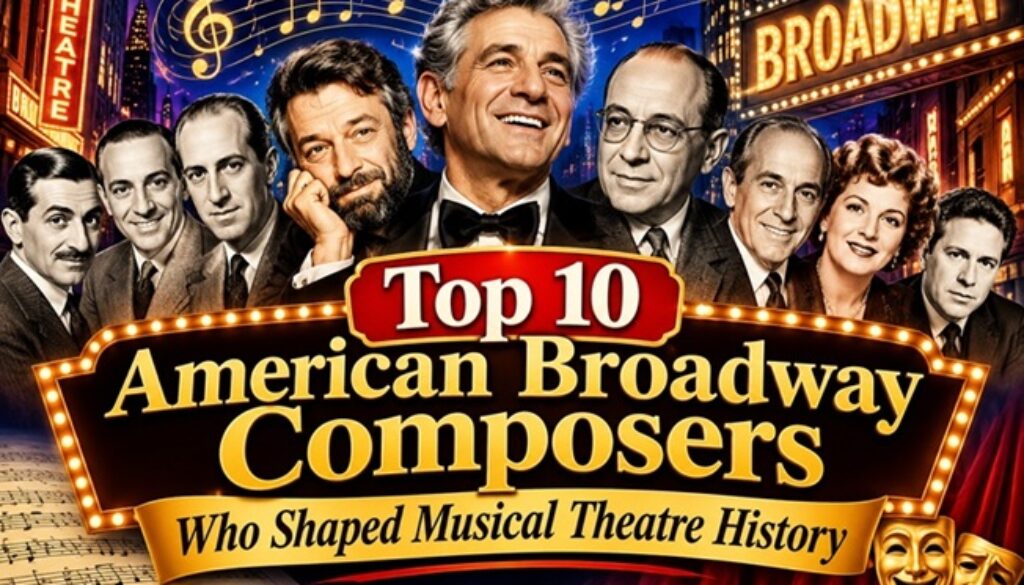
Top 10 American Broadway Composers Who Shaped Musical Theatre History | Theatre Gold
Top 10 American Broadway Composers Who Shaped Musical Theatre History
From the Tin Pan Alley jazz rhythms of George Gershwin to the architectural brilliance of Stephen Sondheim and the hip-hop revolution of Lin-Manuel Miranda, meet the ten American composers who built the Great White Way.
Broadway musical theatre is widely celebrated as America’s most vibrant indigenous art form. While European operetta laid the nineteenth-century groundwork for theatrical storytelling set to music, it was on the stages of New York City—amid the neon glow of Times Square and the intimate orchestra pits of Forty-Fourth Street—that American composers forged something entirely new. Over the course of more than a century, these musical dramatists transformed stage entertainment from loosely connected revues and vaudeville sketches into psychologically complex, structurally unified masterworks.
Examining the vast landscape of theatrical history—from the foundational entries cataloged in Wikipedia’s extensive archive of Broadway composers and lyricists to critical retrospectives published by Classical-Music.com, The New York Times, and Playbill—one truth becomes unmistakable: a select group of American writers did not merely write hit songs; they rewrote the rules of dramatic storytelling. They taught audiences that a melody could reveal a character’s deepest unspoken neurosis, that a counterpoint duet could compress an entire marriage into four minutes, and that jazz, folk, rock, and hip-hop could all command the prestige of grand opera.
Evaluating artistic greatness across generations requires balancing melodic genius, theatrical innovation, cultural longevity, and sheer influence on subsequent generations of writers. Focusing specifically on American-born or American-naturalized composers whose primary creative home was the Broadway stage, here is our definitive ranking of the Top 10 American Broadway Composers of all time.
At a Glance: The 10 Titans of the American Musical
| Rank | Composer | Lifespan | Signature Broadway Masterworks | Defining Theatrical Contribution |
|---|---|---|---|---|
| #1 | Stephen Sondheim | 1930–2021 | Sweeney Todd, Company, Into the Woods | Psychological complexity & the modern concept musical |
| #2 | Richard Rodgers | 1902–1979 | Oklahoma!, Carousel, South Pacific | The integrated book musical & Golden Age architecture |
| #3 | George Gershwin | 1898–1937 | Porgy and Bess, Girl Crazy, Of Thee I Sing | Fusing jazz syncopation & symphonic ambition with theatre |
| #4 | Jerome Kern | 1885–1945 | Show Boat, Roberta, Very Good Eddie | Father of the modern American musical score |
| #5 | Leonard Bernstein | 1918–1990 | West Side Story, Candide, On the Town | Symphonic intensity, rhythmic fury & operatic scale |
| #6 | Cole Porter | 1891–1964 | Kiss Me, Kate, Anything Goes | Urbane wit, chromatic sophistication & dual mastery |
| #7 | Irving Berlin | 1888–1989 | Annie Get Your Gun, As Thousands Cheer | The voice of American popular song on the Broadway stage |
| #8 | John Kander | b. 1927 | Cabaret, Chicago, Kiss of the Spider Woman | Dark satire, vaudeville pastiche & political edge |
| #9 | Jerry Herman | 1931–2019 | Hello, Dolly!, Mame, La Cage aux Folles | Unapologetic optimism, brassy showstoppers & heart |
| #10 | Lin-Manuel Miranda | b. 1980 | Hamilton, In the Heights | 21st-century hip-hop, Latin rhythms & historical reinvention |
#10 Lin-Manuel Miranda
Few artists in the history of the American theatre have detonated a cultural earthquake on the scale of Lin-Manuel Miranda. Emerging in the early twenty-first century with a profound reverence for Broadway tradition—studying at the feet of Stephen Sondheim and Jonathan Larson—Miranda recognized that the musical vocabulary of the Great White Way had fallen dangerously behind the music people actually listened to in the streets of New York.
With In the Heights (2008), Miranda brought salsa, merengue, freestyle rap, and Latin pop into the Richard Rodgers Theatre, capturing the vibrant pulse of Washington Heights with warmth and structural precision. Yet it was Hamilton (2015) that permanently altered the trajectory of Broadway. By telling the story of America’s founding fathers through dense, multi-syllabic hip-hop battles, R&B ballads, and Britpop pastiche, Miranda proved that contemporary urban music could carry Shakespearean dramatic weight. As critics at The New York Times observed upon its premiere, Miranda achieved a seamless synthesis where every musical motif—from Eliza’s descending scale to Burr’s clipped rhythmic cadence—serves as psychological characterization.
Theatre Gold Archival Notes
- Essential Scores: In the Heights (2008), Bring It On: The Musical (co-composer, 2012), Hamilton (2015).
- Signature Songs: “My Shot,” “Wait for It,” “Satisfied,” “Breathe,” “96,000.”
- Major Honors: Pulitzer Prize for Drama, three Tony Awards, Grammy Awards, Emmy Awards, and a MacArthur “Genius” Grant.
#9 Jerry Herman
In an era when Broadway increasingly leaned toward brooding introspection and dissonant modernism, Jerry Herman stood proudly as the unapologetic champion of the hummable, life-affirming showtune. A master of both music and lyrics, Herman possessed an uncanny gift for writing melodies that audiences could whistle walking up the aisle at intermission, yet beneath his buoyant brass sections beat a deeply humane and surprisingly progressive heart.
Herman made theatrical history in the 1960s with back-to-back mega-hits: Hello, Dolly! (1964), which held the record as Broadway’s longest-running musical for years, and Mame (1966). Both shows centered on indomitable, eccentric women who refuse to let society dim their vitality. Later, in 1983, Herman broke monumental ground with La Cage aux Folles—the first mainstream Broadway musical to place a gay couple at the center of its romantic narrative. Its Act I finale, “I Am What I Am,” transcended the stage to become an enduring global anthem of self-acceptance and pride.
Theatre Gold Archival Notes
- Essential Scores: Milk and Honey (1961), Hello, Dolly! (1964), Mame (1966), Mack & Mabel (1974), La Cage aux Folles (1983).
- Signature Songs: “Before the Parade Passes By,” “If He Walked Into My Life,” “I Am What I Am,” “Time Heals Everything.”
- Major Honors: Two competitive Tony Awards for Best Original Score plus the 2009 Special Tony Award for Lifetime Achievement in the Theatre.
#8 John Kander
Working alongside his legendary lyricist partner Fred Ebb for more than four decades until Ebb’s passing in 2004, John Kander perfected one of Broadway’s sharpest dramatic tools: the “concept” pastiche score. Kander understood that traditional American entertainment forms—vaudeville, Weimar-era cabaret, jazz-age ragtime, and 1940s big-band swing—could be weaponized as devastating mirrors for political decay, media sensationalism, and moral complacency.
In Cabaret (1966), Kander’s intoxicating, sleazy Berlin nightclub songs seduce the audience into laughing along with the Kit Kat Klub’s decadent revue—only to pull the rug out as the shadow of Nazism engulfs the stage. Nine years later, in Chicago (1975), Kander crafted a razor-sharp vaudeville score where every murderess and corrupt lawyer gets a classic turn in the spotlight, turning the American justice system into a glittering circus. Even into his nineties, Kander continued writing bold, socially conscious theatre with works like The Scottsboro Boys (2010) and New York, New York (2023).
Theatre Gold Archival Notes
- Essential Scores: Cabaret (1966), Zorba (1968), Chicago (1975), Woman of the Year (1981), Kiss of the Spider Woman (1993), The Scottsboro Boys (2010).
- Signature Songs: “Willkommen,” “Maybe This Time,” “All That Jazz,” “Theme from New York, New York.”
- Major Honors: Three competitive Tony Awards, a 2023 Special Tony Award for Lifetime Achievement, Emmy Awards, Grammy Awards, and Kennedy Center Honors.
#7 Irving Berlin
When fellow composer Jerome Kern was famously asked what place Irving Berlin held in American music, Kern delivered an immortal verdict: “Irving Berlin has no place in American music—he IS American music.” Arriving in New York’s Lower East Side as a Jewish immigrant child and teaching himself to play piano almost exclusively in the key of F-sharp (using a custom transposing lever built into his upright piano), Berlin became the unmatched chronicler of the American spirit across six decades.
While Berlin wrote hundreds of standalone standards for Tin Pan Alley and Hollywood, his Broadway legacy is monumental. From the dazzling Ziegfeld Follies revues and the topical newspaper-inspired As Thousands Cheer (1933) to his crowning book-musical triumph, Annie Get Your Gun (1946), Berlin demonstrated an effortless ability to blend vernacular American speech with unforgettable melodic clarity. His theatrical anthem “There’s No Business Like Show Business” remains the unofficial national hymn of Broadway itself.
Theatre Gold Archival Notes
- Essential Scores: Music Box Revues (1921–1924), As Thousands Cheer (1933), This Is the Army (1942), Annie Get Your Gun (1946), Call Me Madam (1950).
- Signature Songs: “There’s No Business Like Show Business,” “Anything You Can Do,” “Blue Skies,” “Heat Wave,” “God Bless America.”
- Major Honors: Special Tony Award (1963), Academy Award, Congressional Gold Medal, and Presidential Medal of Freedom.
#6 Cole Porter
Unlike nearly all of his peers—who hailed from working-class Jewish immigrant families in New York—Cole Porter was born into immense Midwestern wealth, educated at Yale and Harvard, and spent the 1920s throwing lavish parties in Paris and Venice. Yet behind Porter’s champagne-soaked cosmopolitan persona lay a fiercely disciplined musical craftsman capable of turning out some of the most harmonically daring and lyrically dazzling scores ever heard on Broadway.
Writing both his own music and lyrics, Porter elevated the “list song” to high literature, packing internal rhymes, classical allusions, and sly double entendres into sinuous, minor-to-major melodies that seemed to slink across the orchestra pit. After defining 1930s musical comedy with Anything Goes (1934), Porter defied severe chronic pain following a 1937 horseback riding accident to compose his undisputed theatrical masterpiece: Kiss Me, Kate (1948). Blending backstage Broadway farce with Shakespeare’s The Taming of the Shrew, Kiss Me, Kate won the very first Tony Award for Best Musical in 1949.
Theatre Gold Archival Notes
- Essential Scores: Fifty Million Frenchmen (1929), Gay Divorce (1932), Anything Goes (1934), Kiss Me, Kate (1948), Can-Can (1953).
- Signature Songs: “Night and Day,” “I Get a Kick Out of You,” “Anything Goes,” “Too Darn Hot,” “So in Love.”
- Major Honors: Two Tony Awards (Best Musical and Best Composer/Lyricist for Kiss Me, Kate) and Grammy Hall of Fame inductions.
#5 Leonard Bernstein
Leonard Bernstein was a musical polymath who refused to acknowledge any wall separating Carnegie Hall from Times Square. As music director of the New York Philharmonic, Bernstein was the most famous classical conductor in America; as a Broadway composer, he injected the American musical with symphonic rigor, jagged asymmetric rhythms, and white-hot emotional urgency.
Bernstein burst onto Broadway at age twenty-six with On the Town (1944), capturing the kinetic energy of three sailors on twenty-four-hour shore leave in wartime New York. He followed it with the sparkling wit of Wonderful Town (1953) and the operatic brilliance of Candide (1956), whose overture remains one of the most frequently performed concert pieces in the world. Then, in 1957, collaborating with Jerome Robbins, Arthur Laurents, and a young lyricist named Stephen Sondheim, Bernstein composed West Side Story. Built around the dissonant musical interval of the tritone (heard in the opening three notes of “Maria”), West Side Story proved that a Broadway musical could achieve the tragic grandeur of grand opera without sacrificing a single ounce of street-level visceral power.
Theatre Gold Archival Notes
- Essential Scores: On the Town (1944), Wonderful Town (1953), Candide (1956), West Side Story (1957), 1600 Pennsylvania Avenue (1976).
- Signature Songs: “Tonight (Quintet),” “Maria,” “Somewhere,” “America,” “Glitter and Be Gay,” “New York, New York.”
- Major Honors: Tony Award for Wonderful Town, 1969 Special Tony Award, 16 Grammy Awards, and Kennedy Center Honors.
#4 Jerome Kern
Before Jerome Kern, the Broadway stage was largely dominated by European-style operettas filled with Ruritanian princes, Viennese waltzes, and artificial plots disconnected from American life. Kern single-handedly invented the modern American musical score. Beginning in the 1910s with his intimate “Princess Theatre” musicals, Kern insisted that songs should never be dropped arbitrarily into a show; instead, they had to flow naturally out of everyday American dialogue and character action.
On December 27, 1927, Kern and lyricist Oscar Hammerstein II premiered Show Boat at the Ziegfeld Theatre—a watershed date in theatre history. Tackling themes of racism, miscegenation, domestic abandonment, and economic hardship across four decades on the Mississippi River, Show Boat shattered every convention of light musical comedy. Kern’s sweeping, pentatonic masterpiece “Ol’ Man River” gave Broadway its first true dramatic aria, establishing a blueprint that Richard Rodgers and Oscar Hammerstein II would build upon sixteen years later.
Theatre Gold Archival Notes
- Essential Scores: Very Good Eddie (1915), Leave It to Jane (1917), Sally (1920), Show Boat (1927), Roberta (1933).
- Signature Songs: “Ol’ Man River,” “Can’t Help Lovin’ Dat Man,” “All the Things You Are,” “Smoke Gets in Your Eyes,” “The Way You Look Tonight.”
- Major Honors: Two Academy Awards for Best Original Song and posthumous induction into the Songwriters Hall of Fame and American Theater Hall of Fame.
#3 George Gershwin
In a tragically brief life cut short by a brain tumor at age thirty-eight, George Gershwin accomplished what no composer before or since has ever matched: he simultaneously conquered Tin Pan Alley, the Broadway musical stage, Hollywood, and the international symphonic concert hall. Alongside his lyricist brother Ira Gershwin, George infused Broadway with the restless, syncopated heartbeat of 1920s and 1930s American jazz, blues, and Charleston rhythms.
Gershwin’s Broadway output spans glittering jazz-age comedies like Lady, Be Good! (1924), Funny Face (1927), and Girl Crazy (1930), as well as the razor-sharp political satire Of Thee I Sing (1931)—the first musical ever awarded the Pulitzer Prize for Drama. Then, in 1935, Gershwin unveiled his magnum opus, Porgy and Bess. Combining African-American spiritual traditions, blues harmonies, and late-Romantic operatic orchestration, Porgy and Bess produced timeless standards like “Summertime” and “I Got Plenty o’ Nuttin’” while standing as one of the supreme achievements in American music.
Theatre Gold Archival Notes
- Essential Scores: Lady, Be Good! (1924), Oh, Kay! (1926), Funny Face (1927), Girl Crazy (1930), Of Thee I Sing (1931), Porgy and Bess (1935).
- Signature Songs: “Summertime,” “I Got Rhythm,” “Someone to Watch Over Me,” “Embraceable You,” “Swanee”.
- Major Honors: Special Pulitzer Prize Citation (1998), Congressional Gold Medal, and the Library of Congress Gershwin Prize named in his and Ira’s honor.
#2 Richard Rodgers
If Broadway had a Mount Rushmore, Richard Rodgers would be carved into the stone twice—once for each of his two monumental creative partnerships. Few composers in any genre have possessed Rodgers’s seemingly inexhaustible gift for pure, soaring, architecturally balanced melody. Remarkably, he reinvented his entire musical style halfway through his career to match two radically different lyricists.
From 1919 to 1942, Rodgers partnered with Lorenz Hart to create breezy, urbane, jazz-inflected musical comedies like Babes in Arms (1937) and the groundbreaking anti-hero musical Pal Joey (1940), yielding evergreen standards such as “My Funny Valentine” and “Bewitched, Bothered and Bewildered.” Then, in 1943, Rodgers joined forces with Oscar Hammerstein II to premiere Oklahoma!. By fully integrating song, dialogue, and Agnes de Mille’s choreography into a unified dramatic arc, Rodgers and Hammerstein launched the Golden Age of Broadway. Their subsequent run—Carousel (1945), South Pacific (1949), The King and I (1951), and The Sound of Music (1959)—remains the most commercially and artistically dominant streak in theatrical history.
“What makes Richard Rodgers unique is that he could write a melody that sounds completely inevitable—as though it had existed in nature forever—while underneath, his harmonic progressions are remarkably subtle and sophisticated.” — Adapted from Broadway musicological retrospectives
Theatre Gold Archival Notes
- Essential Scores: The Boys from Syracuse (1938), Pal Joey (1940), Oklahoma! (1943), Carousel (1945), South Pacific (1949), The King and I (1951), The Sound of Music (1959).
- Signature Songs: “Oh, What a Beautiful Mornin’,” “If I Loved You,” “Some Enchanted Evening,” “My Funny Valentine,” “My Favorite Things.”
- Major Honors: The first person to achieve the “PEGOT” (Pulitzer, Emmy, Grammy, Oscar, and Tony Awards), winning six competitive Tony Awards and Kennedy Center Honors.
#1 Stephen Sondheim
At the summit of American musical theatre stands Stephen Sondheim—the Shakespeare of Broadway, the composer-lyricist who transformed the American musical from an engine of escapist entertainment into an instrument of profound psychological, philosophical, and emotional truth. Mentored in his youth by Oscar Hammerstein II, who taught him how to build a song like a one-act play, Sondheim spent over sixty years pushing the boundaries of what could be sung on a stage.
After writing the acclaimed lyrics for West Side Story (1957) and Gypsy (1959), Sondheim stepped forward as both composer and lyricist, beginning a revolutionary string of collaborations with director Harold Prince. In Company (1970), he fractured linear plot into a modernist examination of modern marriage and urban isolation. In Follies (1971), he contrasted pastiche showtunes with raw, haunting confrontations with regret. In A Little Night Music (1973), he composed an entire score in variations of triple meter, gifting the world “Send in the Clowns”.
And then came Sweeney Todd: The Demon Barber of Fleet Street (1979)—a towering, blood-drenched Grand Guignol thriller whose relentless, Bernard Herrmann-inspired score sits comfortably alongside the operas of Berg, Britten, and Verdi. Whether exploring the agony of artistic creation in Sunday in the Park with George (1984), the dark moral consequences of fairy tales in Into the Woods (1987), or the dark underbelly of the American Dream in Assassins (1990), Sondheim never wrote down to his audience. As The New York Times wrote upon his passing in 2021, he taught generations of theatregoers that ambiguity, dissonance, and ambivalence could sing with heartbreaking beauty.
Theatre Gold Archival Notes
- Essential Scores: A Funny Thing Happened on the Way to the Forum (1962), Company (1970), Follies (1971), A Little Night Music (1973), Sweeney Todd (1979), Merrily We Roll Along (1981), Sunday in the Park with George (1984), Into the Woods (1987), Assassins (1990).
- Signature Songs: “Send in the Clowns,” “Being Alive,” “Losing My Mind,” “Sunday,” “No One Is Alone,” “Epiphany”.
- Major Honors: Eight competitive Tony Awards (more than any other composer in history), the 2008 Special Tony Award for Lifetime Achievement, the Pulitzer Prize for Drama, an Academy Award, eight Grammy Awards, the Presidential Medal of Freedom, and a Broadway theatre named in his honor.
Honorable Mentions: The Broader Tapestry of American Broadway
Narrowing more than a century of American theatrical genius down to ten names inevitably leaves out titans whose contributions remain indispensable to the Broadway canon. Any comprehensive study of Wikipedia’s Broadway composers directory or Playbill’s historical archives must also salute Frank Loesser (Guys and Dolls, How to Succeed in Business Without Really Trying), Jerry Bock (Fiddler on the Roof, She Loves Me), Jule Styne (Gypsy, Funny Girl), Stephen Schwartz (Wicked, Pippin), Alan Menken (Little Shop of Horrors, Beauty and the Beast), Jonathan Larson (Rent), Jeanine Tesori (Fun Home, Caroline, or Change), and Stephen Flaherty (Ragtime, Once on This Island).
Together, these composers prove that Broadway is never a static museum piece. Every generation inherits the harmonic breakthroughs of Jerome Kern, George Gershwin, and Richard Rodgers, sharpens them through the psychological lens of Stephen Sondheim, and reimagines them for a new century. As long as an overture swells in a darkened Manhattan theatre and the curtain rises on a fresh story, the legacy of these ten American masters continues to sing.