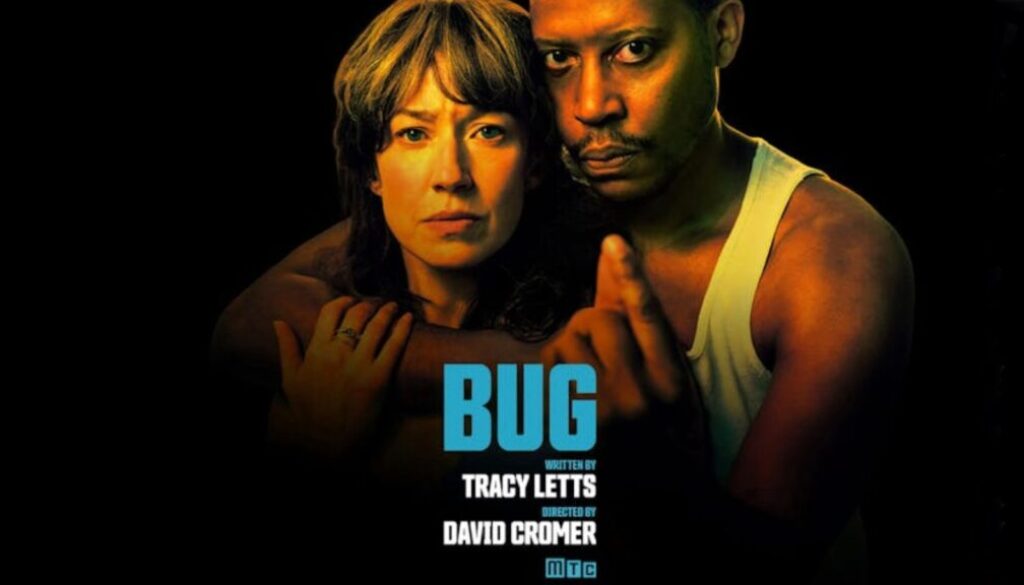
Bug by Tracy Letts: Complete Guide to the Play, Broadway Run, Movie & History
Bug by Tracy Letts: The Definitive Guide to the Play, Broadway Premiere, Movie & Legacy
From its gritty 1996 London fringe premiere to its star-studded 2026 Broadway debut with Carrie Coon, explore the complete history, plot, cast, awards, and cinematic adaptation of Tracy Letts’ paranoid masterpiece.
Few theatrical works in the modern American canon capture the claustrophobic horror of shared delusion and government paranoia quite like Bug. Written in 1996 by Tony Award and Pulitzer Prize-winning playwright Tracy Letts (August: Osage County, Killer Joe, Superior Donuts), Bug is a dark, visceral psychological thriller that blurs the boundary between traumatic reality and obsessive madness. Set entirely inside a seediness-drenched, run-down motel room in rural Oklahoma, the play charts the agonizing, fiery descent of two damaged souls who find solace in each other, only to construct an impenetrable labyrinth of conspiracy, insect infestation, and biological horror.
Though it premiered in London in 1996 and earned an award-winning Off-Broadway engagement in 2004, Bug took exactly thirty years to make its long-awaited Broadway debut. Opening on Broadway at Manhattan Theatre Club’s Samuel J. Friedman Theatre in January 2026, directed by two-time Tony winner David Cromer and starring Carrie Coon alongside Namir Smallwood, the play proved its uncanny, prophetic relevance for a modern era steeped in disinformation and viral conspiracy theories. This exhaustive guide explores every dimension of Bug—including its full plot synopsis, comprehensive production history, original cast listings, major awards, feature film adaptation, and complete Broadway statistics.
Bug at a Glance: Key Historical Facts
- Playwright: Tracy Letts
- World Premiere: Gate Theatre, London (September 1996)
- Off-Broadway Premiere: Barrow Street Theatre (February 2004)
- Broadway Premiere Venue: Samuel J. Friedman Theatre (261 West 47th Street, New York, NY)
- Broadway Run Dates: Previews began December 17, 2025 | Official Opening: January 8, 2026 | Closing Date: March 8, 2026
- Broadway Performance Count: 25 Previews and 70 Regular Performances (95 Total Performances)
- 2026 Broadway Stars: Carrie Coon (Agnes White) & Namir Smallwood (Peter Evans)
- 2006 Feature Film Adaptation: Directed by William Friedkin, starring Ashley Judd and Michael Shannon
Full Plot Synopsis: Inside Act I & Act II
Bug unfolds in real time within a dingy, cheap motel room on the outskirts of Oklahoma City. The atmosphere is oppressive, stained with alcohol, stale tobacco, and the impending dread of violent intrusion.
Act I: Isolation, Intrusion, and Infiltration
The play opens on Agnes White, a lonely, thirty-something cocktail waitress residing in a bleak motel room. Agnes is haunted by profound trauma: her four-year-old son, Lloyd, vanished without a trace from a grocery store parking lot years prior, a mystery that shattered her life and drove her into severe drug and alcohol abuse. Compounding her anxiety, her abusive ex-husband, Jerry Goss, has just been released on parole from state prison and has begun terrorizing her with threatening, silent phone calls and physical intimidation.
To seek protection and company, Agnes invites her lesbian friend and co-worker, R.C., over to the motel. R.C. arrives accompanied by Peter Evans, a quiet, polite, and intensely soft-spoken young man who claims to be a recently discharged Gulf War veteran. Peter’s gentle demeanor and hyper-vigilance immediately contrast with the crude masculinity of Jerry Goss. After R.C. leaves, Peter stays the night with Agnes. Though their initial connection is tender and born of mutual loneliness, subtle cracks in Peter’s sanity quickly emerge. He confesses that he has difficulty sleeping and harbors a deep distrust of authority and medical establishments.
The delicate atmosphere is shattered when Jerry Goss violently barges into the motel room, asserting his dominance over Agnes and mocking Peter. Peter remains strangely calm, observing Jerry before Jerry departs with threats of returning. Shortly after, Peter insists he has discovered an aphid—a microscopic bug—on the bedsheets. Though Agnes cannot initially see it, Peter speaks with alarming authority about an ongoing insect infestation. As the act draws to a close, Peter and Agnes share an intimate encounter, cementing an emotional bond that binds Agnes to Peter’s escalating obsession.
Act II: Delusion, Dissection, and Destruction
When Act II opens, the motel room has undergone a terrifying metamorphosis. Believing the room is under surveillance and infested by microscopic bio-engineered bugs, Peter has completely covered the walls, windows, and ceiling in bright, crinkling aluminum foil. High-wattage bug zappers hang overhead, casting an eerie blue glare, and yellow flypaper strips dangle everywhere. Peter has transformed the room into an airtight, sterile containment zone to fend off what he claims is a secret military experiment.
Peter reveals his grand narrative to Agnes: while serving in the military, he was subjected to forced biological testing at a government medical facility in Wheeling, West Virginia. He claims army doctors surgically implanted microscopic, egg-laying aphids beneath his skin and inside his bloodstream. According to Peter, the insects communicate through high-frequency signals and are designed to infect the population. Consumed by grief over her missing child and terrified of Jerry, Agnes succumbs to folie à deux—a shared psychosis. She begins seeing the bugs too, picking at her own skin, feeling phantom bites, and frantically searching her body for larvae.
R.C. returns to the motel room, horrified by the transformation of her friend and the foil-lined nightmare inside. She desperately begs Agnes to leave Peter, revealing that Peter is actually a psychiatric patient who escaped from a military mental hospital. Agnes fiercely rejects R.C., choosing to align her reality entirely with Peter. Later, a mysterious man named Dr. Sweet arrives at the motel, claiming to be a military psychiatrist who wants to help Peter return to the hospital. Peter accuses Dr. Sweet of being a government operative sent to retrieve the biological “data” inside his body. In a burst of psychotic rage, Peter brutally attacks and kills Dr. Sweet.
In the terrifying climax, Peter and Agnes convince themselves that Dr. Sweet was a synthetic robot sent by the conspiracy. Peter cuts into his own arm with a scalpel to excavate an embedded “microchip,” and in a horrifying moment of self-mutilation, pulls out one of his own teeth with pliers to inspect the root for eggs. Completely convinced that their bodies are ground zero for a global plague, Agnes formulates the ultimate conspiracy logic: her missing son Lloyd was taken by the government to serve as the initial prototype for the bug program. To prevent the conspiracy from capturing them and harvesting their parasites, Peter and Agnes douse themselves and the motel room in gasoline. In an ecstasy of shared delusion and tragic love, they ignite a lighter, engulfing themselves and the motel room in a fatal inferno.
Original Casts & Character Breakdown
The power of Bug relies entirely on an tight five-member ensemble. Below is a detailed breakdown of the characters alongside their original performers across major historical productions:
| Character | Character Description | Original London Cast (1996) | Original Off-Broadway Cast (2004) | Broadway Premiere Cast (2026) |
|---|---|---|---|---|
| Agnes White | A lonely, traumatized cocktail waitress grieving her missing son. | Shannon Cochran | Kate Skinner | Carrie Coon |
| Peter Evans | A gentle yet deeply paranoid Gulf War veteran who believes he is infested. | Michael Shannon | Michael Shannon | Namir Smallwood |
| Jerry Goss | Agnes’s abusive, hot-tempered ex-husband recently released on parole. | Michael Cullen | Michael Cullen | Steve Key |
| R.C. | Agnes’s pragmatic, loyal lesbian friend and fellow waitress. | Navi Rawat | Amy Landecker | Jennifer Engstrom |
| Dr. Sweet | A military psychiatrist who attempts to bring Peter back to a facility. | Zak Orth | Reed Birney | Randall Arney |
Production History: From London Fringe to Broadway 2026
London Premiere: Gate Theatre
After being rejected by several American regional theatre companies due to its extreme violence, drug use, and distressing psychological themes, Tracy Letts took Bug across the Atlantic. The play received its world premiere at London’s tiny Gate Theatre in Notting Hill in September 1996. Directed by Dexter Bullard, the production proved to be an instant sensation. British critics praised Letts’ sharp, visceral writing, and the production established actor Michael Shannon as a major theatrical force.
New York Premiere: Barrow Street Theatre
Eight years after its London debut, Bug finally arrived in New York City, opening Off-Broadway at Greenwich Village’s Barrow Street Theatre in February 2004. Re-teaming director Dexter Bullard with Michael Shannon as Peter, the production initially starred Kate Skinner (who was later succeeded by Shannon Cochran as Agnes). The Off-Broadway run was a massive critical triumph, running for nearly a full year and sweeping the Off-Broadway award season, including Lucille Lortel and Obie Awards.
Steppenwolf Theatre Company Staging
In early 2020, Chicago’s famous Steppenwolf Theatre Company staged a landmark revival of Bug, directed by Tony winner David Cromer. Starring ensemble member Carrie Coon alongside Namir Smallwood, the production was hailed as a masterpiece of sensory theater. Though interrupted briefly by global theater shutdowns, the production returned in late 2021 to ecstatic reviews, laying the direct creative groundwork for its eventual transfer to Broadway.
Broadway Premiere: Samuel J. Friedman Theatre
Exactly thirty years after its world premiere in London, Bug made its official Broadway debut during the 2025–2026 season. Presented by Manhattan Theatre Club at the Samuel J. Friedman Theatre, the production brought together the acclaimed Steppenwolf team led by director David Cromer. Featuring Carrie Coon as Agnes White, Namir Smallwood as Peter Evans, Jennifer Engstrom as R.C., Steve Key as Jerry Goss, and Randall Arney as Dr. Sweet, the Broadway premiere became an immediate event.
Critics from The New York Times, The New Yorker, and The Wall Street Journal lauded the production as an extraordinary triumph. Reviewers highlighted the incredible physical intensity of Carrie Coon and Namir Smallwood, Takeshi Kata’s chilling scenic design, and David Cromer’s taut direction. To preserve the production’s claustrophobic immersion, Manhattan Theatre Club instituted a strict phone-free policy using Yondr pouches. Due to massive box-office demand, the limited Broadway run extended twice before completing its scheduled 95-performance engagement on March 8, 2026.
Feature Film Adaptation (2006)
Bug (2006 Feature Film)
In 2006, legendary Hollywood director William Friedkin (The Exorcist, The French Connection) brought Bug to the big screen. Tracy Letts adapted his own stage play into the feature film screenplay, retaining the claustrophobic single-location setting of the motel room while utilizing close-up cinematography and disturbing sound design to heighten the psychological horror.
Michael Shannon reprised his stage role as Peter Evans, starring opposite movie star Ashley Judd as Agnes White, with Harry Connick Jr. playing Jerry Goss. The film premiered at the 2006 Cannes Film Festival in the Directors’ Fortnight section, where it won the prestigious FIPRESCI (International Federation of Film Critics) Award. Lionsgate released the film theatrically in May 2007. While its intense, non-traditional narrative divided mainstream cinema audiences, the film garnered strong critical acclaim for Judd and Shannon’s performances and has since developed a devoted cult following among psychological horror aficionados.
Awards, Honors, and Critical Accolades
Across its thirty-year history on stage and screen, Bug has earned substantial awards and critical accolades across London, Off-Broadway, cinema festivals, and Broadway. Below is a summary of major honors bestowed upon the play and its artists:
Stage Awards & Honors
- 2004 Lucille Lortel Awards: Winner – Outstanding Play
- 2004 Lucille Lortel Awards: Winner – Outstanding Director (Dexter Bullard)
- 2004 Lucille Lortel Awards: Winner – Outstanding Sound Design (Brian Ronan)
- 2004 Obie Awards: Winner – Performance (Shannon Cochran)
- 2004 Drama Desk Awards: Winner – Outstanding Sound Design (Brian Ronan)
- 2004 Drama Desk Awards: Nominee – Outstanding Play
- 2004 Drama Desk Awards: Nominee – Outstanding Director (Dexter Bullard)
- 2020 Joseph Jefferson Awards (Chicago): Winner – Best Production (Play)
- 2020 Joseph Jefferson Awards (Chicago): Winner – Performer in a Principal Role (Carrie Coon)
Film & Festival Honors
- 2006 Cannes Film Festival: Winner – FIPRESCI International Film Critics Award (William Friedkin)
- Saturn Awards: Nominee – Best Horror Film
- St. Louis Film Critics: Nominee – Best Actress (Ashley Judd)
- Golden Trailer Awards: Winner – Best Horror TV Spot
Themes and Critical Analysis: Why Bug Endures
Three decades after Tracy Letts originally penned the play, Bug remains a deeply disturbing and prescient work of modern American drama. The play’s enduring power stems from its exploration of several core thematic pillars:
- Shared Psychosis (Folie à Deux): At its core, Bug is an unsettling study of how trauma makes individuals vulnerable to irrational belief systems. Agnes does not adopt Peter’s wild conspiracies because she is unintelligent, but because shared madness offers her intimacy, purpose, and an explanation for the unbearable loss of her child.
- Government Paranoia and Disinformation: Written in the mid-1990s in the shadow of the Oklahoma City bombing and Waco siege, Bug foresaw the rise of modern internet rabbit holes and viral conspiracy theories. The play illustrates how isolation breeds deep distrust in medical and governmental institutions.
- The Metaphor of the Insect: Insects in Bug symbolize guilt, trauma, and invisible pain. Burrowing under the skin, the bugs represent the psychological horrors that individuals carry inside themselves when grief and abuse go untreated.
Reporting, cast data, production dates, and historical information compiled from Wikipedia, Playbill, The New York Times, BroadwayNews, BroadwayWorld, Manhattan Theatre Club, and TheatreGold Archives.
Explore Authentic Broadway Memorabilia
Discover historic Playbills, rare posters, and authentic theatrical souvenirs at TheatreGold’s store: