Death of a Salesman by Arthur Miller: Complete Guide, Broadway Runs, Movie & Analysis
Death of a Salesman by Arthur Miller: The Definitive Guide to the Play, Broadway Runs & Legacy
An exhaustive, detailed exploration of Arthur Miller’s Pulitzer-winning masterpiece—from its landmark 1949 premiere at the Morosco Theatre to its star-studded 2026 Broadway revival at the Winter Garden Theatre starring Nathan Lane and Laurie Metcalf.
Few works in the history of world drama have shaken the cultural consciousness as profoundly as Arthur Miller’s Death of a Salesman. Premiering on Broadway in February 1949 under the direction of Elia Kazan, Miller’s poignant two-act tragedy captured the quiet desperation of post-war capitalism, exposing the devastating psychological toll of chasing an elusive, transactional vision of the American Dream. At its core is Willy Loman, an aging, exhausted traveling salesman whose world crumbles as he confronts his professional obsolescence, his strained relationship with his sons, and the tragic gulf between his inflated self-delusions and stark reality.
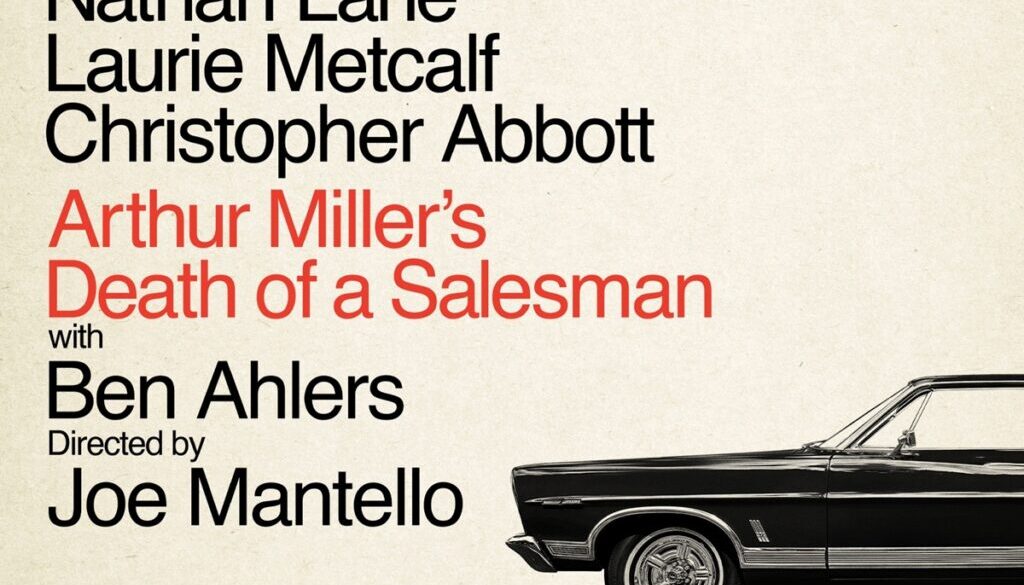
Spanning over seven decades, Death of a Salesman has remained a vital fixture on global stages, earning the Pulitzer Prize for Drama, the Tony Award for Best Play, and five subsequent Tony Awards for Best Revival of a Play across various decades. In spring 2026, Arthur Miller’s tragedy made a historic return to Broadway at the iconic Winter Garden Theatre. Directed by three-time Tony Award winner Joe Mantello and starring three-time Tony winner Nathan Lane as Willy Loman alongside two-time Tony winner Laurie Metcalf as Linda Loman and Christopher Abbott as Biff Loman, the 2026 revival reaffirmed the play’s timeless brilliance for a contemporary era navigating economic uncertainty and shifting identity. Below is the complete guide to the play’s plot, character dynamics, production history, film adaptations, major awards, and complete Broadway run metrics.
Death of a Salesman at a Glance: Essential Historical Facts
- Playwright: Arthur Miller
- World Premiere Venue: Morosco Theatre (45th Street, New York, NY)
- Original Broadway Run: Opened February 10, 1949 | Closed November 18, 1950 (742 Performances)
- Original Creative Team: Directed by Elia Kazan; Scenic & Lighting Design by Jo Mielziner; Incidental Score by Alex North
- Total Broadway Productions: 7 Major Broadway Engagements (1949 Original, 1975, 1984, 1999, 2012, 2022, 2026)
- 2026 Broadway Revival Venue: Winter Garden Theatre (1634 Broadway, New York, NY)
- 2026 Broadway Run Dates: Previews began March 6, 2026 | Official Opening: April 9, 2026 | Closing Date: August 9, 2026
- 2026 Broadway Performance Count: 36 Previews and 129 Regular Performances (165 Total Performances)
- 2026 Broadway Lead Cast: Nathan Lane (Willy Loman), Laurie Metcalf (Linda Loman), Christopher Abbott (Biff Loman), Ben Ahlers (Happy Loman)
- Major Accolades: 1949 Pulitzer Prize for Drama, 1949 Tony Award for Best Play, 5 Tony Awards for Best Revival
Full Plot Synopsis: Act I, Act II & Requiem
Death of a Salesman unfolds across a single 24-hour period in the late 1940s inside the wood-framed Brooklyn home of Willy Loman and various locations in New York City and Boston. The narrative weaves seamlessly between the present day and subjectively remembered or hallucinated memories from Willy’s past, creating a fluid theatrical form Miller originally titled The Inside of His Head.
Act I: Exhaustion, Delusions, and Golden Memories
The play opens late at night as 63-year-old traveling salesman Willy Loman returns unexpectedly to his home in Brooklyn. Exhausted, disoriented, and struggling with failing eyesight, Willy tells his devoted wife, Linda, that he was unable to drive his car without drifting off the road. Linda, deeply concerned for his physical and mental state, urges him to ask his employer, Howard Wagner, to transfer him to a permanent desk job in New York so he no longer has to make grueling road trips through New England.
Staying upstairs in their childhood bedroom are Willy’s two adult sons: 34-year-old Biff and 32-year-old Happy. Biff, a former high school football star who once held immense promise, has drifted for over a decade working low-paying farm jobs out West, unable to find stability or purpose. Willy harbors intense resentment toward Biff for failing to achieve material success, frequently insulting him before immediately reversing himself to praise Biff’s inherent greatness. Happy, a serial womanizer who works as a low-level assistant in a department store, shares Biff’s bed and tries to comfort his brother, though Happy himself suffers from deep existential cynicism.
As Willy mutters to himself in the kitchen, the play shifts into a memory sequence from fifteen years earlier. The Loman house appears bright and unencumbered by the towering apartment buildings surrounding it in the present. In this memory, a younger, vibrant Willy washes his car with his adored teenage sons. Willy instills in Biff and Happy his core philosophy of life: that personal charm and being “well-liked” are the ultimate keys to success, far superior to academic discipline or hard work. The memory shifts as Willy’s successful, wealthy neighbor, Charley, arrives to play cards in the present. While playing cards, Willy hallucinates a conversation with his long-deceased older brother, Ben—a ruthless adventurer who walked into the African jungle at age seventeen and walked out at twenty-one rich from diamond mines. Ben represents Willy’s ultimate, unfulfilled ideal of hyper-masculine success.
After Willy wanders outside in his pajamas talking to himself, Linda confronts Biff and Happy. She reveals the terrible truth: Willy is losing his mind, his commission sales have been revoked, and he is living off small borrowed loans from Charley while pretending it is his salary. Furthermore, Linda reveals she found a rubber hose attached to the gas heater in the basement, proving that Willy has been attempting suicide. Desperate to save his father and restore peace, Biff agrees to stay in New York and approach his former employer, Bill Oliver, for a loan to start a sporting goods business with Happy—a plan that fills Willy with newfound hope.
Act II: The Collapse of Dreams and The Boston Revelation
The following morning begins with brief optimism. Willy sets off to Manhattan to meet Howard Wagner to request a local sales job, while Biff goes to meet Bill Oliver. However, Willy’s meeting with Howard goes disastrously. The young, insensitive Howard dismisses Willy’s thirty years of loyal service to the company, informing Willy that there is no room for him in New York. When Willy loses his composure, Howard fires him outright, stripping away Willy’s professional identity.
Desperate, Willy visits Charley’s office to borrow money to pay his life insurance premium. There, Willy encounters Charley’s son, Bernard. As a boy, Bernard was a studious, awkward kid whom Willy mocked as “liked, but not well-liked.” In the present, Bernard is a successful, humble lawyer preparing to argue a case before the Supreme Court. Willy asks Bernard why Biff’s life seemed to derail after high school. Bernard reveals that Biff’s downward spiral began immediately after Biff failed a high school math test and took a train to Boston to seek Willy’s help. Bernard asks Willy what happened in that Boston hotel room that caused Biff to burn his favorite sneakers and abandon his college prospects—a question Willy angrily refuses to answer.
That evening, Biff and Happy meet Willy for dinner at Frank’s Chop House. Biff tries to tell his father the truth: Bill Oliver did not remember him, refused the loan, and in a moment of panic, Biff stole Oliver’s fountain pen from his office. Unable to confront his father’s fragile mental state, Biff is interrupted by Willy, who reveals he was fired that morning. As Willy spirals into vivid hallucinations of the past, the tragic memory of Boston is finally dramatized on stage: a teenage Biff walked into Willy’s hotel room and discovered Willy having an extramarital affair with a laughter-filled woman. Devastated by his father’s betrayal and hypocrisy, Biff realized Willy was a fraud, destroying Biff’s faith in his father’s ideals.
Overwhelmed by hallucinated guilt, Willy abandons his sons at the restaurant. Biff and Happy return home late, where an enraged Linda berates them for deserting their father. Outside in the garden in the middle of the night, Willy talks to the hallucinated ghost of Brother Ben. Willy formulates a final, desperate plan: if he dies in a car crash, his family will receive $20,000 in life insurance money, which will finally give Biff the financial capital to become a grand success. Biff confronts Willy in the yard, holding the rubber hose and forcing his father to face reality. Biff breaks down crying, embracing Willy and declaring that they are both ordinary, hard-working men, not grand leaders. Overwhelmed by the realization that Biff genuinely loves him, Willy waits until the house settles, gets into his car, and drives at high speed into the night, sacrificing his life for the insurance payout.
Requiem: At the Graveside
The play concludes at Willy’s quiet funeral. Aside from Linda, Biff, Happy, Charley, and Bernard, no buyers or colleagues attend. Happy angrily vows to stay in New York to fulfill his father’s dream and prove Willy did not die in vain. Biff, however, rejects his father’s philosophy forever, realizing Willy had “the wrong dreams” and never knew who he truly was. Standing alone at the grave, Linda speaks to Willy’s memory, revealing that she made the final payment on their house earlier that day. Through tears, she whispers, “We’re free and clear… We’re free,” as Alex North’s haunting flute melody fades into darkness.
Original Casts & Major Broadway Revivals Breakdown
Across its seven decades on Broadway, Death of a Salesman has served as a pinnacle showcase for world-class actors. Below is a comparative cast breakdown across six of its landmark Broadway productions:
| Role | Original Broadway (1949) | 1984 Revival | 1999 Revival | 2012 Revival | 2022 Revival | 2026 Revival |
|---|---|---|---|---|---|---|
| Willy Loman | Lee J. Cobb | Dustin Hoffman | Brian Dennehy | Philip Seymour Hoffman | Wendell Pierce | Nathan Lane |
| Linda Loman | Mildred Dunnock | Kate Reid | Elizabeth Franz | Linda Emond | Sharon D Clarke | Laurie Metcalf |
| Biff Loman | Arthur Kennedy | John Malkovich | Kevin Anderson | Andrew Garfield | Khris Davis | Christopher Abbott |
| Happy Loman | Cameron Mitchell | Stephen Lang | Ted Koch | Finn Wittrock | McKinley Belcher III | Ben Ahlers |
| Charley | Howard Smith | Charles Durning | Howard Witt | Bill Camp | Delroy Lindo | Stephen DeRosa |
| Uncle Ben | Thomas Chalmers | Louis Zorich | Allen Hamilton | John Glover | André De Shields | John Glover |
Comprehensive Production History: 1949 to 2026
The Morosco Theatre Premiere
Opening on February 10, 1949, at the Morosco Theatre, Death of a Salesman was an instant cultural landmark. Directed by Elia Kazan with legendary skeletal set design by Jo Mielziner, the original production starred Lee J. Cobb as Willy Loman, Mildred Dunnock as Linda, Arthur Kennedy as Biff, and Cameron Mitchell as Happy. The play received unanimous rave reviews, running for 742 performances and winning six Tony Awards alongside the Pulitzer Prize for Drama.
Circle in the Square Engagement
Marking the play’s first Broadway return 26 years after its premiere, George C. Scott directed and starred as Willy Loman in an arena-style staging at Circle in the Square Theatre. Scott’s ferocious, volatile performance earned widespread praise and a Tony Award nomination for Best Actor in a Play during a limited 71-performance run.
The Broadhurst Theatre Revival
To mark the play’s 35th anniversary, producer Robert Whitehead staged a high-profile revival starring Dustin Hoffman as Willy Loman alongside John Malkovich as Biff and Stephen Lang as Happy. Hoffman’s physically smaller, nervous-energy interpretation brought a fresh dynamic to Willy. The production won the Tony Award for Best Reproduction of a Play and was filmed for television in 1985.
The Eugene O’Neill Theatre Revival
Originating at Chicago’s Goodman Theatre, director Robert Falls brought a towering 50th-anniversary revival to the Eugene O’Neill Theatre on the exact 50th anniversary of its original premiere (February 10). Starring Brian Dennehy as a imposing, tragic Willy Loman and Elizabeth Franz as Linda, the production swept the 1999 Tony Awards, winning Best Revival, Best Actor, Best Featured Actress, and Best Director.
The Ethel Barrymore Theatre Revival
Directed by legendary director Mike Nichols, this critically revered 2012 revival reconstructed Jo Mielziner’s original 1949 set design and Alex North’s score. Starring Philip Seymour Hoffman as Willy Loman and Andrew Garfield as Biff, the strictly limited engagement grossed over $1 million weekly and won the Tony Award for Best Revival of a Play and Best Direction.
The Hudson Theatre Revival
Transferring from London’s Young Vic and West End, this groundbreaking revival reinterpreted Arthur Miller’s classic through the perspective of a Black American family in post-WWII Brooklyn. Starring Wendell Pierce as Willy Loman and Olivier Award winner Sharon D Clarke as Linda, the production earned critical acclaim for illuminating systemic racial barriers within the context of Willy’s tragedy.
Winter Garden Theatre Revival
In spring 2026, producer Scott Rudin and director Joe Mantello mounted a major Broadway revival at the historic Winter Garden Theatre. Starring three-time Tony winner Nathan Lane as Willy Loman, two-time Tony winner Laurie Metcalf as Linda Loman, Christopher Abbott as Biff, and Ben Ahlers as Happy, the production offered an intensely visceral, claustrophobic staging. Featuring scenic design by Chloe Lamford and lighting design by Jack Knowles, the revival was hailed by critics as a landmark event. Running for a limited 14-week engagement, the production grossed over $2.5 million in its final week alone, concluding its scheduled 165-performance run on August 9, 2026, while winning Drama Desk and Outer Critics Circle Awards for Best Revival.
Feature Film & Television Adaptations
Columbia Pictures Feature Film (1951)
The first screen adaptation was produced by Stanley Kramer and released by Columbia Pictures in December 1951. Directed by László Benedek, the film starred Fredric March as Willy Loman, with original Broadway cast members Mildred Dunnock and Cameron Mitchell reprising their roles, alongside Kevin McCarthy as Biff. Though Arthur Miller expressed disappointment with changes to the play’s dreamlike structure, the film was a major critical success, earning five Academy Award nominations (including Best Actor for March and Best Supporting Actor for McCarthy) and winning four Golden Globe Awards.
CBS Television Adaptation (1985)
Based on the acclaimed 1984 Broadway revival, director Volker Schlöndorff adapted the production into a landmark CBS television movie broadcast in September 1985. Attracting over 25 million viewers, the film preserved the theatrical stylized sets of the stage production. Dustin Hoffman and John Malkovich received ecstatic praise, with Hoffman winning the Primetime Emmy Award and Golden Globe Award for Best Actor, and Malkovich winning the Emmy for Best Supporting Actor.
Showtime Network Feature (2000)
Following the 50th-anniversary Broadway revival, Showtime captured the production for television in 2000. Starring Brian Dennehy and Elizabeth Franz, the filmed performance earned Brian Dennehy the Golden Globe Award and Screen Actors Guild Award for Outstanding Actor in a Television Movie.
Awards, Honors, and Critical Nominations
Across its seven-decade production history, Death of a Salesman stands as one of the most decorated plays in theatrical history. Below is a summary of major accolades across its original run and major revivals:
1949 Original & Early Revivals
- 1949 Pulitzer Prize for Drama: Winner (Arthur Miller)
- 1949 Tony Awards: Winner – Best Play (Arthur Miller)
- 1949 Tony Awards: Winner – Best Author (Arthur Miller)
- 1949 Tony Awards: Winner – Best Director (Elia Kazan)
- 1949 Tony Awards: Winner – Best Supporting Actor (Arthur Kennedy)
- 1949 Tony Awards: Winner – Best Scenic Design (Jo Mielziner)
- 1949 New York Drama Critics’ Circle: Winner – Best American Play
- 1984 Tony Awards: Winner – Best Reproduction of a Play
- 1999 Tony Awards: Winner – Best Revival of a Play
- 1999 Tony Awards: Winner – Best Lead Actor (Brian Dennehy)
- 1999 Tony Awards: Winner – Best Featured Actress (Elizabeth Franz)
- 1999 Tony Awards: Winner – Best Director (Robert Falls)
2012, 2022 & 2026 Modern Revivals
- 2012 Tony Awards: Winner – Best Revival of a Play
- 2012 Tony Awards: Winner – Best Direction of a Play (Mike Nichols)
- 2012 Drama Desk Awards: Winner – Outstanding Revival of a Play
- 2023 Tony Awards: Nominee – Best Lead Actor in a Play (Wendell Pierce)
- 2023 Tony Awards: Nominee – Best Featured Actress (Sharon D Clarke)
- 2026 Drama Desk Awards: Winner – Outstanding Revival of a Play
- 2026 Drama Desk Awards: Winner – Outstanding Direction of a Play (Joe Mantello)
- 2026 Drama Desk Awards: Winner – Outstanding Scenic Design (Chloe Lamford)
- 2026 Drama Desk Awards: Winner – Outstanding Lighting Design (Jack Knowles)
- 2026 Outer Critics Circle: Winner – Outstanding Revival of a Play
Themes and Critical Analysis: Why Death of a Salesman Endures
More than seventy-five years after its debut, Death of a Salesman remains a cornerstone of American literature due to its sharp exploration of human psychological vulnerabilities:
- The Cost of the American Dream: Miller critiques an uncritical faith in material prosperity. Willy Loman believes that superficial charm and popularity guarantee success, blinding him to the value of honest labor, self-knowledge, and emotional truth.
- Fathers and Sons: The central emotional axis of the play is the tragic relationship between Willy and Biff. Willy projects his unfulfilled ambitions onto Biff, while Biff struggles to free himself from his father’s unrealistic expectations and discover his own authentic identity.
- Subjective Memory and Time: By blending present-day reality with memory and hallucination, Miller dramatizes how suppressed guilt and regret consume the human mind. The walls of Willy’s home disappear on stage, symbolizing how past mistakes shatter present stability.
Reporting, cast data, performance counts, historical information, and awards listings compiled from Wikipedia, Playbill, The New York Times, Internet Broadway Database (IBDB), BroadwayWorld, Concord Theatricals, and TheatreGold Archives.
Explore Authentic Broadway Memorabilia
Discover historic Playbills, vintage posters, and authentic theatrical souvenirs from Arthur Miller masterpieces at TheatreGold’s store: