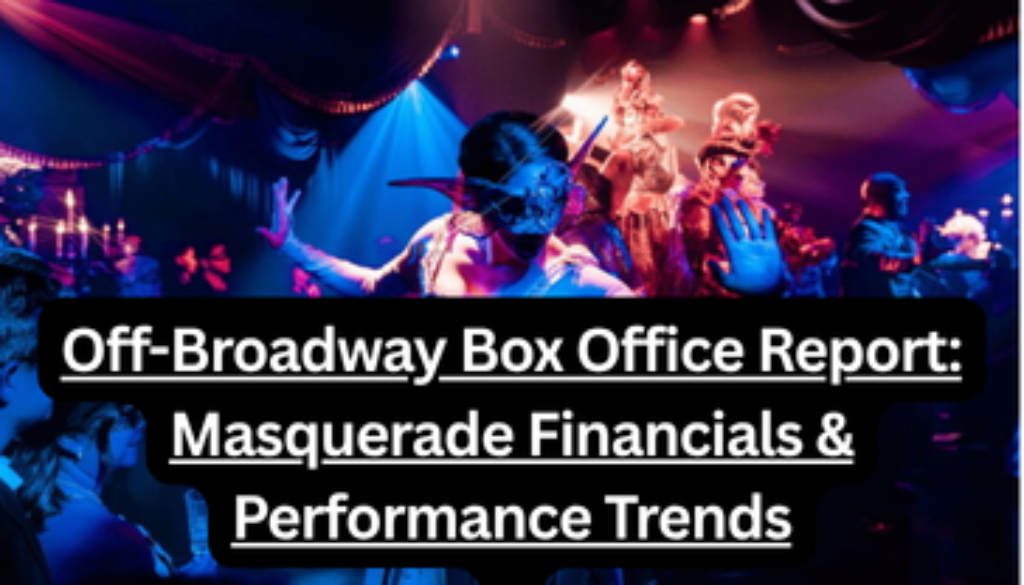
Off-Broadway Box Office Report: Masquerade Financials & Performance Trends
Off-Broadway Box Office Report: Masquerade Financials & Performance Trends
A deep dive into last week’s ticket receipts, pulse capacities, average yield, and long-term economic outlook for the immersive Phantom of the Opera reimagining.
Since taking over the multi-story former Lee’s Art Shop building at 218 West 57th Street, Masquerade—the groundbreaking immersive adaptation of Andrew Lloyd Webber’s The Phantom of the Opera directed by Diane Paulus and produced by Randy Weiner—has redefined commercial financial metrics for Off-Broadway. Operated via a staggering schedule of six staggered “pulses” per night across six simultaneous cast pairings, the production acts as a hybrid of a high-yield Broadway blockbuster and an exclusive luxury experience.
Last week’s financial performance demonstrated that demand for high-end, immersive pop-culture IP remains virtually unshakeable. Command over a strict premium dress code, exclusive VIP add-ons, and intimate, up-close audience caps per entry block allow the venue to achieve structural revenue numbers that rival medium-sized Broadway houses while technically operating under Off-Broadway commercial guidelines.
📊 Masquerade Production Snapshot (Week Ending August 30, 2026)
- Weekly Gross Receipts: $612,400 (Estimated including baseline tickets & VIP tiering)
- Venue Location: 218 West 57th Street (The Palais Garnier Experience)
- Total Audience Attendance: 2,810 guests across 8 performance slots (48 total pulses)
- Average Pulse Capacity Realized: 97.5%
- Average Ticket Price (ATP): $217.93
- Operating Structure: 6 Staggered Entry Pulses per performance window / 6 Parallel Cast Pairs
Detailed Financial & Attendance Breakdown: Last Week
Because Masquerade relies on timed entry pulses (groups of 60 guests entering every 15 minutes), analyzing its box office requires looking at performance windows across afternoon matinees and evening blocks rather than traditional auditorium seating rows.
| Performance Window | Total Pulses Run | Gross Receipts | Attendance | Capacity % | Avg Ticket Price |
|---|---|---|---|---|---|
| Prime Evening Blocks (Fri – Sat) | 12 Pulses | $198,000 | 720 | 100.0% | $275.00 |
| Standard Evening Blocks (Tue – Thu, Sun) | 24 Pulses | $295,200 | 1,392 | 96.6% | $212.07 |
| Weekend Matinee Blocks (Sat – Sun) | 12 Pulses | $119,200 | 698 | 96.9% | $170.77 |
Key Financial Takeaways for Masquerade
1. Record-Setting Average Ticket Price (ATP) for Off-Broadway: With an ATP hovering near $218—and weekend evening tiers regularly commanding $275 to $350—Masquerade generates yields unprecedented for a non-Broadway-contract venue. Premium pricing is driven by tight capacity caps (360 total guests per full performance window spread across 6 entry times).
2. High Labor Costs Offset by Premium Yields: Supporting six simultaneous cast rotations (including veteran Broadway talent like Hugh Panaro, Kyle Scatliffe, Telly Leung, and Eryn LeCroy) alongside extensive immersive floor management makes Masquerade one of the most expensive Off-Broadway shows to operate. However, consistent near-100% capacity and strong secondary beverage revenue at the post-show underground bar keep weekly profit margins healthy.
3. Long-Term Commercial Viability: Entering its second autumn at 218 West 57th Street, the show has successfully transitioned from an initial viral spectacle into an established NYC destination event for both local theater enthusiasts and high-budget travelers.
Strategic Analysis: The Immersive Musical Model
The continuing success of Masquerade provides crucial data for commercial theatrical producers watching the post-broadway landscape:
- IP Re-imagining Over Original Immersive Ventures: Unlike traditional original dance-theater models like Sleep No More, utilizing world-famous Andrew Lloyd Webber musical theater scores guarantees immediate global brand recognition, mitigating early marketing risks.
- Dress Codes as Experience Amplifiers: The strict black, white, and silver formalwear requirement effectively turns the audience into part of the set design, driving viral social media engagement and reinforcing higher price points.