Edward Albee: Life, Plays & Legacy – The Definitive Guide to America’s Greatest Playwright
Edward Albee - Podcast
The definitive biography & complete works
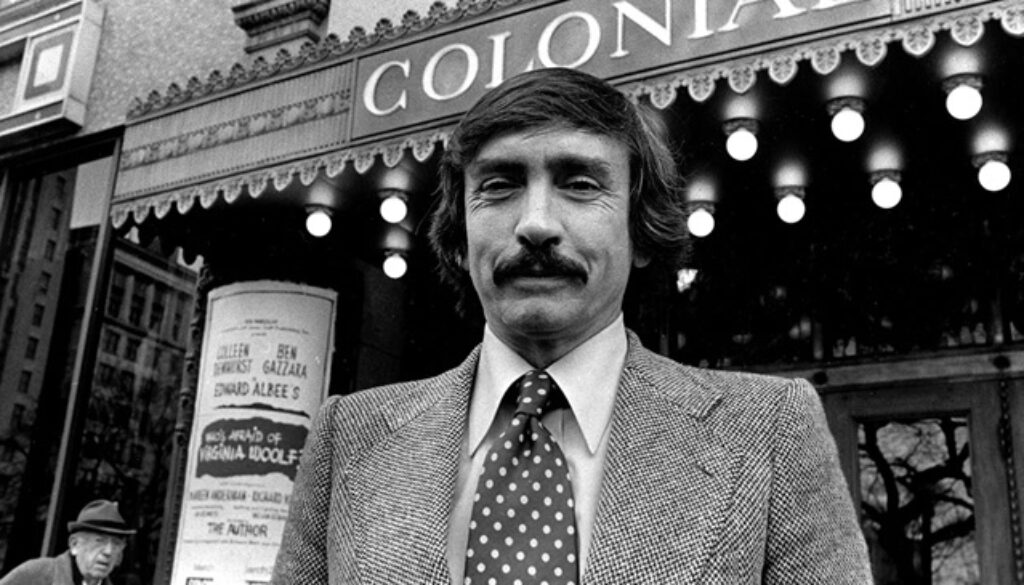
Edward Albee
March 12, 1928 — September 16, 2016
“Widely considered to be the foremost American playwright of his generation” — The New York Times
Early Life
Edward Franklin Albee III was born on March 12, 1928, in Washington, D.C. His biological father left his mother, Louise Harvey, shortly after his birth, and he was placed for adoption within two weeks. He was taken to Larchmont, New York, where he was raised by his adoptive parents.
His adoptive father, Reed A. Albee, was the wealthy son of vaudeville magnate Edward Franklin Albee II and owned several theatres. His adoptive mother, Frances (Cotter) Albee — Reed’s second wife — was a socialite. Albee’s relationship with both adoptive parents was difficult and would shape much of his later work. He later based the central character of his 1991 play Three Tall Women on his mother.
Education: A Series of Expulsions
Albee’s formal education was characterised by a restless refusal to conform. He attended the Rye Country Day School before being sent to the Lawrenceville School in New Jersey, from which he was expelled. He was then enrolled at Valley Forge Military Academy in Wayne, Pennsylvania, from which he was dismissed within a year. He eventually graduated from The Choate School (now Choate Rosemary Hall) in Wallingford, Connecticut, in 1946 — having already written nine poems, eleven short stories, several essays, a long-act play called Schism, and a 500-page novel titled The Flesh of Unbelievers.
He enrolled at Trinity College in Hartford, Connecticut, but was expelled in 1947 for skipping classes and refusing to attend compulsory chapel. He never returned to formal education.
Breaking with His Family
Albee left his adoptive family in his late teens. In later interviews he described the split variously: “I never felt comfortable with the adoptive parents. I don’t think they knew how to be parents. I probably didn’t know how to be a son, either.” In a 1994 interview he said he left at 18 because he “had to get out of that stultifying, suffocating environment.” He told Charlie Rose in 2008 that his parents wanted him to become a “corporate thug” and refused to support his ambition to write.
Greenwich Village Years
Albee moved into New York’s Greenwich Village, where he supported himself with a series of odd jobs while dedicating himself to learning his craft. His roommate during this period was the composer William Flanagan, who would remain a close friend and collaborator. It was during this period in the Village that Albee encountered the graffito that would eventually inspire the title of his most celebrated play: the phrase “Who’s afraid of Virginia Woolf?” written in soap on a bar mirror.
The Early Plays 1958–1966
Georgia State University English professor Matthew Roudané divides Albee’s plays into three distinct creative periods. The first — the Early Plays (1959–1966) — is characterised by gladiatorial confrontations, raw combative energy, and battles fought to the metaphorical death. These works established Albee as both a voice of American theatrical innovation and an uncomfortable presence in the cultural mainstream.
The Zoo Story (1958–59)
Albee’s first play was written in just three weeks. The Zoo Story received its world premiere in Berlin in 1959 before arriving Off-Broadway in New York in 1960. The play depicts an encounter between two strangers on a park bench in Central Park — the comfortable Peter and the disturbing, searching Jerry — that escalates to an act of violence. The Berlin premiere before a New York opening was a pattern Albee would repeat: his next play, The Death of Bessie Smith, also premiered in Berlin before arriving in New York.
In 2004, Albee added a companion piece called Homelife, renaming the combined work At Home at the Zoo — a two-act examination of the same themes across different domestic settings. The Drama Desk awarded Albee its Vernon Rice Award for The Zoo Story in 1960.
The Sandbox, The American Dream & Other Early Plays
The Sandbox (1960) and The American Dream (1961) continued Albee’s assault on the complacent middle-class American family. Both plays mock the conventions of domestic life with a sharp, absurdist edge. The American Dream in particular draws on the Theatre of the Absurd tradition of European playwrights Samuel Beckett, Eugène Ionesco, and Jean Genet, offering an Americanised version of their techniques. Also from this period: The Death of Bessie Smith (1960), a charged examination of racial injustice, and the short comedic piece Fam and Yam (1960).
In 2008, celebrating Albee’s 80th birthday, a series of his early one-acts were mounted at the historic Cherry Lane Theatre Off-Broadway — including The American Dream and The Sandbox, which the playwright himself directed.
Who’s Afraid of Virginia Woolf? (1962)
Albee’s most iconic and enduring work opened on Broadway at the Billy Rose Theatre on October 13, 1962, and ran for 664 performances until May 16, 1964. The original cast starred Uta Hagen as Martha, Arthur Hill as George, George Grizzard as Nick, and Melinda Dillon as Honey, directed by Alan Schneider.
The play won the Tony Award for Best Play in 1963. Its drama jury selection for the 1963 Pulitzer Prize was overruled by the Columbia University advisory board, which objected to the play’s profanity and sexual themes — refusing to award any Pulitzer Prize for drama that year. Two jurors, John Mason Brown and John Gassner, resigned in protest. The original cast recording won a Grammy Award for Best Spoken Word Album in 1963.
The Academy Award-winning 1966 film adaptation, directed by Mike Nichols and starring Elizabeth Taylor and Richard Burton, was selected for preservation in the US National Film Registry by the Library of Congress in 2013 as “culturally, historically, or aesthetically significant.”
Tiny Alice, A Delicate Balance & Other Mid-Decade Works
Tiny Alice (1964) was a complex, metaphysical play that received a Tony nomination for Best Play in 1965. A Delicate Balance (1966) won Albee his first Pulitzer Prize for Drama in 1967 — a quiet, searching examination of a well-to-do Connecticut couple whose routine is disturbed by their best friends arriving with a nameless, indefinable fear. It received a Tony nomination for Best Play but was passed over.
The Middle Plays 1971–1987
Roudané’s second period — the Middle Plays (1971–1987) — covers years during which Albee largely fell out of favour with Broadway audiences and increasingly premiered new work in American regional theatres and in Europe. Yet he continued to write with ambition, producing work that critics would later reassess with considerably more generosity.
All Over (1971)
All Over — originally titled Death, conceived as the second half of a double bill with a companion play titled Life (which would become Seascape) — premiered on Broadway at the Martin Beck Theatre, directed by John Gielgud and starring Jessica Tandy, Madeleine Sherwood, and Colleen Dewhurst. Clive Barnes of The New York Times called it “a lovely, poignant and deeply felt play” and described its structure as “a series of almost operatic arias demanding pin-point concentration from the audience.”
Seascape (1974–75)
Seascape debuted on Broadway with Deborah Kerr and Frank Langella and won Albee his second Pulitzer Prize for Drama in 1975. It was nominated for the Tony Award for Best Play, losing to Peter Shaffer’s Equus. Clive Barnes of The New York Times called it “a major event,” observing that Albee’s work had become “leaner, sparer and simpler” with maturity, and placing him alongside Beckett and Pinter in the pantheon of postwar dramatic writers.
Listening, Counting the Ways & The Lady from Dubuque
Albee continued to produce work throughout the late 1970s, writing Listening (1976) and Counting the Ways (1976) before returning to Broadway with The Lady from Dubuque (1980), which had a limited run. Both Listening and Counting the Ways premiered at the Hartford Stage Company before European productions.
The Man Who Had Three Arms & Walking
The Man Who Had Three Arms (1982, originally titled Finding the Sun) was received very negatively on Broadway. Frank Rich of The New York Times described it as “a temper tantrum in two acts” and wrote that Albee “makes almost no attempt even to pretend that Himself is anything other than a maudlin stand-in for himself.” Walking followed in 1984, and Envy in 1985 — both shorter and less widely seen works from a difficult period.
Marriage Play (1987)
Marriage Play concluded the middle period. Michael Billington of The Guardian, reflecting on Albee’s trajectory during the 1980s, wrote that American dramatists “invariably end up as victims of their own myth” — never forgiven for failing to match their early masterpieces — but that Albee had “kept on trucking.” Of Marriage Play, Billington wrote that at its conclusion the play achieves “a metaphorical resonance by suggesting that marriage is an accumulation of meaningless habits.”
The Later Plays 1991–2016
Roudané’s third period — the Later Plays (1991–2016) — represents what critics widely described as a remarkable comeback. These works were received by appreciative audiences and critics worldwide, confirming Albee’s permanent place in the first rank of American dramatists.
Three Tall Women (1991–94)
Three Tall Women premiered at Vienna’s English Theatre in 1991 before its American premiere. It is a two-act play about three unnamed women at different stages of life — widely understood to be a meditation on Albee’s relationship with his adoptive mother. It won Albee his third Pulitzer Prize for Drama in 1994.
The play was revived on Broadway in 2018, directed by Joe Mantello and starring Glenda Jackson, Laurie Metcalf, and Allison Pill. The revival won the Tony Award for Best Revival of a Play. Entertainment Weekly described it as “a not-quite-memory play filled with regret, resentment, entitlement, various bodily indignities” in which a nonagenarian revisits events of her life through dementia and the differing recollections of her younger selves.
The Lorca Play, Fragments & The Play About the Baby
The Lorca Play arrived in 1992 and Fragments: A Concerto Grosso in 1993. The Play About the Baby (1998) received a Pulitzer Prize nomination in 2001, extending the streak of his mature work receiving the highest recognition, though it did not win.
The Goat, or Who Is Sylvia? (2000–02)
The Goat, or Who Is Sylvia? opened in 2002 and won Albee the Tony Award for Best Play — his second Tony for Best Play, following Who’s Afraid of Virginia Woolf? in 1963. The play also won the Drama Desk Award for Outstanding New Play. A Pulitzer Prize nomination followed in 2003. The play examines a successful architect whose marriage is shattered by a shocking secret.
Occupant, At Home at the Zoo & Me Myself and I
Occupant (2001), an examination of the sculptor Louise Nevelson, was directed by Pam MacKinnon — who would later direct the acclaimed 2012 Broadway revival of Who’s Afraid of Virginia Woolf?. At Home at the Zoo (2004) expanded The Zoo Story with a new first act. Me Myself and I (2007) — featuring identical twin sons, their mother, and the metaphysics of identity — was Albee’s final completed new play. Knock! Knock! Who’s There!? (2003) also appeared during this period.
Stage Adaptations
In addition to his original plays, Albee adapted a number of significant literary works for the stage. All four were produced on Broadway:
| Play | Year | Source Work | Original Author |
|---|---|---|---|
| The Ballad of the Sad Café | 1963 | Novella of the same name | Carson McCullers |
| Malcolm | 1966 | Novel of the same name | James Purdy |
| Breakfast at Tiffany’s | 1966 | Novel of the same name | Truman Capote |
| Everything in the Garden | 1967 | Play of the same name | Giles Cooper |
| Lolita | 1981 | Novel of the same name | Vladimir Nabokov |
An opera libretto adaptation of Herman Melville’s short story Bartleby was also created by Albee (in collaboration with composer William Flanagan) in 1961, predating the Broadway adaptations. Albee also worked on The Ice Age (1963), an opera project that remained uncompleted.
Opera & Music
Albee’s work extended into opera, rooted in his long creative friendship with the composer William Flanagan — his roommate during the Greenwich Village years. Their collaboration produced the opera libretto Bartleby (1961), based on Herman Melville’s story Bartleby, the Scrivener. Albee also worked on a second opera project, The Ice Age (1963), which was begun but never completed.
The connection between Albee’s dramatic work and musical structure runs deeper than these formal collaborations. Clive Barnes famously described All Over (1971) as structured like “a series of almost operatic arias,” and Albee himself often discussed the musicality of his writing — its attention to rhythm, silence, and the precise weight of individual words. His work as a whole demonstrates an operatic interest in the formal patterning of speech and emotion.
Essays & Non-Fiction
Albee collected his critical and reflective writing in a single major non-fiction volume:
Stretching My Mind: Essays 1960–2005
Published by Avalon Publishing in 2005 (ISBN: 9780786716210), Stretching My Mind collects Albee’s essays spanning 45 years of engagement with theatre, art, and the American cultural condition. The volume covers his thinking on playwriting, on his own work, on the responsibilities of the artist to society, and on the state of the American stage. It provides essential context for readers seeking to understand the intellectual framework behind his dramatic writing.
Albee had been writing non-fiction alongside his plays from very early in his career — his first published works, while still at school in 1946, included poems and essays — and his prose voice carries the same precision and occasional acerbity as his dramatic dialogue.
Complete Works
Original Plays
Stage Adaptations (Broadway)
Opera & Unfinished Works
Non-Fiction / Essays
Personal Life
Identity and Sexuality
Albee was gay and stated in interviews that he first knew he was gay at age twelve and a half. As a teenager in Larchmont, he formed a close friendship with the Weissinger family — particularly Florence Weissinger (whom Albee and others called “Mummy”), and her children Muir and Delphine. Albee and Delphine had what he described as a “long and intense” and “unofficially engaged” relationship.
Despite the prominence of gay and non-heterosexual characters in his early work, Albee consistently resisted being categorised as a “gay writer.” In his acceptance speech for the 2011 Lambda Literary Foundation Pioneer Award for Lifetime Achievement, he said: “A writer who happens to be gay or lesbian must be able to transcend self. I am not a gay writer. I am a writer who happens to be gay.”
Jonathan Thomas
Albee’s longtime partner was Jonathan Richard Thomas, a sculptor. They were together from 1971 until Thomas’s death on May 2, 2005, from bladder cancer — a partnership of 34 years. Albee also had a relationship of several years in the 1950s with playwright Terrence McNally, who would himself go on to become a major figure in American theatre.
Home, Art and the Foundation
Albee lived in a 6,000-square-foot loft that had formerly been a cheese warehouse in New York’s Tribeca neighbourhood. He held an extensive collection of fine art, utilitarian objects, and sculptures, with a particular interest in works created by indigenous cultures of Africa and Oceania.
In 1967, Albee established the Edward F. Albee Foundation, Inc., funded from royalties earned by Who’s Afraid of Virginia Woolf? The foundation funds the William Flanagan Memorial Creative Persons Center in Montauk, New York — known as “The Barn” — as a residence for writers and visual artists. The foundation’s mission is “to serve writers and visual artists from all walks of life, by providing time and space in which to work without disturbance.”
Academic Life
The once-expelled student dedicated much of his later career to supporting university theatre in America. Albee served as Distinguished Professor of Playwriting and held the Lyndall Finley Wortham Chair in the Performing Arts at the University of Houston. His plays are published by Dramatists Play Service and Samuel French, Inc.
Death & Legacy
Edward Albee died at his home in Montauk, New York, on September 16, 2016, at the age of 88. His death was reported by the New York Times, The Guardian, Los Angeles Times, and broadcast media worldwide. The New York Times described him as “widely considered to be the foremost American playwright of his generation.”
His estate, including his extensive fine art collection, was subsequently unveiled by Sotheby’s ahead of a major auction. He was survived by his work, his foundation, and his enduring influence on successive generations of American playwrights. Paula Vogel has credited Albee’s mix of theatricality and biting dialogue with helping to reinvent postwar American theatre in the early 1960s.
“American dramatists invariably end up as victims of their own myth: in a success-crazed culture they are never forgiven for failing to live up to their own early masterpieces. But if Edward Albee has suffered the same cruel fate as Arthur Miller and Tennessee Williams, he has kept on trucking.”
— Michael Billington, The Guardian
Awards & Accolades
Pulitzer Prize for Drama
| Year | Work | Result |
|---|---|---|
| 1967 | A Delicate Balance | Won |
| 1975 | Seascape | Won |
| 1994 | Three Tall Women | Won |
| 2001 | The Play About the Baby | Nominated |
| 2003 | The Goat, or Who Is Sylvia? | Nominated |
Tony Awards
| Year | Category | Work | Result |
|---|---|---|---|
| 1963 | Best Play | Who’s Afraid of Virginia Woolf? | Won |
| 1964 | Best Play | The Ballad of the Sad Café | Nominated |
| 1965 | Best Author / Best Play | Tiny Alice | Nominated |
| 1967 | Best Play | A Delicate Balance | Nominated |
| 1975 | Best Play | Seascape | Nominated |
| 2002 | Best Play | The Goat, or Who Is Sylvia? | Won |
| 2005 | Lifetime Achievement | — | Received |
Drama Desk Awards
| Year | Category | Work | Result |
|---|---|---|---|
| 1960 | Vernon Rice Award | The Zoo Story | Won |
| 1975 | Outstanding New Play | Seascape | Nominated |
| 1976 | Outstanding Director | Who’s Afraid of Virginia Woolf? (revival) | Nominated |
| 1994 | Outstanding Play | Three Tall Women | Nominated |
| 2002 | Outstanding New Play | The Goat, or Who Is Sylvia? | Won |
| 2008 | Special Award | — | Received |
Grammy Award
| Year | Category | Work | Result |
|---|---|---|---|
| 1963 | Best Spoken Word Album | Who’s Afraid of Virginia Woolf? (Original Cast Recording) | Won |
| 1963 | Best Album Notes | Who’s Afraid of Virginia Woolf? | Nominated |
Honorary Awards & Recognition
| Year | Award |
|---|---|
| 1972 | Elected Fellow, American Academy of Arts and Sciences |
| 1980 | Gold Medal in Drama, American Academy and Institute of Arts and Letters |
| 1985 | Inducted into the American Theatre Hall of Fame |
| 1995 | St. Louis Literary Award, Saint Louis University Library Associates |
| 1996 | Kennedy Center Honors |
| 1996 | National Medal of Arts |
| 1999 | PEN/Laura Pels Theater Award — Master American Dramatist |
| 2003 | Fitzgerald Award for Achievement in American Literature |
| 2005 | Tony Award for Lifetime Achievement |
| 2005 | Academy of Achievement Golden Plate Award |
| 2009 | Honorary Degree, Bulgarian National Academy of Theater and Film Arts (NATFA) |
| 2011 | Edward MacDowell Medal for Lifetime Achievement |
| 2011 | Lambda Literary Foundation Pioneer Award for Lifetime Achievement |
| 2013 | Chicago Tribune Literary Prize |
| 2015 | America Award in Literature |
Links
Torch Song Trilogy – Memorabilia
Cat on a Hot Tin Roof – Memorabilia
The Boys in the Band – Memorabilia