Brandon Uranowitz: Tony Nominated for Ragtime Broadway 2026
Brandon Uranowitz: The Child Recast from Ragtime Who Returned as Its Leading Man — and His Fifth Tony Nomination
In 1997, an eleven-year-old boy from New Jersey played the Little Boy in the world premiere of Ragtime in Toronto — and was then recast when the show moved to Broadway. Twenty-eight years later, Brandon Uranowitz stands on the stage of the Vivian Beaumont Theater as Ragtime‘s leading man, earning his fifth Tony nomination and calling it “one of the most healing and rewarding experiences of my life.”
West Orange, New Jersey: A Jewish Boy Who Loved Theatre and Almost Lost It
Brandon Uranowitz was born on 9 July 1986 in Livingston, New Jersey and grew up in the neighbouring community of West Orange — a suburban town in Essex County, approximately twenty miles west of Manhattan, with a strong Jewish community that shaped Uranowitz’s early cultural identity in ways he has spoken about with increasing candour as his career has matured. He attended the Montclair Kimberley Academy — a prestigious independent school that gave him both the academic rigour and the arts exposure that would prove foundational.
He was, from an early age, a Jewish kid who loved performing. His Bar Mitzvah — which he has described with characteristic self-deprecating warmth — was, by his own account, a theatrical production in its own right: a three-act ceremony involving swimming, dancing, and the distribution of personalised towels bearing the legend “I made a splash at Brandon’s Bar Mitzvah.” The impulse to make every occasion a performance is one that would serve him well on the Broadway stage.
His earliest formal performing arts training came through the Performers Theatre Workshop in Maplewood, New Jersey — a community performing arts institution that gave him his first structured exposure to the craft of theatrical performance. And it was through this training that he came to the experience that would define the most extraordinary arc of his career: his casting, at the age of eleven, in the world premiere of Ragtime.
He has spoken, in his Broadway.com interview, about growing up grappling with his sense of self — specifically about the two aspects of his identity that now feel most central to his work: his Jewish identity and his gay identity. “The two parts of myself that for so many years brought a lot of shame and discomfort,” he has said. The journey from that shame to the kind of self-knowledge that can produce great art — a journey he describes as inseparable from his theatrical career — is one of the animating stories of his professional life. He came out publicly as gay in 2017, and has spoken about how the theatrical roles he has played — in works like Falsettos, Burn This, and Leopoldstadt — have been part of that ongoing process of self-understanding and self-acceptance.
The Wound That Became a Gift: Ragtime in Toronto, 1997
In 1997, the world premiere of Ragtime — Terrence McNally’s sweeping musical adaptation of E.L. Doctorow’s novel, with music by Stephen Flaherty and lyrics by Lynn Ahrens — was staged in Toronto, Canada, as its out-of-town tryout before transferring to Broadway. An eleven-year-old Brandon Uranowitz was among the children cast in the production, playing The Little Boy — the small but crucial role of the wealthy White family’s child who observes and absorbs the events of the play with a child’s unguarded openness.
He performed in the Toronto production with full commitment and considerable skill — by all accounts a talented child performer who had found, in the theatrical environment, the natural home for his intelligence and sensitivity. Then came the experience that he has described as both devastating and ultimately, paradoxically, formative. When the production prepared to transfer to Broadway, Uranowitz was recast. The role of the Little Boy went to another child for the Broadway production. He was not making the trip to New York.
“It was heartbreaking,” he has said, though that word barely touches what the experience of being recast from a Broadway transfer means to a child who had invested himself fully in the work. As he told the New York Theatre Guide, the wound remained with him for years — the sense of having been so close to something and then not getting there. “I almost left acting,” he confided to Broadway.com, revealing that the combination of this early professional rejection and his struggles with personal identity led him to a period of genuine uncertainty about whether the theatrical life was his to claim.
He persisted. He enrolled at NYU’s Tisch School of the Arts, where he trained formally as a theatre artist and began building the technical and conceptual foundations that would sustain a career of extraordinary range and consistency. At NYU he appeared in Off-Broadway productions of Shakespeare — Richard III and Twelfth Night — as well as musicals including Evita, developing both his classical and his musical theatre range. Following graduation, he starred as Mark Cohen in the national touring company of Rent, his first sustained professional engagement and a deeply appropriate introduction to the professional world of American musical theatre: a show about artists navigating identity, community, and loss in New York City.
His statement on receiving the 2026 Tony nomination — “This recognition is beyond my 11-year-old self’s wildest dreams. If there’s anything I’ve learned, it’s this: the things that are meant for you won’t pass you by” — carries the full weight of that twenty-eight-year journey. It is not merely a gracious awards-season platitude. It is a man bearing witness, with evident emotion, to the completion of an arc he thought might never close.
It’s so interesting to me that the two parts of my identity that have resonated so much with people who come and see my work are my gay identity and my Jewish identity. The two parts of myself that for so many years brought a lot of shame and discomfort. I think the only way to succeed is to have a firm grasp of your own identity and be fully self-actualized.
Brandon Uranowitz, Broadway.com, May 2026The Broadway Years Begin: Baby, It’s You! to An American in Paris
Brandon Uranowitz made his Broadway debut in 2011 in Baby, It’s You! — the jukebox biographical musical about the creation of the Brill Building pop sound of the early 1960s, which played at the Broadhurst Theatre. The production gave him his first experience of the Broadway ecosystem as an adult professional — the ecosystem he had been tantalizingly close to as an eleven-year-old but had never fully entered.
Over the years that followed, he built a steady career in New York’s Off-Broadway and institutional theatre world alongside his emerging Broadway presence. He appeared in Becoming Eve at New York Theatre Workshop, in Tick, Tick… Boom! at the Kennedy Center (earning a Helen Hayes Award nomination), and in productions of Assassins at Classic Stage Company and Torch Song Trilogy at Studio Theatre (earning a further Helen Hayes nomination). He also appeared in multiple New York City Center Encores! productions — including, crucially, an early Encores! staging of Ragtime that began to reconnect him to the material that had shaped his earliest professional experience.
The breakthrough came in 2014, when he was cast as Adam Hochberg in Christopher Wheeldon’s production of An American in Paris — first at the Théâtre du Châtelet in Paris, then on Broadway at the Palace Theatre from April 2015. Adam Hochberg is the Jewish-American songwriter friend whose unrequited love for the ballet dancer Lise forms one of the production’s emotional counterpoints to the central romance. Uranowitz brought to the role a combination of precise comic timing, genuine emotional depth, and a specific quality of Jewish intellectual warmth that made Adam one of the most distinctive characters in recent Broadway musical memory. He received his first Tony Award nomination for Best Featured Actor in a Musical — immediately announcing him as a performer whose consistency would generate further nominations in coming years.
Falsettos, The Band’s Visit, and the Definition of a Theatre Artist
If An American in Paris established Uranowitz as a significant Broadway talent, it was the 2016 Broadway revival of Falsettos — William Finn and James Lapine’s landmark musical about a Jewish family navigating divorce, homosexuality, and AIDS in the early 1980s — that confirmed him as a genuine theatrical artist rather than merely a skilled performer. The revival, presented by Lincoln Center Theater at the Walter Kerr Theatre from October 2016, starred Christian Borle as Marvin, Andrew Rannells as Whizzer, and Stephanie J. Block as Trina — the wife Marvin has left for Whizzer — with Uranowitz playing Mendel, Trina’s psychiatrist and eventual new husband.
Mendel is, in some ways, the show’s most interesting character: the sensible, loving man who has no claim to romantic or tragic grandeur but who provides, through his steadiness and his genuine care, the emotional stability around which the other characters’ more spectacular disintegrations occur. Playing this role in a production of such emotional intensity and vocal ambition required exactly the quality that Uranowitz possesses in unusual measure: the ability to be fully present as a supporting presence without diminishing or stealing from the central performances, while remaining entirely specific and fully human himself. He received his second Tony nomination for Best Featured Actor in a Musical.
The production also had a significant personal dimension. Uranowitz has acknowledged that his gay identity — something he was still in the process of publicly claiming during this period — made the material of Falsettos particularly resonant and personally meaningful. Playing in a show about queer love and queer loss in a period of AIDS crisis, opposite performers who invested the material with the full weight of its historical specificity, was for him a formative artistic and personal experience.
In the years following Falsettos, Uranowitz continued to accumulate the kind of Broadway credits that define a career of sustained quality. He appeared as Itzik in the Tony Award-winning The Band’s Visit (2018) — the quiet, beautiful musical about an Egyptian police band stranded overnight in an Israeli desert town, which won ten Tony Awards. He joined Prince of Broadway (2017) — the Harold Prince retrospective revue, which gave him the opportunity to inhabit characters from across Prince’s legendary directorial career. And in 2019, he received his third Tony nomination — for Best Featured Actor in a Play — for his performance as Larry in the Broadway revival of Lanford Wilson’s Burn This, opposite Keri Russell and Adam Driver. His ability to earn nominations in both play and musical categories in successive Tony seasons is a rare distinction that speaks to the completeness of his theatrical range.
Leopoldstadt: The Role That Won the Tony — and Why It Mattered
The production that finally brought Brandon Uranowitz the Tony Award he had been nominated for three times without winning was Tom Stoppard’s Leopoldstadt — the great playwright’s most personal work, a sweeping drama about a prosperous Jewish family in Vienna across half a century, from the confident prosperity of 1899 through the catastrophe of 1938 and into the reckoning of 1955. The play is partially autobiographical: Stoppard himself discovered, late in life, that he was Jewish, and that much of his extended family had perished in the Holocaust. Leopoldstadt is his attempt to honour and understand that history.
Uranowitz played two roles in the production: Ludwig — a Merz family brother-in-law in the earlier scenes, a man of warmth and intellectual engagement navigating the complexities of assimilation and identity — and Nathan — a descendant in the harrowing final scene, one of the handful of family members who survived to confront what has been lost. The dual portrayal required him to embody, within a single evening, both the life that preceded the catastrophe and the surviving consciousness that must comprehend it — a task of extraordinary emotional and intellectual demand.
The production, directed by Patrick Marber, opened on Broadway at the Longacre Theatre in October 2022 and ran through January 2023. Uranowitz’s performance drew the most consistently passionate critical notices of his career, with multiple reviewers noting that his Nathan — the surviving descendant who appears at the play’s devastating conclusion — was the emotional heart of the entire evening. He won the Tony Award for Best Featured Actor in a Play at the 76th Annual Tony Awards in June 2023, his fourth nomination and first win.
In his acceptance speech, Uranowitz was moved to tears. He has spoken subsequently about the particular significance of winning for a role that engaged so directly with his own Jewish identity — the same identity that he had carried with shame and discomfort for so many years, and that had now been recognised, through Stoppard’s and Marber’s extraordinary work, as the source of some of the most important theatrical art he had made. The Leopoldstadt Tony win is, in a sense, the pivot point in his story: the moment at which the shame became a gift, and the gift became a triumph.
He also appeared in the 2022 Broadway revival of Assassins at Classic Stage Company, playing Leon Czolgosz — the assassin of President McKinley — demonstrating once again his range across the full spectrum of American musical theatre from the lyrical to the grotesque.
The Return to Ragtime: Playing Tateh Twenty-Eight Years Later
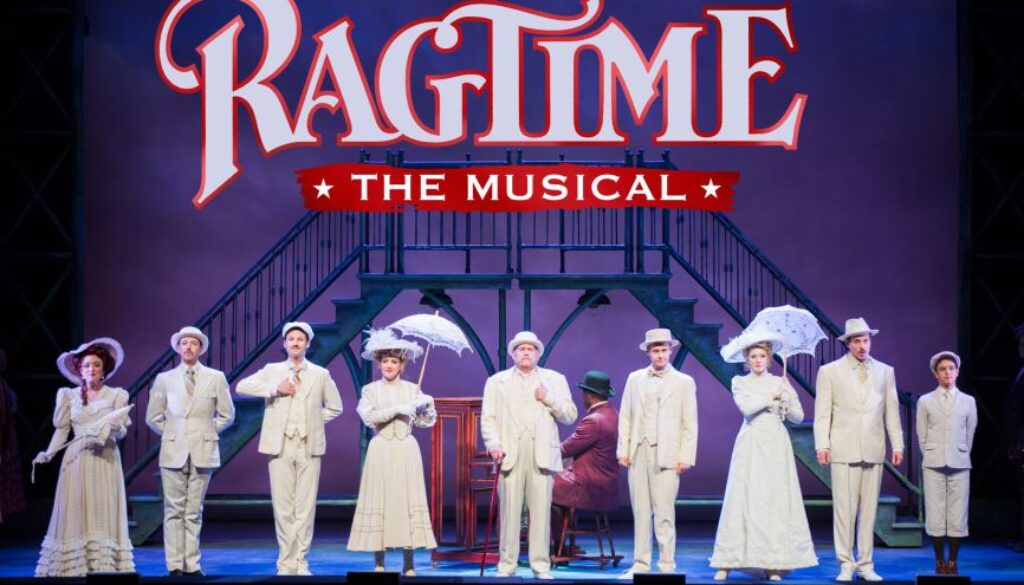
The moment that director Lear deBessonet first approached Uranowitz about playing Tateh in the new revival of Ragtime is one that the actor has described as “cosmic.” He had already appeared in an Encores! concert staging of the show at New York City Center in 2024 — his first direct engagement with the material since his childhood in the Toronto premiere. When the full Broadway production was announced, with Uranowitz confirmed in the leading role of Tateh alongside Joshua Henry as Coalhouse Walker Jr. and Caissie Levy as Mother, the theatrical community understood immediately what the casting meant: the child who had been turned away at the door was returning as a leading man.
Tateh — whose full name is Baron Ashkenazy, a name he assumes as part of his assimilation into American life — is a Latvian Jewish immigrant and artist who arrives in America at the turn of the twentieth century with nothing but his talent, his daughter, and his belief that the promises of the New World are real. He starts on the Lower East Side, selling his paper silhouette art on the street, struggling and suffering through the grinding poverty of immigrant life in early twentieth-century New York. By the play’s second act, through talent, perseverance, and the invention of the moving image — his paper silhouettes become the first animated films — he has achieved material success and the hope of genuine happiness. It is, as Uranowitz told the Ticketmaster blog, “a deeply, deeply satisfying journey to take as an actor: Act I for Tateh is extremely emotionally and psychologically and physically painful, and then Act II is full of hope and a bright future.”
The personal resonances of the role for Uranowitz — a gay Jewish man from New Jersey — are profound and explicit. Tateh’s story of assimilation, of changing his name while retaining his accent, of trying to find belonging in a country that offers promise without guarantee, is in direct dialogue with Uranowitz’s own experience of navigating identity in a world that has not always been comfortable with who he is. He has described playing Tateh as inseparable from his experience playing in Leopoldstadt — both works asking, in different registers and from different historical moments, the same fundamental question about whether Jewish assimilation is possible or desirable or even ultimately survivable.
“Once we lose hope, that’s it,” he told Broadway.com, speaking about Tateh’s radical optimism. “Hope is a very radical thing.” In the political context of the 2025-26 Broadway season, with American discourse about immigration as fraught and urgent as it has been in generations, the statement lands with considerable weight — and Uranowitz’s investment in the character’s hope, specifically as a queer Jewish man who has navigated his own version of the question of whether America can be his, gives every performance a biographical dimension that audiences have clearly felt.
Returning to Ragtime has been one of the most healing and rewarding experiences of my life. This recognition is beyond my 11-year-old self’s wildest dreams. If there’s anything I’ve learned, it’s this: the things that are meant for you won’t pass you by.
Brandon Uranowitz, reacting to his 2026 Tony nomination, New York Theatre GuideWhat the Critics Said: Ragtime Reviews and Uranowitz’s Performance
Tony Nominated: Best Actor in a Leading Role in a Musical — Fifth Career Nomination
Brandon Uranowitz’s fifth Tony nomination — his first in the Best Actor in a Leading Role category, having previously received four nominations in featured actor categories — arrives for the role that completes the most remarkable full-circle arc in his career. His previous nominations: An American in Paris (2015, Featured Actor Musical), Falsettos (2017, Featured Actor Musical), Burn This (2019, Featured Actor Play), Leopoldstadt (2023, Featured Actor Play — WON).
Full Best Actor in a Musical category nominees:
- Nicholas Christopher — Chess
- Luke Evans — Richard O’Brien’s The Rocky Horror Show
- Joshua Henry — Ragtime
- Sam Tutty — Two Strangers (Carry a Cake Across New York)
- Brandon Uranowitz — Ragtime
The Complete Tony Award Record: Five Nominations, One Win
| # | Year | Category | Production / Role | Result |
|---|---|---|---|---|
| 1 | 2015 | Best Featured Actor in a Musical | An American in Paris (Adam Hochberg) | Nominated |
| 2 | 2017 | Best Featured Actor in a Musical | Falsettos (Mendel) | Nominated |
| 3 | 2019 | Best Featured Actor in a Play | Burn This (Larry) | Nominated |
| 4 | 2023 | Best Featured Actor in a Play | Leopoldstadt (Ludwig/Nathan) | WON ★ |
| 5 ★ | 2026 | Best Actor in a Leading Role in a Musical | Ragtime (Tateh) — FIRST LEADING NOM | Nominated |
His 2026 nomination is particularly notable because it is his first in a leading actor category — his previous four nominations having all been for featured performances. The promotion from featured to leading designation reflects not merely his career trajectory but his specific achievement in Ragtime: a show in which he is genuinely, indisputably, one of three co-equal leading performers.
Screen Credits and Off-Broadway: The Work Beyond the Broadway Stage
Alongside his Broadway career, Uranowitz has built a solid and eclectic screen and Off-Broadway record. His television work includes a recurring role in the second season of Amazon’s The Marvelous Mrs. Maisel — the prestige period comedy that, like many of the theatrical projects he has chosen, is rooted in a specifically Jewish American experience. He appeared as Dustin Hoffman in the FX limited series Fosse/Verdon — playing a man whose own theatrical craft and complicated personal life make him an appropriate subject for an actor of Uranowitz’s particular sensibility. He has appeared in Blue Bloods, Dietland, and Inside Amy Schumer. His film credits include Here Today (with Billy Crystal), The Kitchen, and Stage Fright.
His Off-Broadway work is equally distinguished. He played Leon Czolgosz in John Doyle’s revival of Stephen Sondheim’s Assassins at Classic Stage Company (2021), a role that confirmed his range within the Sondheim canon he has inhabited with such consistency across his career. He appeared in Becoming Eve at New York Theatre Workshop and received Helen Hayes Award nominations for productions of Tick, Tick… Boom! at the Kennedy Center and Torch Song Trilogy at Studio Theatre in Washington, D.C. He also participated in multiple New York City Center Encores! productions, including earlier stagings of Ragtime, Titanic, Road Show, and Grand Hotel — a sustained engagement with the Encores! project that reflects his commitment to the development and celebration of the American musical theatre repertoire.
A Career in Full: Selected Stage Credits
Plays The Little Boy in the world premiere of Ragtime in Toronto. Recast before the production transfers to Broadway. The experience nearly leads him to abandon acting — but ultimately shapes the extraordinary full-circle arc of his career.
Trains at the Performers Theatre Workshop in Maplewood, NJ, then at NYU Tisch where he appears in Off-Broadway productions of Shakespeare and musicals. Stars as Mark Cohen in the national touring company of Rent following graduation — his first major professional engagement.
Broadway debut in the jukebox musical about the Brill Building era. His first experience of the Main Stem as an adult professional, seventeen years after his first close encounter with it as a child.
Breakthrough Broadway role as Adam Hochberg in Christopher Wheeldon’s production, first at the Théâtre du Châtelet in Paris, then on Broadway. First Tony nomination (Best Featured Actor in a Musical). Grammy nomination for cast recording.
Second Tony nomination (Best Featured Actor in a Musical) for Mendel in the Lincoln Center Theater revival opposite Christian Borle, Andrew Rannells, and Stephanie J. Block. A personally significant role in a show that directly engaged with his gay and Jewish identities. Drama Desk nomination.
Appears in the Harold Prince retrospective revue — one of the most significant producing directors in Broadway history — inhabiting characters from across Prince’s legendary career.
Joins the company of the Tony-winning musical — one of Broadway’s most quietly devastating shows — as Itzik, a man in a small Israeli desert town whose life is briefly and unexpectedly opened up by the arrival of an Egyptian police band.
Third Tony nomination (Best Featured Actor in a Play) for Larry in the Broadway revival of Lanford Wilson’s play, opposite Keri Russell and Adam Driver. A nomination in a play rather than musical category — demonstrating the range that makes him unusual among Broadway leading men.
Wins the Tony Award for Best Featured Actor in a Play for his dual portrayal of Ludwig and Nathan in Tom Stoppard’s masterwork about a Viennese Jewish family across fifty years of catastrophe. The most personal and most acclaimed performance of his career to that date.
First adult engagement with Ragtime, playing Tateh in the Encores! concert staging that eventually leads to the Broadway production. The role immediately feels, as he has described, like something that was always meant to be his.
Returns to Ragtime as its leading man Tateh — twenty-eight years after being recast from the show’s world premiere. Tony nomination for Best Actor in a Leading Role in a Musical (his fifth career nomination and first in a leading actor category). Production extended twice, now running through 2 August 2026. Eleven Tony nominations for the production in total.
The Things That Are Meant for You: What Brandon Uranowitz’s Career Teaches Broadway
There is a particular quality to theatrical redemption stories — the ones in which a performer who was turned away from something comes back, years later, to claim it in its fullest form — that is unlike any other kind of artistic vindication. It requires patience and perseverance in proportions that most people could not sustain, and a willingness to continue investing in the art form that once rejected you even when the rejection has left its mark.
Brandon Uranowitz has done all of this. He persisted through the devastating Toronto recast. He trained, built his craft, and appeared in Off-Broadway productions and national tours while his peers were winning awards. He made his Broadway debut at twenty-five, and then spent the next fifteen years building one of the most consistently excellent records of any performer of his generation — five Tony nominations across both play and musical categories, in leading and featured roles, in works as different as An American in Paris and Leopoldstadt, Falsettos and Burn This. He won his Tony. He found his identity — as a gay man, as a Jewish man, as an American — and he put all of it on the stage, night after night, in service of the stories that those identities make him best equipped to tell.
And then Ragtime came back around. As he told the New York Theatre Guide, with the quiet certainty of a man who has earned the right to say it: “The things that are meant for you won’t pass you by.” Twenty-eight years in the making, Tateh belongs to him. The Vivian Beaumont knows it. The audiences who have wept through “Our Children” and stood at the finale of “Make Them Hear You” know it. And on 7 June 2026, when the 79th Annual Tony Awards take place at Radio City Music Hall, the Tony community will have the opportunity to know it too.
I’m just grateful to be leading a company with Caissie Levy and Joshua Henry. It’s beyond anything I ever thought was possible for myself.
Brandon Uranowitz, Broadway.com, May 2026